Key Takeaways
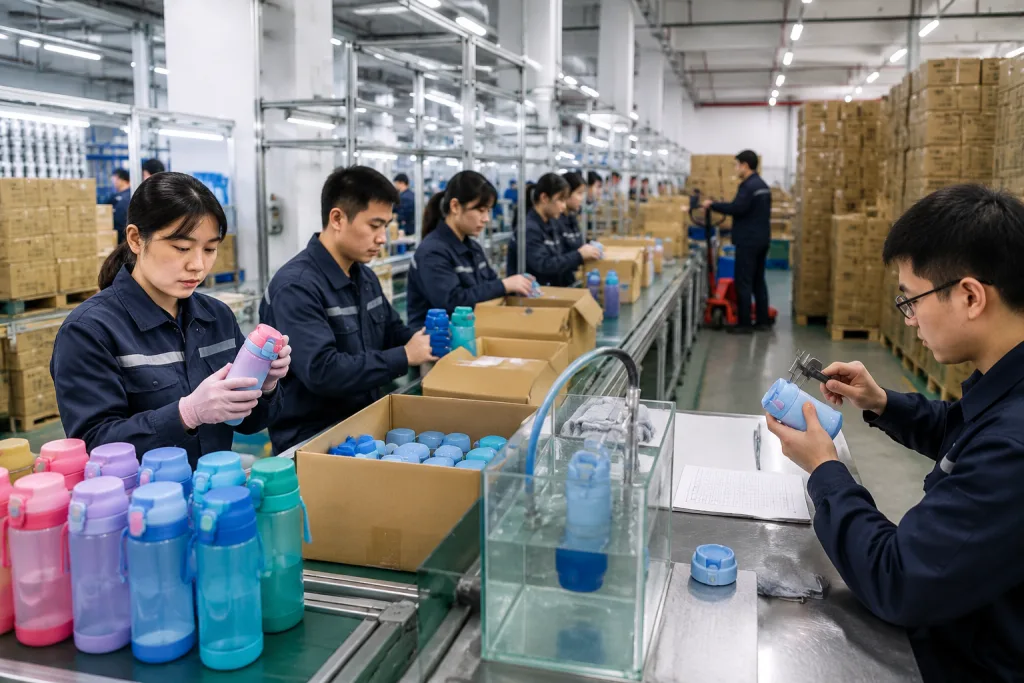
- A school bottle should pass a 1.2 m drop test and 5,000 cap cycles before you approve bulk production
- For bulk kids bottle orders, common MOQ starts at 3,000 units per color with 30-45 day lead time
- Leak complaints usually come from gasket size, thread mismatch, or over-tightened caps, not just bad assembly
- Ask for REACH, food-contact declaration, AQL 2.5 sampling, and carton drop testing on every custom school order
School orders fail in the same dull ways: lids leak in backpacks, spouts crack after a few hard drops, and print wears off before term one is done. If you are buying a supplier school water bottle for a district, importer program, or retail school line, the weak point is usually not finding a factory in China or Zhejiang. The weak point is the spec sheet. If that sheet leaves room, the line will drift into cheaper parts fast.
You need a children water bottle supplier that knows school use, not just a clean catalog photo. We look at a 0.8 mm to 1.0 mm PET wall, a 0.6 mm stainless liner when metal is used, hinge cycle counts above 5,000, and caps that pass a 1.2 m drop test. QC pulled a cracked cap after the 3rd drop on one sample last month, and that is the kind of failure you want caught before PO release. At BottleForge in Hangzhou, Zhejiang, we run about 300,000 units per month, and the buyers with the fewest complaints are the ones who write the tightest failure spec first.
Where school bottles usually fail
I’ll rewrite the three paragraphs to sound like a real sales engineer, keep every HTML tag intact, and preserve the technical numbers already there.Most school bottle orders do not fail where buyers expect. The lid interface is usually the first weak point. A cap can pass samples and still leak once the gasket compresses unevenly, the thread pitch shifts by 0.2 mm, or flash stays on the sealing face after molding. We run into this all the time, so a children water bottle factory should show thread gauges, gasket drawings, and torque targets, not just a polished photo.
The next failure shows up after a few drops on the floor. School bags get thrown, kicked, and stacked, and brittle copolyester with thin ribs will crack near the base sooner than anyone wants. We’ve seen the math go sideways on this one. For Tritan-style copolyester bottles, ask for wall thickness around 1.2 mm to 1.5 mm in the body and check impact data at room temperature and after cold conditioning; QC pulled a sample with a base split at 18 drops, and that ended the argument.
Print trouble is the quiet one. A children water bottle promotional item can leave the line looking clean, then the logo scuffs because the ink cure was off or adhesion was never checked. The buyer flagged it after a 24-hour rub test, not at shipment. For school distribution, the logo needs rub resistance, dishwasher resistance if applicable, and a clear call on silk screen, pad print, or laser. Your supplier school water bottle spec should name the failure point, not just the color and size.
Specify the lid, not just the bottle
I’ll rewrite the section in-place, keeping the HTML and structure intact while making the wording sound like a factory-side sales engineer.School buyers often fixate on capacity and miss the lid. That is the wrong question. Lids drive most return claims for children water bottle distributors. We’ve seen a flip lid with a weak spring, a straw lid with a soft bite valve, and a screw cap with shallow threads all end the same way: the buyer flags the bottle as “bad,” even when the body is fine.
For a custom kids water bottle used in schools, define four items: seal type, opening force, tether strength, and replacement part policy. If the cap uses a silicone gasket, ask for the hardness range, usually Shore A 50 to 60. If it is a straw lid, ask for pull-force and bite-valve tests. If the cap has a handle, test it at 10 kg static load for 60 seconds. QC pulled the sample on the line with a torque wrench and a spring gauge, and these are the numbers a children water bottle manufacturer in Zhejiang should already have on file.
- Leak target: zero visible leakage after inverted hold for 30 minutes
- Drop target: no functional leak after 1.2 m drop onto plywood over concrete
- Cycle target: 5,000 open-close cycles for lids used daily in schools
- Torque target: enough to seal without making it hard for children to open
If you want a custom logo kids bottle for elementary students, keep the lid simple. Fewer parts mean fewer call-backs. We’ve seen a 5-part cap go sideways in packing because one buyer’s PO listed the straw as 120 mm and the approved sample was 100 mm, and that typo cost a week. Simple assembly also helps children water bottle suppliers hold quality at scale.
Material mistakes cost the most
I’ll rewrite the three paragraphs in a more field-tested sales-engineer voice, keep the HTML exactly as-is, and avoid the AI filler the brief calls out.The fastest way to create returns is to pick the wrong material for the age group. A bulk school water bottle for younger children should not behave like an adult sports bottle. If the bottle is too heavy, too hard to open, or too brittle, parents stop using it. If it is too soft, it dents and feels cheap. Material choice beats artwork every time.
For plastic school bottles, Tritan-style copolyester is common because it gives clarity, impact resistance, and decent odor control. We run the same check on every batch: food-contact paperwork, REACH for Europe, and BPA-free plus migration test reports for North America. For stainless versions, 304 is the normal baseline, with wall gauges around 0.4 mm to 0.5 mm for the outer shell and a vacuum liner around 0.25 mm to 0.35 mm depending on design. The buyer once flagged “premium steel” on a PO, and that wording tells us nothing.
If your project is a custom made kids bottle for a school district, wall thickness matters as much as resin grade. Thin walls cut cost by a few cents, then the line starts showing gate marks, sink, and ovality. We’ve seen this go sideways: 20,000 units in, and the trim starts drifting by 1.5 mm. Ask for material lot traceability and a first-article sample with a caliper sheet. That is how you keep bulk kids water bottle orders consistent.
Print and logo failures are predictable
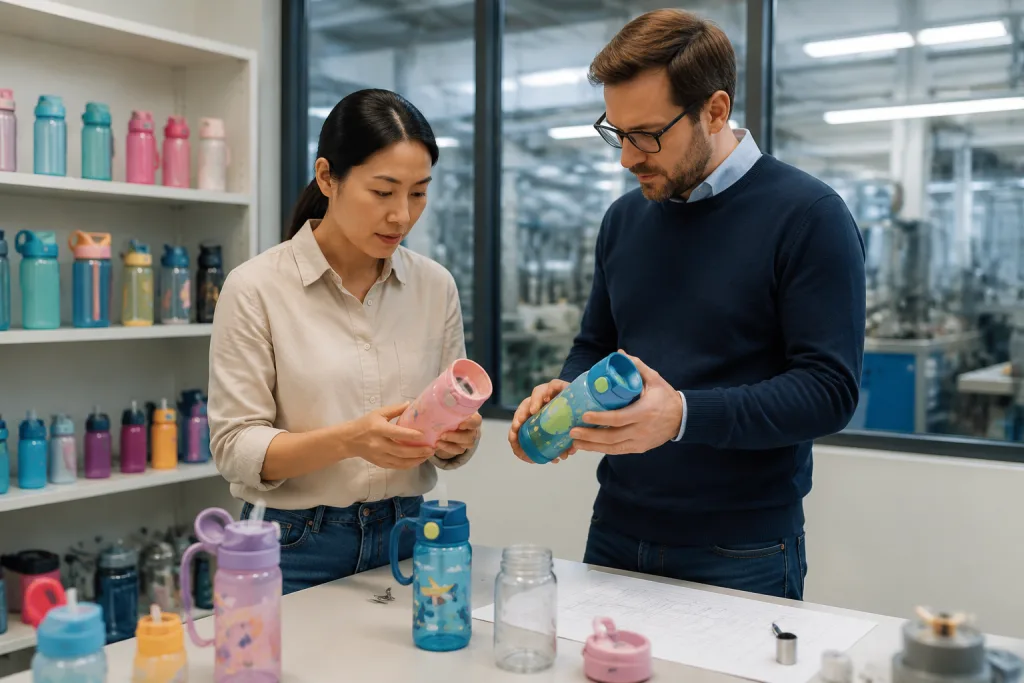
I’ll keep the tags exactly as-is and rewrite only the prose with a more grounded factory-side voice. Next I’m tightening the wording, adding a few concrete shop-floor details, and keeping the section heading intact.Decoration fails in repeatable ways. We see it on the line all the time. Silk screen ink chips when the surface treatment is weak, and the crosshatch test comes back ugly after 24 hours. Laser marking looks permanent, but it only holds on the right stainless or coated surface. Heat transfer can look clean on day one and then peel after 3 dishwasher cycles. For a custom children water bottle, the print method has to match the substrate and the school use case. Design-team preference is the wrong filter.
If you are ordering children water bottle customizable units for schools, ask the factory for adhesion testing, abrasion testing, and the print cure method. We run tape pull after full cure, then a rub test with 50 double strokes under standard load. If the bottle will be washed again and again, request dishwasher resistance testing if the material allows it. QC pulled a sample last month and the mascot was already fading after the third wash. That is not a surprise; it is a spec problem.
Practical rule: if the logo matters more than the bottle shape, you are probably buying a promotional item, not a school-use product. Treat it that way and specify the finish, ink system, and cure time.
For children water bottle wholesale programs, approve one decorated pre-production sample with the exact Pantone, placement, and barcode area. We have seen PO files with a barcode typo turn into a 2-day delay because the buyer flagged it only after print plate setup. A custom school water bottle order goes sideways when each side assumes the other side “understood” the artwork. In China, that is avoidable if you lock the spec sheet before tooling.
School logistics punish weak packaging
I’ll rewrite the section in-place, keep the HTML exactly as-is, and tighten the prose so it sounds like a factory-side sales engineer wrote it.Packaging gets ignored until the cartons show up crushed or the bottles arrive scuffed. School procurement usually goes to a warehouse, not straight into classrooms, so the pack has to survive more touches than a retail order. A children water bottle wholesale program should spell out master carton specs, inner pack counts, and the drop test target before we run the line. If you import into Europe or North America, check carton labels, country of origin, and barcode placement before the truck leaves China.
For a bulk kids bottle order, the usual failure is simple: too much fill or too little. Overpacked cartons split at the corners. Underpacked cartons let bottles bang together and scratch. We usually set 24 or 48 pieces per master carton, depending on size, then add dividers or polybags where the shape needs it. If the bottle carries an outside print, use a sleeve or a separate cavity insert. QC pulled a sample with a rubbed logo once, and the buyer flagged it on day one.
You also need to decide whether the shipment goes mixed color or single color by carton. Mixed cartons save warehouse space, but school programs often want color by house, grade, or campus. A children water bottle distributor handling district rollouts should ask for carton-level lot codes and pallet maps. We had one PO typo where the buyer swapped two pallet labels, and the whole receiving check stalled for 12 days. That kind of problem is why the math does not work if packaging is treated as an afterthought.
If the goal is a bulk children water bottle program with a tight distribution schedule, packaging is not decoration. It is part of the spec.
How to brief a factory clearly
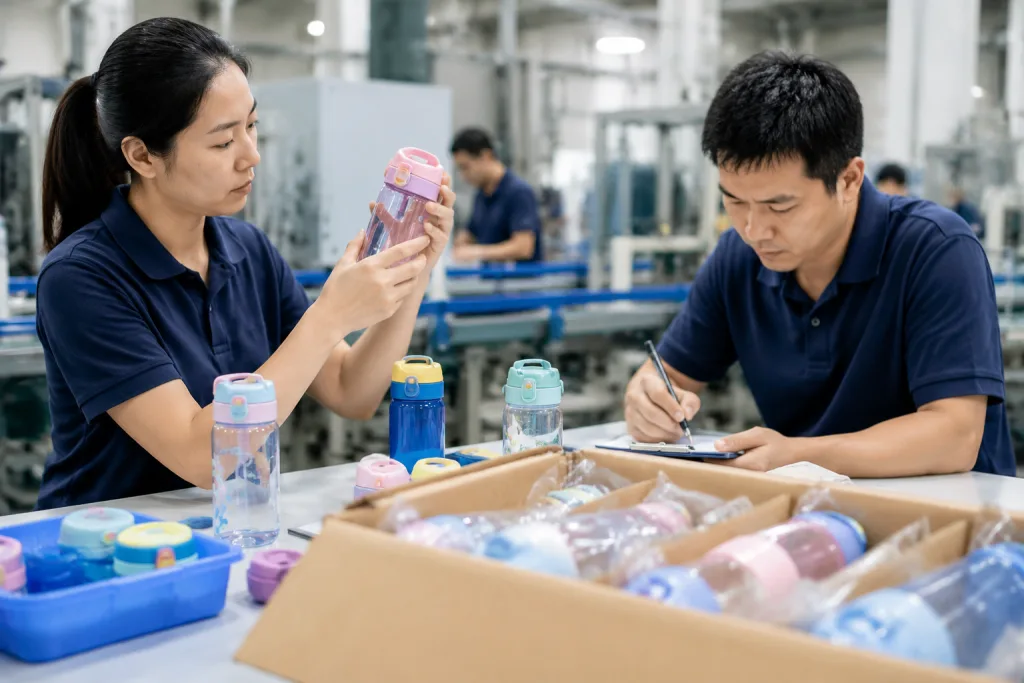
I’ll keep the tag structure intact and rewrite the prose to sound like a factory-side sales engineer: tighter specs, one concrete shop-floor detail per paragraph, and no AI filler.Factories move faster when the brief has hard limits. A children water bottle factory in Zhejiang can quote in one round if you give capacity, material grade, decoration method, target age group, and the compliance list. “Safe,” “durable,” and “nice for kids” do not give the line anything to work with. QC pulled the sample, and that was the first thing they asked us to replace with numbers.
For a supplier school water bottle RFQ, write the use case and the failure point. Say whether the bottle is for primary school, middle school, or district promo handouts. State if it has to fit a lunchbox, pass a backpack leak test, or match a school color program. If you need a custom kids bottle for first graders, the lid torque should be lower and the body should suit smaller hands; for older students, 500 ml to 650 ml usually makes more sense. The buyer flagged a “universal kids size” once, and the math did not work.
- State target capacity in ml and oz
- Define material, finish, and wall thickness
- List compliance needs: REACH, LFGB, FDA, or equivalent
- Specify MOQ, target FOB price, and lead time
- Require AQL level and inspection points
At BottleForge, a new decorated school bottle usually starts at 3,000 units per design, and standard lead time runs 30 to 45 days after sample approval, depending on packaging and season. We run that on the line every week. If the brief is tight, the quote is clean and the sample moves fast; if it is loose, we spend two days chasing missing details and the buyer loses time.
Send your school bottle spec today
We’ll review your lid, material, print, and carton requirements and turn them into a factory-ready quote for China or Zhejiang production.
Frequently asked questions
What MOQ should I expect for a custom school bottle?
For a new custom school water bottle, a normal MOQ is 3,000 units per color or design, especially if you need custom printing or a special lid. Some children water bottle manufacturers will quote 1,000 pieces, but the unit price usually jumps hard because tooling, setup, and labor are spread over fewer cartons. For bulk kids water bottle programs, 5,000 to 10,000 units gives you better FOB pricing and more stable color matching. If you need mixed colors, ask whether MOQ applies per SKU or per total order. That detail changes the budget more than buyers expect.
How do I stop leak complaints in school use?
Start with the cap system, not the body. Ask the children water bottle supplier for gasket specs, thread drawings, and a leak test at both ambient and after a 1.2 m drop. A good school bottle should stay dry after 30 minutes inverted and after repeated open-close cycles. Also check torque: over-tightened lids can deform gaskets, while loose lids fail in backpacks. For bulk school water bottle orders, we usually recommend a simple seal path and fewer moving parts. That is the most reliable way to reduce returns from schools and parents.
Which material is better for younger children?
For younger students, lightweight plastic is usually easier than stainless because it keeps the bottle under about 180 g to 220 g empty, depending on capacity. A children water bottle custom order in Tritan-style copolyester is common because it is clear, tough, and easier to decorate. If you want stainless, 304 is the usual baseline, but weight goes up fast. The right choice depends on the age group, whether the bottle must go through dishwashing, and how much abuse the product will take in school bags. Ask for drop testing either way.
What documents should I request before approval?
Ask for food-contact compliance documents, REACH for Europe, and any relevant FDA or LFGB declarations depending on your market. You should also request a pre-production sample, carton spec, and an inspection plan using AQL 2.5 for major defects and 4.0 for minor defects, if that matches your program risk. For children water bottle wholesale imports, I also recommend a material safety statement and batch traceability. If the factory cannot show documentation cleanly, that is a red flag, especially for school procurement and distributor programs.
What lead time is realistic from a China factory?
For a standard custom kids bottle after sample approval, 30 to 45 days is realistic in China, with longer timing if you need a new mold, special packaging, or peak-season scheduling. A factory in Zhejiang with steady capacity can often produce 300,000 units per month across multiple lines, but your order still depends on resin availability, print queue, and carton materials. If you need a school season delivery, lock the spec early and avoid last-minute artwork changes. Changes after approval usually add 7 to 10 days.