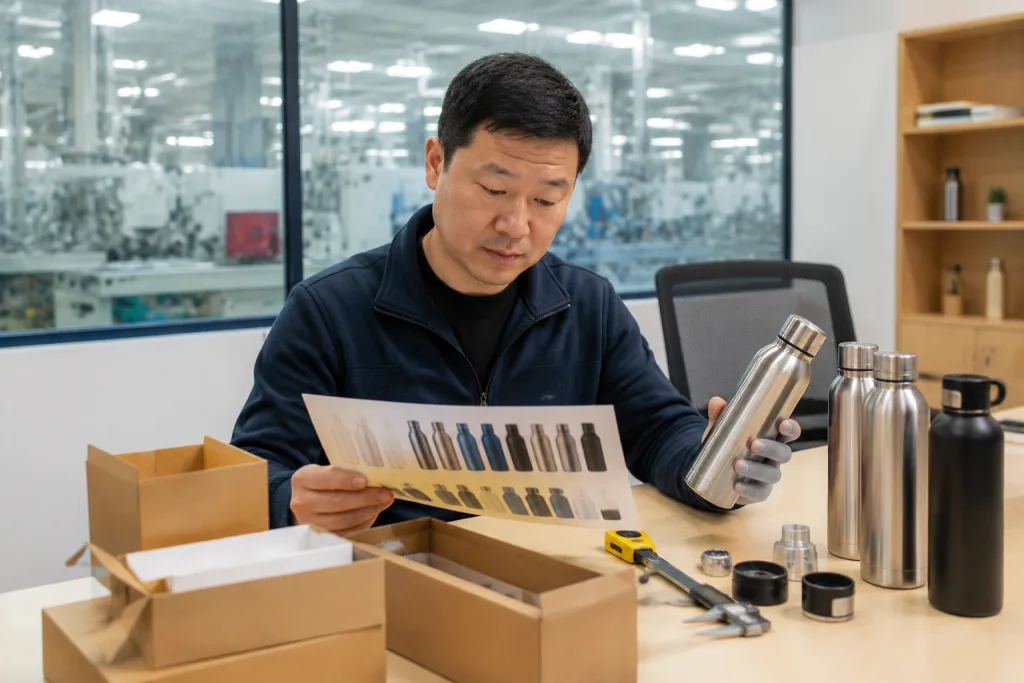
Key Takeaways
- A real supplier list water bottle comparison starts with material grade, not price; 18/8 stainless and Tritan-like plastics are the usual baseline.
- MOQ matters: a canteen custom order often starts at 500 units, while complex customized drinkware can push to 1,000 units or more.
- Lead time is a sourcing metric, not a guess; a capable canteen manufacturer should quote 20–35 days for standard custom runs.
- Export-ready buyers should ask for REACH, LFGB, FDA, and AQL 2.5 inspection terms before approving production.
If you are building a supplier list water bottle program, the hard part is not finding names. The hard part is reading a spec sheet without getting fooled by glossy samples and vague promises. A canteen supplier can quote a low unit price and still miss wall thickness, coating adhesion, or export packaging. That is where B2B drinkware buying goes sideways.
For buyers in Europe and North America, the clean comparison is line by line: material, capacity, lid structure, print method, carton spec, testing standard, and factory capacity. A serious canteen factory in Zhejiang or elsewhere in China should answer those points fast. If they cannot, they are not ready for your program. We make custom drinkware in Hangzhou, Zhejiang, and the buyers who save money are usually the ones who ask for the boring details first. QC pulled a 304 stainless sample at 0.5 mm last week, and that is where the real story starts.
Start with the body material
I’m rewriting the prose only, keeping the HTML tags and the section structure intact. I’ll tighten the sales tone, add concrete factory-floor detail, and strip the AI-style filler.The first line on any supplier list water bottle spec sheet is body material. That line sets weight, unit cost, insulation behavior, and how well the bottle survives the line and the truck. For stainless models, 304 inner walls are the commercial baseline. If a canteen manufacturer quotes 201 on the inside, you are buying a cheaper bottle with more corrosion risk. We’ve seen that go sideways after 3 months in salty coastal markets. For single-wall promo stock, that can pass. For retail or corporate gifting in North America and Europe, it usually fails the buyer test.
Wall thickness matters more than most buyers think. A 0.4 mm wall keeps price down, but a 0.6 mm or 0.7 mm wall feels better in hand and dents less in transit. On plastic programs, ask whether the canteen customizable body is PP, Tritan-style copolyester, or a lower-grade blend with recycled filler. QC pulled a sample on the bench with a caliper at 0.58 mm, and the buyer flagged it because the PO called for 0.7 mm. A canteen supplier should name the resin, not hide behind “food grade.” If they dodge that question, the math doesn’t work.
Buyer impact: the body spec decides whether your custom drinkware order lands as retail-ready or promotional-only. It also changes freight weight, carton breakage, and the return rate after first use. On one 10,000-piece run, a 40 g difference per bottle added 0.8 kg per carton, and the freight quote moved enough to wipe out the margin.
Read the lid like a failure point
I’ll rewrite this section in-place, keep the HTML exactly as-is, and tune the prose to sound like a factory-side sales engineer.Most leaks start at the cap, not the bottle. So the lid line needs the same check as the body. A custom canteen with a screw cap, flip lid, or sport top creates a different complaint pattern. A screw cap is simpler and usually lands USD 0.20 to 0.60 lower per unit. A one-touch lid adds parts, tooling risk, and more assembly time on the line.
If the bottle is for distributor drinkware programs or outdoor retail, ask about gasket material and spare parts. Silicone seals are standard, but durometer and fit decide the result. We have seen a seal pass sample day and deform after 50 wash cycles. For a customized canteen, ask for the closure torque spec and the leak test method. Good factories in Zhejiang will tell you whether they run inverted testing at 48 hours, 6 hours, or a fast hand check. You want the actual number.
Practical rule: if the lid has three or more moving components, build a sample approval step into the schedule and add 7 to 10 extra days for testing and correction.
Capacity changes the whole quote
I’ll rewrite the section in place, keep the HTML exactly as-is, and tighten the language so it sounds like a factory-side sales engineer wrote it.Capacity is not a marketing label. A 500 ml bottle and a 750 ml canteen for the same buyer can need different blanks, cartons, and line settings. Bigger volume usually means a wider body, more steel, and higher freight. If your supplier list water bottle covers 12 oz, 17 oz, 24 oz, and 32 oz, compare stacking and carton use too. We’ve seen a bottle look cheap on the unit price and turn expensive once the pallet math lands.
For retail shelves, 500 ml and 650 ml often move faster because they fit cup holders and day bags. For gyms, schools, and outdoor packs, 750 ml or 1 L makes more sense. A canteen distributor should give you net weight, gross weight with packaging, and master carton count. If they only send capacity and unit price, the spec is thin. Capacity also decides logo space, and on a canteen promotional item that matters more than insulation claims. QC pulled one sample at 68 mm diameter last month because the print area was 8 mm short of the buyer’s artwork.
Ask for cubic meter data before you sign the PO. We had a buyer flag a typo on the carton spec once: 0.10 CBM was typed as 0.01, and that one zero changed the freight quote on 5,000 units out of Zhejiang.

Decoration affects both margin and claims
I’ll rewrite the three paragraphs in a more sales-engineer voice, keep the HTML exactly as-is, and preserve the specific numbers and tags.Decoration is where margin gets squeezed fast. Screen print, laser engraving, heat transfer, UV print, and powder coat all act differently on stainless and plastic. We’ve seen a canteen custom logo look fine on day one, then fail a dishwasher test after 20 cycles because the ink stack was wrong. For a distributor canteen order, the right call is the method that fits how the buyer will use it, not the mockup that photographs best.
Laser engraving stays clean and holds up, but it cuts into the base metal, so the finish can look too plain for a canteen promotional run. Silk screen is the cheap route for large flat areas and works well on a simple one-color logo. UV print gives more color options, but if surface prep is weak, abrasion shows up fast. Ask the canteen supplier for adhesion data and check whether decoration runs in-house or gets outsourced. We run this line every week, and the surface treatment step usually adds 2 to 4 days to lead time.
Commercial detail: if your brand wants a customized growler or customizable growler with full-wrap artwork, the setup fee goes up and the color tolerance gets tighter than a basic one-color imprint. QC pulled the sample on a 330 ml test run last month and the buyer flagged a small shift on the wrap seam; that’s the kind of thing that turns into a claim if nobody signs off early.
Packaging decides export damage
I’ll rewrite the section in-place, keep the HTML structure intact, and make the copy sound like a factory-side sales engineer wrote it.Packaging is part of the spec, not an afterthought. A canteen factory shipping 10,000 units a month should show inner box drawings, master carton compression numbers, and the drop-test setup they actually run on the line. For export orders, ask if the individual box is plain, printed, or retail-ready with barcode space. If the buyer ships to Amazon or a 3PL, FNSKU labels, polybagging, and master carton marks need to match the receiving plan before we start packing.
Carton quality drives claim rates more than most buyers think. A 5-ply outer carton can survive a short truck route, but sea freight to Europe or North America usually needs better compression resistance. We’ve seen this go sideways on gift sets: the buyer wanted molded pulp inserts, then pushed back on the extra $0.18 per set. Foam or pulp cuts rattling, but it changes cost and MOQ. A good canteen manufacturer gives packaging levels, not one fixed box. QC pulled the sample, and the corner crush held at 18 kg, which is the kind of number that matters.
- Request carton drop-test and vibration-test results.
- Confirm pack count per carton and carton dimensions in millimeters.
- Check whether the inner bag is PE, compostable, or omitted.
- Match the label format to your warehouse system before production starts.
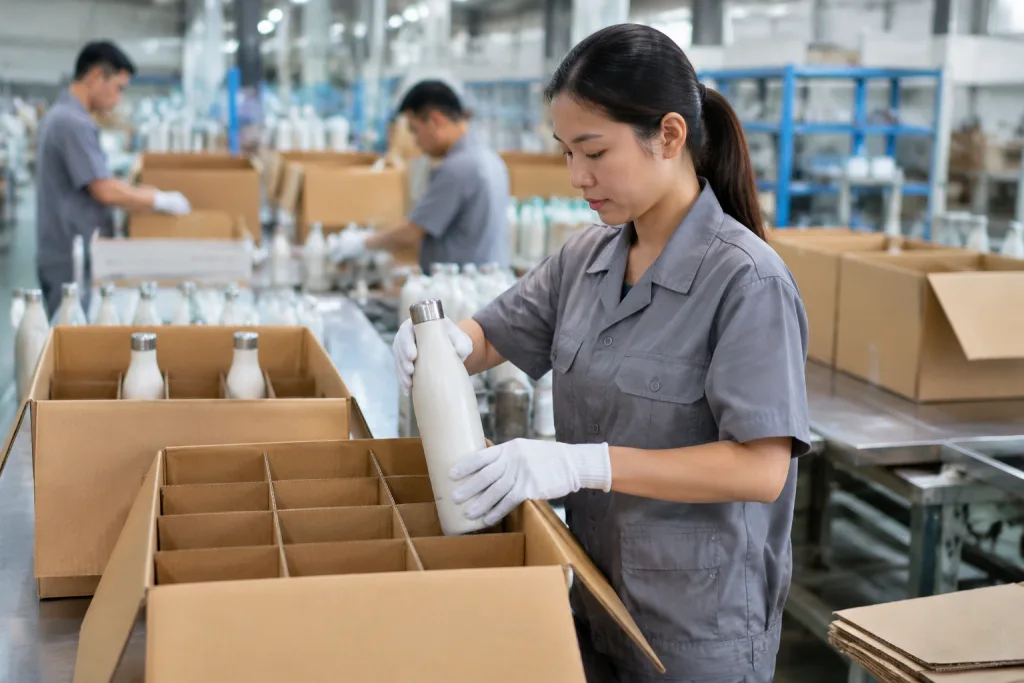
Testing separates suppliers from vendors
I’ll rewrite just the HTML prose, keep the tags intact, and make the tone sound like a real export salesperson from the shop floor. Then I’ll sanity-check that I didn’t touch the structure or the required test specs.Testing is the quickest way to tell a real canteen manufacturer from a trading-layer canteen vendors setup. For Europe, ask for REACH and LFGB. For North America, ask for FDA food-contact compliance and any ASTM test references if that category calls for them. On stainless drinkware, we also check vacuum retention, salt spray on the coating line, and dishwasher durability if the spec claims it. QC pulled a 6-hour vacuum sample last week; it held, but the buyer still wanted the report number.
Do not accept a vague “passed” line. Ask for the test date, the lab name, and the sample ID. If you want a supplier list water bottle that is actually export-ready, you need a fixed inspection standard too. AQL 2.5 is common for major defects in consumer goods, though some buyers cut it tighter for gift or retail programs. We’ve seen a carton typo turn into a claim on arrival, so this is not the place to wing it. For a canteen distributors network, one bad batch can hit more than one account, and the math does not work if QC is loose.
China reality: plenty of factories in Zhejiang can make good parts; the split is whether they record the process. We ship better when the paperwork is clean, because that is what protects you when the container lands and the customer starts asking for proof.
Send your spec sheet. Get a real quote.
We can review your supplier list water bottle specs, flag hidden cost drivers, and quote custom drinkware from our Hangzhou, Zhejiang factory.
Frequently asked questions
What should I ask first on a supplier list water bottle quote?
Start with material, capacity, lid type, decoration method, MOQ, and lead time. A serious quote should tell you whether the body is 304 or 201 stainless, what the wall thickness is, and whether the lid is leak-tested. For custom drinkware, ask for FOB price, packaging spec, and a sample timeline. A clean quote from a canteen supplier in China or Zhejiang should also state whether tooling is needed. If the answer is vague, the price is probably incomplete. For retail programs, I usually want all six items before I compare vendors.
What is a normal MOQ for a custom canteen order?
For a basic canteen custom order, 500 units is common at a capable factory. If you want multiple colors, special printing, or a complex closure, 1,000 units may be more realistic. Some canteen manufacturer lines can sample below MOQ, but the unit price rises sharply. For customized drinkware programs, the MOQ often depends on whether the same blank is used across sizes. A canteen supplier should explain whether MOQ is per color, per logo, or per SKU. That detail changes your launch budget more than the unit price does.
How long does production usually take?
For standard custom drinkware, plan on 20 to 35 days after sample approval and deposit. If you need special packaging, multi-color print, or new tooling, add 7 to 15 days. A good canteen factory in Zhejiang will separate sampling time from mass production time instead of bundling everything into one estimate. If a canteen vendor quotes 10 days for a new custom canteen with decoration and export packing, they are either overpromising or leaving out steps. Always confirm whether the lead time is for FOB pickup or finished goods ready to ship.
What price range should I expect?
For a simple stainless bottle, FOB pricing can start around USD 2.20 to 3.80 per unit at volume, depending on wall thickness, lid, and print. Better insulation, laser engraving, or retail packaging can push it into USD 4.50 to 7.50 or more. A customized growler or large-capacity promotional piece often costs more because of material usage and carton size. A canteen supplier should quote based on exact specs, not a rough guess. If the price looks too low, check whether the finish, testing, or packaging was quietly removed from the quote.
Can a distributor drinkware program use one spec for multiple channels?
Yes, but only if the spec is balanced. For example, one 750 ml stainless body can serve ecommerce, corporate gifting, and canteen promotional retail if you change the logo method and packaging per channel. A distributor canteen program usually works best when the base item stays fixed and the decoration changes. That reduces tooling, keeps inventory manageable, and makes reorders faster. If you try to customize everything for every account, your canteen distributors setup becomes expensive and hard to replenish. One stable blank with three packaging variants is often the smarter path.