Key Takeaways
- A serious supplier list vacuum bottle RFQ should lock in 7 items: capacity, 304/316 steel, wall thickness, lid type, finish, logo method, and carton pack.
- For a custom thermos order, expect MOQ around 1,000 pcs, sample time of 7-12 days, and bulk lead time of 25-35 days from approved pre-production sample.
- Good stainless thermos quotes should show FOB China pricing, AQL 2.5/4.0 inspection terms, and carton specs by master case, not just unit price.
- If you sell bulk thermos into retail or promo channels, lock PO line items early: body spec, leak test, drop test, decoration position, and FNSKU or barcode needs.
If you are building a supplier list vacuum bottle program for outdoor retail or promo sales, the hard part is not finding names. The hard part is separating a real factory thermos partner from a polished sales desk that cannot hold ±0.3 mm on the cap, keep cartons flat, or ship on time. For stainless thermos projects, one bad line item can push landed cost up 8% to 15% after sample charges, rework, and a missed vessel.
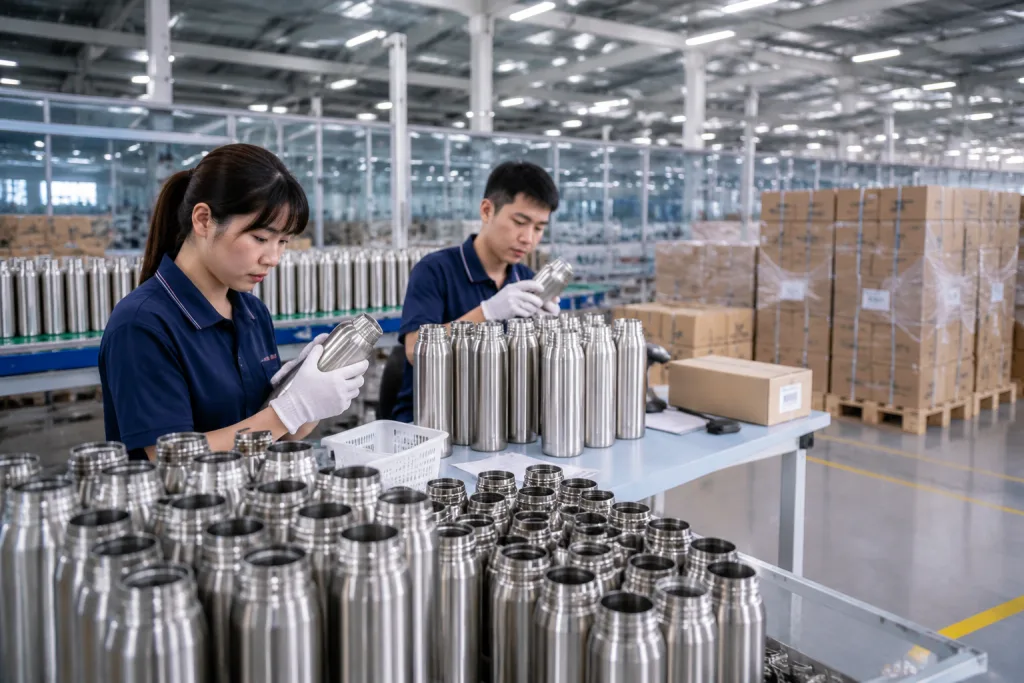
Buying in China, especially Zhejiang, is simple if you run it in the right order: RFQ, sample approval, PO, then bulk release. At BottleForge in Hangzhou, we run 120,000 units per month across insulated drinkware, with a standard MOQ of 1,000 pcs for custom thermos and 25-35 day bulk lead time after sample signoff. QC pulled the sample, checked the lid torque, and if the supplier cannot give that level of detail, the math does not work.
Start with the buying brief
I’ll rewrite just this section in-place style: keep the HTML structure, strip the AI-ish phrasing, and make it sound like a factory sales engineer wrote it.Before you ask any thermos supplier for pricing, write a brief our factory team can quote without chasing you for basics. If the brief is vague, the numbers come back vague too, and then sample rounds turn into paid back-and-forth. For a stainless thermos RFQ, the core data is simple: capacity, target market, price band, lid style, finish, logo method, packaging, and delivery window.
For outdoor retail, add the use case and the performance target. A 500 ml stainless thermos for hiking does not need the same lid or coating as a 750 ml promotional thermos for corporate gifting. If you want a customizable thermos line, state whether the bottle must hit 24-hour hot retention, 12-hour cold retention, or both. We run this on the line every week in Zhejiang: buyers who say what the customer needs get quotes faster than buyers who ask us to guess.
- Capacity: 350 ml, 500 ml, 750 ml, or 1,000 ml
- Steel grade: 304 for standard, 316 for higher corrosion resistance
- Body structure: single wall, double wall, or vacuum insulated
- Finish: powder coat, matte paint, spray, or brushed steel
- Pack-out: color box, mailer, retail carton, or bulk tray
Do not ask for a generic custom thermos price if you need a promotional thermos with individual barcodes. Put that in the brief on day one, or the buyer flagged it later and the math stops working.
Build the supplier list
I’ll rewrite the HTML in a more grounded sales-engineer voice, keep the tags intact, and preserve the structure while tightening the supplier-list advice.Your supplier list vacuum bottle search should start wide, then cut hard. I’d screen 8 to 12 thermos manufacturers and thermos suppliers, but keep only the ones that can prove they are real factories, not a thermos vendor flipping catalog stock. Ask for factory audit records, production photos from the line, and the last third-party inspection report. If they dodge those three, drop them.
A real manufacturer thermos partner in China usually comes back with straight numbers: monthly output, MOQ, mold count, and decoration capacity. Ask whether they run silkscreen, laser engraving, heat transfer, and powder coating in-house or push them out. We’ve seen buyers lose 12 days because a powder line was full, while bottle forming still had capacity. That is the wrong place to be guessing.
Here is the filter I use:
- Can they quote a distributor thermos order with FOB or EXW terms in 24 hours?
- Do they give wall thickness in mm and steel gauge, not just “premium steel”?
- Can they show BSCI, ISO 9001, or another current factory audit?
- Do they mention REACH, LFGB, FDA, or ASTM where relevant to your market?
Skip the supplier thermos pitch if it misses these basics. QC pulled a sample at 2.5 mm once and the buyer flagged it on the spot; that kind of detail saves a shipment. A good supplier list gets smaller after one hard pass, and that is the point.
Read the quote line by line
I’ll rewrite the section in place, keep the HTML structure untouched, and tighten the sales-engineering tone with concrete factory detail.Most buyers compare only unit price and miss the cost stack. Wrong move. A proper stainless thermos quote should spell out body spec, lid spec, surface finish, decoration, packaging, and carton loading. If you get one number with no breakdown, you do not have a quote; you have a guess. On our line, QC checks this with a caliper and a carton test sheet before we release the file.
For a customized thermos, I want the quote to show whether the bottle uses 0.4 mm or 0.5 mm 304 inner and outer walls, because that changes weight and heat retention. Ask for sample pricing apart from bulk pricing. We have seen buyers push back on a USD 30 to 120 sample range, then act surprised when tooling and logo setup are separated from production. For bulk thermos, a 500 ml powder-coated vacuum bottle sits in a different bracket than a brushed steel retail pack. The math does not work if you mix them. Run the comparison cleanly, or your supplier list will send you in circles.
PO line items should match the quote structure:
- Item 1: bottle body, capacity, steel grade, wall thickness
- Item 2: lid, material, seal type, leak-test requirement
- Item 3: decoration, one or two colors, logo position, Pantone reference
- Item 4: packaging, inner box, master carton, barcode or FNSKU
That is how you keep a thermos custom project from drifting during revision rounds. We once caught a PO typo on a 500 ml order where the buyer wrote 50 ml, and that one line would have wrecked the whole run.
Lock the sample exactly
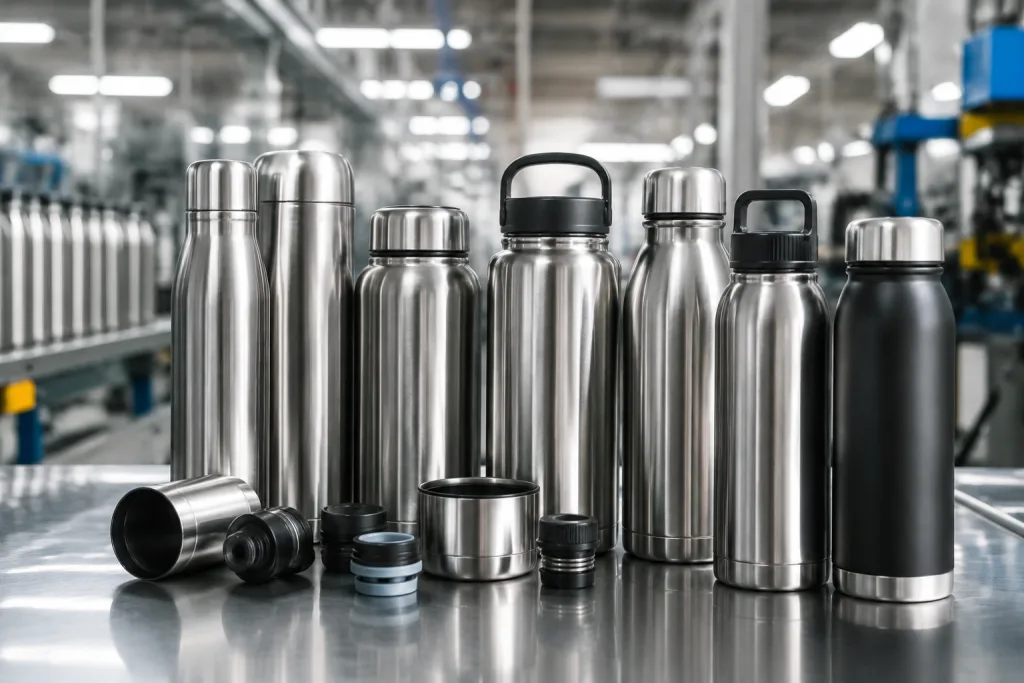
I’ll rewrite the section in place, keep the HTML structure untouched, and tighten the sales-engineer tone with concrete factory details.Samples are where weak projects show up fast, and where too many buyers get sloppy. Never sign off a custom thermos sample because it “looks fine.” Run the leak test, check the neck finish with calipers, and write the result down. If you sell to distributors or outdoor retailers, the sample is your reference standard, not a desk ornament.
Ask for three sample types: blank sample, decorated sample, and pre-production sample. The blank sample shows body welds and wall thickness; the decorated sample checks logo position and color match; the pre-production sample confirms the carton, insert, and lid. For a supplier thermos order, the final sample needs the exact gasket, coating, and printed artwork that will go into bulk production. If the factory wants to swap a lid or change the cap gasket after approval, that is a new sample, not a small tweak.
Approve the sample only after it passes leak test, retention check, finish inspection, and drop test. A 24-hour water leak test and a 1-meter carton drop test are basic, not premium.
Give the factory a sample approval sheet with the PO line items already filled in. We had one buyer flag a typo on the lid color code, and that saved a 5,000-piece headache on the line. In Zhejiang, the better factories expect this kind of discipline; the weak ones push back because they want room to improvise.
Place the PO with controls
I’ll keep the HTML exactly as-is and rewrite only the prose with tighter, more seller-like wording. Next I’m checking the wording for the controls, then I’ll return the cleaned section.Once the sample is signed off, the purchase order needs to work like a control sheet. Do not hide key points in email threads. A custom thermos PO should name the bottle model, capacity, steel grade, artwork file version, carton count, payment terms, inspection standard, and shipment window. If you sell on Amazon or through retail, put the barcode or FNSKU rule in the PO before the line starts packing, not after.
For a distributor thermos or a thermos distributors program, I would also put the defect limit and inspection method on the PO. AQL 2.5 for major defects and 4.0 for minor defects is common on stainless drinkware. If the supplier cannot hold that line, the next batch eats margin fast. State the call on vacuum failure, coating scratches, and logo shift over 2 mm. We’ve seen the buyer flag a 3 mm logo drift and reject the carton at final QC.
A clean PO for thermos bulk should include:
- Product: vacuum insulated stainless thermos
- Quantity: 1,000 / 3,000 / 5,000 pcs by SKU
- Unit price: USD FOB China
- Artwork: Pantone, print method, approved file date
- Inspection: AQL level, third-party inspector, sampling size
- Packaging: box type, carton quantity, pallet or no pallet
This is where a real thermos manufacturer stands apart from a casual supplier list entry. A clear PO saves 3 days on the line and cuts dispute time later. The math does not work any other way.
Control bulk production and shipping
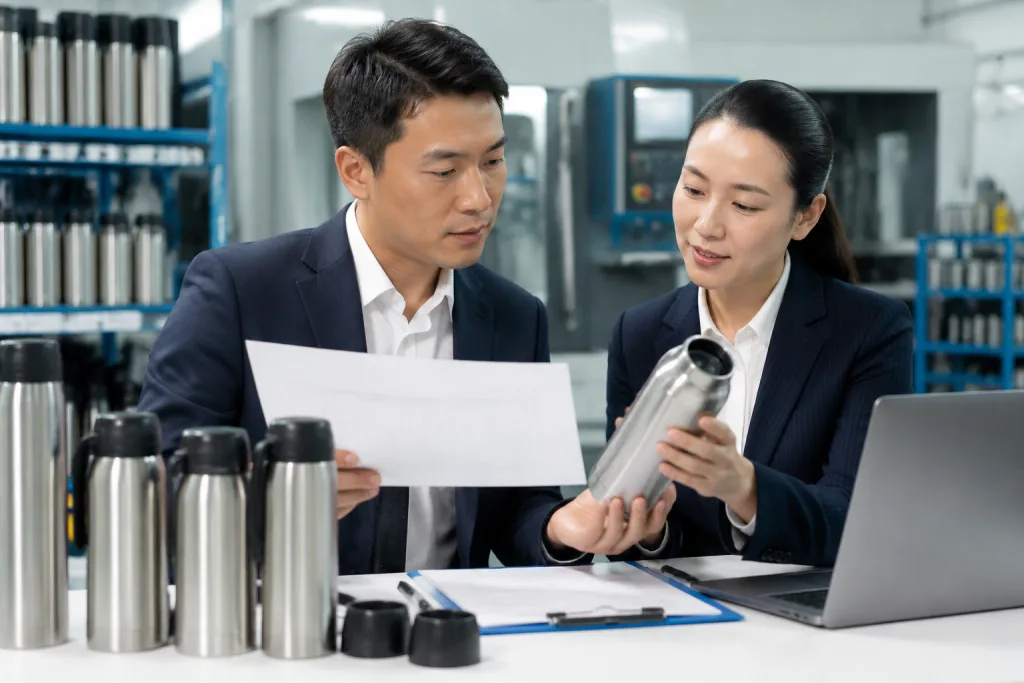
I’ll rewrite the section in-place, keeping every tag and list structure unchanged while tightening the sales-engineer tone and adding concrete factory-floor detail.Bulk production is where process drift shows up fast. We ask for a pre-production meeting, first article sign-off, and a midline check. For a factory thermos order in China, I want photos of the first 50 units on the line, not a vague “production started” message. If the project is a promotional thermos run, check print opacity and logo register before the line keeps moving.
Typical stainless thermos lead time from approved sample to bulk shipment is 25 to 35 days for standard decoration, and 35 to 45 days if you add multiple colors, complex packaging, or retail inserts. On one 5,000-piece PO, QC pulled the sample cartons on day 12 and caught a cap mismatch before we shipped the wrong version. In Hangzhou and the wider Zhejiang supply chain, faster is possible, but only if molds, caps, and cartons are already in the warehouse. Shipping terms matter too. FOB is the cleaner call for most buyers because it keeps freight, insurance, and landed cost under your own numbers.
Before release, verify these points:
- Capacity tolerance within your spec band
- Leak test result on random cartons
- Logo alignment and color consistency
- Carton drop performance and pack count
- Outer cartons labeled to your destination code
If you want a thermos promotional program that repeats, treat each shipment as a controlled run. A good thermos supplier should ship the same result on the next PO without rewriting the process. The buyer flagged it once on a 2 mm logo shift, and that was enough.
Keep the supplier list useful
I’ll rewrite the three paragraphs in place, keep the HTML unchanged, and tune the voice to sound like a real sales engineer with sharper factory-floor detail.Your supplier list should not turn into a spreadsheet graveyard. We rank each thermos supplier by reply time, sample match, color consistency, and price hold across 3 reorders. After the first PO, we usually cut it to 2 or 3 names that actually behave like partners. That is how we keep a stainless thermos program under control when the catalog goes from 20 SKUs to 80.
I would tag each supplier by job: custom thermos, promotional thermos, bulk thermos, and distributor thermos. One factory can be strong in one lane and weak in the next. We have seen polished retail bottles run fine, then the same plant miss a mixed-SKU promo order because the line changed over too often. Another plant can ship thermos bulk quantity without drama, but the laser engraving is off by 0.3 mm or the gift box print has a typo the buyer flags on day one. Use the QC sheet and the sample sign-off, then put the right job with the right manufacturer thermos team.
China, Zhejiang included, gives you enough depth to be selective. Good. Use that leverage. The goal is not to collect 20 names. The goal is to know which supplier thermos partner can quote straight, turn a sample in 5 to 7 days, and ship on the date they promised when the next PO lands.
Send your RFQ and compare real factories
We quote stainless thermos programs with clear MOQ, FOB pricing, and sample timelines, so you can move from supplier list to approved bulk order faster.
Frequently asked questions
What should I ask first in a supplier list vacuum bottle RFQ?
Start with capacity, steel grade, wall thickness, lid style, logo method, finish, and packaging. For example, a 500 ml 304 stainless thermos with 0.5 mm inner and outer walls, powder coat, one-color logo, and retail box is a complete RFQ. If you skip those details, quotes will vary by 10% to 25% and sample revisions will drag on. Good suppliers in Zhejiang or elsewhere in China can usually respond within 24 hours when the brief is complete.
What MOQ is normal for a custom thermos order?
For a real factory thermos program, MOQ is often 1,000 pcs per SKU for standard customization, sometimes 3,000 pcs if you need special packaging or new tooling. Some suppliers will offer 500 pcs, but price usually rises 12% to 20%. If you are comparing thermos manufacturers, ask whether the MOQ covers the bottle only or the full decorated and packed unit. That distinction matters more than the headline number.
How long does a sample and bulk order take?
A blank sample can take 3 to 5 days if the mold exists. Decorated samples usually take 7 to 12 days. After sample approval, bulk production for stainless thermos is commonly 25 to 35 days, and 35 to 45 days if the project has complex print or gift packaging. In China, lead time depends on whether caps, cartons, and coating lines are already scheduled. If you need a faster turnaround, confirm that before PO release.
What should be on the PO for bulk thermos?
Your PO should include product model, capacity, steel grade, logo artwork version, color code, quantity by SKU, unit price, packaging spec, inspection standard, and shipment term. Add AQL 2.5 major and 4.0 minor if that matches your quality target. For Amazon or retail distribution, include barcode or FNSKU requirements. A clear PO protects you if the supplier changes a lid, carton, or print detail after approval.
How do I know if a thermos supplier is a real factory?
Ask for production photos, monthly output, in-house process list, and third-party audit proof such as BSCI or ISO 9001. A real manufacturer thermos partner should also answer technical questions about wall thickness, vacuum sealing, and decoration methods without delay. If they only send catalog photos and never state MOQ or lead time, they are probably a trading layer. In Zhejiang, real factories usually know their numbers and share them fast.