Key Takeaways
- A usable supplier list thermos should screen for 1.0 mm body wall, 201 or 304 stainless, and leak test at 100% on the line
- Most QC failures start at the lid: 0.2-0.3 mm gasket mismatch or thread variation is enough to cause leaks after 3-5 drops
- For bulk thermos orders, expect MOQ from 1,000 pcs per color and lead time of 25-35 days after sample approval
- A solid thermos manufacturer in Zhejiang should show AQL 2.5 records, REACH-compliant materials, and packaging drop-test results
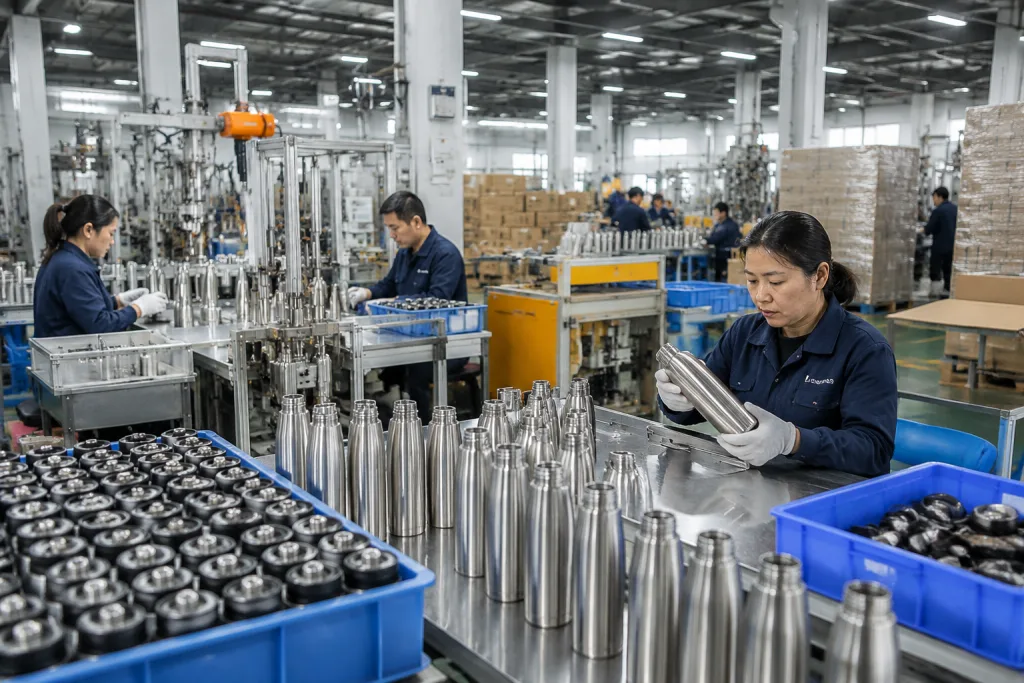
If you are building a supplier list thermos program, the hard part is not finding factories in China. The hard part is cutting out the ones that look fine on a quote sheet but miss the details that eat margin later: vacuum leaks, lid fit drift, coating scratches, off-center logos, and claims that fall apart on a drop test. For outdoor retailers and promo brands, one bad lot can turn a bulk thermos order into a week of complaints and chargebacks. We have seen a buyer flag a 1.5 mm logo shift on a 10,000-piece run, and the whole shipment sat while QC pulled samples.
At BottleForge in Zhejiang, we see the same pattern again and again. Buyers start with a broad thermos supplier list, ask for a customizable thermos, and then find out the real question is not who can quote USD 2.40 FOB, but who can hold a 1.0 mm wall, pass AQL 2.5, and ship a steady factory thermos run at 30,000 units/month without cosmetic drift. The math does not work any other way. That is the standard to use when you compare suppliers, distributors, and manufacturers in China—we run the line to that bar, or the order gets noisy fast.
Where the first leaks start
I’ll keep the tag structure intact and rewrite the prose in a more field-tested supplier tone. Next I’m tightening the language, adding a couple of factory-floor specifics, and keeping the list structure unchanged.The first leak in a stainless thermos program usually is not the vacuum. It is the joint. A body can pass a quick glance and still fail because the shoulder weld has a pinhole, the liner and shell are off by 0.3 mm, or the cap gasket comes in too hard. We saw one batch pass a bench fill, then fail after a 12-hour hot-cold cycle and a 1-meter drop test. The buyer flagged it only after the carton came back damp.
If you are building a supplier list thermos shortlist, ask each thermos manufacturer how they check seal integrity. On our line, QC pulled the sample every 30 minutes for a vacuum hold test, and we still run 100% retention checks on branded orders plus spot checks for boil-to-cold temperature loss. For stainless construction, 304 is the right call on the inner liner for most retail programs; 201 only makes sense when the math is tight and the product is promo-grade, not outdoor retail. If a thermos supplier cannot tell you where the seal is formed, how it is tested, and what the reject rate was on the last lot, they are not ready for a serious bulk thermos order.
- Ask for vacuum leak test method and pass/fail limit
- Specify liner grade, usually 304 for retail programs
- Require weld appearance and seam concentricity photos
- Set an in-process reject target under 1.5%
Lid fit is usually the weak point
I’ll rewrite the section in a more field-tested B2B tone, keep the HTML structure intact, and preserve the technical numbers already in place.The lid is where a lot of thermos customized orders go wrong. The body can take months of handling on the line, but a lid with loose tolerances starts rotating, squeaking, or leaking after a few uses. If the thread pitch drifts by even 0.3 mm, or the gasket groove is too shallow, the buyer flags the whole product. For a supplier list thermos, lid drawings matter just as much as capacity and finish.
For a custom thermos, ask the factory for the exact lid material, gasket hardness, and cycle test count. A solid thermos factory will state PP or Tritan for the cap shell, food-grade silicone for the seal, and at least 3,000 open-close cycles for the lid mechanism. For a promotional thermos, we can simplify the cap structure to cut cost, but do not shave the gasket spec. We once saw a distributor save USD 0.06 per unit and lose a full container to leaks. The math does not work.
Spec the lid first, then the artwork. A clean logo means nothing if the cap fails on day three.
Buyer checklist
- Demand thread drawings and a gasket cross-section
- Request torque range for tightening, not just fit photos
- Test 3-5 drop cycles from 1 meter with water inside
- Use a separate approval for the lid color and finish
Finish damage during packing
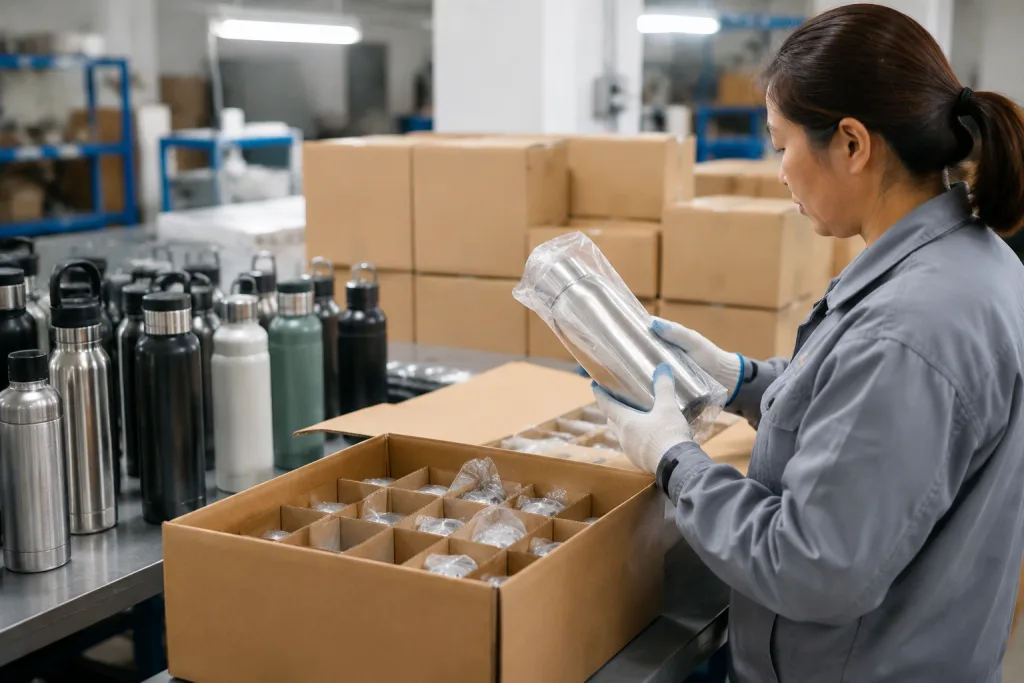
I’ll rewrite the prose in place, keep the HTML structure exactly as-is, and tune the tone to sound like a factory-side sales engineer.Most cosmetic claims start in packing, not on the line. A stainless thermos with a matte powder coat can leave QC clean and still land scratched because the carton insert is weak, the shrink bag rubs the finish, or the outer box has 15 mm of empty space. We’ve seen this go sideways on camp retail orders and influencer kits. The buyer flagged the scuffs, not the mold line.
For thermos bulk shipments, the pack spec matters as much as the bottle spec. Ask for carton drop-test results at 70 cm, and push for individual polybags or molded trays on premium finishes. If the order ships to Amazon FBA, you still need carton labels, FNSKU placement, and a master carton count that matches the packing list. A good supplier thermos partner in Zhejiang should send packing photos before mass production and confirm whether the goods move FOB Ningbo or FOB Shanghai. We run this check on the packing table with a tape measure, because the math does not work when the inner box has too much slack.
- Specify insert type for each finish: gloss, matte, or painted
- Ask for carton drop-test records before shipment
- Confirm barcode and master carton label placement
- Keep headspace under 8 mm inside the inner box
Logo failure is often a spec problem
I’ll rewrite the three paragraphs in-place, keep the HTML exactly as-is, and make the sales copy sound like a factory-side engineer wrote it.When a custom thermos order goes wrong on decoration, buyers usually blame the factory first. Sometimes that is fair. On the line, we see the problem start with a vague artwork spec. Laser engraving on curved stainless steel is not the same as silk screen on a flat powder-coated shell. Push a 60 mm logo onto a tight radius and it will stretch. Ask for a multi-color print on a soft-touch finish, and the ink bond can fail after a few wash cycles. That is where a thermos custom brief needs hard numbers, not loose wording.
Tell your supplier list thermos candidates the decoration details: logo size in mm, Pantone code, print position, and whether the art must pass dishwasher cycles. For a simple promo run, laser engraving is usually the safer call. For retail, a clean one-color print often beats a busy label. We ask for a pre-production logo sample and a 48-hour adhesion test on the actual coating. QC pulled a sample last month and the buyer flagged a 2 mm shift on the side print. If a supplier says every method works without checking the surface finish, that is a bad sign.
In Zhejiang, plenty of factories run both silk screen and laser. The better ones will tell you which process fits 304 stainless, the powder coat, and the curve on the bottle instead of selling the pricier method. That is the wrong question to ask. On one PO, a buyer typed “logo center” and forgot the offset; the sample came back 8 mm off and we had to redo the film. Good suppliers save you that mess before the order hits production.
Thermal claims that do not hold up
I’ll rewrite this section in-place, keep the HTML structure untouched, and make the claims read like a factory-side sales engineer wrote them.Temperature claims are easy to print and hard to defend after a retailer or distributor checks them. We have seen a thermos maker quote 12 hours hot and 24 hours cold, then lose the case because the cap seal was soft, the wall thickness drifted by 0.3 mm, or the preheat step changed from one run to the next. If you compare thermos suppliers on brochure copy alone, you end up with numbers that do not repeat from lot to lot.
Set the test method before you ask for price. Put the starting water temperature, room temperature, fill level, and pass mark in writing. We usually run 95°C water, 20°C room, full fill, lid closed, and checks at 6, 12, and 24 hours. For a stainless thermos in the 500 ml to 750 ml range, a solid unit should still feel clearly warm at 12 hours and should not sweat on the outside. QC pulled one sample last month with a loose liner at the neck, and the buyer flagged it right away. Ask if the supplier tested the body alone or the full assembled bottle. That is the wrong question to skip.
- Lock the thermal test method in the PO
- Require full-assembly testing, not shell-only data
- Ask for sample retention results by production lot
- Keep claims conservative for distributor thermos programs
MOQ, price, and factory reality
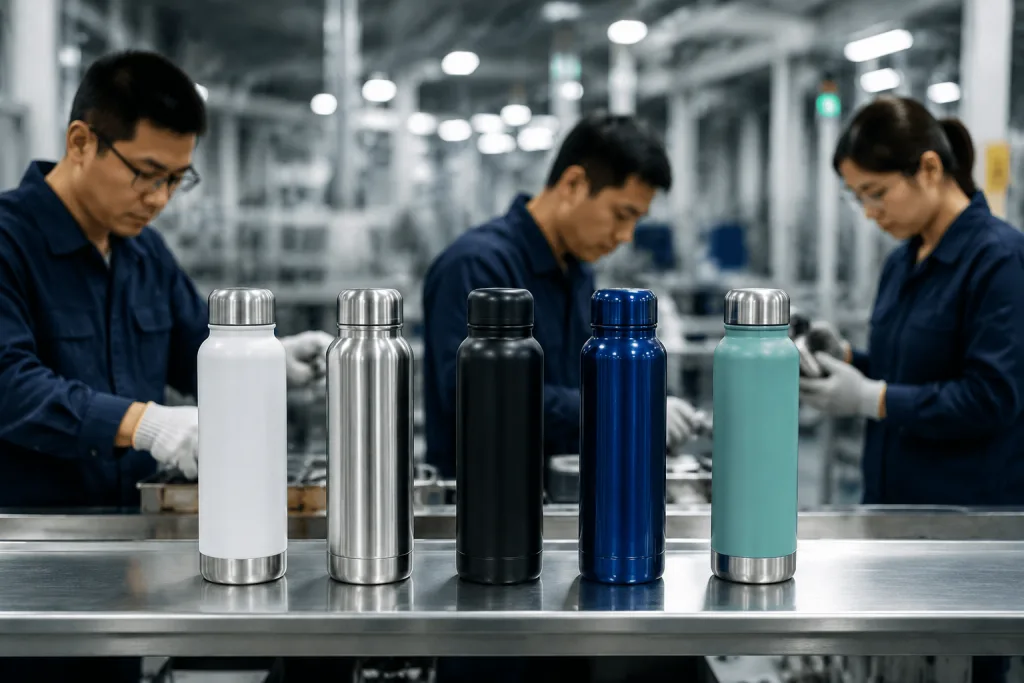
I’ll tighten the copy, keep the HTML untouched, and make it read like a factory-side sales engineer wrote it. Then I’ll return only the rewritten section.Price only means something when it matches the line. For a standard stainless promotional thermos, a Zhejiang factory usually quotes USD 2.20-3.80 FOB, and that range moves with capacity, finish, and decoration. Add custom color, laser logo, and a gift box, and the math shifts fast. Our MOQ is usually 1,000 pcs per SKU or per color, with 25-35 days lead time after sample approval. If a supplier offers 300 pcs with full customization at bulk pricing, something is off. We’ve seen that setup cost show up later as print defects or thin wall thickness.
Ask how much the thermos factory runs each month. A stable export maker may ship 30,000-60,000 units/month across several lines, and that matters when you have repeat distributor orders to fill. Smaller shops can handle niche promo runs, but once the order is split into three artwork versions, consistency starts slipping. QC pulled a sample last week and found a 1.2 mm gap on the lid fit; that is the kind of miss that causes claims later. If you need a supplier list thermos that can support retail replenishment, pick a partner with line discipline, not just the lowest quote.
Compare the full package: MOQ, lead time, sample turnaround, and whether the supplier can issue REACH, LFGB, or food-contact documents when needed. One typo on a PO—“304 ss” changed to “201 ss”—has burned more deals than bad pricing ever did. That is the wrong question to ask if you only chase cents. A thermos supplier becomes a real long-term vendor when it can repeat the same quality three containers later.
Send your thermos spec and get a real quote
Share capacity, finish, logo method, and target price. We will tell you what is realistic for China production and what will fail in QC.
Frequently asked questions
What should I ask first on a supplier list thermos?
Start with the basics that expose real capability: stainless grade, wall thickness, lid structure, MOQ, lead time, and testing method. For a serious factory thermos program, ask whether the inner liner is 304 or 201, whether the wall is 0.4-0.6 mm, and whether every unit gets a leak check. Then ask for sample lead time, usually 5-7 days, and mass production lead time, usually 25-35 days after approval. If the thermos supplier cannot answer these without hesitation, move on.
How do I compare bulk thermos quotes fairly?
Compare on the same spec sheet, not on headline price. A USD 2.35 quote with plain packaging is not equal to a USD 2.95 quote that includes a printed box, laser logo, and carton labels. Check body material, finish, logo method, and packaging insert. For a thermos bulk order, even a USD 0.08 difference in gasket or coating can change return rates later. Ask every supplier thermos candidate to quote the same decoration, same carton count, and same test standard.
What is a realistic MOQ for custom thermos production?
For most customized thermos runs, 1,000 pcs per color or per artwork is realistic in China. Some Zhejiang factories will accept 500 pcs if the model is standard and the decoration is simple, but the unit cost usually rises by 10-20%. If you want a custom mold, special lid, or complex print, MOQ can move to 3,000 pcs. A good thermos manufacturer will tell you where the setup cost sits instead of pretending every custom job is easy.
How do I avoid leaks in a promotional thermos order?
Focus on the lid and sealing ring. Ask for food-grade silicone with a defined hardness, a thread drawing, and a 100% leak test on the line. Then require a drop test from 1 meter, three times, with hot water inside. For a promotional thermos, also keep the design simple; a clean single-wall cap often fails less than a complex flip mechanism. The best thermos distributor programs are usually the simplest ones mechanically.
Can one thermos supplier handle retail and distributor orders?
Yes, if the supplier has enough capacity and line control. A factory running 30,000 units/month can usually support both retail and distributor thermos programs, but only if they segment the lines and keep artwork changes controlled. Ask whether they can manage multiple SKUs, export packing, and reorder consistency. If they also provide AQL 2.5 inspection reports, REACH documents, and photo records by lot, that is usually a sign they can act as a reliable thermos supplier for repeated business.