Key Takeaways
- A workable supplier list thermos bottle order usually starts at 1,000 units per SKU, with lead time around 25-35 days after sample approval.
- For stainless vacuum insulation, 18/8 inner and outer shells with 0.4-0.5 mm wall thickness are common and easier to control in China.
- Plan on FOB China pricing around USD 2.80-6.50 per unit for most 500-750 ml custom thermos builds, depending on lid and finish.
- A real QC plan should cover vacuum retention, leak testing, drop test, coating adhesion, and carton drop testing under AQL 2.5.
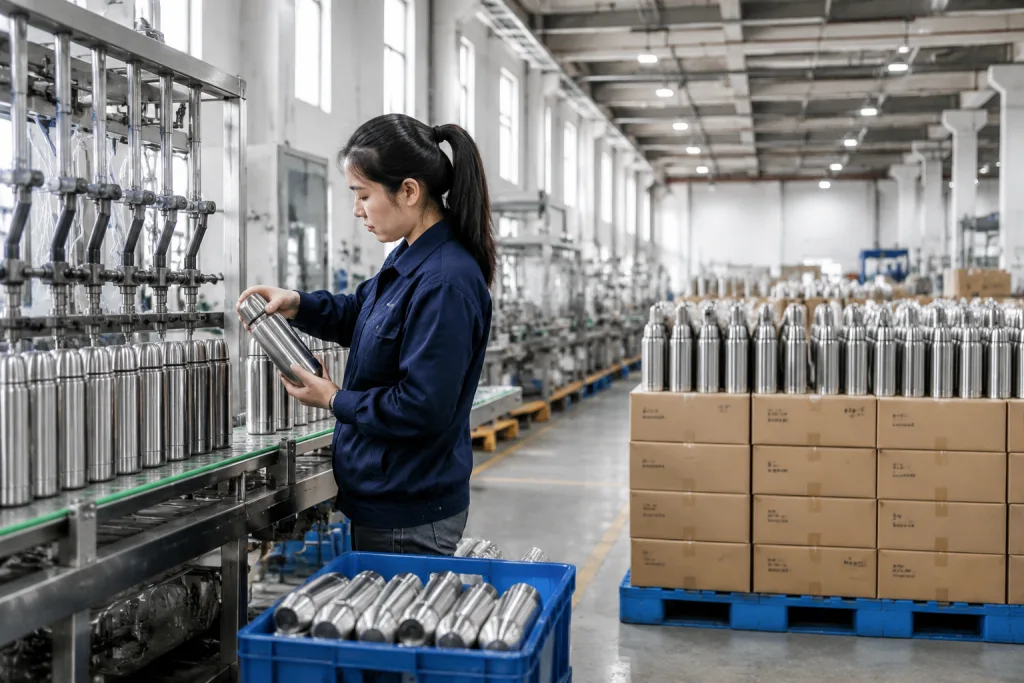
You are not buying a “thermos.” You are buying a repeatable order that has to survive retail shelves, Amazon prep, and end-user abuse without turning into a refund problem. When a buyer asks us for a supplier list thermos bottle, the real question is simpler: which thermos supplier can hold spec, hit the date, and ship 5,000 units a month from China without making you chase every carton? We run that check on the line with a torque test on the lid, because a loose cap turns into a chargeback fast.
For outdoor retailers and promotional brands, the mistake starts with the logo instead of the build. We see the same thing every week in Zhejiang: a buyer wants a custom thermos at a sharp FOB price, then QC pulled the sample and found a leaking stopper, a scratched powder coat, or a carton count off by 2 pcs. That is the wrong question to ask. A proper supplier list thermos bottle order starts with material, capacity, lid type, test standard, MOQ, and QC gate; that is how you turn a one-off inquiry into a steady thermos bulk program.
Start With the Use Case
I’ll rewrite the HTML in place, keeping the tags and structure intact while tightening the sales tone and adding a few factory-floor details.Before you compare supplier thermos options, define the use case like a buyer, not like a marketer. A thermos for hiking is not the same as a promo thermos handed out at trade shows. Outdoor retail usually asks for a tougher powder coat, a lid that does not pop loose in a backpack, and a vacuum spec that holds after 8 hours in a cold room test. Promo buyers care more about print area, carton count, and a lower FOB number. If you skip that split, your supplier list thermos bottle search gets messy fast.
For a standard stainless thermos program, we ask for five inputs: capacity, lid style, insulation hours, finish, and packing method. A 500 ml thermos custom order can run with a straight body and a simple screw cap. A 750 ml retail SKU often needs a handle lid, powder coating, and a matte finish that looks stronger on shelf. QC pulled the sample last week and the buyer flagged the lid torque, not the cup body. If you want a distributor thermos line, keep it tight: one body size, two lid options, one print method. Too many variables turn a clean thermos supplier project into line chaos.
Typical starting point: 500 ml, 18/8 stainless steel, 0.45 mm wall, 6-12 hour hot retention, 1,000 pcs MOQ, FOB Ningbo or Shanghai. That is a normal factory thermos baseline in Zhejiang. We run that spec every week, and it is far easier to source than a fully bespoke shape. The math on a custom mold does not work for a first order.
Pick the Right Build
I’ll rewrite this section in-place, keep the HTML exactly as-is, and tighten the copy so it sounds like a factory-side sales engineer.The build decides whether your custom thermos is retail-ready or just cheap on paper. We run 304 stainless inside and outside on most vacuum bottles, with a vacuum gap that slows heat transfer. For a steady manufacturer thermos, wall thickness usually sits at 0.4-0.5 mm. Go thinner and you save a few cents, but denting and seam failures show up fast. Go thicker and the bottle gets heavy, which hurts hiking packs and commuter bags.
We supply three builds from China all the time: single-wall non-vacuum for basic promo runs, double-wall vacuum for standard retail, and copper-plated vacuum for better heat hold. The copper-plated version costs more, and the math still works if your claim needs real-world retention, because we see about 10-20% better heat performance in test bottles. If you print 12 hours hot and 24 hours cold, QC should pull the sample and check it before the carton run starts. A thermos manufacturer in Zhejiang should give you measured data, not a pretty catalog line.
- Good: 304/304, 0.4 mm, powder coat, PP lid, 6-hour target.
- Better: 304/201, 0.45 mm, threaded lid, silicone seal, 8-12 hours.
- Best: 304/304, 0.5 mm, copper-plated vacuum, premium lid, 12+ hours.
If you are building a supplier list thermos bottle for distributors thermos channels, keep the build spec unchanged across reorders. We’ve seen this go sideways when a buyer accepts a 0.1 mm wall change and the next shipment lands with a different feel, a different weight, and a QC headache. Same spec, same line, fewer surprises.
Lock the Logo and Finish
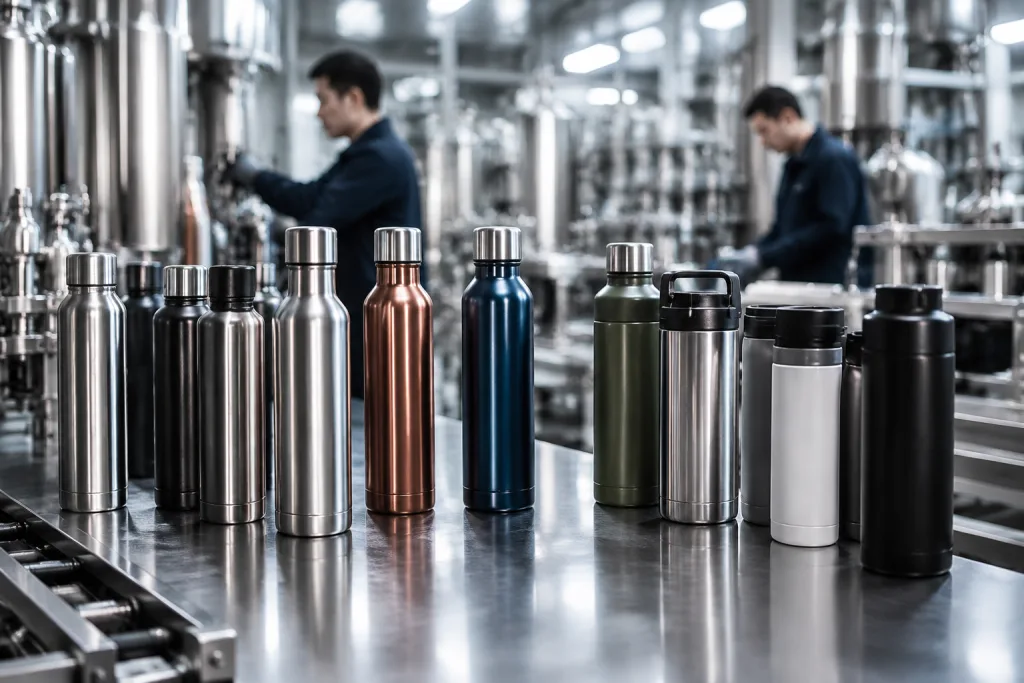
I’ll rewrite the prose in-place, keep the HTML exactly as-is, and tighten the sales-engineer tone with concrete factory detail and cleaner pricing language.Most buyers lowball decoration cost. A plain stainless shell can look premium, but once you add print, laser, or wrap graphics, the process choice drives cost and yield. For a thermos customizable project, silkscreen fits one or two colors and is usually the cheapest route. Laser engraving looks cleaner and holds up better, but it leaves bare metal, which does not suit every promotional thermos campaign. Heat transfer or a full wrap adds setup time and carton handling, so we only push it when the artwork needs that coverage; on the line, the wrap station adds about 18 minutes per carton stack.
As a thermos supplier, we quote decoration apart from construction. That keeps the math clear. A 500 ml thermos bulk order can land at USD 3.10 FOB with one-color print, or USD 3.55 FOB with laser logo and matte powder coating. If you need a customizable thermos with variable names, that is a different workflow and usually adds 5-12 days to production. We had one buyer flag a PO typo on logo position, and QC pulled the sample again because a 20 mm shift made the mark sit off-center. A custom thermos order should state logo placement in millimeters for exactly that reason.
Good decoration is not about more ink. It is about repeatable placement, clean edges, and a finish that survives 30-50 wash cycles without looking tired.
For outdoor retailers, a textured powder coat usually beats glossy paint. For promo brands, a bright Pantone match may matter more than scratch resistance. Choose the trade-off on purpose, not by accident. We run the same 600-grit check on every matte panel before packing, and that catches the weak finishes fast.
Use Factory QC Like a Buyer
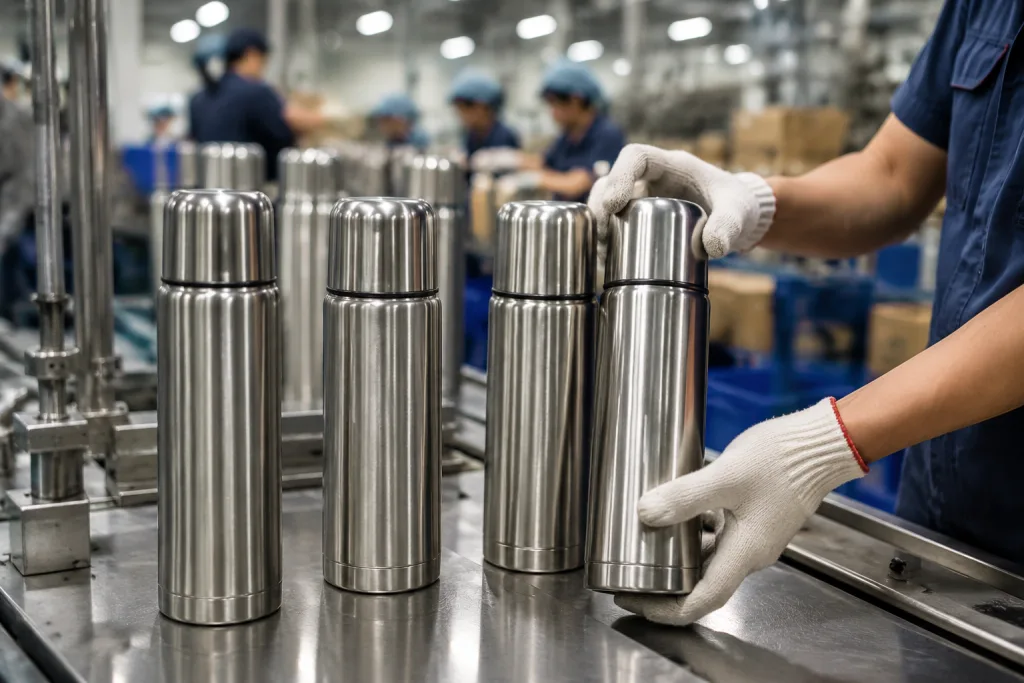
I’ll rewrite the prose in-place, keep the HTML exactly as-is, and make the QC language sound like a factory sales engineer.QC is where a lot of supplier thermos jobs die without noise. A sample can pass hand checks and still leak after shipping. A real factory thermos run should cover vacuum testing, lid torque, leak checks, coating adhesion, and carton drop tests before the first mass shipment leaves. We run AQL 2.5 for major defects and AQL 4.0 for minor defects on consumer drinkware, and we quarantine any lot that repeats the same issue twice.
For a stainless thermos, the checks should stay simple and measurable. Fill the bottle with 95°C water, close it, and check the shell after 10 minutes for heat rise; we use an IR thermometer at the line. Then invert it for 10 minutes and confirm there is no leak at the lid or seepage at the stopper. For export orders, we also ask for REACH coating support and food-contact declarations on the materials. If the buyer asks for the US market, the right question is which component needs ASTM-related support docs, not whether the factory “has compliance.” In Zhejiang, the good thermos makers show test records from QC pulled sample logs, not just a promise.
Practical QC sequence: pre-production sample, gold seal approval, inline inspection at 30%, final random inspection at AQL, then carton drop test at 80 cm. For distributor thermos channels, we also check barcode and carton mark match against the PO; one typo on a case label can stall a warehouse intake for 3 days. We’ve seen that go sideways more than once.
Price the Order Correctly
I’ll rewrite the prose in-place, keep the HTML tags exactly as-is, and tighten the pricing language so it reads like a factory-side sales engineer wrote it.Pricing a bulk thermos order is not just a unit-price game. We run the full landed math: product cost, decoration, inner carton, master carton, testing, freight, and duty. Swap the lid from PP to stainless and the quote can move USD 0.20-0.60 per unit. If you send ten suppliers only the capacity and logo file, you get ten different answers. That is the wrong question to ask. A proper thermos distributor buying round starts with a fixed spec sheet.
For a common 500 ml custom thermos built in China, we usually see USD 2.80-4.20 FOB with a simple screw lid and one-color print. QC pulled a sample last week and the wall thickness came in at 0.38 mm, which is fine for this tier. A more premium 750 ml stainless thermos with powder coating and a better lid often lands around USD 4.80-6.50 FOB. MOQ is usually 1,000 pcs per color or 2,000 pcs split across two colors, though some thermos suppliers in Zhejiang can take 500 pcs if you accept a higher unit cost. Lead time is usually 25-35 days after sample approval; in peak season, we have seen 25 days turn into 40.
If your channel is retail, check case pack efficiency and pallet height first. If your channel is promotional, decoration cost and ship date matter more. Ask the manufacturer thermos team to quote EXW, FOB, and door-to-door options in one sheet. We once caught a PO typo on carton count that changed the booking math by 18 cartons, and the buyer flagged it before sailing. Without side-by-side terms, a low quote turns into a surprise at booking.
Build a Supplier List That Works
I’ll rewrite the three paragraphs in place, keeping the HTML tags and the section structure intact while making the copy sound like a factory-side sales engineer wrote it.A real supplier list thermos bottle is not a spreadsheet full of names. It is a short list with proof. We start with three buckets: thermos factory, thermos manufacturer, and thermos vendor capability. Then we cut by what they actually run on the line, not by what they say in a catalog. A plant that does 500ml promotional cups with simple pad print is not the same shop that holds coating color within 0.5 mm on retail vacuum bottles. Put the wrong supplier thermos against the wrong channel, and the math does not work.
Here is the order I recommend. First, check factory profile and monthly capacity; a stable Zhejiang facility should show 300,000-500,000 units per month across drinkware lines. QC pulled the sample on one run and found a lid gap outside spec at 1.2 mm, so numbers alone never close the deal. Second, ask for sample photos, test reports, and export history to Europe or North America. Third, request a live spec sheet with materials, wall thickness, lid BOM, and carton dimensions. Fourth, confirm whether they can customize without pushing MOQ too high. A good thermos manufacturers short list is usually 3-5 factories, not 20.
For outdoor retailers, you need a thermos custom program that can reorder the same SKU in six months without a color drift or cap change. For promo brands, you want a thermos promotional supplier that can hit the ship date even when the order lands in peak season. We’ve seen this go sideways when the buyer flagged a PO typo on the carton count and the whole line had to stop for one day. In both cases, Zhejiang and the broader China supply base are strong when the spec is locked. Loose spec means loose quality.
Send your thermos spec and get a factory quote
We’ll review your drawing, confirm MOQ, and quote a stable China production plan with QC checkpoints and realistic lead time.
Frequently asked questions
What MOQ should I expect for a supplier list thermos bottle order?
For a standard stainless thermos, the normal MOQ is 1,000 pcs per SKU and often 500 pcs per color if the factory is flexible. If you want multiple print positions, special lids, or a thermos customizable finish, MOQ usually rises to 2,000 pcs. In Zhejiang, some factories can sample faster, but production MOQ still matters because vacuum lines and coating lines are set up in batches. If a thermos supplier offers 100 pcs at a very low price, check whether the spec is truly retail-grade or just a simple promotional thermos build.
How much does a custom stainless thermos cost FOB China?
For a basic 500 ml custom thermos, expect roughly USD 2.80-4.20 FOB China. A better 750 ml stainless thermos with powder coating, improved lid, and one-color logo often lands at USD 4.80-6.50 FOB. Laser logo, copper-plated vacuum, or gift packaging can add USD 0.20-1.20 per unit. Prices from China vary by steel grade, lid BOM, and carton spec, so ask each thermos manufacturer to quote the same drawing and same packing list. Otherwise, the lowest quote is usually missing something.
What tests should I require before shipment?
At minimum, ask for leak testing, vacuum retention testing, lid torque testing, coating adhesion, and carton drop testing. For export orders, request AQL 2.5 inspection on major defects and photo records of the final lot. A proper factory thermos supplier should also provide material declarations and, where needed, REACH-related support for Europe. If your buyer is an outdoor retailer, add thermal performance testing at 95°C fill temperature and check it at 6, 8, and 12 hours. That keeps the thermos supplier accountable to a number, not a slogan.
Can I combine different colors in one order?
Yes, but watch the MOQ and setup cost. Most thermos suppliers in China allow 2-4 colors if each color is at least 500 pcs, though the total order may need to reach 1,000-2,000 pcs. If you are ordering a bulk thermos program for a distributor, the safest approach is one body, one lid, and two finish colors. More variations increase risk in coating matching, carton labeling, and inventory control. In Zhejiang factories, color splits are easy only when the spec stays stable.
What is the best way to choose between silkscreen and laser engraving?
Choose silkscreen if you need a lower-cost promotional thermos with 1-2 logo colors and a strong visual hit. Choose laser engraving if you want a permanent mark that will not wear off after repeated washing. Laser is usually a little more premium and may add USD 0.10-0.35 per unit depending on logo size and machine time. For a retailer thermos line, laser on powder coat can look clean and durable. For a thermos promotional campaign, silkscreen is usually faster and more economical.