Key Takeaways
- Set AQL at 2.5 major and 4.0 minor, with 100% leak testing for lids before packing
- For PP shaker bottles, specify food-grade PP, LFGB or FDA contact compliance, and 0.9-1.2 mm wall thickness
- A realistic China factory lead time is 25-35 days after sample approval for 5,000-20,000 units
- Do not approve mass production until logo adhesion passes tape test, rub test, and 20-cycle wash test
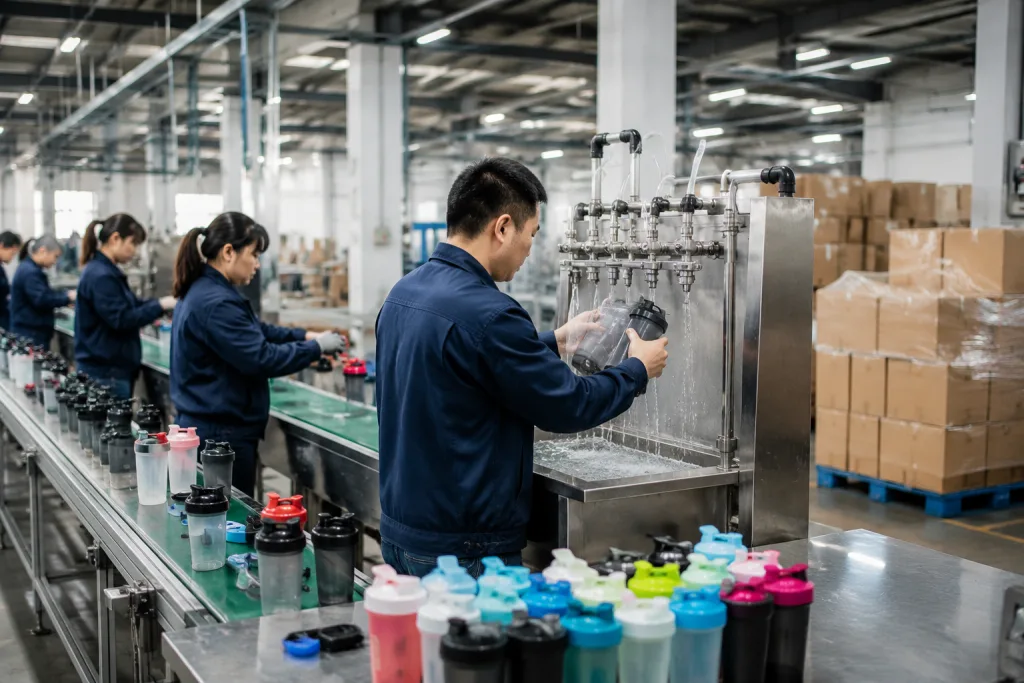
A supplier list shaker bottle project usually starts with a spreadsheet: price, MOQ, capacity, logo method, lead time. Clean enough. Then the first carton lands with a lid that seeps at 45° tilt, a cloudy cup wall, a mixing ball that rattles loose, or a logo that starts peeling after 20 dishwasher cycles. For fitness brands and gym chains, this is not a cheap giveaway. It lives in lockers, cars, supplement bags, and post-workout photos. If it fails, the member blames your brand, not the factory in China.
At BottleForge Industrial in Hangzhou, Zhejiang, we see the same avoidable failures in bulk shaker bottle and custom sports water bottle orders. The problem is usually not the line. It is loose specs, no pre-production sample, and QC checking only the print, not the leak test or cap torque. We run a 2.0 mm wall cup on one line and a 5,000-piece MOQ on another, so we know where the weak spots show up. Build the supplier list, RFQ, and inspection sheet like the bottle will get tossed in a gym bag every day, because that is the right question to ask.
The spreadsheet hides the risk
I’ll rewrite the section in place, keeping the HTML tags and list structure intact while tightening the sales-engineer voice and adding concrete shop-floor detail.A supplier list shaker bottle search can pull in 40 factories and trading companies in one afternoon. The trap is simple: most quotes look alike until you ask how the bottle is made. A 700 ml PP shaker at USD 0.85 FOB Ningbo and a USD 1.18 version can sit in the same PDF, but the cheaper one may run thinner resin, a looser thread tolerance, and a lid hinge that snaps after 300 open-close cycles. We’ve seen that go sideways on the line.
For a fitness chain ordering a bulk fitness water bottle for new member packs, the failure shows up fast. Staff hand out 10,000 pieces in three weeks, then the front desk starts logging complaints. For a distributor shaker bottle program, the damage moves slower but costs more: retailer returns, credit notes, and stock that cannot be resold. The buyer flagged the cap leak, and QC pulled the sample with a 0.3 mm mismatch on the thread.
Your supplier list should rank production control, not just price. Ask each China supplier for these numbers before you shortlist them:
- Monthly capacity: a real sports bottle factory should state line capacity, such as 300,000-600,000 units/month, not “large capacity.”
- MOQ by decoration: plain color may start at 1,000 pcs, while custom Pantone resin and custom logo shaker bottle runs often start at 3,000-5,000 pcs.
- Food contact documents: FDA, LFGB, EU 10/2011, or REACH reports must match the material and component, not a random bottle from 2019.
- QC method: AQL level, leak test method, torque checks, and drop test height should be written, not promised on a call.
Our Zhejiang team is blunt on this point: if a supplier cannot answer basic process questions in numbers, leave them off the approved list. The math does not work. We once got a PO with “custome shaker botle” typed three different ways, and the factory still had to stop and confirm the 5,000 pcs spec before cutting tooling.
Leakage starts at the thread
I’ll rewrite the section in-place, keeping the HTML structure and the exact technical numbers intact, while making it sound like a factory-side sales engineer wrote it.The most common complaint in a bulk gym water bottle or bulk sports water bottle order is leakage. Buyers usually point at the silicone gasket, but the leak often starts earlier: thread shrinkage, cap warpage, weak hinge design, poor gasket compression, or flash left on the sealing face. We see this on the line all the time.
For a customized shaker bottle, put the sealing system in the RFQ. Do not write “leakproof lid” and expect 3 factories to read it the same way. State the lid type, gasket hardness, test angle, and test time. A clean shop-floor spec for gym channels is simple: fill to 90% capacity, close the cap at normal hand torque, shake vertically for 30 seconds, invert for 10 minutes, then check for droplets. For premium retail or supplement bundles, add a 1.2 m drop test on 3 faces after filling to 80%. QC pulled the sample, and that saved us from a bad PO typo once.
Thread tolerance matters more than buyers think. PP and Tritan-style copolyester shrink differently during cooling, and if mold temperature moves around, the bottle mouth can ovalize by 0.2-0.4 mm. That is enough for a slow leak in a sports bag. Ask the supplier to measure mouth outer diameter, thread height, and cap engagement on first articles, then every 2 hours during production. The math does not work any other way.
For a custom gym water bottle with a flip cap, the hinge is another weak point. A thin hinge may pass sample approval and still split after repeated use. Request an open-close cycle test of at least 1,000 cycles for normal promotional orders and 3,000 cycles for paid retail merchandise. This is the wrong question to ask if someone says that is overkill. Gym members open the lid with sweaty hands, drop it on rubber flooring, and toss it into bags with keys and a phone charger.
Leakproof is not a marketing word. It is a test condition with water level, shaking time, angle, temperature, and acceptance criteria.
Plastic problems you cannot see
I’ll rewrite the prose only, keep the HTML exactly as-is, and make the section sound like a factory-side sales engineer wrote it.Material failure is harder to catch than a crooked logo because the first sample can look clean. We’ve seen a PP shaker pass visual check and then go cloudy, smell oily, or warp after hot washing. A clear custom made shaker bottle can also scratch fast if the resin grade is loose. For Europe and North America, ask for written food-contact compliance on every part: cup body, lid, gasket, mixing ball, strainer, and printing ink.
For PP shaker bottles, ask for food-grade polypropylene with a typical wall thickness of 0.9-1.2 mm for 600-800 ml capacity. Below 0.8 mm, the cup feels thin and starts to deform when squeezed on the line. For stainless mixing balls, specify 304 stainless steel, wire diameter around 0.7-0.9 mm, and no sharp burrs. For silicone gaskets, ask for odorless food-grade silicone, usually 50-60 Shore A hardness, depending on the groove design.
If you are sourcing a customizable sports water bottle for a gym chain, temperature claims have to be real. PP is not a boiling-water bottle. A buyer once flagged “dishwasher safe” on a PO, but the supplier never said rack position, wash temperature, detergent, or cycle count. If your members expect machine washing, require a 20-cycle dishwasher simulation at 65-70°C and check deformation, odor, logo loss, and cap fit after the run.
For a bulk shaker bottle used in supplement sampling, odor control is the make-or-break point. Protein powder residue does not forgive weak resin or rough polishing. Ask for smooth internal surfaces, no deep ejector marks inside the cup, and a cleaning test with warm water and neutral detergent. We ship this kind of check from real production resin, not showroom stock, and that is the right standard. A Zhejiang or Guangdong factory should know the difference.
Logo failures are usually rushed approvals
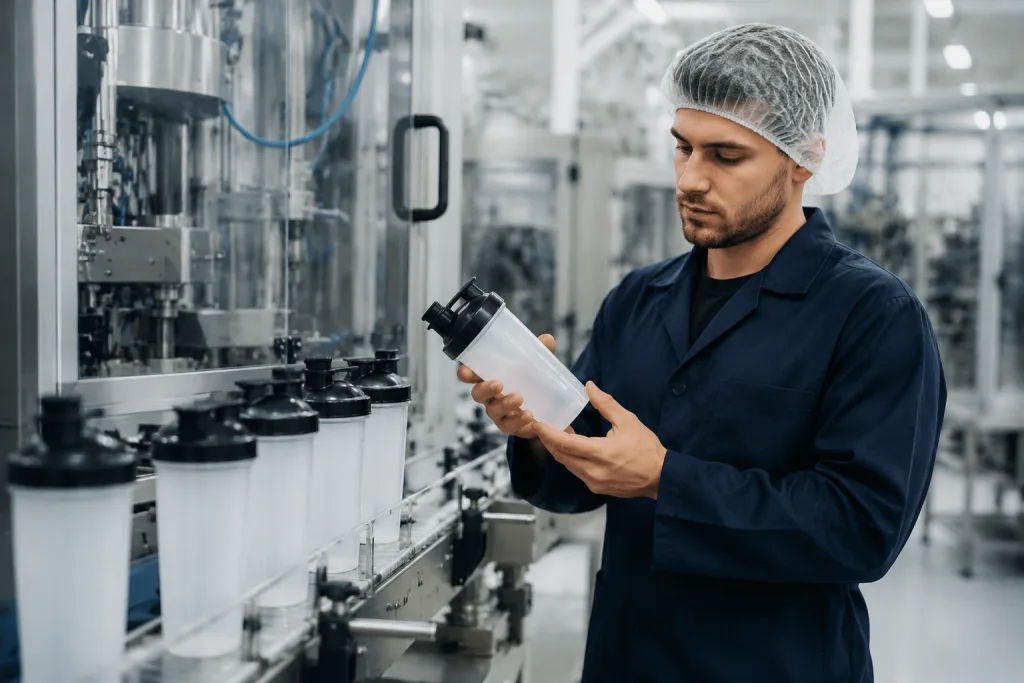
I’ll rewrite the section in-place, keep the HTML exactly as-is, and tighten the sales-engineer tone while adding a few concrete factory details.Fitness brands care about logo sharpness, and they should. Logo durability matters more than the first photo. We have seen a custom logo shaker bottle pass desk approval and then fail after sweat, detergent, abrasion, and stacking. The usual trouble shows up as ink peeling, laser engraving cut too shallow, color shift, or print position walking on the curved body. QC pulled a sample once and the logo had already lifted at the edges after 18 wash cycles.
Pick the decoration method by use case and budget. Silk screen printing is cost-efficient for one or two colors on PP, usually adding USD 0.05-0.12 per unit depending on size and quantity. Heat transfer handles gradients, but the adhesion test has to be tight. Laser engraving fits stainless steel parts, not standard PP bodies. Pad printing works on lids or small curved areas, though a big logo can look thin. This is the wrong question to ask if the artwork is still changing every week.
For a customized gym water bottle or distributor fitness water bottle program, send vector artwork and define the logo size in millimeters, not “large front logo.” Use a spec like this: front logo 55 mm wide, centered 80 mm from the bottle base, Pantone 186C, tolerance plus or minus 2 mm. If you want a wrap print, ask whether the factory runs a rotary screen machine or manual alignment. Manual wrap work is where drift and overlap issues show up. We’ve had a PO typo for “58 mm” instead of “85 mm,” and the buyer flagged it before the line started.
Approve a pre-production sample from the same material, same surface texture, and same ink system planned for bulk production. Then require three checks:
- 3M tape test: cross-cut or firm tape pull after 24 hours curing, with no visible ink lift.
- Alcohol rub test: 50 cycles with 75% alcohol on printed area for gym sanitation exposure.
- Wash test: 20 warm-wash cycles, then check fading, peeling, and tackiness.
For a custom fitness water bottle sold as merchandise, take the extra few days on these tests. Reprinting 12,000 defective bottles is not a real option; the math does not work once freight, packaging, and launch deadlines are locked. We ship to that timeline all the time, and the QC gauge on the table does not care about excuses.
Packaging breaks before bottles do
I’ll rewrite the section in place, keep the HTML exactly as-is, and tune the prose to sound like a factory-side sales engineer.Most distributors buying gym water bottles stare at the bottle spec and forget the carton. That is where the trouble starts. We’ve seen good shaker bottles show up scuffed, dented, or with lids rubbed by the next unit over because the pack-out was weak. In bulk sports water bottle shipments, cartons get beaten up at the line, during loading, at the port, in the warehouse, and again if the order goes into parcel networks.
For plain wholesale, a polybag plus export carton is often enough. For retail shelves, we run a color box, barcode, warning label, and SKU carton marks. For e-commerce or member welcome kits, an individual kraft box cuts scuffing, but the math changes fast: a plain polybag can add USD 0.015-0.03 per unit; a printed color box can add USD 0.12-0.30, depending on board grade and print area. QC pulled a sample once with a 1.5 mm rub mark on the cap ring, and the buyer flagged it immediately.
Set the carton strength up front. For most 600-800 ml plastic shaker bottles, a five-layer corrugated export carton is safer than a thin three-layer carton, especially for sea freight. Ask for carton gross weight under 15 kg when possible. Heavy cartons get manhandled. We’ve seen crushed corners after 30-40 days on the water from China to Europe or North America, and no amount of wishful thinking fixes that.
If you need FNSKU labels, retail barcodes, or gym-chain DC labels, put that in the RFQ on day one. Labeling after production can add 3-5 days, and relabeling in a bonded warehouse is not cheap. For a distributor sports water bottle program with four colors, ask for color-coded outer carton marks and a packing list by SKU. Mixed cartons sound efficient, but the buyer typo on the PO is all it takes for picking errors to snowball.
Drop test the master carton before you approve the pack plan. Drop it from 60 cm on one corner, three edges, and six faces. Then check bottle scuffing, cap cracks, and box deformation. If the pack cannot survive that on the floor, it will not survive the container. Simple as that.
Inspection must test function
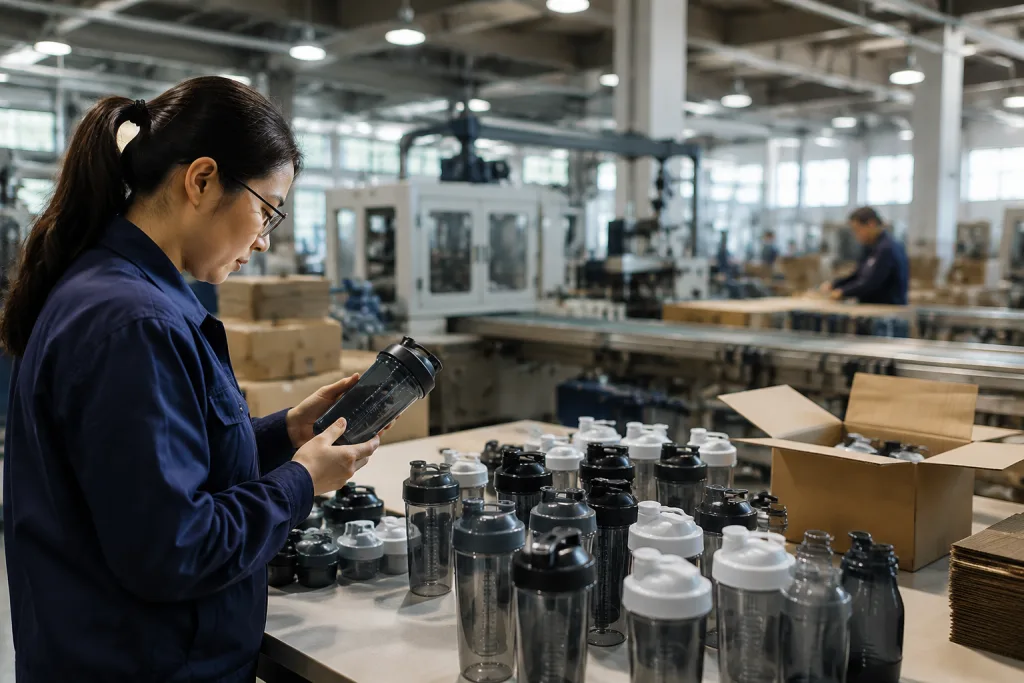
I’ll rewrite the section in place, keep the HTML structure unchanged, and sharpen the language so it reads like a buyer-side inspection note from the factory floor.AQL inspection works only when the checklist matches the real failure modes. A lot of customizable shaker bottle inspections stop at scratches, dust, color spots, and logo position. Those matter, but they miss leaking caps, weak hinges, poor gasket fit, and lids that cross-thread. We’ve seen that go sideways on the line.
For most bulk gym water bottle orders, use General Inspection Level II with AQL 2.5 for major defects and 4.0 for minor defects. Critical defects, including unsafe burrs, contamination, wrong food-contact material, or severe leakage, should be 0 acceptance. On top of sampled inspection, require 100% factory leak testing at the lid assembly station. QC pulled the sample, filled it with 300 ml of water, and found the issue in 12 seconds. Leakage is the complaint that comes back first.
Your QC checklist should split defects cleanly:
- Critical: sharp metal burr, foreign matter inside bottle, wrong material, chemical odor, cracked body, severe leak.
- Major: cap does not close, logo peeling, wrong color, missing gasket, incorrect capacity marking, barcode unreadable.
- Minor: light scuffing, small color speck, slight print position shift within agreed tolerance.
For a custom shaker bottle order from our Hangzhou, Zhejiang supply base, our normal flow is incoming resin check, first-article approval, in-process inspection every 2 hours, 100% leak test after lid assembly, and final AQL before carton sealing. A normal MOQ is 3,000 pcs per color for custom color PP, with 25-35 days mass production after approved sample and deposit. For a 50,000 pcs gym chain rollout, the buyer flagged it early, and we split the run into two shipments instead of forcing one tight batch.
Do not let the factory set all acceptance rules after the goods are finished. Put the inspection table in the purchase order. If the PO only says “good quality,” the math does not work when 8% of caps leak.
Build the supplier list correctly
I’ll rewrite the section in place, keep the HTML exactly as-is, and tune the wording so it sounds like a factory-side sales engineer rather than generic copy.A solid supplier list shaker bottle process is not about chasing the lowest five quotes. It is about cutting out factories that cannot hold your risk. A supplement brand buying a bulk shaker bottle cares about odor after protein powder, cap seal under pressure, and screw-thread consistency. A gym chain ordering a customizable gym water bottle for member onboarding cares about logo repeatability, quick replenishment, and carton marks by club code.
Start with a short technical RFQ. Put the capacity, material, lid style, mixing component, decoration method, color target, packaging, test standard, compliance market, annual forecast, and first order quantity on one sheet. If you want a custom made shaker bottle mold, ask for tooling cost, cavity count, steel grade, sample lead time, and who owns the tool. We ran one mold at 40 days to T1 and the steel was P20, not the 718 the buyer expected; that kind of surprise kills trust. If a supplier throws out “free mold” on a complex design, the math does not work—someone is paying for it somewhere.
For distributors shaker bottle programs, press on repeat-order control. Will the second run match the first Pantone chip? Is the same mold locked for your program? Are print screens tagged and stored on the rack? Can the supplier hold 2-3% spare parts like lids and gaskets? QC pulled a sample once and found a 1.2 mm flash on the cap ring; that sort of miss becomes a returns headache when you support retailers for 12 months.
For gym chains, ask about logistics. FOB Ningbo or Shanghai is the normal route from Zhejiang and the nearby China production belt. Air freight works for a rushed club opening, but we’ve seen it cost more than the bottle on a 700 ml plastic custom sports water bottle. Carton size drives the freight bill fast. Ask for the outer carton dimensions before you place the PO, or you will get burned on landed cost.
The best supplier is not the cheapest. It is the one that tells you where the bottle can fail, writes the control points down, and lets you check them before mass production starts.
Send your shaker bottle RFQ for a factory review
Share capacity, material, logo artwork, MOQ, and target market. Our Zhejiang team will check the risk points before you place bulk orders.
Frequently asked questions
What MOQ should we expect for a custom logo shaker bottle?
For an existing mold with standard PP colors, a realistic MOQ is often 1,000-3,000 pcs per design. If you need custom Pantone resin, most factories in China will ask for 3,000-5,000 pcs per color because resin mixing and machine setup create waste. For a custom made shaker bottle with new tooling, the first order is usually 5,000-10,000 pcs to make the mold cost sensible. Decoration also changes MOQ. One-color silk screen printing is easier at low quantity; wrap print, gradient transfer, or special packaging raises setup cost. For gym chains, we usually suggest testing 3,000 pcs first, then moving to 10,000-50,000 pcs once lid fit, logo durability, and member feedback are confirmed.
How long does production take after we approve samples?
For an existing customizable shaker bottle mold, mass production normally takes 25-35 days after sample approval, deposit, and final artwork confirmation. Add 5-7 days if you need custom resin color matching, and add 7-10 days for complex retail packaging. A new mold changes the schedule: expect 30-45 days for first mold samples, then another 10-15 days for adjustment if the thread, lid fit, or surface finish needs correction. Sea freight from China to Europe or North America can add roughly 25-45 days depending on port pair and season. If you have a gym opening date, work backward from the in-hands date, not the factory ship date.
Which material is better for bulk gym water bottle programs?
For price-sensitive bulk gym water bottle programs, food-grade PP is usually the practical choice. It is light, durable, and cost-efficient for 600-800 ml shaker bottles. For a clearer premium look, copolyester can work, but the unit price is higher and scratch resistance must be checked. Stainless steel is better for insulated sports bottles, not classic protein shakers unless you accept a higher cost and different user experience. For PP, specify 0.9-1.2 mm wall thickness, odorless food-grade resin, and compliance for your sales market such as FDA or LFGB. If you claim dishwasher safety, test at 65-70°C for 20 cycles before printing that claim on packaging.
How do we compare suppliers beyond unit price?
Ask each supplier for the same RFQ and compare measurable answers. You want FOB price, MOQ, lead time, monthly capacity, material grade, compliance reports, logo method, packaging cost, defect policy, and AQL standard. A serious supplier should explain how they test leakage, how often they measure thread dimensions, and whether lids are leak-tested 100% before packing. Check whether they are a factory or trading company, but do not stop there; some factories are weak at export documentation, and some trading teams manage QC well. For a distributor sports water bottle program, also ask about repeat color control, spare lids, barcode handling, and carton labeling. The lowest quote is risky if it hides missing tests.
Can one supplier handle shaker bottles and sports water bottles?
Yes, but verify the production base. A factory strong in PP shaker bottles may not produce stainless vacuum bottles in-house, and a stainless bottle factory may outsource plastic shaker bodies. That is not automatically bad, but you need transparency. If you plan to source a custom shaker bottle, custom fitness water bottle, and customized sports water bottle from one partner, ask which items are made in their own workshop and which are subcontracted. Then require the same QC standard across all SKUs: AQL 2.5/4.0, food-contact reports, logo adhesion tests, and carton drop tests. For brand consistency, also align Pantone colors, logo placement rules, and packaging structure across the full gym merchandise range.