Key Takeaways
- A usable supplier list outdoor canteen should filter for MOQ 3,000–5,000 pcs, 35–45 day lead time, and test reports before price.
- Most failures come from 5 points: sealing, coating, print adhesion, carton compression, and inconsistent 304 steel thickness.
- For stainless canteens, specify 0.4–0.6 mm wall thickness, 18/8 steel, and thread gauge checks on every batch.
- A serious Zhejiang canteen manufacturer should support AQL 2.5 inspection, REACH/food-contact compliance, and 100,000+ units/month output.
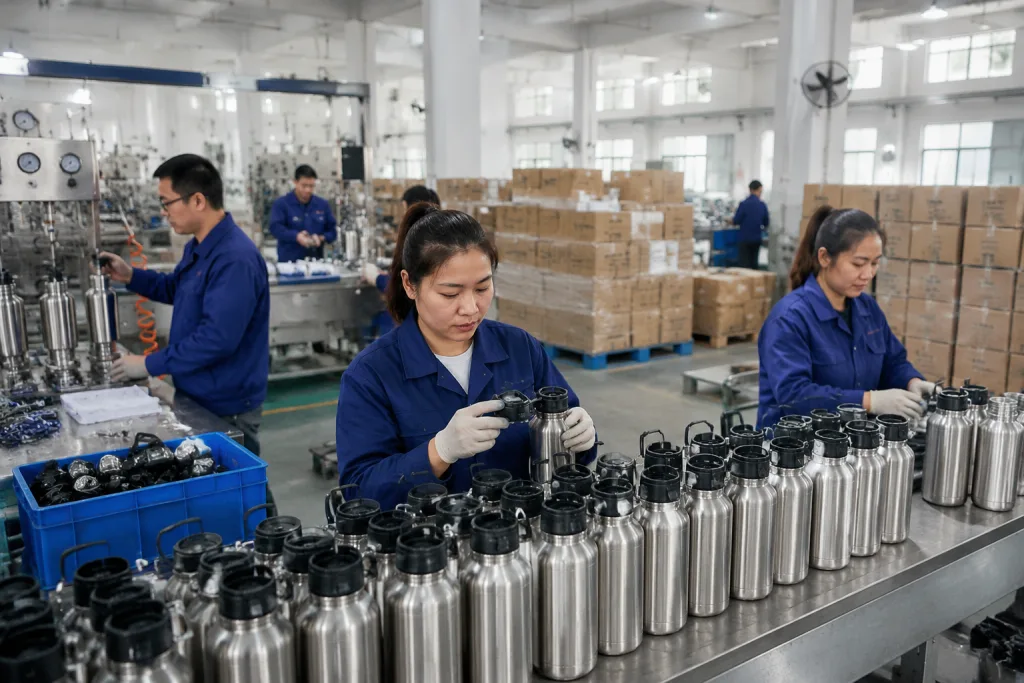
You are not buying a bottle. You are buying an outcome on the line. If your supplier list outdoor canteen comes only from glossy catalogs, the first PO usually shows the weak spots: a leaking cap, a print that shifts by 1.5 mm, a dent picked up in transit, or a supplier that goes quiet when you ask for test reports. In Zhejiang, we see this every season. The sample passes, then the mass run fails on threads, coating, or carton packing.
The better way to source a custom drinkware program is to work backward from failure points. A good canteen factory should tell you where a custom canteen can crack in production, how they control it with torque checks and drop tests, and what happens if AQL 2.5 finds defects. This is the real split between a canteen supplier and a manufacturing partner in China. Anything else is just a quote sheet, and the math does not work.
What Usually Breaks First
I’ll rewrite this section in-place, keep the HTML exactly as-is, and strip the AI-ish phrasing while making it sound like a factory-side sales engineer wrote it.Most canteen orders do not blow up in a dramatic way. We see a cap seep, a flat finish that looks off under light, or a body that drifts enough to jam on the capping head. On our line, a 0.3 mm neck change is enough to create trouble. That is why the first check should be failure mode, not catalog photos. A canteen manufacturer that really handles customized drinkware will talk about tolerance, thread fit, and test data before decoration.
The common failure points on an outdoor canteen are simple to name, and costly to miss:
- Seal failure: cap liner hardness and thread pitch do not match after thermal cycling.
- Surface failure: powder coat or spray paint chips after a 1.0 m drop test.
- Print failure: logo rubs off after 50–100 abrasion cycles.
- Dimensional drift: neck finish varies by 0.3–0.5 mm, breaking closure fit.
- Transit damage: inner packaging is too weak for export carton stacking.
If you need a customizable canteen or canteen customized for retail, promotions, or distributor packs, ask which of these five checks run in-house. QC pulled the sample on a 600 ml body last week and found the cap liner failed after thermal cycling, so this is not a theoretical list. The buyer flagged it, and the math does not work if the factory cannot show where the control sits. In China, the factory that answers cleanly usually has the process; the one that talks around it is often a trading company, not a true canteen factory.
Sealing Problems Cost The Most
I’ll rewrite the section in-place, keep the HTML structure intact, and tighten the prose so it sounds like a factory-side sales engineer.Leakage is the fastest way to turn a low-cost canteen into a chargeback. We’ve seen a cap pass appearance check and still fail on the line because the gasket was 0.3 mm thin or the neck finish was cut off-center. This matters even more for a custom canteen used in hiking, camping, or sporting channels, where the bottle gets shaken, dropped, and stored sideways.
Specify the closure like an engineer, not like a shopper. For a stainless outdoor canteen, ask for:
- Thread tolerance: no more than ±0.15 mm on the mating dimensions.
- Liner material: food-grade silicone or TPE, with a recorded compression set result.
- Torque range: define tightening force in N·m for manual or automatic assembly.
- Leak test: 30 minutes inverted at room temperature, then repeat after 24-hour hot/cold cycling.
A decent canteen supplier in Zhejiang should have a cap torque tester, a vacuum leak tank, and basic thermal cycling in QC. If they do not, the math does not work. You are not buying customizable canteen production; you are buying hope. Ask for the reject rate from the last 3 orders. If the buyer flagged a typo on the PO, fix it early; bad paperwork and bad caps usually show up together. If the answer is “0.8% on caps, 1.2% on liners,” you are talking to someone who actually measures.
For export orders, leakage defects above 0.5% usually become a profit problem, not a quality problem.
Decoration Fails After Production
I’ll rewrite the three paragraphs to sound like a factory-side sales engineer, keep the HTML exactly as-is, and make the language tighter with a few concrete shop-floor details.Logo decoration is where a lot of canteen promotional orders go sideways. The sample passes, then the mass run shifts shade, loses register, or starts peeling after packing. We’ve seen the buyer flag it on day 3 of a 5,000-piece run because the surface wipe was rushed and the cure oven sat 10°C low. For customized canteen work, decoration is part of the spec, not a last-step add-on.
Pick the method for the actual use case. Screen print fits a 1-color logo. Laser engraving is the better call on stainless steel. Heat-transfer and full-wrap graphics work too, but only if the coating and cure profile stay steady. If you source from a canteen vendor or canteen distributor, ask how they check adhesion. A cross-hatch tape test alone is too weak for export orders. We run abrasion tests, alcohol rub checks, and a 48-hour cure hold before the cartons move to packing.
For bulk custom drinkware, I would not take a supplier who cannot state the ink brand, cure temperature, and minimum cure time. On one PO, the buyer typed the logo size as 35 mm, then sent art at 28 mm; QC pulled the sample and the print had to be reset. In Zhejiang, a solid factory will usually offer print, laser, and embossing based on the product line. If your channel is retail, ask whether the finish can hold a UPC or FNSKU label without edge lift. That is not a small detail once warehouse scanning starts failing units.
Steel Grade And Wall Thickness
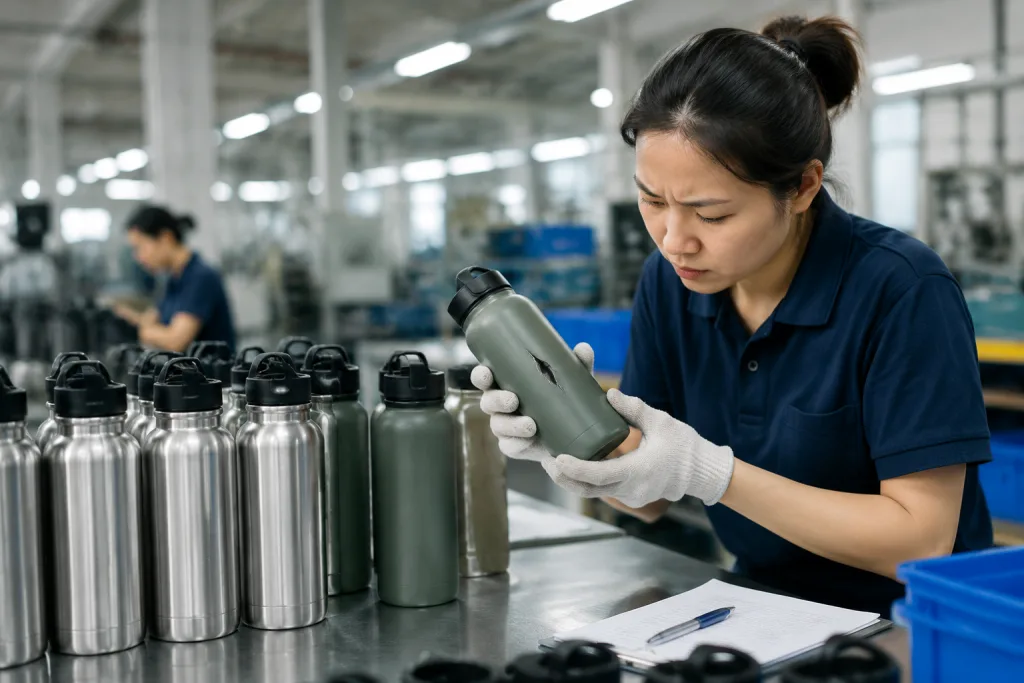
I’m rewriting the prose only, keeping the HTML structure and the existing tags intact. I’ll tighten the sourcing language, add a few factory-floor details, and avoid the AI-style filler the same way we’d brief a buyer on a real spec sheet.Material shortcuts are where outdoor canteen orders go wrong. We have seen a canteen pass the eye test with thin steel and mixed lots. A 0.35 mm body dents in carton drop tests, while 0.7 mm adds dead weight and cost with no payoff. For most stainless programs, 0.4–0.6 mm wall thickness is the range we run, depending on bottle size and whether it is single-wall or insulated.
Ask for the steel grade, not a brochure line. For food-contact stainless, 18/8 or 304 is the normal spec. If you want lower magnetic pull or cleaner corrosion resistance, the mill cert has to match the claim. A real canteen manufacturer will show incoming coil checks, thickness sampling with a micrometer, and weld seam inspection at the line. In a supplier list outdoor canteen search, that is the quickest way to spot factory-direct supply versus a trading desk.
For a custom growler or customizable growler program, the same rule applies. Weight, seam quality, and neck finish decide how long the bottle lasts in the field. We have had buyers flag a PO typo on unit weight, then the sample came in 32 g heavier and the math did not work. If you are buying customized drinkware for distributors, compare grams per unit across factories; a 25–40 g gap usually means different steel usage or a different build.
Packaging Fails In Transit
I’ll rewrite the section in place, keeping the HTML tags and structure intact while making the prose sound like a factory-side sales engineer wrote it.We have seen buyers lock onto the bottle and ignore the carton. Then the cans land scuffed, dented, or crushed because the pack was built for shelf photos, not export freight. With outdoor canteens going to Europe or North America on mixed pallets, that mistake shows up fast. A 2% factory defect rate can become an 8% claim rate once the outer box gives up.
Spec packaging from the bottom up:
- Inner protection: choose an individual polybag, sleeve, or molded tray based on finish sensitivity and the 304 stainless surface.
- Drop target: run a 1.0 m drop on 3 faces, 3 edges, and 1 corner before you sign off the sample.
- Carton strength: set the ECT or burst strength to match export stacking, not just local truck delivery.
- Master pack count: keep the count fixed for warehouse handling, FBA splits, and retail carton checks.
If you work with a canteen supplier in China, ask for carton compression data and pallet pattern photos. A serious canteen factory in Zhejiang will know how the line holds up after 35 days on sea freight and will push reinforcement if your route is hot, humid, or both. We ship this every week, and the buyer flagged it once a PO typo changed the master pack count by 12 pcs. For distributor programs, the packaging needs to survive forklift hits and re-handling in two or three warehouses, so the wrong question is whether the bottle passed alone. You need a packaging sample, not just a product sample.
How To Build A Real Supplier List
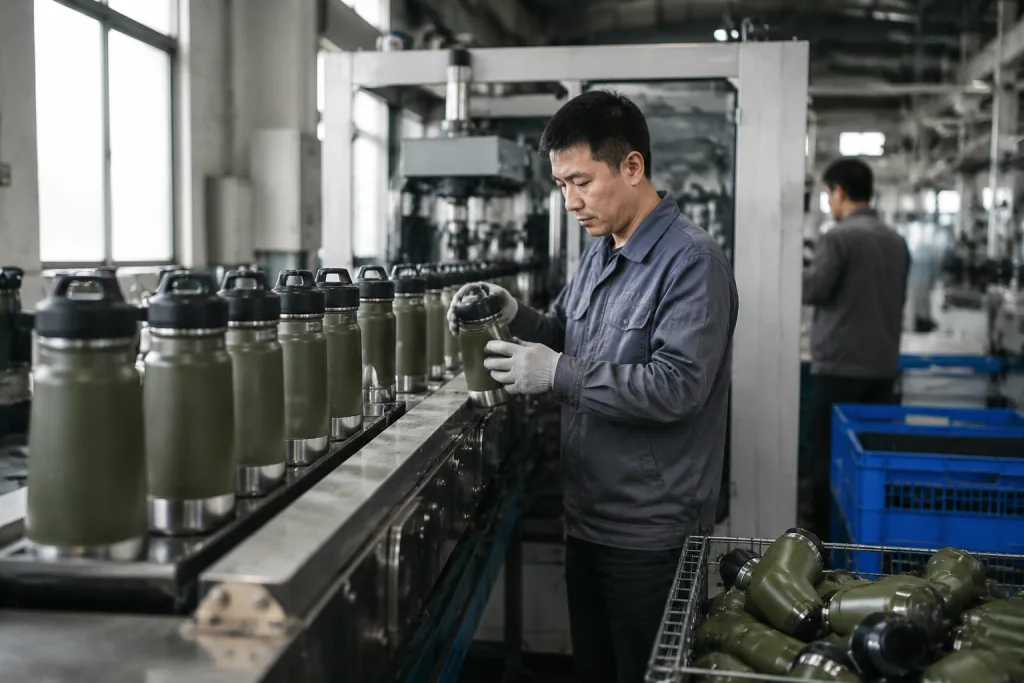
I’ll keep the HTML exactly as-is and rewrite only the prose, with tighter buyer-language and a few factory-floor specifics baked in.A useful supplier list is not a phone book. It is a production shortlist with filters. Start with factories that can show capacity, compliance, and QC gear. For a mainstream outdoor canteen program, we would want a canteen factory in China with at least 100,000 units/month monthly output, MOQ 3,000–5,000 pcs per SKU, and a standard lead time of 35–45 days after sample approval. On the line, we run a torque check on caps and a leak test on random pulls; if a supplier cannot quote those numbers straight, they are not set up for repeat orders.
Your screening questions should be blunt:
- Can you show REACH, food-contact, or LFGB papers for this material?
- Do you inspect to AQL 2.5 for major and minor defects?
- Do molding, welding, printing, and packing stay in-house, or do you pass them out?
- Can you handle OEM artwork, barcodes, and retail carton specs without back-and-forth?
That is how you separate canteen suppliers from canteen distributors and from factories that only take OEM work when the schedule is slow. If you are buying canteen custom or canteen customizable stock for private label, ask for sample sign-off, golden sample retention, and a written defect list before you place the PO. QC pulled the sample, the buyer flagged one typo on the carton, and we fixed it before mass run; that is the kind of control that keeps a program clean. China has plenty of capacity. The math only works when process control is real.
Send your canteen spec for a real quote
We can review material, closure, decoration, and packaging together, then quote a China-made outdoor canteen program with practical MOQ and lead time.
Frequently asked questions
What should I ask before choosing a supplier list outdoor canteen?
Ask for MOQ, lead time, material grade, QC method, and compliance documents before you request a quote. A serious factory should answer with numbers: MOQ 3,000–5,000 pcs, lead time 35–45 days, 304 or 18/8 steel, and AQL 2.5 inspection. Also ask whether they own printing, welding, and packing in-house. If they cannot show test reports or sample photos from a recent export order, move on.
How do I reduce leakage risk on a custom canteen order?
Lock down the cap system, not just the bottle body. Specify thread tolerance, liner material, and torque range, then require inverted leak testing for 30 minutes at room temperature and again after thermal cycling. For export orders, I would also ask for a retained golden sample and a written reject limit under 0.5% for sealing defects. That is the difference between a workable product and a chargeback problem.
What MOQ is normal for canteen custom production in China?
For most OEM outdoor canteen orders, MOQ is usually 3,000–5,000 pieces per SKU, depending on body style, printing method, and packaging. If you need multiple colors or multiple logos, the effective MOQ often rises because the factory has to split setup time. A Zhejiang canteen manufacturer with 100,000 units/month capacity is more likely to support repeat runs and stable pricing than a small workshop.
Can one supplier handle custom drinkware and custom growler orders?
Yes, if the factory has the right forming, welding, and finishing equipment. Many canteen manufacturers can also produce custom growler or customizable growler styles, but you should not assume the same tooling works for both. Ask for samples, wall thickness data, and finish options. A growler program usually has different neck dimensions, lid requirements, and packaging needs, so it should be quoted separately.
How do I know if a canteen supplier is factory-direct?
Ask for workshop photos, equipment lists, and a production schedule tied to specific processes like forming, welding, coating, and packing. A true canteen factory should be able to show in-house quality checks, material records, and export carton specs. If every answer is vague or they only talk about what they can source, you are likely dealing with a canteen vendor or distributor rather than the manufacturer. In China, that distinction matters for both cost and lead time.