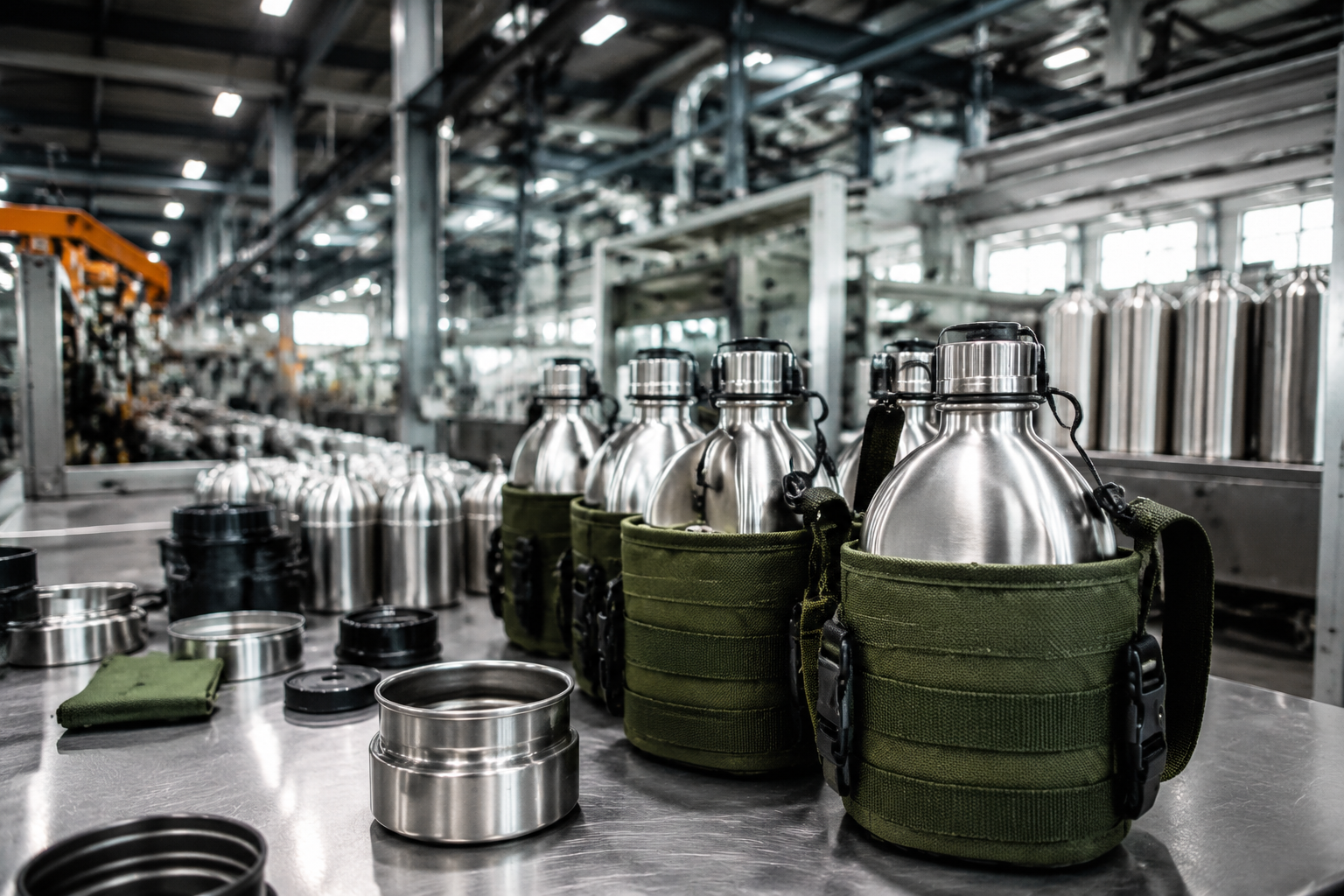
Key Takeaways
- A basic stainless custom canteen usually starts at 1,000-3,000 pcs per color with FOB China pricing around USD 3.20-6.80
- New mold or cap tooling can add USD 800-3,500 and 18-35 days before mass production
- A practical order timeline is 7-12 days for samples, 25-40 days for production, and 25-38 days for sea freight to Europe or North America
- For promotional canteen orders, decoration and packaging often add 8-22% to the unit cost
If you are building a supplier list military canteen buyers can actually use, the hard part is not collecting names. The hard part is telling a real canteen factory from a trading desk that cannot hold wall thickness, leak test results, cap fit, or carton drop performance. A low quote turns costly fast when the sample takes 18 days, the logo flakes, or the shipment misses the retail window.
At BottleForge Industrial in Hangzhou, Zhejiang, we quote custom drinkware from the production floor back: material, mold status, decoration, packing, AQL inspection, and vessel schedule. Last month QC pulled three samples at 1.2 mm wall thickness, and the buyer flagged a PO typo before we started the line. China works well for customized canteen programs, but only if you ask for MOQ, USD unit cost, tooling days, pre-production sample days, and real mass production capacity on day one.
Start With Landed Cost
I’ll rewrite this section with sharper buyer language, specific factory-floor detail, and cleaner cost framing, while keeping the HTML tags exactly as-is.A supplier list military canteen project should start with landed cost, not the cheapest FOB line on a spreadsheet. FOB Ningbo or Shanghai helps with quoting, but your finance team pays for inner box, export carton, AQL 2.5 inspection, ocean freight, duty, inland delivery, and compliance tests. For a 1 qt stainless canteen, we usually see USD 3.20-6.80 FOB China at 3,000 pcs, depending on steel grade, cap build, finish, and whether the cover or pouch is packed in. On the line, a 2 mm typo on the PO can swing the carton count and blow up the math.
The first cost driver is material. Single-wall 304 stainless steel at 0.45-0.55 mm wall thickness costs more than 201 stainless steel, but it sells better into outdoor, emergency, and government-adjacent retail channels. Aluminum runs lighter and can land cheaper, often USD 2.10-4.20 FOB at volume, but buyers need to check coating, taste transfer, and food-contact paperwork. Tritan or another copolyester works for transparent promo canteens, though it changes the product from field kit to retail drinkware. QC pulled the sample, and the buyer flagged the odor test before we even talked color.
The second driver is structure. A plain body with a standard screw cap sits at one price point. Add a chain, silicone seal, textured powder coating, carabiner, belt pouch, custom cap, or embossed logo, and the cost moves fast. A pouch alone can add USD 0.75-2.40 depending on 600D polyester, canvas, MOLLE-style webbing, snap buttons, and sewing quality. We’ve seen this go sideways when a buyer asked for “military style” without pinning down the webbing spec.
For distributor drinkware buyers, the right comparison is not “canteen supplier A is 20 cents cheaper.” It is whether the canteen manufacturer can hold the same spec on repeat orders. Zhejiang factories with steady polishing, coating, and assembly lines usually quote less wildly, and they also ship fewer surprises after deposit. If the sample matches, the 5,000 pcs reorder is where the real test starts.
MOQ Tiers Change The Quote
I’ll rewrite the section in place, keep the HTML untouched, and make the copy sound like it came from a factory-side sales engineer.MOQ is where a military canteen project turns into a real order or gets stuck at quote stage. A supplier can say “low MOQ” in the first email, then you find out it only covers a stock body, stock cap, stock carton, and one-color logo. Fine for an event run. Wrong for a retail line that needs a matte finish, printed box, color-matched cap, or a canteen set with a pouch.
At BottleForge Industrial, we run MOQ by process, not by slogan: 500 pcs for stock-color sample-market programs, 1,000 pcs for laser engraving or one-color silkscreen on existing models, 3,000 pcs for custom powder coating, and 5,000-10,000 pcs for new color parts or special packaging. A fully customized body shape needs tooling, and that usually only pencils out above 10,000 pcs. QC pulled a 0.5 mm cap gap on one trial run, and that one detail changed the whole quote.
The price curve is easy to read once you’ve run enough jobs. At 500 pcs, you pay for line changeover, print setup, carton splitting, and small-batch handling. The unit price can sit 18-35% above a 3,000 pcs order. At 3,000 pcs, the line can run coating, printing, and packing with less downtime. At 10,000 pcs, cap makers, seal suppliers, and pouch vendors start treating the order like a proper program.
Watch any quote that offers 100 pcs for a canteen customized order with a clean-looking unit price. The math doesn’t work. It usually means stock goods with light decoration, no formal QC, or a supplier planning to claw back margin later through freight, tooling, or change fees. We’ve seen that go sideways. A serious canteen manufacturer will tell you the real MOQ and the reason behind it.
For a supplier list military canteen spreadsheet, create separate columns for stock MOQ, custom color MOQ, custom packaging MOQ, and new mold MOQ. One MOQ number is not enough.
Tooling And Samples Add Time
I’ll keep the HTML structure intact and rewrite the prose to sound like a factory-side sales engineer, with concrete timing, tooling detail, and less generic phrasing.Lead time does not start on the production line. It starts when artwork, Pantone code, cap style, carton marks, and inspection standard are locked. If those items come in five emails over two weeks, the clock is still sitting on the desk. For a standard customizable canteen, we run a digital mockup in 1-2 working days, a logo sample in 5-8 days, and a full pre-production sample in 7-12 days after artwork approval.
New tooling changes the math. A custom cap mold usually needs 18-25 days and runs about USD 800-1,800. A modified body mold takes 25-35 days and costs USD 1,500-3,500. A full new stainless body shape can go past that, because we still need welding fixtures, leak-test fixtures, pouch size checks, and a packaging redraw. If the launch date is fixed, start with an existing factory model and save new tooling for the second order. That is the safer move.
Decoration samples have their own clock. Laser engraving is the fastest route because there is no ink curing, and it holds up well on brushed stainless or powder coat. Silkscreen is clean and cost-friendly for one or two colors, but curved bodies need the right jig or the print drifts. Heat transfer gives more color, yet the adhesion test can fail if the coating is weak. On a military canteen promo order, we usually ask for one physical decorated sample before mass production, even when the buyer wants to approve a PDF. QC pulled the sample at 72 hours once, and the buyer flagged a font shift that the render had hidden.
A workable China schedule looks like this: 2-3 days for final order review, 7-12 days for sample making, 3-5 days for sample approval and deposit confirmation, 25-40 days for mass production, 2-4 days for AQL inspection and correction, then booking. If a canteen vendor claims 15 days for a complicated custom canteen without checking artwork and packaging, ask what got cut. We have seen that go sideways on carton marks alone. One PO typo on the ship-to line can burn a full day.
Decoration Is Not Free Branding
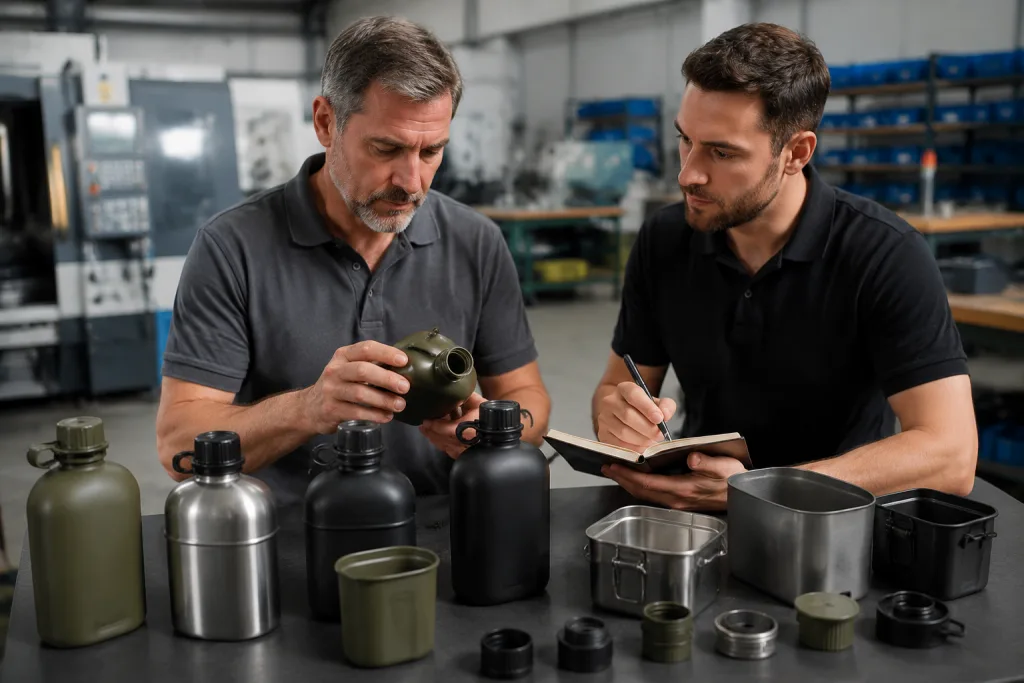
I’ll rewrite the section in-place, keep the HTML exactly as-is, and make the copy sound like a factory-side sales engineer wrote it.Decoration cost gets underestimated by new B2B buyers all the time. A canteen custom program is not the same as dropping a logo on a flat notebook. The body is curved, the shoulder has a tight radius, the seam line can block print, and the cap chain can snag on a pouch or belt clip during packing. We run into this on the line: if the art sits 8-10 mm too low, QC pulls the sample because the mark rubs after one carton shake test.
Laser engraving usually adds USD 0.15-0.45 per piece, depending on logo size and line speed. One-color silkscreen often adds USD 0.12-0.35 per piece, plus a screen fee of USD 40-80 per color. Multi-color printing can add USD 0.30-0.90 per piece. Embossed or debossed logos need tooling, usually USD 300-1,200, and the math only works once you are past 3,000 pcs. If you want a retail-grade custom drinkware finish, do not treat decoration like a last-step checkbox.
Powder coating is another cost driver. A standard matte black or army green from the factory’s stock powder is the easy route. A custom Pantone match can push you to 3,000 pcs MOQ and add USD 120-300 in powder surcharge. We also ask for cross-hatch adhesion testing and boiling water or dishwasher simulation if the canteen will be reused hard. One buyer once flagged a PO typo on the coating code, and that single line turned into a 12-day delay because we had to remake the sample batch. For European buyers, REACH and LFGB material declarations may be needed depending on channel. North American buyers may ask for FDA food contact compliance and, for children’s items, ASTM and CPSIA considerations.
My view is simple: over-branding makes a military-style canteen look cheap. The better sell is usually a small laser mark, a cap in the right color, and a pouch that holds up. A distributor can place that set into outdoor, camping, emergency, corporate gift, and field-kit channels without it looking like leftover promo stock. We have seen this go sideways when the artwork covered half the body; the buyer thought it would read premium, but it just looked loud.
Production Capacity Must Be Verified
I’ll rewrite the section in-place, keep the HTML intact, and make the language sound like a factory-side sales engineer. Then I’ll give you just the cleaned HTML.A canteen supplier can talk about capacity, but you need to pin down which capacity. Body forming, coating, printing, assembly, and packed finished goods per month are different numbers. A line may press 300,000 metal bottles monthly and still coat only 120,000 pcs if the color is special. Printing often becomes the choke point when every canteen order needs two-sided artwork.
At BottleForge Industrial in Hangzhou, Zhejiang, our custom drinkware output runs up to 500,000 units per month across stainless bottles, travel tumblers, sports bottles, growlers, and canteens, depending on model mix. On the line, we check welding, coating, and packing schedules before we quote. A 5,000 pcs order can move in 30 days. A 50,000 pcs distributor canteen order with pouch, insert card, and four carton marks may need split production and a tighter loading plan — we’ve seen that go sideways when the buyer sends the PO with one carton mark typo.
Ask every canteen manufacturer for three records before you put them on a supplier list: recent production photos of similar items, a sample QC checklist, and a packing specification with carton dimensions and gross weight. If they also have BSCI, ISO 9001, or third-party social compliance audit experience, that helps chain retailers and larger distributors get through onboarding. Certifications do not control the line by themselves, but they make the paperwork cleaner.
For AQL, most buyers use Level II with 2.5 for major defects and 4.0 for minor defects. Critical defects stay at zero, especially sharp edges, leakage, contamination, broken caps, and unsafe coating. Your purchase order should state the inspection standard in black and white. Leave it vague, and each canteen vendor will decide what “acceptable” means after QC has already pulled the sample and packed the cartons.
Freight And Packing Affect Margin
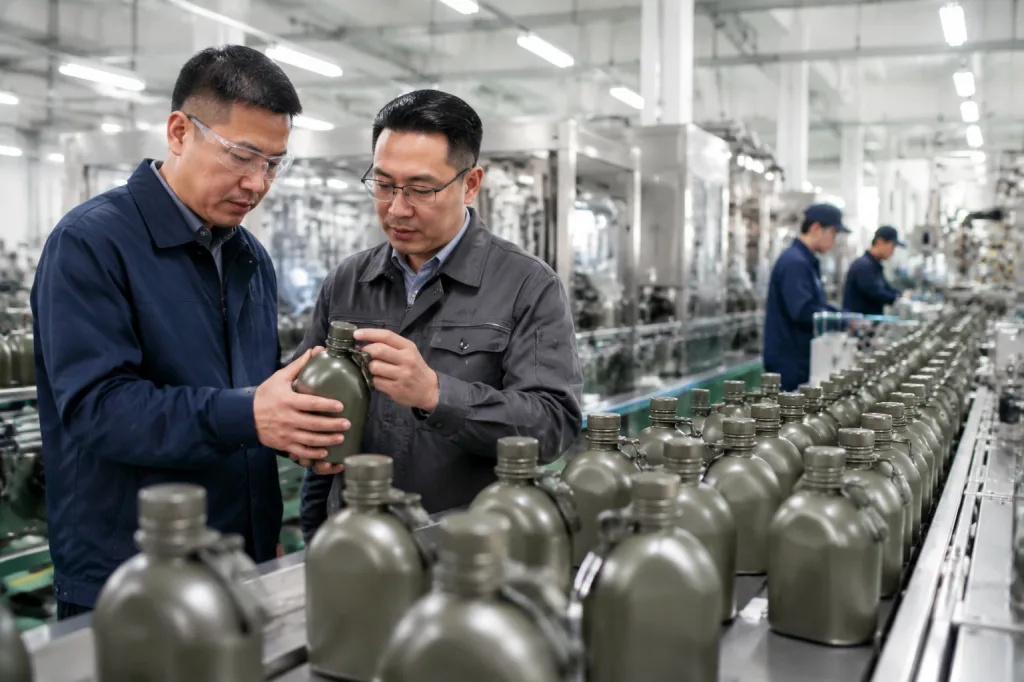
I’ll rewrite the section in-place, keep every tag structure intact, and make it sound like a sales engineer who knows freight math and packing pain points.Canteens look small on paper, but packing still eats margin. A single-wall stainless canteen is light, yet a pouch, retail box, insert, and export carton all add volume. If the shipment goes to Amazon FBA, a distributor warehouse, or a retail DC, carton weight, barcode placement, FNSKU labeling, suffocation warnings on polybags, and master carton marks need to be locked before production starts.
A bulk-packed canteen may run with one polybag and a white inner box, with 24 or 48 pcs per export carton. A retail-ready customized drinkware program may need a color box, instruction sheet, silica gel, pouch, barcode sticker, and outer carton. We’ve seen that packaging change add USD 0.25-1.10 per unit and lift CBM by 10-35%. That hits sea freight and warehouse handling. On a 3,000 pcs order, the freight gap can be a few hundred dollars. The math does not lie.
FOB is usually the cleanest term for experienced canteen distributors because you control the forwarder and consolidation. EXW may look cheaper, but then local trucking, export handling, and paperwork land on your desk. DDP can work for small promotional orders, though you need to know who is importer of record and how duty gets cleared. For Europe and North America, sea freight usually takes 25-38 days port-to-port; air freight can move in 5-9 days, but on low-value drinkware it can cost more than the product. We run that comparison on every line.
For supplier comparison, ask for packed carton dimensions, gross weight, net weight, HS code suggestion, and estimated CBM per 1,000 pcs. A serious canteen factory can send those numbers fast. QC pulled the sample and measured the master carton at 58 x 38 x 32 cm before we even started the line. A weak supplier says “we check later,” and that usually means your landed cost is already slipping.
Build A Usable Supplier List
I’ll rewrite the section in place, keep the HTML exactly as-is, and make the prose sound like a buyer-side sales engineer wrote it.A supplier list military canteen buyers can actually use should be short, numeric, and backed by samples or quotes. You do not need 40 names. Three to 5 qualified options is enough: one stock canteen vendor for speed, one factory that handles customization well, one pouch or accessory factory, and maybe one backup if the line gets tight in peak season. More names just slow the call chain and give you shallow pricing.
Score every supplier with the same sheet: MOQ by custom level, FOB price at 1,000/3,000/10,000 pcs, sample lead time, mass production lead time, tooling cost, available materials, decoration methods, certification readiness, AQL acceptance, monthly capacity, and reply speed. Add one column for risk notes. We use notes like “good price, no BSCI,” “strong coating, MOQ 5,000 pcs,” “sample in 7 days, packing looks rough,” or “good on custom growler and customized growler sets, weak on military canteen pouches.” QC pulled the sample, and that one line usually tells the story.
Do not ask every supplier to quote a vague “customizable drinkware canteen.” Send a controlled RFQ: capacity, material, wall thickness, cap type, finish, logo size, packaging, test requirements, target delivery date, and shipping term. If you are sourcing a customizable growler, distributor growler, or another outdoor bottle too, split the RFQs unless the same factory clearly runs both lines. A mixed brief looks lazy, and the buyer flagged it on our side more than once.
The better canteen manufacturers in China will push back when the brief does not add up. That is a good sign. If you want USD 2.50 FOB for a 304 stainless canteen with pouch, custom box, two-color print, and 1,000 pcs MOQ, the math does not work. We tell buyers to change the spec or raise the budget, because it is better to hear no on day 1 than to miss ship date by 12 days after deposit.
Send Your Canteen RFQ For A Numeric Quote
Share target MOQ, material, logo, packing, and delivery market. We will return FOB pricing, lead time, tooling notes, and practical risk flags.
Frequently asked questions
What MOQ should I expect for a custom military canteen?
For an existing canteen body with one logo, expect 1,000 pcs as a normal MOQ, with some stock-color programs possible at 500 pcs. For custom powder coating, 3,000 pcs is more realistic because the coating line, powder purchase, and color cleaning all add setup time. For a new cap color, special pouch, or retail box, 3,000-5,000 pcs is common. For a new body mold, most canteen manufacturers will want 10,000 pcs or a tooling charge that makes the economics acceptable. If a canteen supplier offers 100 pcs with full customization, confirm whether it is only laser engraving on stock goods.
How much does a customized canteen cost from China?
A basic aluminum or stainless customized canteen can range from USD 2.10-6.80 FOB China depending on material, size, cap, finish, and packaging. A 304 stainless single-wall model with silicone seal and one-color logo is often around USD 3.20-5.20 at 3,000 pcs. Add a pouch and the cost may rise by USD 0.75-2.40. Add color box packaging and barcode labels, and another USD 0.25-1.10 per unit is possible. These are factory-level ranges, not landed costs. Your landed cost must include inspection, ocean freight, duty, domestic delivery, and any compliance testing required by your channel.
How long does production take after I approve the sample?
For a standard custom canteen using an existing body and cap, mass production usually takes 25-40 days after sample approval and deposit. If the order includes custom powder coating, pouch sewing, retail packaging, or multi-color printing, use the longer end of that range. A new cap mold can add 18-25 days before production, while a modified body mold can add 25-35 days. Sea freight to Europe or North America often adds 25-38 days port-to-port, plus customs and inland delivery. If your retail launch is fixed, build the schedule from the delivery date backward and leave at least 7 days for inspection corrections.
What should I ask canteen suppliers before adding them to my list?
Ask for MOQ by customization type, FOB price at 1,000/3,000/10,000 pcs, sample lead time, production lead time, tooling cost, monthly capacity, carton dimensions, and inspection standard. Also ask whether they can provide FDA food contact documentation, REACH or LFGB-related declarations for Europe, and BSCI or ISO 9001 audit records if your customer requires them. A real canteen factory should also show recent photos of similar production and explain leak testing, coating checks, and packing method. If a canteen vendor only replies with a price and ignores specifications, keep them as a backup at most.
Can one factory handle canteens, growlers, and other custom drinkware?
Sometimes, but verify the actual production line. A factory strong in stainless sports bottles and travel tumblers may also handle canteen customized orders if it has the right body forming, welding, polishing, coating, and cap assembly capability. A custom growler or customizable growler may use different capacity, thread, handle, and insulation requirements, so do not assume the same quote logic applies. For distributor drinkware programs, one capable China supplier can simplify color matching and packaging style across canteens, growlers, and bottles. Still, request separate samples and AQL criteria for each product type because leakage, coating, and carton drop risks are different.