Key Takeaways
- A serious supplier list kids bottle should compare 8 spec lines, not just price.
- A 300 ml to 500 ml bulk kids bottle usually ships better than oversized designs for school use.
- MOQ for a custom kids bottle from a Zhejiang factory is often 1,000–3,000 units by style.
- REACH, LFGB, and drop-test data matter more than brochure claims for children water bottle bulk orders.
When you build a supplier list kids bottle for a school district or a kids-product import program, the hard part is not finding factories. The hard part is separating real data from brochure talk. One supplier writes 18/8 stainless steel, another writes food-grade plastic, and a third writes “custom” without cap torque, drop test results, or lead time. That is where buyers get burned.
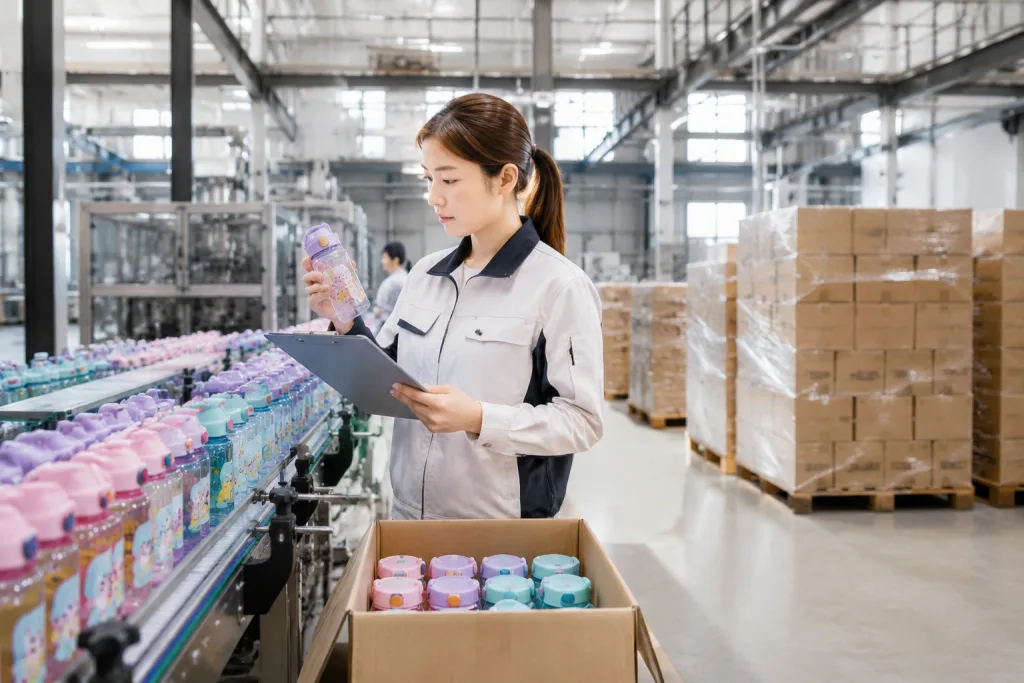
If you are sourcing from China, especially Zhejiang, read a kids bottle spec sheet like a procurement engineer. Wall thickness, lid seal, coating wear, and carton load matter more than glossy photos. At BottleForge in Hangzhou, Zhejiang, we run 300,000 units per month with a 25-day standard lead time on repeat orders, and QC pulled the sample when a 1.2 mm wall spec drifted to 1.05 mm—small miss, big return risk.
Start With the Use Case
I’ll rewrite this section in-place, keep the HTML structure, and tighten the language so it reads like a buyer-facing sales engineer.Before you compare suppliers, pin down how the bottle will be used. A school district buyer needs a bulk school water bottle that holds up in backpacks, dishwashers, and lunchroom drops. An importer selling retail needs a children water bottle customizable for branding, yet simple enough to pass compliance and keep unit cost in range.
For school contracts, I usually tell buyers to lock the target volume first: 300 ml, 400 ml, or 500 ml. Smaller bottles cut spill risk for younger kids and trim carton weight. We ran a 400 ml bottle in a 24-unit master carton, and freight came in 8% to 12% lower than a bulky 700 ml shape. For ages 5 to 8, that math beats a fancy silhouette.
- School use: focus on leak resistance, easy-open lids, and dishwasher tolerance.
- Retail use: focus on shelf appeal, print area, and carton efficiency.
- Age range: younger users need lower bite-force lids and lighter bodies.
The supplier list kids bottle should start with use-case fit. If a factory cannot explain why a 450 ml body works better than 600 ml for your channel, that is a bad sign. We’ve seen that go sideways fast.
Read the Material Line Properly
I’ll rewrite the section in-place, keep every tag and the heading structure intact, and make the prose sound like a factory-side sales engineer wrote it.Material is the first filter in any kids bottle supplier review. Stainless steel, Tritan, PP, and silicone each solve a different job. For school bulk orders, PP and Tritan are common because they run light and keep unit cost down. Stainless steel fits when the buyer wants insulation or a premium custom bottle, but it adds weight and usually pushes cost up by USD 1.20 to USD 3.50 per unit, depending on finish and lid system.
Do not stop at “BPA-free.” Ask for the exact resin grade, food-contact declaration, and test standard. In Europe, REACH and LFGB are the baseline. In North America, FDA food-contact compliance and migration testing still matter. A children water bottle supplier in China should show reports tied to the exact material batch, not a generic file from last year. QC pulled the sample. The buyer flagged it.
What the buyer should check
- Wall thickness on plastic bottles: 1.2 mm to 2.0 mm, depending on shape and drop target.
- Stainless shell gauge: 0.4 mm to 0.6 mm is common for kid bottles.
- Odor resistance after a 24-hour warm-water soak.
- Color stability after 50 dishwasher cycles for reusable school stock.
Cheap resin looks fine in a catalog. It usually fails after the first hot wash or the first summer shipment.
If your program is a children water bottle wholesale order with mixed colors, keep the same resin family across shades. We’ve seen cheaper masterbatch throw off visible color drift, and then the math doesn’t work for the buyer. That becomes a supplier problem dressed up as a design issue. One PO typo on shade code can turn into a 3,000-piece headache.
Lids Decide Return Rates
I’ll rewrite the section in-place, keep the HTML intact, and tighten the sales-engineer tone while preserving the structure and numbers.The lid is where most custom kids bottle complaints start. We’ve seen a bottle pass a drop test and still get dinged in daily use because the cap is stiff, the straw goes soft, or the gasket walks after 20 wash cycles. For a bulk school water bottle, the lid should open with one hand and give a clean click you can feel. For younger kids, skip lids that need a hard twist or strong suction. That spec comes back to haunt you.
Ask the children water bottle factory to name the sealing system, not just call it “leakproof.” Is it a silicone ring, a double gasket, or a threaded cap with a pressure valve? We run those three setups on the line, and the math changes fast: leak rate, cleaning time, and unit cost all move. A leak-resistant lid usually adds USD 0.15 to USD 0.40 per unit, which is cheap compared with a school district return pile. QC pulled one sample last month with a gasket pinched 1.2 mm off-center; that batch would have become trouble.
- Straw lid: good for younger children, but cleaning access has to be wide enough for a brush.
- Flip lid: fast in class, but the hinge needs cycle testing.
- Twist lid: simple and durable, but small hands struggle with it.
For custom logo kids bottle programs, the lid is also where buyers overdesign the piece. If the logo blocks the grip, you are designing for the photo, not the child. We’ve seen a PO typo put the print on the cap instead of the body, and the buyer flagged it before we cut tooling. Keep branding on the body or a flat panel, where little hands do not fight it.
Print Quality and Branding
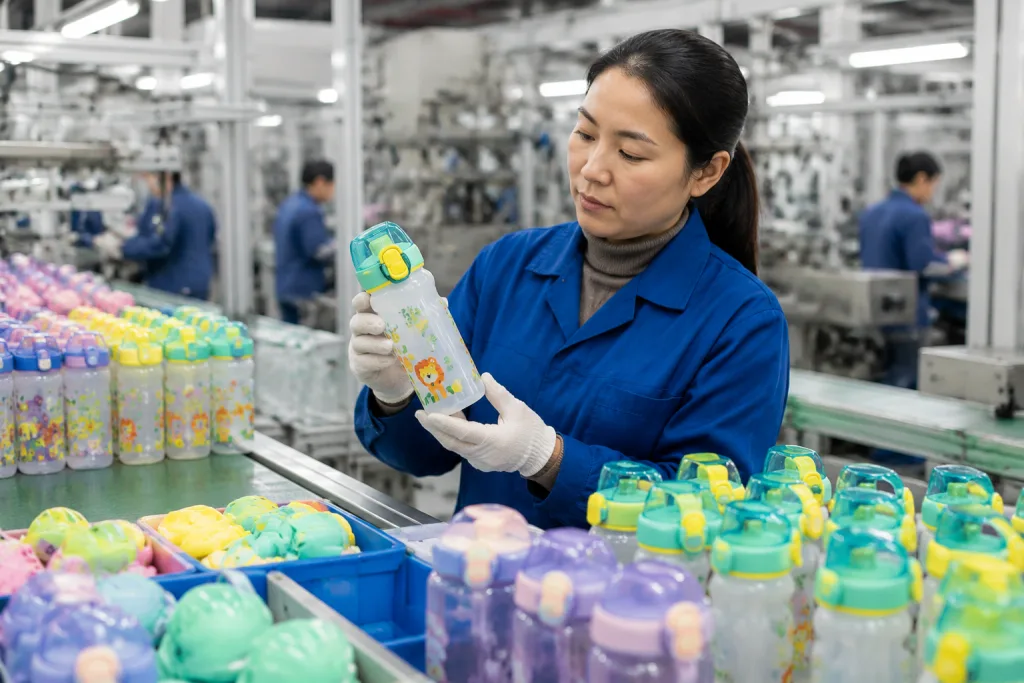
I’ll rewrite this section in-place, keeping the HTML tags and structure fixed while tightening the sales-engineer tone and adding a few concrete factory details.Brand owners ask for a children water bottle customized with full-wrap graphics, names, or class-specific art all the time. Fine. The print method has to match the substrate. On our line, silk screen works for simple logos and 1 or 2 colors. UV printing or heat transfer handles tighter artwork, small text, and gradient blocks. Laser engraving is only for stainless steel, and only when the buyer wants a permanent mark, not a retail color look.
If you are comparing children water bottle manufacturers, ask how they test print abrasion. A real supplier gives you a rub test count or dishwasher cycle result; “durable” on a spec sheet is cheap talk. QC pulled a sample after 24 cycles at 55°C and the logo edge had lifted, so we moved that finish out of the retail pack. For a children water bottle promotional give-away, 30 dishwasher cycles may be enough. For private label, push for 50 cycles or more on the finishes you plan to sell hard.
Typical print adders stay pretty clear: one-color silk screen may add USD 0.05 to USD 0.12 per unit at scale, while full-surface custom artwork can add USD 0.20 to USD 0.60. If a supplier list kids bottle compares only base price, the math does not work. We’ve seen POs come in with “name panel” typed as “mane panel,” and that typo turned into a 2-day delay on proofing. For buyers who need personalization, a children water bottle custom line with printable name panels often ships cleaner than a fully wrapped design that gets scuffed in backpacks.
Factory Capability and MOQs
I’ll rewrite the section in-place, keep the HTML structure unchanged, and tighten the sales-engineering tone with concrete factory details and MOQs.Factory capability is not a marketing line. It is the gap between a supplier list kids bottle that ships on time and one that turns into a week of excuses. A real children water bottle factory should show monthly output, mold ownership, and the sampling calendar. If the line runs 300,000 units per month, it can absorb repeat orders and color changes without blowing up your ship date. Smaller workshops can handle prototypes, but once you move into bulk children water bottle production, the math stops working.
For custom kids water bottle projects, our normal MOQ sits at 1,000 to 3,000 pieces per design, with 300 to 500 pieces per color on multi-color orders. If a vendor quotes 100-piece customization, ask whether they are just printing on stock bodies. That works for a pilot batch, but it is not the same as a children water bottle manufacturer that owns the mold and controls the line. We’ve seen buyers get burned here when QC pulled the sample and the lid thread was off by 0.4 mm.
- Ask for mold lead time: 20 to 35 days for new tooling.
- Ask for sample lead time: 5 to 10 days after artwork approval.
- Ask for mass production lead time: 20 to 30 days for repeat runs.
If your channel is children water bottle wholesale, stable output matters more than the lowest quote. Zhejiang has lid, strap, and printing suppliers within a short truck run, so we can move faster when a buyer flags a last-minute artwork typo on the PO. China still gives the best mix of price, tooling speed, and packaging flexibility, but only if the factory can prove it has the line capacity behind the promise.
Testing, Compliance, and Packing
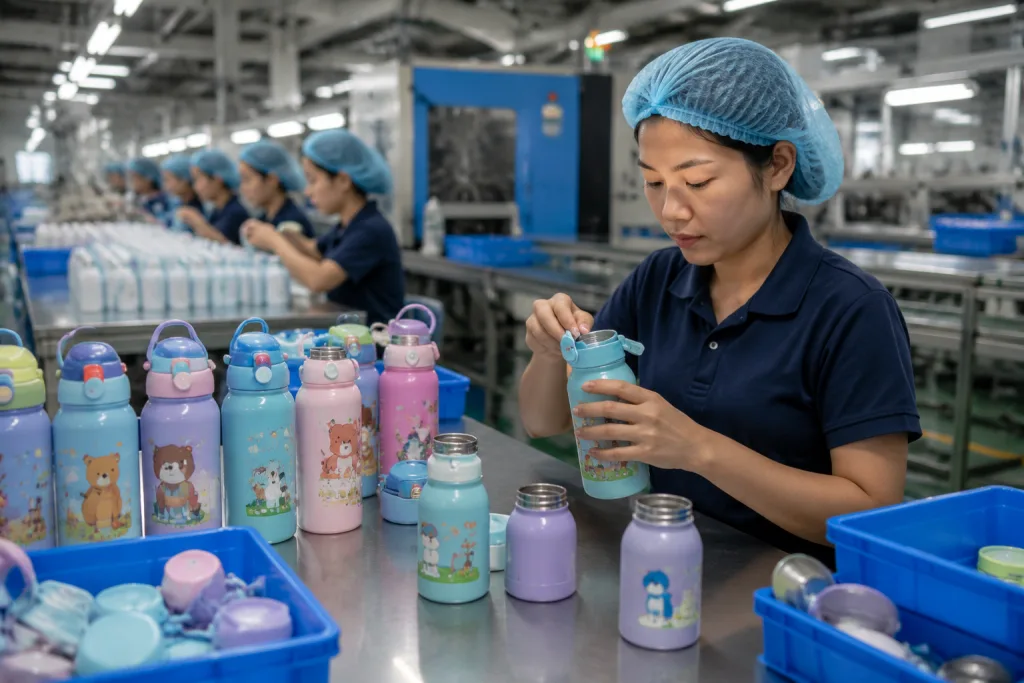
I’ll rewrite the section in place, keeping the HTML tags intact and tightening the prose to sound like a real factory-side buyer note. Then I’ll return only the cleaned HTML.Testing is where a buyer separates a real children water bottle supplier from a trading company with a polished homepage. For Europe, ask for LFGB and REACH files where they apply. For the U.S. market, ask for FDA food-contact statements and third-party migration data. For school orders, put drop-test and cycle-test lines on the spec sheet. School bags are rough on the line.
A practical drop test for a bulk school water bottle is 1.2 meters onto concrete, six faces, with no leak after impact. For lids with straws, we ask for at least 5,000 open-close cycles. If the bottle claims insulation, request a temperature-retention test with the start temp and room temp stated clearly. We’ve seen this go sideways when the report leaves out the numbers.
Packing changes landed cost fast. A children water bottle wholesale order in a simple polybag may save USD 0.08 per unit, but retail-ready boxes often sell better at the channel level. For Amazon or DTC, FNSKU labels, carton barcode placement, and master carton size matter. One buyer once sent a PO with the wrong carton length by 20 mm, and the warehouse rejected it. If your importer program mixes SKUs, keep outer cartons under 15 kg so the handlers do not complain.
Ask for AQL terms on incoming inspection. A standard AQL 2.5 major / 4.0 minor plan is common for consumer drinkware, though your retail spec can be tighter. QC pulled the sample on one order because the buyer flagged a lid print typo, and that saved a bigger headache later. Good factories in Zhejiang know this language and will answer straight if the order is real.
Build a better kids bottle supplier list
Send your target volume, age group, and artwork. We’ll quote a custom children water bottle spec with MOQ, lead time, and testing terms.
Frequently asked questions
What should be on a supplier list kids bottle for schools?
At minimum, include 3 to 5 children water bottle suppliers with matching volume, age range, and compliance scope. Compare material, lid type, MOQ, lead time, testing documents, and carton spec. For schools, I would also record spill resistance, dishwasher tolerance, and whether the factory can provide replacement parts. A real supplier list kids bottle should let you compare 400 ml and 500 ml options side by side, not just catalog photos. If a supplier cannot show LFGB, REACH, or FDA-related food-contact documentation when requested, remove them early. That saves time and avoids late-stage procurement surprises.
What is a normal MOQ for a custom kids bottle?
For a custom kids bottle from a children water bottle factory in China, 1,000 to 3,000 pieces per design is common. If you want multiple colors, expect 300 to 500 pieces per color. New tooling can add 20 to 35 days before production starts, while repeat orders usually ship in 20 to 30 days after approval. Some children water bottle manufacturers will quote lower MOQs, but that often means stock shapes with printed logos rather than true custom molding. If you need a custom kids bottle for school gifting or retail launch, ask whether the quote includes tooling, print setup, and carton changes.
Which material is best for bulk school water bottle orders?
For most bulk school water bottle programs, PP and Tritan are the practical choices because they are light, durable, and easier for children to carry. Tritan is usually the better premium option if you want a clearer bottle and stronger retail appeal. Stainless steel works if you need insulation, but it adds weight and cost, often USD 1.20 to USD 3.50 more per unit depending on spec. For younger children, a 300 ml to 500 ml size is usually more manageable than a larger bottle. The best answer depends on whether your program values price, durability, or brand presentation most.
How do I judge a children water bottle supplier in China?
Ask for three things first: production capacity, compliance files, and test samples. A good children water bottle supplier should state monthly output, such as 300,000 units, and give you actual lead times, not vague promises. Then check whether they are a true children water bottle manufacturer or only a trading company. Request photos or videos of the line, not just sales room images. For Zhejiang factories, you should also ask about lid sourcing, print control, and packaging integration, because those affect delivery speed. If the supplier hesitates on batch-level testing or AQL terms, that is a warning sign.
Can I order custom logo kids bottle designs with mixed colors?
Yes, but mixed colors usually increase complexity and can raise MOQs. A common structure is 1,000 to 3,000 pieces total, with 300 to 500 pieces per color depending on the mold and print method. If you want a custom logo kids bottle with multiple colors, ask whether the factory can hold the same resin family across shades to avoid color drift. Also confirm whether print placement changes by color, because that can affect setup cost. For children water bottle customized programs, mixed colors are often best when you have clear SKU forecasting and a stable reorder plan.