Key Takeaways
- A real supplier list infuser bottle starts with 4 decisions: material, MOQ, decoration, and lead time.
- For factory direct infuser bottle orders, expect MOQ from 2,000 to 5,000 units and lead time around 25 to 35 days.
- Custom logo infuser bottle pricing usually shifts by USD 0.08 to 0.40 per unit depending on print method and color count.
- A credible infuser bottle supplier in Zhejiang should show REACH, LFGB, and BSCI-aligned documentation, plus monthly output above 300,000 units.
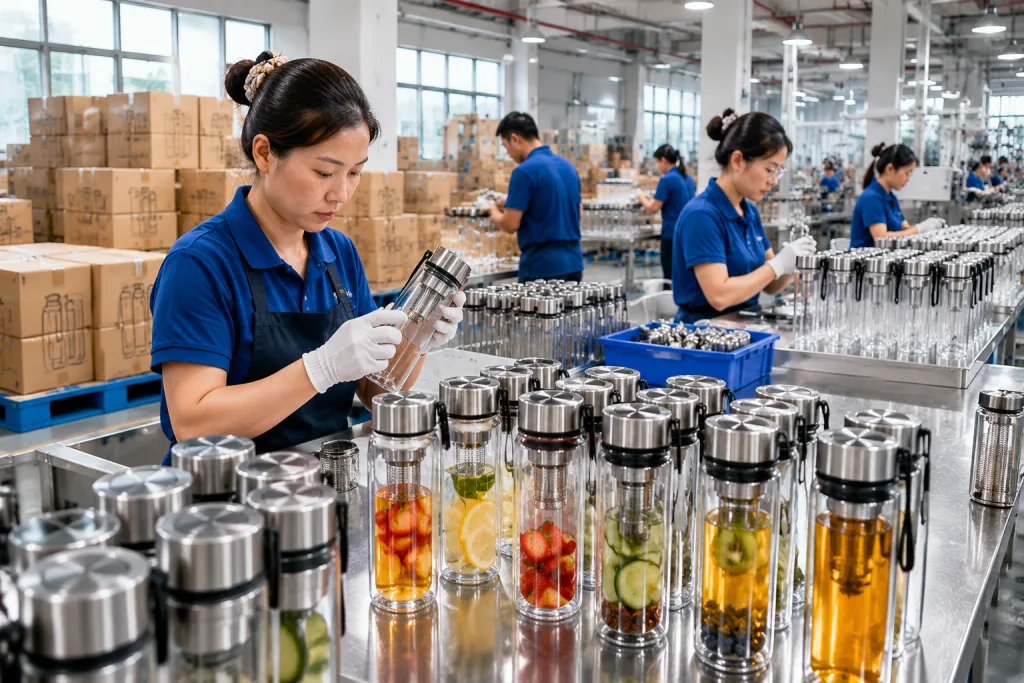
If you are sourcing for a wellness brand or hydration startup, the wrong supplier list infuser bottle decision shows up late: cloudy plastic, weak lids, leaks in transit, or a quote that looked cheap until packaging, decoration, and freight got added. Most first-time buyers want a neat supplier list. The better filter is simpler: find a factory direct infuser bottle maker that can hold tolerance on the line, not a trading layer that talks big and misses the actual build.
At BottleForge in Hangzhou, Zhejiang, we see this every week. A clean custom infuser bottle program starts with four calls: material, capacity, decoration, and supply model. Get those right, and your bulk fruit infuser bottle or custom tea infuser bottle order runs steady. Skip them, and you end up chasing samples for 12 days, then 18, while the cheapest quote turns into the most expensive carton. We ship from a dense drinkware belt, but this is the wrong question to ask as “China or not”; the math only works when you know which factory can actually deliver.
Start with the four buying decisions
I’ll keep the HTML structure intact and rewrite only the prose, with tighter factory-style wording and a few concrete sourcing details.Do not start by asking for a supplier list. Lock four decisions first: what the bottle is made from, how it infuses, how it is branded, and whether you want factory direct or distributor support. That is how we keep a bulk infuser bottle project from turning into quote-comparison theater. On the line, we have seen buyers waste 2 weeks because they skipped those calls and then tried to fix the spec after QC pulled the sample.
Material sets weight, clarity, odor risk, and compliance. Tritan is the usual pick for a custom fruit infuser bottle when you want BPA-free clarity and better impact resistance. Eastman Tritan-style copolyester grades usually handle dishwasher-safe use and give a cleaner premium look. AS plastic costs less, but it does not carry the same value on a premium hydration line. For tea programs, a stainless steel insert or a glass tea chamber matters more than the outer bottle, and the buyer often flags that after the first round.
Capacity changes the whole stack-up. A 700 ml customizable infuser bottle ships easier and sells cleaner in retail than a heavy 1 liter format. Decoration changes sell-through too: one-color pad print may cost only USD 0.08 to 0.15 per piece, while laser engraving on a metal cap or insert can add USD 0.20 to 0.40. Supply model is the last call: a factory fruit infuser bottle source gives lower unit cost and tighter control, while a distributor fruit infuser bottle option can move faster for mixed SKUs but usually slips on consistency. We once got a PO with “700ml” typed as “700 ml” in one place and “750 ml” in another; the math did not work, and the line stopped.
Buyers who force these four choices early usually cut sampling time by 30% to 50%.
For a smart supplier list infuser bottle, rank suppliers by how clearly they answer these four points, not by who sends the prettiest PDF. If they cannot quote MOQ, print method, and lead time in one pass, they are not ready for a real sourcing round.
Choose the right supply model
I’ll rewrite the section in-place, keeping the HTML exactly as-is and tightening the sales-engineer tone. Next I’m swapping out the generic phrasing for concrete factory-floor details and cleaner sourcing language.The biggest mistake in infuser bottle sourcing is treating every quote as if it came from the same shop. A factory infuser bottle supplier and a distributor infuser bottle seller can both price the same model, but the math is different. If you need a bulk fruit infuser bottle for a retail launch, factory direct is usually the better call because we can adjust the mold, check lid fit, and lock down the carton spec.
Factory direct infuser bottle sourcing in Zhejiang gives you tighter pricing and clearer ownership. A solid factory should be running at least 300,000 to 500,000 units per month across its drinkware lines, with MOQ usually 2,000 units for standard molded bottles and 3,000 to 5,000 units for custom color runs. We’ve seen buyers push for 500 units with full customization; that’s usually where the corner-cutting starts.
Distributor fruit infuser bottle suppliers work when you need mixed cartons, small trial orders, or fast in-stock fills. If your brand needs a custom made infuser bottle with a unique cap shape, logo placement, or a proprietary insert, the distributor layer slows the whole job down. In China, especially in Zhejiang, the better factories do not mind audit questions about production cells, QC checkpoints, and monthly output. Ask for these numbers directly:
- Monthly capacity in units
- MOQ by material and decoration
- Lead time for sample and mass production
- Packing format per carton and pallet
If the answers stay vague, walk. QC pulled the sample on a 32 mm lid gap before, and the buyer flagged it on the first inspection. A useful supplier list should only include companies that can state their factory infuser bottle capacity in numbers.
Decide on material and infusion type
I’ll rewrite the section in-place, keep the HTML untouched, and tighten the wording so it sounds like a factory-side sales engineer.For a custom infuser bottle, the infusion insert matters as much as the bottle body. Fruit infuser models usually run with a removable center rod or basket. Tea infuser models need finer filtration and better heat handling. A fruit bottle should let the slices stay clear of the drinking path, and a tea bottle should keep fine leaf particles out of the mouthpiece.
Material trade-offs are direct. Tritan or copolyester is the usual pick for a premium custom infuser bottle because it gives clear looks and impact resistance. If you want a customized tea infuser bottle for hot fill or near-boiling water, check the temperature rating first; we have seen buyers assume every plastic body can take 95°C, and that math does not work. Stainless steel inner baskets last longer, but they add weight and raise the unit cost. Glass looks premium on a shelf, yet breakage claims show up fast once cartons start moving through export lanes.
For a bulk tea infuser bottle, ask for wall thickness and lid seal details. A 2.5 mm to 3.0 mm wall is common for a rigid bottle body, while cap gaskets often use silicone in the 50 to 70 Shore A range. QC pulled a leaking sample last month because the gasket sat 0.3 mm off center, and one weak seal turns into a distributor headache. For fruit programs, confirm fruit chamber diameter, basket hole size, and whether the insert comes out for washing. A custom fruit infuser bottle that traps pulp comes back as a return.
In Zhejiang factories, the samples that pass are not the prettiest ones. They still work after 200 open-close cycles, a 1.2 meter drop test, and a 24-hour inversion test. If a supplier cannot walk you through those checks, they are not ready for your line.
Treat branding as a cost lever
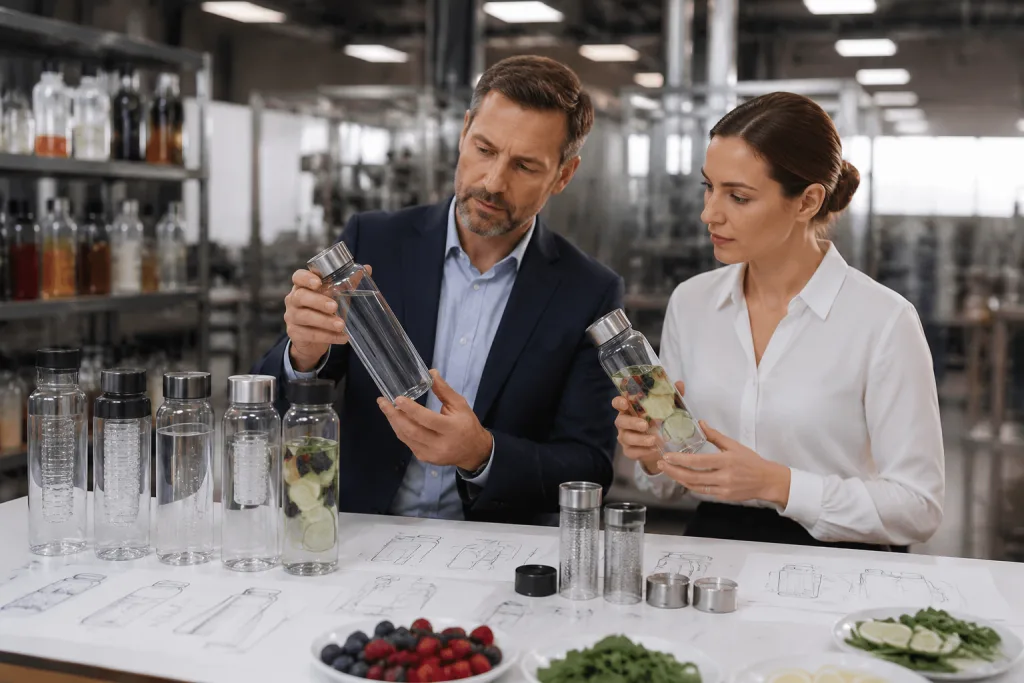
I’ll rewrite the section in place, keep the HTML structure unchanged, and tighten the language so it reads like a factory-side sales note with concrete sourcing detail.Branding is not decoration. It moves MOQ, lead time, and the way the bottle sells on Amazon, retail shelves, or through distributors. A custom logo infuser bottle can be printed by silk screen, heat transfer, UV print, or laser engraving, and the body material decides which one we run. For a 1-color bulk infuser bottle order, silk screen is usually the lowest-cost route.
For a custom tea infuser bottle or custom fruit infuser bottle positioned as premium, the branding has to match the price point. We’ve seen a single-color print add USD 0.08 to 0.15 per unit, while multi-color print or full-wrap decoration can land at USD 0.25 to 0.60. Engraving on a metal cap needs a different fixture and setup, and the math does not work if you ignore it. A quote that looks 12% cheaper can lose once you add print, individual boxing, and FNSKU labels.
Use channel first. Retail buyers need a logo that survives handling and condensation. DTC needs a mark that photographs cleanly under 6500K light. Distributor-led orders need packaging that can take language swaps and barcode changes without redoing the line. A distributor tea infuser bottle usually needs more flexible pack-out than a direct-to-consumer SKU, and we have seen that go sideways when the buyer flagged a last-minute translation change.
When you compare suppliers, ask for print position diagrams, color matching method, and decoration tolerance. QC pulled the sample on our pad printer last week because the line-up drifted 1.2 mm on the second pass, and that is the kind of thing that shows up only on a real spec sheet. A factory that can state Pantone matching and keep tolerance within 1.0 mm is doing the work. “Logo OK” is not a specification.
Check compliance before price
I’m rewriting this section in-place and keeping the HTML tags exactly as-is. I’ll tighten the sales-engineer tone, add a few floor-level specifics, and strip the AI-style filler.Most buyers start with price and check compliance later. That is the wrong order. A supplier list infuser bottle sold into Europe or North America needs a screen for REACH, LFGB where relevant, and food-contact declarations matched to the exact resin and ink on the line. If the body is Tritan or another copolyester, ask for the resin grade and the test report for that batch family. A generic certificate from 5 years ago does not pass a buyer audit.
For North America, you still need supplier support on FDA food-contact input, even if the bottle is not an FDA-certified product in the strict sense. We run carton drop tests at 90 cm, and that matters when a 24-pack lands on a DC floor and two corners crush. For retail programs, the packaging callouts are part of compliance too: carton strength, drop resistance, and barcode accuracy decide whether the shipment stays saleable. A Zhejiang factory should be able to work to AQL 2.5 for major defects and 4.0 for minor defects, with pre-shipment photos and lot traceability. The math does not work any other way.
A serious factory direct infuser bottle partner should show social compliance when your retailer asks for it. BSCI, or a comparable audit framework, matters once your brand moves from online orders into chain accounts. Do not accept “we have certificate” and move on. Ask for the report number, scope, and validity period. QC pulled the sample on one run and found a PDF mismatch on the carton label; that kind of typo becomes your problem if no one catches it. China has thousands of drinkware factories; the real difference is often paperwork discipline, not the machine line.
If your order is a bulk fruit infuser bottle rollout, check migration risk for pigments, adhesives, and printed areas. The cheapest ink is often the failure point. We have seen a buyer flagged in Europe because the sleeve print bled under a simple rub test. That is the sort of issue a brand gets blamed for later, not the supplier.
Build a supplier list you can actually use
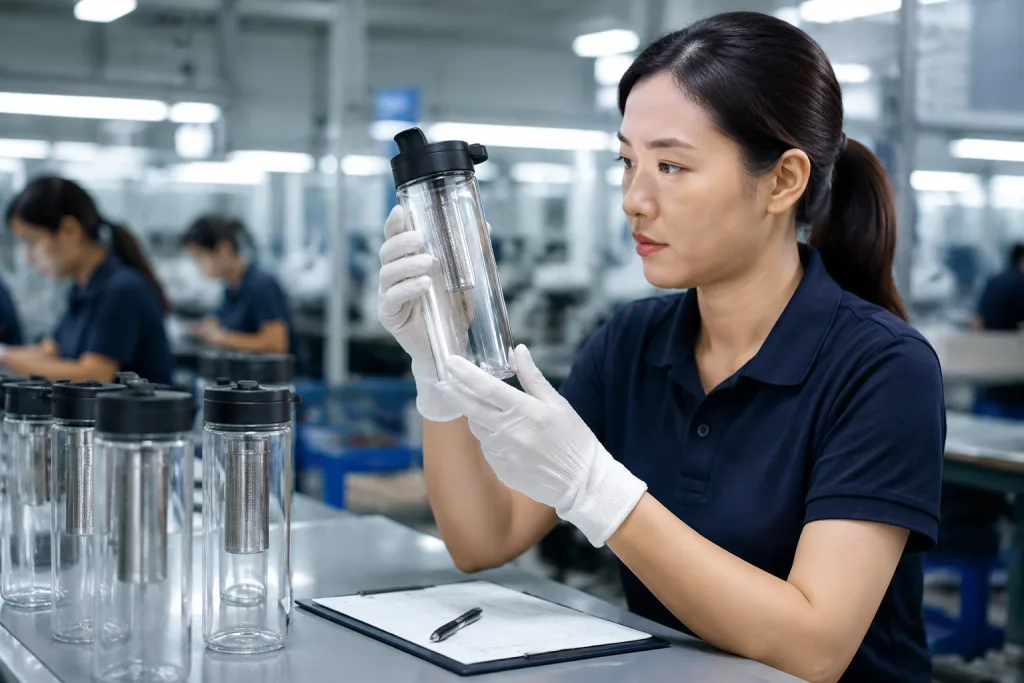
I’ll rewrite the HTML prose only, keep the tags intact, and tighten it into a more natural factory-side sales tone with concrete details.A useful supplier list infuser bottle should be a scoring sheet, not a contact dump. We score each supplier on six items: product fit, MOQ, lead time, compliance, decoration flexibility, and reply speed. Use a 1 to 5 score for each. That strips out the fluff and shows who fits your business model.
For a custom made infuser bottle, the best candidates usually answer technical questions without passing you around. Ask whether they run factory tea infuser bottle, factory fruit infuser bottle, and customizable tea infuser bottle variants on separate lines or on shared tooling. Ask if they can ship 1,000 sample units in 10 to 15 days and if mass production takes 25 to 35 days after sample approval. Ask about custom packaging too, from kraft gift boxes to retail window cartons. We had a buyer flag a PO typo on “window carton” once, and QC pulled the sample back because the fit was off by 2 mm; small errors like that waste a week.
Then sort by channel fit. If you sell to wellness brands, focus on clear wall finish, odor control, and box presentation. If you sell through distributors, push for stable stock, fixed carton counts, and fewer SKUs. If you are a hydration startup, do not overbuild the first model. A clean 700 ml customized fruit infuser bottle with one lid color and one logo position is easier to scale than a launch with three bottle sizes and five print variants. The math does not work.
In our Hangzhou, Zhejiang factory, the programs that move fastest are usually the simple ones: one body color, one logo position, one carton size, and a reorder plan the line can repeat. We run 304 stainless parts on a 12 mm tolerance check at packing, and that kind of setup keeps tooling stable when you need to ship again in 18 days, not 28.
Build your infuser bottle shortlist now
Send your target capacity, MOQ, and logo method, and we’ll help you narrow the supplier list infuser bottle with real factory numbers.
Frequently asked questions
What is the MOQ for a custom infuser bottle order?
For a standard factory direct infuser bottle order, MOQ is usually 2,000 to 3,000 units for stock molds and 3,000 to 5,000 units for custom color or custom logo work. If you need a proprietary cap or insert, tooling MOQ can be higher. A supplier in Zhejiang should tell you the MOQ by decoration method, not just give one number for everything. For a trial run, some factories can support 500 to 1,000 pieces, but unit cost rises quickly and packaging options shrink.
How much does a bulk fruit infuser bottle cost?
A basic bulk fruit infuser bottle in clear copolyester can land around USD 1.20 to 2.40 FOB depending on capacity, wall thickness, and lid style. Add USD 0.08 to 0.15 for a one-color logo print, or USD 0.20 to 0.40 for more complex decoration. If you want retail-ready gift packaging, add another USD 0.20 to 0.60. The big swing factors are resin grade, insert design, and carton specification, not just bottle size.
What lead time should I expect from a factory in China?
For a standard custom infuser bottle, sample lead time is often 7 to 10 days if the mold already exists. Mass production usually takes 25 to 35 days after sample approval and deposit. If you need new tooling, add 15 to 25 days depending on mold complexity. Zhejiang factories with stable production lines can often ship faster, but only if you avoid late artwork changes. One logo change can cost you a week.
What compliance documents should I request?
Ask for food-contact declarations tied to the exact resin, REACH where needed for Europe, LFGB if you are selling into Germany-focused channels, and any available BPA-free and migration testing reports. For larger retail programs, request BSCI or similar social audit evidence, plus carton drop-test or packaging test records if available. A reputable supplier should also provide AQL inspection standards and batch traceability. Do not accept generic certificates without the model number and report date.
Is distributor sourcing better than factory direct sourcing?
If you need speed, mixed SKUs, or small quantities, a distributor tea infuser bottle or distributor fruit infuser bottle source can be convenient. If you need repeat quality, lower cost, and custom tooling control, factory direct infuser bottle sourcing is usually better. For brands planning reorders, factory direct wins more often because you control color, print, lid seal, and packaging. A distributor is a shortcut, not a manufacturing strategy.