Key Takeaways
- Start supplier screening with MOQ, usually 1,000 pcs for custom color and 3,000 pcs for molded parts
- Ask for 304 stainless steel, 0.4-0.5 mm inner wall, and documented LFGB or FDA food-contact compliance
- Budget 25-35 days for sampling plus mass production after artwork approval, excluding sea freight
- Use AQL 2.5/4.0 inspection and test at least 32 pcs per color for leakage, coating, and logo defects
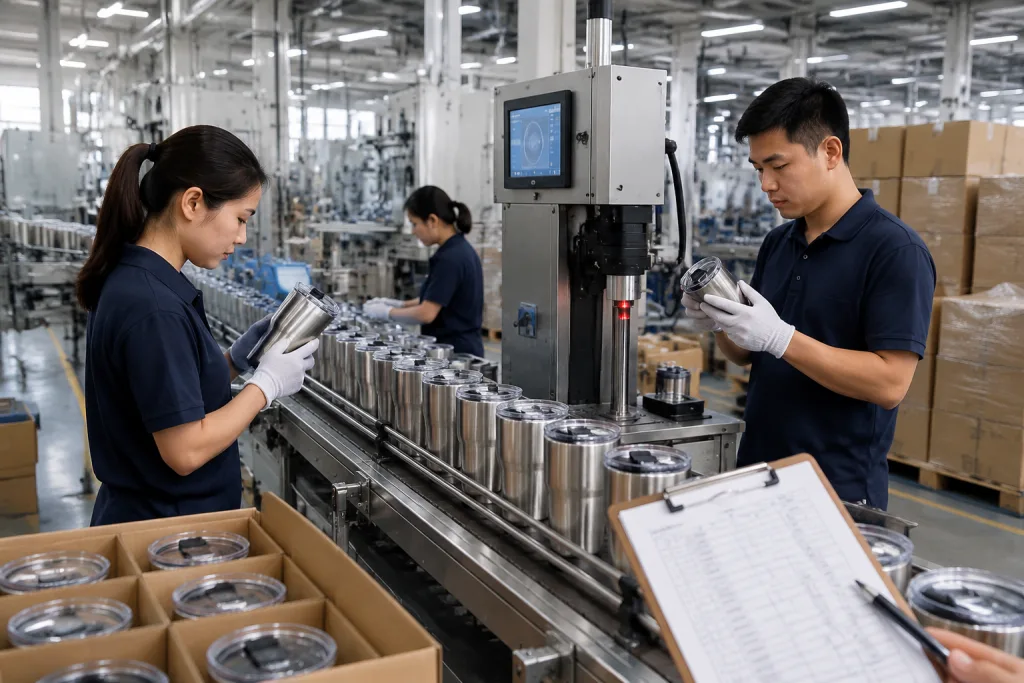
If you are building a supplier list coffee tumbler buyers can actually use, the hard part is not finding names. The hard part is cutting out suppliers that reply in 2 hours but fail on color match, lid fit, heat retention, packaging, or ship dates. Coffee brands and corporate-gift buyers usually need a bulk coffee travel mug that looks retail-ready, clears compliance, and lands before the launch truck pulls in.
We manufacture travel tumblers in Zhejiang, China, so we see the same mistakes every month: buyers comparing only FOB unit price, accepting vague stainless steel grades, or skipping the pre-production sample. QC pulled a 300 ml sample last week and the lid ring was off by 1.2 mm; that kind of miss turns into a buyer complaint fast. A good coffee mug supplier list should show who can handle MOQ, logo method, AQL inspection, private-label packaging, and real line capacity before you wire the deposit.
What belongs on your supplier list
I’ll keep the HTML structure intact and rewrite the prose to sound like a real buyer-side factory conversation, with tighter, more specific language and a few factory-floor details.A supplier list for a coffee tumbler project should not look like a random trade-platform dump. Build it around risk. Start with supplier type: coffee mug factory, trading company, distributor, or gift-program integrator. A factory direct source in China usually controls tooling, surface finishing, and packing better; a local coffee mug distributor can move faster on repeat orders under 500 pcs. We run that split every week.
For a custom travel tumbler project, put these fields on the sheet before you ask for price. The buyer flagged one PO typo on our side last month—one missing lid code turned into a 3-day delay. No mystery there.
- Product scope: stainless steel travel tumbler, ceramic-lined tumbler, plastic lid parts, handle tumbler, or car-cup compatible model.
- MOQ: stock item with logo, custom powder coat, custom shape, and coffee mug private label packaging.
- Factory metrics: monthly capacity, number of polishing lines, laser machines, and assembly staff. Our Hangzhou-region supply chain in Zhejiang can support about 180,000 stainless travel tumblers per month across standard models.
- Compliance: LFGB, FDA food-contact, REACH for coating, Prop 65 if selling into California, and BSCI or Sedex if required by corporate buyers.
- QC terms: AQL level, leakage test method, coating adhesion test, carton drop test, and acceptable color tolerance.
Do not add a supplier to your coffee mug supplier directory just because the catalog looks polished. Catalogs are cheap. Ask for one recent export carton mark, one inspection report, and one production schedule screenshot with sensitive customer data removed. Serious coffee mug manufacturers can send those in 24-48 hours. If they dodge that request, the math does not work.
Which tumbler spec should you request
I’ll rewrite the prose in place, keep every tag as-is, and make the spec language sound like a buyer-facing sales engineer.Most coffee brands and corporate-gift buyers start by asking for a “premium tumbler.” That phrase is too loose for procurement. A supplier will quote the easiest margin unless you pin down the build. For a bulk coffee tumbler, ask for 18/8 stainless steel, which means 304 grade on food-contact parts. On the outer shell, 201 stainless steel works for price-led promo runs, but for retail coffee mug custom made programs, 304 inside and outside is the safer call.
For wall thickness, ask for 0.4 mm to 0.5 mm inner wall and 0.5 mm to 0.6 mm outer wall on a 16-20 oz vacuum tumbler. We’ve seen 0.1 mm shaved off the tube save USD 0.15-0.35 a unit, then the line starts showing dent marks and weld pull. Ask for a real heat test, not a slogan: fill with 95°C water at room temperature, then check again at 6 hours and 12 hours. A workable 20 oz travel tumbler should still hold water above 55-60°C after 6 hours, depending on the lid.
Lid design matters more than most buyers think. A sliding lid is handy, but it is not leakproof. A screw lid with a silicone ring is better for commuting. If you want a bulk travel mug for a conference bag, ask for an inverted leakage test for 30 minutes; QC pulled one sample last month and the buyer flagged a slow drip at the slide slot. For coffee shops, splash resistance is often enough because the tumbler sits on a desk or in a car cup holder.
When you send an RFQ, skip “same as photo.” That is the wrong question to ask. Write: “20 oz double-wall vacuum tumbler, 304 inner, powder coating, laser logo, BPA-free PP lid, silicone gasket, 1 pc white box, 24 pcs master carton.” One line like that cuts out half the quoting games, and it keeps the PO from coming back with a typo on lid color or pack count.
How MOQ changes your real cost
I’ll rewrite the section in-place, keep the HTML structure, and tighten the pricing language so it sounds like a real factory quote note.MOQ is where a supplier list starts paying rent or wasting your time. A coffee mug supplier may quote MOQ 100 pcs, but that usually covers stock color and a simple laser logo. For custom Pantone powder coating, we usually run 1,000 pcs per color because the line loses material during setup. If you want a new lid, handle, or molded silicone part, 3,000-5,000 pcs is the normal range; injection tooling and color matching are the reason.
For FOB Ningbo or Shanghai pricing from Zhejiang, China, a 20 oz stainless vacuum travel tumbler usually lands in these ranges before freight and duty:
- Stock color with laser logo, 500-1,000 pcs: USD 3.20-4.80 per pc.
- Custom powder coat and laser logo, 1,000-3,000 pcs: USD 3.60-5.30 per pc.
- Full-color wrap print, 1,000-3,000 pcs: add USD 0.35-0.90 per pc.
- Retail gift box, insert card, barcode label: add USD 0.25-0.75 per pc.
- New mold or special lid tooling: USD 1,500-6,000 tooling cost, depending on complexity.
For corporate gifting, the lowest unit price is not always the cheapest project. We’ve seen a USD 0.20 saving disappear when the carton was too weak, the coating rubbed in transit, or the FNSKU label went on the wrong panel for Amazon and 3PL receiving. If you are ordering coffee mug promotional products, put packaging labor and carton strength in the quote. QC pulled the sample with a scratched lid once, and that batch never left the line.
Ask every supplier for price at 500, 1,000, 3,000, and 5,000 pcs. The curve tells you fast whether you’re dealing with a real coffee mug oem manufacturer or a trader passing you a quote from another coffee mug factory. A PO typo on a 5,000 pcs order can cost more than the price gap, so check the numbers twice.
Branding methods that survive daily use
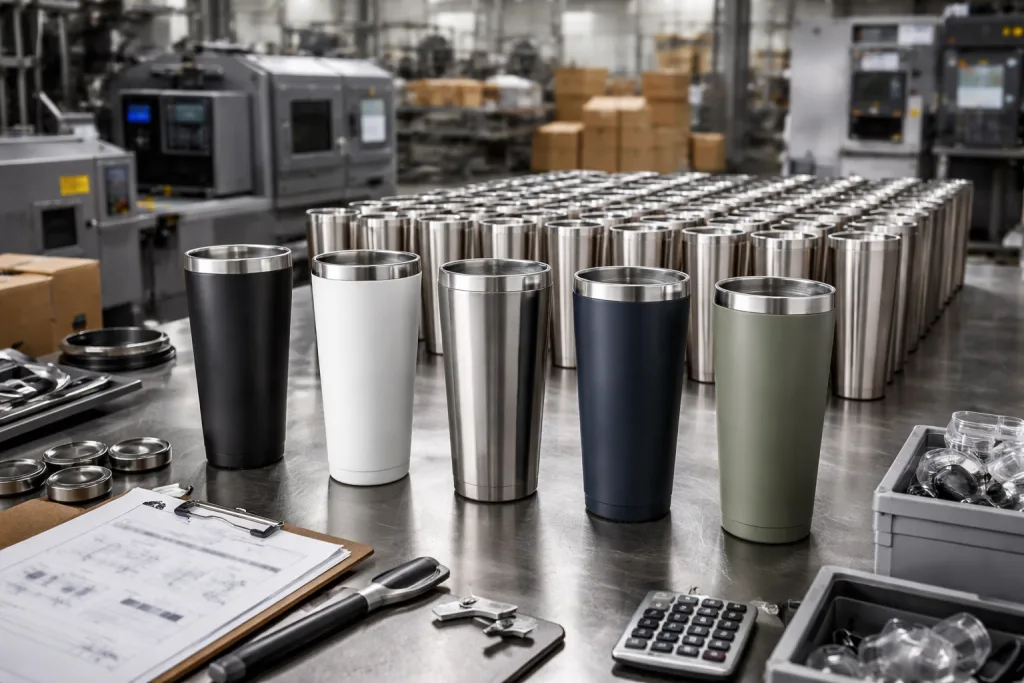
I’ll keep the HTML intact and rewrite only the prose, with a more field-tested supplier tone and a few concrete factory details.Coffee mug custom runs fail in the open when the logo rubs off. A buyer sees that first, and so does the end customer. We run the line with that in mind: choose the decoration method by surface, color count, and how the tumbler will be washed, stacked, and shipped.
Laser engraving is the cleanest call on powder-coated stainless steel. It burns off the coating and shows the metal under it. On our 0.4 mm test text, QC pulled the sample after 48 hours of rubbing and the edge still held. It will not do full-color art, but for a single-logo coffee mug promotional order, it is durable, clean, and usually adds USD 0.10-0.25 per pc, depending on logo size.
Silkscreen printing fits one- or two-color logos on smooth coated shells. The price is good at volume, but the math only works if adhesion passes. We ask for a 3M tape test after curing and a dishwasher simulation if the buyer wants a dishwasher-safe claim. The buyer flagged one PO where the artwork said “dishwasher proof”; that is the wrong question to ask, because powder coat and ink formulas change by supplier.
Heat-transfer or water-transfer printing is the better pick for full-wrap art, gradients, and retail-style graphics. It is common in coffee mug customizable programs, but the line needs tighter edge control and an extra setup step. For a coffee mug private labeling order, decide early if you need bottom laser logo, insert card, printed gift box, care label, EAN/UPC barcode, or master carton shipping mark.
Send artwork as AI, EPS, or editable PDF. Use Pantone codes, not screenshots from a phone. For coffee mug customized color, ask for a coated metal color chip or a photo shot under D65 light. A render is fine for approval, but it is not proof the shade will hold on the press.
Checklist before paying the deposit
I’ll rewrite the section in place, keep the HTML exactly as-is, and sharpen the language so it reads like a buyer-facing factory note.Before you send a 30% deposit, slow down and check the supplier the way we check a component vendor on the line. A bulk travel tumbler looks simple, but it has failure points everywhere: vacuum loss, weld cleanup, lid fit, coating peel, silicone smell, carton crush, and label mix-ups. Your supplier list coffee tumbler shortlist should pass this check, or the math does not work.
- Business match: Does the supplier actually run drinkware, or are they a gift exporter selling everything from pens to mugs? A factory that makes coffee tumblers every day will know lid tolerance, powder coat pinholes, and where vacuum rejects usually show up.
- Sample discipline: Can they send a pre-production sample with your logo, color, lid, and carton before mass production starts? A blank stock cup is not enough for a custom order. QC pulled one sample here last month with the wrong lid gasket, and the buyer flagged it fast.
- Compliance documents: Ask for test reports tied to the material or coating, not a generic certificate copied from another job. For EU buyers, LFGB and REACH matter. For North America, FDA food-contact and Prop 65 screening may matter. We have seen a PO typo turn “304 stainless” into “201” on paper.
- Audit position: If your corporate client asks for BSCI, Sedex, ISO 9001, or a social compliance questionnaire, confirm it before you ask for a quote. Do not assume every coffee mug manufacturer in China holds the same audits. A missed audit here can kill the deal after the sample is approved.
- Inspection plan: Lock down AQL, critical defects, major defects, and minor defects before payment. For drinkware, leakage, sharp edges, wrong material, and wrong logo sit in the critical bucket. We run a 3-minute inverted leak test on the line, and that catches more trouble than a sales promise.
- Shipping data: Get carton size, gross weight, HS code, and loading quantity in writing. A 20 oz tumbler often packs 24 pcs per carton, but a 2 mm change in carton wall thickness can move freight cost. One bad carton spec can turn a good quote into a bad shipment.
For new buyers, 30% deposit and 70% before shipment is still the normal setup. If a supplier asks for 100% upfront on a standard coffee mug in bulk order, ask what risk they are covering. For repeat buyers with stable volume, better terms usually come after 2-3 clean shipments, not before.
Questions to ask during sampling
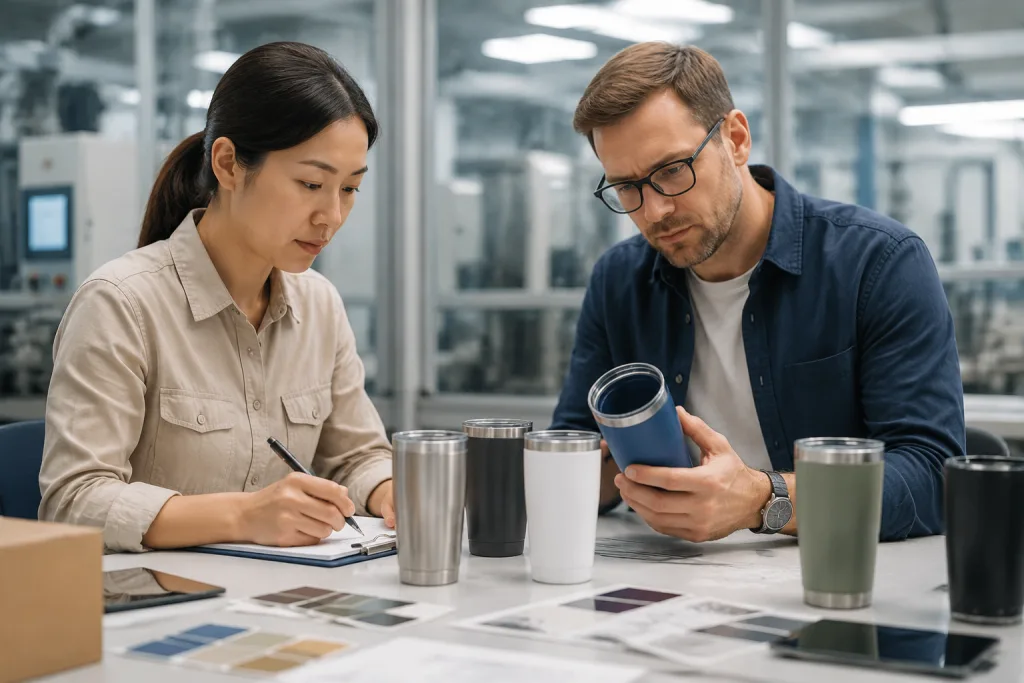
I’ll rewrite the section in-place, keep the HTML structure, and tighten the sales-engineer tone with concrete factory details.Sampling is not a photo exercise. It is the cheapest place to catch a costly miss. For a bulk coffee mug or bulk coffee travel mug order, we ask for two sample stages when timing allows: a stock construction sample first, then a pre-production sample with the real logo and packaging. The first checks feel and function. The second checks whether the line can actually hold the spec.
Ask the supplier to answer these questions in writing:
- What stainless steel grade is used for the inner wall, outer wall, and bottom plate?
- What is the measured wall thickness in mm?
- What lid material is used: PP, Tritan, AS, or another resin?
- Is the silicone gasket food-grade, and does it smell after a hot-water soak?
- What vacuum testing method is used on the production line?
- What is the normal defect rate after coating and final assembly?
- Can the factory pack by color, by logo version, or by department list for corporate gifting?
A serious coffee mug factory direct team should answer these without drama. We run the same check sheet on our bench in Hangzhou, and QC pulled the sample if the wall thickness drifts by 0.2 mm or the lid leaks on a 60°C inversion test. Our standard sample lead time is 7-10 days for laser logo on stock color and 12-18 days for custom coating. Mass production is normally 25-35 days after sample approval for 1,000-5,000 pcs, depending on season and decoration workload.
For corporate gifting, send the recipient-packaging rules early. If each tumbler needs a name label, department split, or kitting with coffee sachets, that is not a warehouse side note. It changes the packing line, labor estimate, and inspection method, and the buyer flags it fast when the PO says one thing and the ship list says another.
Building a shortlist you can defend
I’ll rewrite the section in-place, keep the HTML exactly as-is, and strip the AI-ish phrasing while making it sound like a supplier-side sales engineer.Procurement gets challenged fast by marketing, finance, and sales. A supplier list you can defend is not “we liked this catalog.” It is a scored sheet. Give each coffee mug supplier a 1 to 5 rating for product fit, compliance, MOQ fit, price stability, response speed, sample quality, and export experience. We put compliance and sample quality ahead of price when the tumbler carries a brand name, because one bad lid test on a 500 ml cup turns into a headache later.
For coffee brands, channel fit matters. A retail coffee mug private label program needs carton consistency, barcode accuracy, and color control from run to run. A corporate-gift order needs deadline discipline, logo alignment across departments, and clean bulk packing. A distributor selling coffee mug bulk inventory needs reorder stability and spare lid stock. Same product. Different buying rules. QC pulled one sample with a 1.2 mm print shift, and the buyer flagged it on the spot.
Do not keep ten suppliers active if only three are real contenders. A long coffee mug supplier list just creates quote fatigue and fuzzy comparisons. We run one preferred coffee mug manufacturer, one backup coffee mug factory in China, and one local distributor for small emergency runs. That mix gives price control, production capacity, and short-lead flexibility. The math works; the “let’s keep everyone warm” approach does not.
When you compare quotes, put every line on the same Incoterm first. FOB Ningbo, FOB Shanghai, EXW, DDP, and CIF are not the same number. For North America, confirm duty, Section 301 tariff exposure if applicable, customs brokerage, and final-mile delivery. For Europe, check VAT handling, EORI responsibility, and packaging waste obligations. We have seen a PO typo turn “DDP” into “DAP” and add 12 days of back-and-forth, so a clean spreadsheet beats a cheap surprise.
Send your tumbler RFQ for a practical factory review
Share quantity, artwork, lid style, packaging, and delivery market. We will flag cost drivers before you commit to tooling or deposit.
Frequently asked questions
How many suppliers should be on my coffee mug supplier list?
For active sourcing, 3-5 qualified suppliers are enough. Keep one primary coffee mug manufacturer for repeat production, one backup factory in China, one decoration specialist if your artwork is complex, and one local coffee mug distributor for urgent small runs. More names do not reduce risk unless they are verified. Score each supplier on MOQ, sample quality, compliance, lead time, communication, and price stability. For a 1,000-5,000 pc bulk coffee tumbler order, I would rather manage three proven suppliers than chase twelve low quotes. Too many RFQs also encourage vague pricing because suppliers know the buyer is only shopping.
What MOQ should we expect for a coffee mug custom order?
For stock tumblers with laser engraving, some factories accept 300-500 pcs, though unit cost is higher. For custom powder coating, 1,000 pcs per color is a realistic MOQ because coating setup and color change waste are real. For coffee mug custom made shapes, new lids, or silicone accessories, expect 3,000-5,000 pcs plus tooling. If you need coffee mug private labeling with printed box, barcode, insert card, and carton mark, 1,000 pcs is usually workable. Below that, packaging setup costs can make the project inefficient. Ask for price breaks at 500, 1,000, 3,000, and 5,000 pcs.
Is factory direct always better than using a coffee mug distributor?
Not always. Coffee mug factory direct sourcing is better when you need custom color, private-label packaging, strict AQL inspection, and repeat production. You get more control over materials, production schedule, and defect correction. A distributor can be better for 100-300 pcs, mixed models, domestic rush delivery, or when your team cannot manage import documents. For a corporate-gift buyer ordering 2,000 pcs with a fixed event date, factory direct from Zhejiang, China can save cost but requires disciplined approvals. If your deadline is under 14 days and you need local delivery, a regional distributor may be safer.
What defects should we inspect in a bulk travel tumbler order?
Use AQL inspection and define defects before production. Critical defects include leakage, sharp metal edges, unsafe odor, wrong material, or contamination inside the cup. Major defects include wrong logo position, visible dents, coating scratches over 3 mm, lid mismatch, poor vacuum performance, and incorrect barcode or carton mark. Minor defects include small dust points, slight color variation within agreed tolerance, or tiny packaging scuffs. For a 2,000 pc bulk travel tumbler order, inspect at least according to ANSI/ASQ Z1.4 general level II, with AQL 2.5 for major and 4.0 for minor defects. Add functional tests from multiple cartons.
How long does a private-label coffee tumbler project take?
A normal coffee mug private labeling project takes 35-55 days before ocean transit. Sampling is usually 7-10 days for stock color laser logo and 12-18 days for custom coating or printed packaging. Mass production typically takes 25-35 days after sample approval for 1,000-5,000 pcs. Add 3-7 days for inspection, booking, and export documents. Air freight to North America or Europe may take 5-10 days after pickup, while sea freight can take 25-45 days port to port depending on route. If you need holiday gifting, approve samples at least 90 days before the handout date.