Key Takeaways
- A 64 oz stainless custom growler usually lands at USD 5.20-8.90 FOB China at 1,000-5,000 pcs
- Real production lead time is normally 30-45 days after deposit and approved sample, not after first inquiry
- MOQ tiers change decoration cost sharply: 500 pcs is sampling-friendly, 3,000 pcs is where pricing improves
- Use AQL 2.5/4.0 inspection and confirm REACH, LFGB, FDA, or ASTM needs before mass production
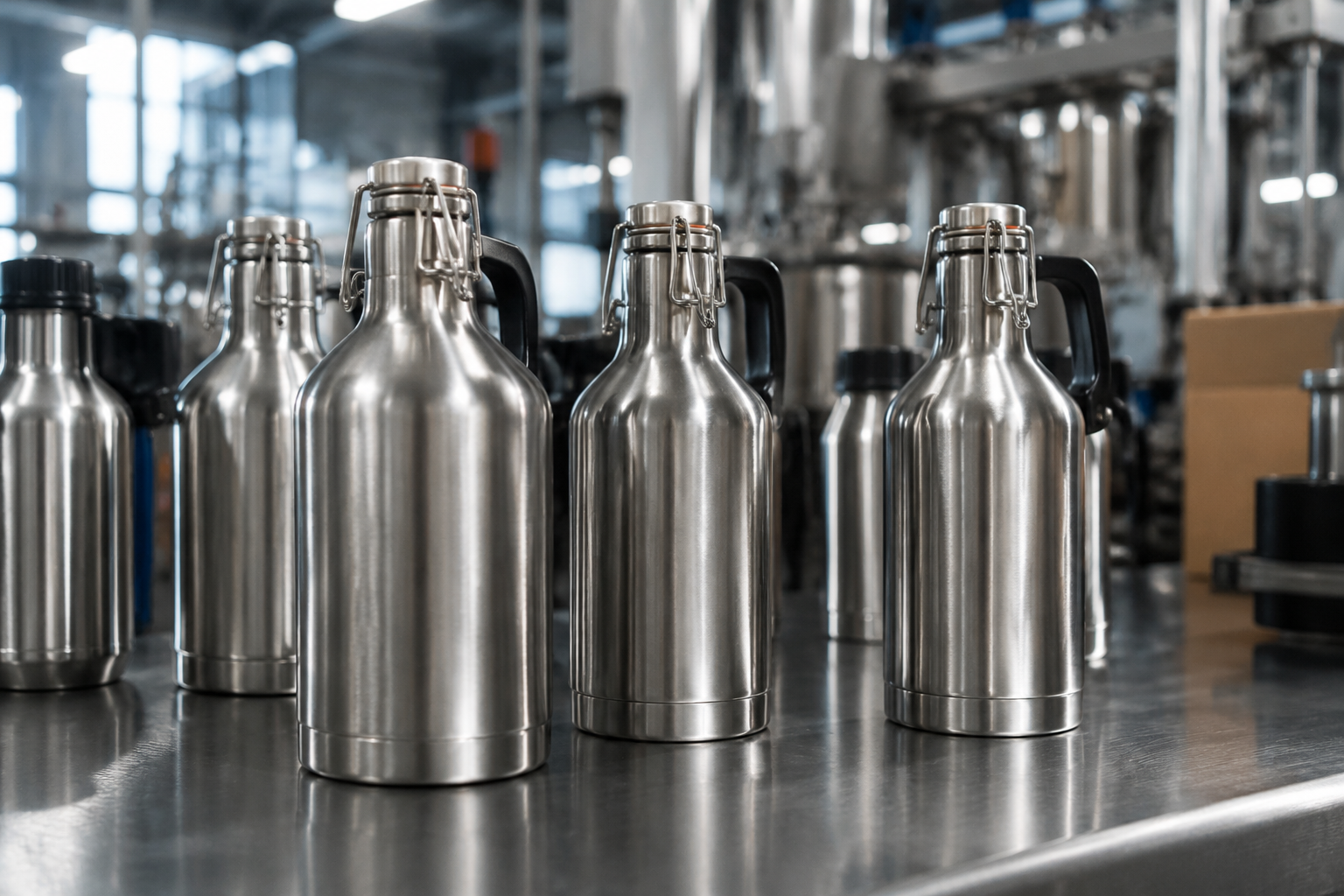
If you are building a supplier list beer growler shortlist, finding 40 names on Alibaba is the easy part. The hard part is knowing which quote is built on 304 stainless, which “30 days” lead time becomes 45 after artwork approval, and which factory still replies when the cap gasket fails a leak test. Beer growlers look simple. The cost moves fast once we add vacuum insulation, powder coating with 8–12% normal line loss, leakproof caps, retail boxes, barcode labels, and REACH documents.
We manufacture custom drinkware in Hangzhou, Zhejiang, and we see the same buying mistake every month: buyers compare FOB unit prices without checking steel grade, coating scrap, carton burst strength, and AQL 2.5 inspection level. This is the wrong question to ask. We run 1,000 ml and 1,900 ml growlers on the line, and QC pulled a sample last week where the buyer’s PO said “matte black” but the approved artwork file said “sand black,” which delayed packing by 2 days. China can be efficient, but only when canteen suppliers and growler factories receive a quotation brief that leaves no room for guessing.
Start with the right shortlist
A useful supplier list beer growler file is not a directory dump. Start with a working shortlist that separates trading companies that quote from Alibaba screenshots, drinkware exporters with mixed factory bases, and stainless factories that run forming, welding, vacuuming, polishing, coating, assembly, and carton packing under direct control. A canteen factory making mostly military-style single-wall bottles is usually the wrong source for a vacuum insulated custom growler with a threaded beer cap; we have seen samples fail at the neck thread by 0.4 mm when checked with a simple go/no-go gauge. A canteen manufacturer that already handles outdoor bottles is closer, but still check pressure testing, weld consistency, and cap gasket fit before you talk price.
For most B2B buyers, I would start with 8-12 potential sources, then cut it to 3-4 after reviewing factory profile, product range, compliance records, and quotation quality. Ask each canteen supplier for monthly capacity, main export markets, BSCI or ISO status, and photos of the actual production line, not the showroom wall. We run into this often: the buyer asks for “best growler factory,” but this is the wrong question to ask until you know whether the line uses automatic girth welding, manual polishing wheels, or outsourced powder coating. If they answer with only a catalog PDF, keep them on the backup list.
In Zhejiang, around 70% of the drinkware supply chain we use sits within a 2-3 hour truck route between stainless forming, polishing, coating, and packing workshops. That is one reason China stays strong for customizable drinkware. Proximity is not control. A serious canteen vendor should know which processes are in-house and which are outsourced; if QC pulled the sample because the powder coat measured 42 μm on one side and 71 μm on the other, the vendor should know which coating line ran it. For BottleForge Industrial in Hangzhou, Zhejiang, typical insulated drinkware capacity is 280,000 units/month, with standard MOQ at 1,000 pcs per color for growlers and 500 pcs for some stock-shape sampling orders.
When you compare canteen manufacturers or canteen vendors, ask for a quotation matrix instead of one price. Request 500, 1,000, 3,000, and 5,000 pcs pricing, with decoration and packaging lines separated. Simple table. The math gets messy when a supplier hides laser logo, color box, and 5-ply export carton inside one unit price; we once had a PO typo list 3,000 pcs with 30,000 color boxes, and the buyer flagged it only after the carton artwork was approved. A clear matrix shows who understands distributor drinkware programs and who is just guessing.
What actually drives unit cost
The shell price of a beer growler is only one line on the cost sheet. A 64 oz stainless steel customized growler using 304 inner steel and 201 or 304 outer steel usually sits around USD 5.20-8.90 FOB Ningbo or Shanghai at 1,000-5,000 pcs. If you require full 304 inner and outer, add roughly USD 0.35-0.80 per unit depending on gauge and market steel price. On our line, QC checks the body with a digital caliper at the shoulder and base; a 0.1 mm wall change can move the quote faster than a nicer catalog photo. For a heavy-duty outdoor model, wall thickness and base design matter more than the catalog photo.
Common cost drivers include:
- Body construction: single-wall growlers are cheaper, often USD 2.60-4.20 FOB, but they do not hold temperature and feel less premium. We usually see buyers push back after they hold the sample and compare the weight against a 64 oz vacuum unit.
- Vacuum insulation: double-wall construction adds welding, vacuum testing, and scrap risk. Expect USD 1.50-2.80 more than a single-wall model. QC pulled 32 pcs from one 1,200 pcs trial run last spring because the vacuum decay test failed after 6 hours.
- Finish: standard powder coating is usually USD 0.45-0.85 per unit. Rubber paint, metallic coating, or gradient color can add USD 0.80-1.60. The line needs a clean color card and Pantone code; one PO typo, 7545C instead of 7455C, cost a buyer 5 days of sample delay.
- Cap system: a basic screw cap may cost USD 0.25-0.45. A swing-top, carry handle, or insulated cap can add USD 0.60-1.40. We run a 5 kg pull test on handle caps because loose rivets turn into complaints fast.
- Decoration: laser engraving can be USD 0.18-0.45 per position. Silk screen can be USD 0.12-0.35, but setup and color registration matter. For curved bodies, our screen room checks a 2 mm registration tolerance before bulk printing.
If you are quoting canteen promotional items for a brewery, outdoor retailer, or event program, the artwork area can become the hidden cost. One-color logos are easy. Wraparound graphics on tapered bodies need more testing, usually 2 rounds of pre-production samples instead of 1. A custom canteen with two-sided branding may be cheaper than a full-wrap growler because the surface is more forgiving. We have seen this go sideways when the buyer approved a flat AI file but never checked how the logo stretched near the seam.
Do not compare a canteen customized quote with a growler quote unless the specification is matched. Capacity, steel grade, coating type, cap material, individual box, master carton strength, and testing requirements should be listed line by line; better yet, send a 12-row spec sheet and ask each supplier to quote against the same cells. The lowest canteen supplier may simply be quoting a thinner product. This is the wrong question to ask if the buyer only says, “What is your best price?”
MOQ tiers change the math
I’ll rewrite the prose in place, keep the HTML structure intact, and make the pricing/MOQ logic sound like a factory-side sales engineer wrote it.MOQ is not a penalty; it is where the line stops being handwork and starts running on schedule. For a custom growler, 300 pcs can work if you accept a stock color, a stock cap, and laser engraving. The FOB price often lands 20-35% higher than at 1,000 pcs because coating, setup, packing, and QC time get divided across fewer units. We have seen buyers push back on this number, but the math does not move.
At 500 pcs, we can still test a custom drinkware idea for a regional brewery or a corporate gift run. You will live with fewer color choices and a higher decoration charge. At 1,000 pcs, most canteen suppliers and growler factories open up on powder coating, carton marks, and plain retail boxes. At 3,000 pcs, the price curve starts to work better because the coating line loss, labor slots, and carton buys get cleaner. At 5,000 pcs, you can ask for a dedicated production window, custom caps, and tighter packing instructions. QC pulled one sample at 1,000 pcs last month for a 2 mm lid gap, so this is not theory.
A practical MOQ breakdown for insulated 64 oz growlers is:
- 300-500 pcs: stock body, stock cap, laser logo, USD 7.80-10.50 FOB.
- 1,000 pcs: custom color, one logo method, basic box, USD 6.40-8.90 FOB.
- 3,000 pcs: better coating control, lower unit cost, USD 5.70-7.80 FOB.
- 5,000 pcs: stronger custom options, possible cap upgrade, USD 5.20-7.20 FOB.
For distributor canteen programs, the same rule holds. A canteen distributor buying mixed SKUs should ask if MOQ is set per model, per color, or per logo. We have seen a supplier quote 1,000 pcs per color, then agree to 500 pcs per color once the total order reaches 3,000 pcs. Get that in writing before you send pricing to the buyer; a PO typo on the color code can turn into a week of back-and-forth.
Sampling time is not free time
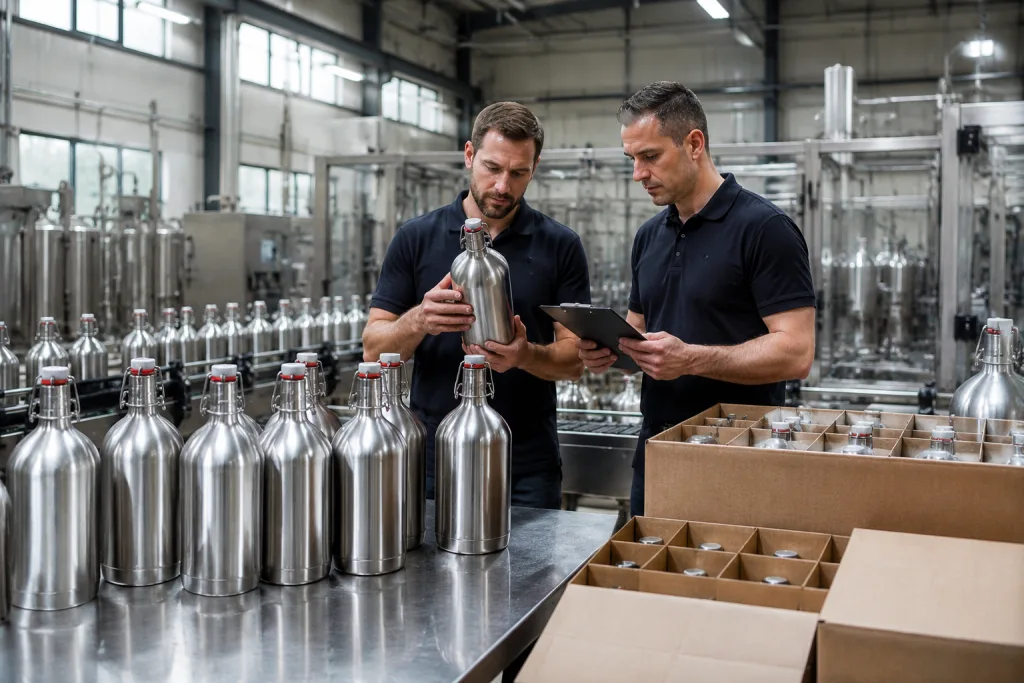
I’ve got the target section. I’m rewriting it in-place with tighter buyer-floor language, keeping the HTML tags untouched and the specs/numbers intact.Sampling is where a buyer finds out whether a canteen vendor has its act together. A normal pre-production sample for a customizable growler takes 7-12 days if the mold is existing, the color is standard, and the logo file is clean. If you ask for a new cap, a special coating chip, or a molded silicone part, sampling moves to 18-30 days. Tooling for a new plastic cap insert can take 20-35 days on its own.
Budget sample cost separately. A stock growler sample with laser logo is usually USD 30-80, setup included, before courier freight. A custom color sample can run USD 80-180 because we have to mix paint, shoot a small coating batch, and eat more loss on the line. A fully customized growler with new lid tooling can need USD 600-2,500 depending on complexity. For canteen customizable items, new body tooling is far more expensive, and the math only works above 10,000 pcs.
Artwork approval also moves the clock. Vector files in AI, PDF, or EPS format go fast. Low-resolution PNG logos slow everything down because the supplier has to redraw or simplify the lines. For laser engraving, strokes under 0.2 mm may fill in or come out weak after production. For silk screen, text under 5 pt is risky on curved metal bodies; QC pulled the sample before when the buyer flagged a blurry batch from a 3.8 pt file.
My practical advice: approve one golden sample and keep one at the factory. If you are a distributor growler buyer serving a chain account, ask for two retained samples and photograph the carton packing. We’ve seen this go sideways when the purchase order says “same as sample” but nobody can point to the right unit. Serious canteen distributors should treat sampling as QC, not a sales show.
Production calendar by milestone
I’ll rewrite the section in place, keep the HTML exactly as-is, and tighten the prose so it reads like a factory-side sales engineer.Lead time starts only after three items are closed: deposit received, artwork approved, and sample approved. Miss one, and the clock has not started. For a normal China order of 1,000-5,000 pcs insulated beer growlers, mass production usually takes 30-45 days. In peak season, from August to November, we run 45-60 days to stay safe.
A clean timeline usually looks like this:
- Quotation and spec lock: 2-4 working days if your brief already covers capacity, material, color, logo, packing, and destination.
- Sample production: 7-12 days for existing molds; 18-30 days if you ask for a special finish or a new part.
- Sample shipping: 3-6 days by courier to North America or Europe, depending on customs clearance.
- Mass production: 30-45 days after deposit and sample approval for 1,000-5,000 pcs.
- Final inspection: 1 day for onsite AQL inspection, plus 1-2 days if rework is needed.
- Ocean freight: about 25-40 days to US West Coast or North Europe port, and inland delivery adds more time.
If you need Amazon FBA or retail distribution, add time for FNSKU labels, carton drop-test review, pallet height rules, and carton weight limits. We saw a buyer lose 6 days because the PO typo said 36 oz on one line and 32 oz on another; QC pulled the sample and the math did not work. A distributor drinkware order shipping to three warehouses is not the same job as one FOB container shipment. Your supplier list beer growler spreadsheet needs a lead-time column for paperwork, not just production.
China factories can move fast when the spec is locked. They slow down when buyers change Pantone colors, carton marks, or barcode files after the line has started. Lock the files before deposit if the launch date matters.
Quality checks buyers should price in
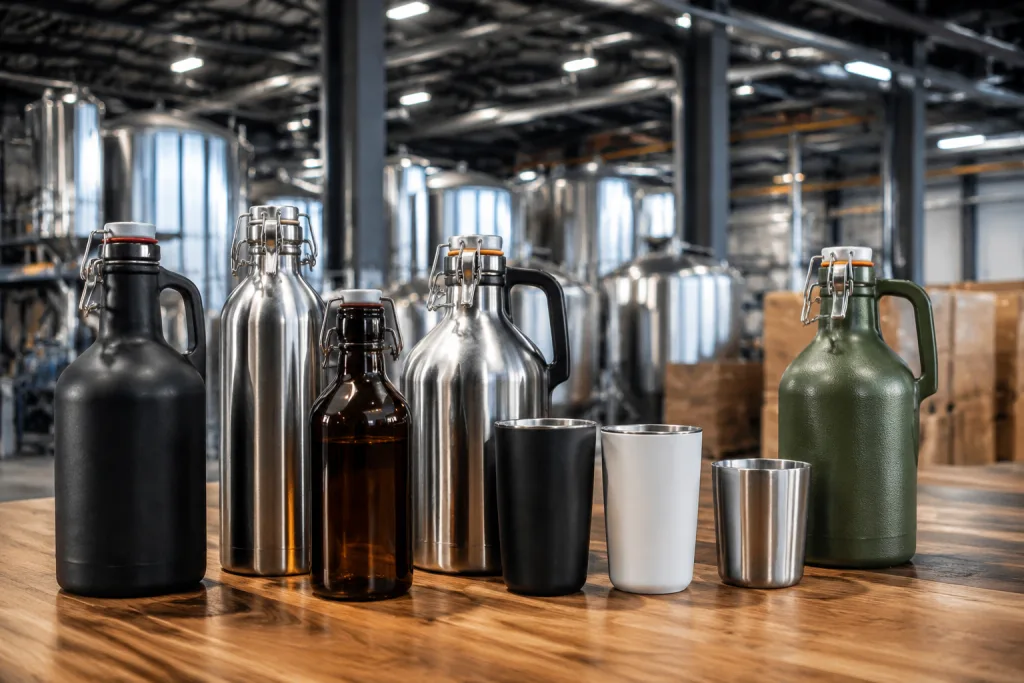
I’ll rewrite the four paragraphs in-place, keeping the HTML tags and the section heading unchanged, while tightening the sales-engineer tone and adding concrete factory-floor detail.Quality control costs less than replacing 3,000 leaking growlers. We run this from the PO stage: capacity tolerance, vacuum insulation, coating adhesion, logo placement, cap torque, gasket fit, leak resistance, odor, carton strength, and barcode scan rate if retail labels are on the box. On one 32 oz run, QC pulled the sample and found a 1.8 mm neck offset that would have thrown off the cap seal.
For most B2B orders, AQL general inspection level II with critical 0, major 2.5, minor 4.0 is a solid starting point. Critical defects are sharp edges, leaking caps, unsafe material, or contamination. Major defects are wrong logo, heavy dents, failed coating adhesion, or vacuum failure. Minor defects are small cosmetic marks within the agreed limit. If you are buying canteen promotional goods for a fixed event date, skipping inspection because the unit price is low is the wrong question to ask.
Compliance changes by market. For Europe, ask for LFGB, REACH, and food-contact paperwork. For the United States, FDA food-contact expectations and California Proposition 65 screening may apply. For kids products, ASTM and CPSIA issues can come up, but most beer growlers are adult products. If a canteen manufacturer says “all certificates available” but cannot link the report to the exact resin, coating, or gasket batch, the math does not work. We’ve seen buyers flag a PO typo on the material code and the whole file went back to square one.
Some defects come from the line. Powder coating chips when pretreatment is weak. Laser logos drift when coating thickness changes by 0.2 mm. Weld marks show more on brushed steel than on matte black finish. A capable canteen factory will call these tradeoffs before production starts. A weak supplier promises perfect output, then asks you to accept “normal tolerance” after shipment.
Build a quote sheet suppliers respect
I’ll rewrite the prose in place, keep the HTML exactly as-is, and strip the AI-ish phrasing while making it sound like a real factory sales note.A clean RFQ saves 3 to 5 days. It also tells canteen suppliers you are a real buyer, not someone fishing for random numbers. Put the basics on one sheet: capacity, use case, steel grade, insulation spec, lid style, coating color, logo method, packing, compliance market, quantity tiers, Incoterm, destination port, and launch deadline. We run quotes faster when every buyer sends the same sheet.
Use exact language. Don’t write “premium custom canteen” and hope the factory guesses right. Write “64 oz double-wall vacuum insulated stainless growler, 304 inner, 201 outer acceptable, matte powder coating, one-position laser logo, individual white box, 24-hour cold claim not required, FOB Ningbo.” QC pulled the sample on a 48-hour test, and that level of detail gets a better price than three vague emails.
For distributor growler and distributor canteen programs, list annual forecast and first order quantity as separate numbers. A factory may quote 1,000 pcs differently when you show a believable 12,000 pcs yearly plan across three colors. Do not pad the numbers. We’ve seen that go sideways on the first PO. A modest forecast with real buying history beats a huge promise every time.
Ask each canteen supplier to confirm exclusions line by line. Sample courier cost, export carton printing, spare gaskets, third-party inspection, and local FOB charges all need a yes or no. The buyer flagged a PO typo on “carton” vs “cartons” before, and that kind of small miss turns into a debit note. A good China supplier answers straight.
Send your growler specs for a real factory quote
Share capacity, quantity, logo method, market, and deadline. We will return MOQ, FOB pricing, sample timing, and production lead time.
Frequently asked questions
How many suppliers should I include in a beer growler shortlist?
Start with 8-12 names, then reduce to 3-4 after checking factory type, export experience, MOQ, compliance fit, and response quality. A supplier list beer growler file with 50 unverified names wastes time. Ask every source for capacity, lead time, FOB port, BSCI or ISO status, and sample terms. For a first custom growler project, you want at least one primary factory, one backup canteen manufacturer, and one secondary canteen vendor for price benchmarking. Do not place the order with the cheapest quote until you compare steel grade, cap design, packing, inspection standard, and payment terms.
What is a realistic MOQ for a custom beer growler?
For an existing stainless growler mold, 1,000 pcs per color is the most common MOQ for stable pricing. Some China factories can accept 300-500 pcs if you use stock color, stock cap, and simple laser engraving, but unit price may rise 20-35%. At 3,000 pcs, pricing usually improves because coating, cartons, and labor scheduling become more efficient. If you need a new lid, custom molded part, or canteen customized body shape, expect higher MOQ, often 5,000-10,000 pcs depending on tooling. Always ask whether MOQ is per model, per color, or per logo.
How long does a customized growler order take from China?
For 1,000-5,000 pcs using an existing mold, plan 7-12 days for sampling and 30-45 days for mass production after deposit and sample approval. Add 3-6 days for courier sample shipping to Europe or North America. Ocean freight can add 25-40 days depending on port and inland delivery. During peak season, total production time can stretch to 45-60 days. If you need FNSKU labels, retail cartons, pallet rules, or third-party inspection, add another 3-7 days. Lead time starts after artwork, deposit, and sample approval are complete, not after your first email.
Which decoration method is best for growlers and canteens?
Laser engraving is the safest choice for stainless or powder-coated growlers when you want durability and a clean one-color mark. It usually costs USD 0.18-0.45 per position, depending on size and order quantity. Silk screen is cheaper for simple logos, often USD 0.12-0.35, but curved bodies and multi-color registration can create rejects. Heat transfer or full-wrap printing works for bold retail graphics, but cost and testing increase. For canteen promotional orders under 1,000 pcs, laser is usually the least risky. For 3,000 pcs or more, compare both price and appearance with physical samples.
What quality standard should I put on the purchase order?
Use AQL general inspection level II with critical 0, major 2.5, minor 4.0 unless your customer requires a stricter plan. Define critical defects as leaks, unsafe material, sharp edges, contamination, or wrong product. Major defects should include wrong logo, serious dents, failed coating adhesion, vacuum failure, and carton marking errors. Ask for leak testing, coating adhesion testing, capacity checks, and barcode scans if retail labels are used. For Europe, confirm LFGB and REACH needs before production. For the US, discuss FDA food-contact expectations and Proposition 65 screening if relevant to your sales channel.