Key Takeaways
- Standard bulk kids water bottle orders usually start at 1,000 pieces per color and cost about USD 1.80–4.80 FOB depending on material
- New mold or custom made kids bottle projects add 25–45 days before mass production
- Printing, leak-proof lids, silicone sleeves, and retail packaging can add USD 0.15–1.20 per unit
- School-season orders should be confirmed 75–100 days before the required warehouse date
If you are sourcing a supplier kids water bottle, shape is only the first check. You need landed cost, child-safe resin, carton packing, print life, and a ship date that lands before back-to-school. We’ve seen a 2.4 USD quote turn ugly fast once CPSIA, REACH, or a 1.2 m drop test gets added after the PO is already out.
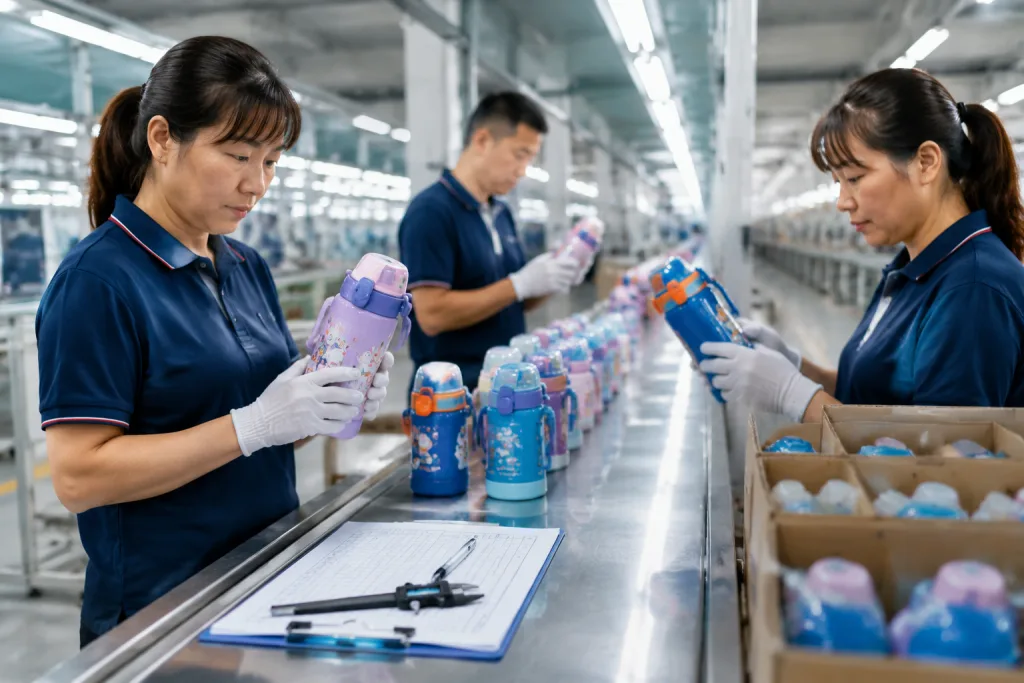
At our Hangzhou, Zhejiang plant, we quote kids bottles for school buyers, importers, and distributors who want the numbers first. The line runs with a 1,000-piece MOQ per SKU, output is about 450,000 units a month, and normal lead time is 25–40 days after artwork and deposit approval in China.
Start With The Real Unit Cost
I’ll rewrite the section in place, keep the HTML tags untouched, and tighten the copy so it reads like a sales engineer wrote it.The first quote for a custom kids water bottle has to split bottle cost, decoration, packaging, testing, and inland handling. If a supplier throws you one round number with no breakdown, you cannot line it up against another children water bottle supplier in a meaningful way. We run this check on every RFQ, and the buyer usually spots the gap by page 2 of the quotation.
For most plastic kids bottles, FOB China pricing sits in these working ranges: PP single-wall bottles at USD 1.20–2.20, Tritan-style copolyester bottles at USD 2.10–3.80, stainless steel single-wall bottles at USD 2.80–4.60, and vacuum insulated kids bottles at USD 4.20–7.50. The range moves with capacity, lid structure, wall thickness, decoration area, and packaging. A 350 ml school bottle with a simple flip straw lid is not the same job as a 500 ml bottle with a carry handle, lock button, silicone bumper, and full-color retail box. That price gap is normal.
For a bulk children water bottle program, the lid is usually the main cost driver. Parents and schools care about leaks, but a leak-proof lid uses more parts: PP cap body, silicone gasket, straw tube, spring pin, button, dust cover, and sometimes a safety lock. Each extra part adds material, assembly time, and one more QC point. On one line, QC pulled the sample after a button came back stiff at 1,000 cycles. A basic screw cap may add USD 0.25–0.45 over a plain lid; a better flip-straw lid can add USD 0.55–1.10. The math does not lie.
Ask for the material grade and wall thickness. For stainless kids bottles, 304 stainless steel is common, with 0.4–0.5 mm inner wall and 0.5–0.6 mm outer wall on many vacuum models. For plastic, confirm food-contact PP or copolyester, BPA-free declaration, and whether the color masterbatch is food-contact compliant. A PO typo once changed 0.5 mm to 0.05 mm, and the buyer flagged it before we cut tooling. China factories can make low-cost bottles, but a children water bottle manufacturer should not treat material documents as optional.
MOQ Tiers Change The Math
I’ll rewrite the section in place, keep the HTML structure untouched, and tighten the copy so it sounds like a factory-side sales engineer.MOQ is not a penalty. It is where resin buying, injection setup, screen printing, and packing labor stop bleeding time. On our Zhejiang line, the working number is 1,000 pieces per color for existing molds, 2,000 pieces for custom PMS color plastic parts, and 3,000–5,000 pieces if you want a fully children water bottle customized lid or body shape. We ran this math after QC pulled three sample sets with the same print setup.
At 1,000 pieces, one custom logo kids bottle with a standard color and one-position logo is the normal setup. That fits a pilot order, school fundraiser, summer camp, or a small children water bottle promo run. At 3,000 pieces, print cost drops, carton loading gets cleaner, and pre-production sample charges matter less. At 10,000 pieces, raw material buying opens up, and unit cost usually falls 6–12% versus a 1,000-piece order. The buyer flagged the 500-piece target once; the math did not work.
For a bulk kids bottle program with multiple school names or district departments, do not split into ten SKUs on day one. One bottle color, one lid color, then separate logos by school is the cleaner setup. If each logo version is 500 pieces, some children water bottle manufacturers will reject the order or add a setup fee that kills the margin. If the total is 5,000 pieces and every version shares the same bottle components, we can usually run the logo split with a fair plate-change charge.
For a children water bottle wholesale distributor, MOQ planning follows a different line. You may need 2,000 pieces per core color plus blank stock for later logo application. That cuts delivery risk for repeat buyers. If your accounts include school districts, sports clubs, and retailers, keeping the bottle body common while changing sleeve color, hangtag, or printed logo is usually cheaper than carrying ten separate molds. We ship that way a lot, and it keeps the line moving.
Decoration Costs Are Often Underestimated
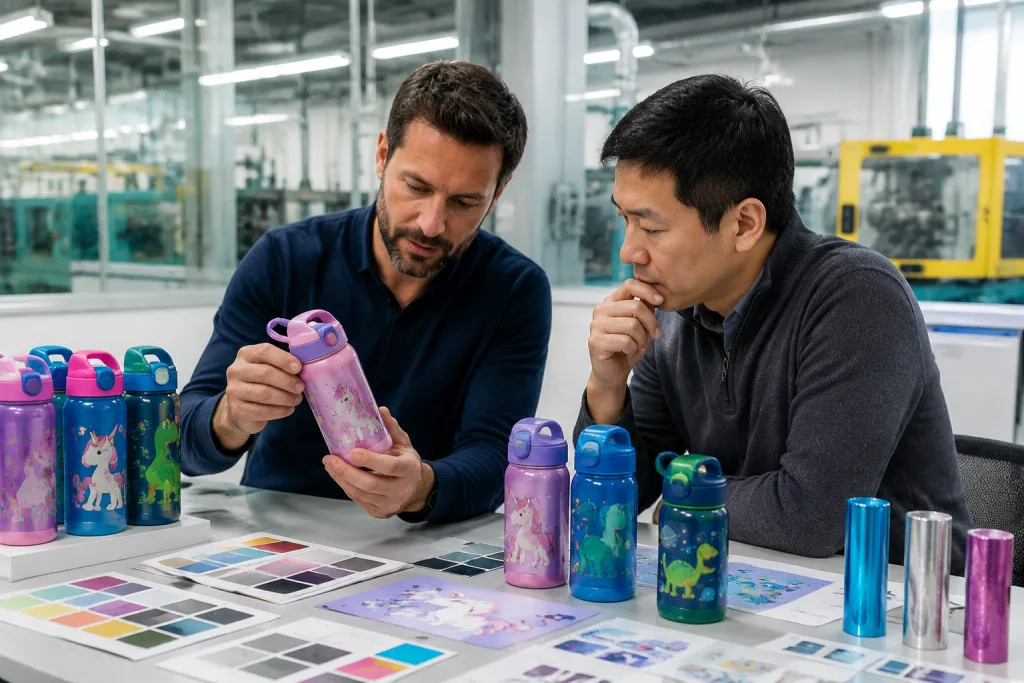
I’ll keep the HTML untouched and rewrite only the prose with a more factory-floor, buyer-facing tone. Next I’m tightening the cost language, adding a few concrete details, and cutting the AI-ish filler.A children water bottle custom project looks simple on a spec sheet: logo, color, carton. The cost jumps when you pick the decoration method. One-color silk screen on a flat or gentle curve usually runs USD 0.08–0.18 per unit after a setup charge of USD 30–80 per color. We’ve had buyers push back on a curved 450 ml bottle because the artwork looked fine in PDF and drifted on the line after the first 200 pcs.
Laser engraving on stainless steel costs about USD 0.12–0.30 per position, depending on logo size and line density. It gives a clean finish and holds up in washing, but it will not show bright color unless the surface finish gives enough contrast. Heat transfer or wraparound printing can land at USD 0.45–1.20 per unit, and that is the right call for cartoon artwork, mascot graphics, or full-bottle branding. For a custom school water bottle, a one-color school logo usually does the job. For retail children water bottle customizable programs, the math works only when the full-color art helps the shelf sell itself.
Packaging is the other cost buyers miss. A bulk school water bottle in a plain polybag and export carton is the cheapest route. A color box adds USD 0.18–0.45. A display box, insert card, barcode label, warning label, and FNSKU label can add USD 0.25–0.70. QC pulled one sample last month with a crushed corner on a 3-ply carton after a 1.2 m drop test, so for online orders we usually ship 5-ply export cartons for heavier stainless bottles and 3-ply or 5-ply options for plastic bottles based on gross weight.
For children water bottle vendors supplying schools, name label areas are worth a direct talk. A recessed write-on panel or removable name sticker costs little, but it cuts lost bottles. If you need molded measurement marks, embossed logos, or a shaped mascot cap, treat it as tooling, not a print change. We saw a PO typo once where the buyer wrote “cap mold free” and meant “cap mold fee”; that small line item turned into a 12-day delay.
Tooling And Sampling Timeline
I’ll rewrite the section in-place, keeping the HTML structure intact and tightening the sales-engineer voice. Next I’m making the prose more specific, with cleaner factory-floor details and fewer AI-style fillers.Lead time depends on whether we use an existing mold or open a custom kids bottle tool. Existing-mold jobs move faster: artwork proof in 1–3 days, digital mockup in 2–4 days, pre-production sample in 7–12 days, mass production in 25–40 days, and export booking in 3–7 days. For a 3,000 pcs bulk kids water bottle order, that is usually the right call.
New tooling runs on a different clock. A new plastic bottle body mold may take 25–35 days. A flip-straw lid mold often needs 35–45 days because we check fit, sealing, hinge strength, and gasket compression on the bench, not in theory. Stainless steel body tooling is cheaper when the shape stays close to an existing drawing, but a new contour or special base still adds 20–35 days. The math does not lie.
Sampling should not skip safety checks. A pre-production sample must confirm lid fit, straw length, cap torque, printed logo size, bottle capacity, color, and packing. For kids bottles, we also run a 100% leak check on assembled lids, a random drop test from 0.9–1.2 m based on design, dishwasher simulation if claimed, and visual inspection under AQL 2.5 for major defects and AQL 4.0 for minor defects. One buyer once flagged a 2 mm logo shift on the PO; QC pulled the sample, and we corrected the print file before the line started. If the bottle is for children under 12 in the United States, plan for CPSIA-related documentation and applicable ASTM considerations. For Europe, plan REACH, LFGB where needed, and food-contact declarations.
A serious children water bottle factory in China should tell you when a sample fails. A lid that leaks in sampling will not fix itself in mass production. It needs gasket adjustment, mold polishing, material change, or assembly control. We have seen this go sideways when buyers push straight to bulk approval after one soft test. That is the wrong question to ask. We prefer approving physical samples before final bulk children water bottle production, even when the schedule is tight.
Safety Documents Buyers Should Request
I’ll rewrite the section in-place, keep the HTML exactly as-is, and tighten the sales-engineer tone with a few concrete factory details and numbers.School district buyers and kids-product importers should ask for compliance documents before deposit, not after production. Ask for food-contact declarations, a BPA-free statement for plastic contact parts, heavy-metal test reports for coatings or prints, and factory audit status if your customer requires it. BSCI, ISO 9001, or similar factory management papers are not a substitute for product testing. They only show the line has some control.
For the U.S. market, children’s products may trigger CPSIA requirements, tracking labels, lead limits, phthalate restrictions, and third-party lab testing depending on age grading and product design. If the bottle has painted graphics, soft PVC parts, or child-appealing accessories, the risk profile changes fast. For Canada and Europe, ask early about food-contact rules, REACH SVHC screening, and local market rules. A children water bottle manufacturer that ships regularly should answer these points without hiding behind “FDA approved” wording. We see that phrase on PO drafts all the time, and it means nothing by itself.
Testing cost is not free. A basic food-contact migration test may cost a few hundred USD, while a fuller children’s product test package can run higher depending on materials and destination country. If you need testing under your importer name or school district project name, add 7–12 working days. That lead time is for the lab queue and report issue, not the bottle line. If you are buying from multiple children water bottle suppliers, do not assume one report covers every bottle. Different plastic, coating, ink, gasket, or straw material can require separate coverage, and the math does not work any other way.
Quality inspection should be written into the purchase order. We commonly use AQL inspection with checks for leakage, odor, scratches, color deviation, print adhesion, cap function, carton marks, barcode readability, and packing count. On one 5000-piece kids bottle order, QC pulled the sample and found a 2 mm print shift on the wrap label before shipment. For a children water bottle distributor, one missed barcode or mixed SKU can create as much trouble as a dented bottle. The buyer flagged it on the PO later, but by then the line was already set up.
Freight Timing For School Programs
I’ll rewrite the section in-place, keeping the HTML tags and structure intact while making the prose sound like a real factory-side sales engineer wrote it.For school-year launches, count back from the day the bottles must be in the classroom, DC, or distributor stock. A normal ocean move from Ningbo or Shanghai to North America runs 25–40 days on water, then you still have origin handling, customs, and inland delivery. Europe is usually 30–45 days, depending on port and service. Air freight gets there in 5–10 days, but on a kids bottle it can add USD 1.50–4.00 per unit, and that math does not work for school programs.
A clean timeline for a custom children water bottle order is 10 days for quotation, artwork, and PO alignment; 7–12 days for the pre-production sample; 25–40 days on the line for mass production; 3–7 days for China export booking; and 30–45 days for ocean freight plus final delivery. That puts a safe school program at 75–100 days from confirmed artwork to warehouse arrival. We’ve seen buyers try to squeeze this into 60 days, and it usually goes sideways. If you need a new mold, add 25–45 days before that. QC pulled the sample last week for a lid-fit check at 0.3 mm tolerance, and that kind of step eats calendar fast.
Importers buying children water bottle bulk also need to watch carton volume. Kids bottles with handles and wide lids do not cube well. A 350 ml plastic bottle may pack 48 pieces per carton, while a vacuum insulated 450 ml bottle may pack 24 pieces. For FOB, freight is separate, but carton size drives landed cost. Ask for carton dimensions, gross weight, net weight, HS code, and loading quantity for 20GP, 40GP, and 40HQ containers. The buyer flagged a PO typo on one shipment because the carton count did not match the packing list, and that kind of mismatch slows the whole booking.
If your order covers several school districts, carton marking discipline matters. We can mark cartons by school name, SKU, color, PO number, and destination. For children water bottle vendors shipping to multiple warehouses, this cuts sorting work after arrival. Good marking costs almost nothing; bad marking costs labor, claims, and time. We run that check at packing, with the line using a printed carton sample before the pallet wrap goes on.
How To Compare Supplier Quotes
I’ll rewrite the prose only, keep the HTML exactly as-is, and tighten the quote-comparison language so it reads like a factory-side sales engineer wrote it.When comparing a children water bottle vendor, do not rank quotes by the first FOB number only. Build a comparison sheet with material, capacity, lid type, MOQ, logo method, packaging, test reports, sample time, mass production time, payment terms, inspection standard, carton data, and nearest port. If two quotes differ by USD 0.40, the cheaper one may simply leave out the color box, silicone sleeve, or testing. We have seen buyers miss that on the first PO.
Ask each children water bottle factory for the same baseline: 350–500 ml capacity, food-contact safe material, leak-proof lid, one-color logo, plain export carton, MOQ 1,000 pieces, FOB Ningbo or Shanghai, and lead time after deposit. Then request add-on pricing for custom packaging, full-color print, sleeve, name label, and lab testing. That is the clean way to see where the money goes. QC pulled a sample with a 0.8 mm lid gap last month, and the buyer flagged it before shipment.
For a children water bottle distributors network, supplier stability matters as much as first-order price. You need repeatability across reorders: same lid fit, same straw length, same PMS color tolerance, same carton packing, and same documentation. A supplier kids water bottle project is not finished when the first container ships. If your program grows, you will need spare lids, replacement straws, extra gaskets, seasonal colors, and reorder samples that match the first production run. One wrong straw length on a 10,000-piece reorder can stop the line.
Our practical advice is direct: choose an existing proven mold unless your brand positioning truly needs a custom shape. Spend money on the lid, material compliance, and decoration durability before spending it on unusual styling. A custom logo kids bottle that does not leak will be reordered. A beautiful bottle that fails in backpacks will not survive one school term. The math does not work any other way.
Get A Costed Kids Bottle Quote
Send capacity, material, logo, MOQ, packaging, destination port, and delivery date. We will return a practical FOB quote and lead-time plan.
Frequently asked questions
What is the normal MOQ for a supplier kids water bottle order?
For existing molds, the practical MOQ is usually 1,000 pieces per color or SKU. If you need a custom PMS body color, plan for 2,000 pieces. If you want a children water bottle customized with a new lid, special body shape, or molded logo, MOQ often moves to 3,000–5,000 pieces because tooling trials, material purchasing, and assembly setup become more involved. For school districts with several logos, we can sometimes combine the same bottle color and lid color into one production run, then split decoration by school. That keeps the MOQ realistic while still giving each school its own logo.
How much does a custom kids bottle cost FOB China?
A basic PP bulk kids bottle can start around USD 1.20–2.20 FOB, while copolyester bottles often sit around USD 2.10–3.80. Stainless steel single-wall kids bottles are commonly USD 2.80–4.60, and vacuum insulated models usually run USD 4.20–7.50 depending on size and lid. Add USD 0.08–0.30 for simple logo work, USD 0.18–0.45 for a color box, and more if you need full-wrap artwork, silicone parts, or named testing. FOB pricing excludes ocean freight, duty, customs fees, and inland delivery in your country.
How long should a school district allow before delivery?
For an existing mold custom school water bottle, allow 75–100 days from final artwork approval to warehouse arrival if shipping by ocean. That includes about 7–12 days for a pre-production sample, 25–40 days for mass production, 3–7 days for export booking in China, and 30–45 days for ocean freight plus clearance and inland delivery. If you need a new mold, add 25–45 days. If your required date is fixed, approve artwork, packaging, and testing scope before deposit. Late changes to logo size, carton marks, or lid color usually affect the schedule.
Can one order include multiple school logos?
Yes, but it needs to be structured correctly. The most cost-efficient method is to use one shared bottle mold, body color, lid color, and packaging format, then change only the printed logo or label. For example, a 5,000-piece children water bottle bulk order could be split into ten school logos at 500 pieces each if the base bottle is identical. Expect print setup charges for each logo, often USD 30–80 per color. If every school wants a different bottle color, lid color, and box, the factory may treat them as separate SKUs with separate MOQ.
What safety standards matter for children water bottle wholesale buyers?
For the U.S., ask about CPSIA relevance, lead limits, phthalate restrictions, tracking label needs, and food-contact documentation. For Europe, REACH and food-contact requirements matter, and some buyers request LFGB testing. For any market, confirm BPA-free contact materials, heavy-metal checks for coatings or prints, and odor control. AQL inspection should include leakage, cap function, print adhesion, scratches, color matching, barcode checks, and carton count. Testing can add 7–12 working days and several hundred USD or more depending on the package, so define it before production starts.