Key Takeaways
- A 3,000-unit MOQ is common for a supplier kids drink bottle with standard decoration; custom molds often start at 5,000 units.
- FOB pricing for a basic 500 ml kids bottle usually sits around USD 1.20-1.80, while insulated builds can exceed USD 4.50.
- Typical lead time is 20-35 days for stock tooling and 45-60 days for new molds or complex packaging.
- AQL 2.5 for critical defects and REACH-compliant materials should be your baseline for Europe and North America.
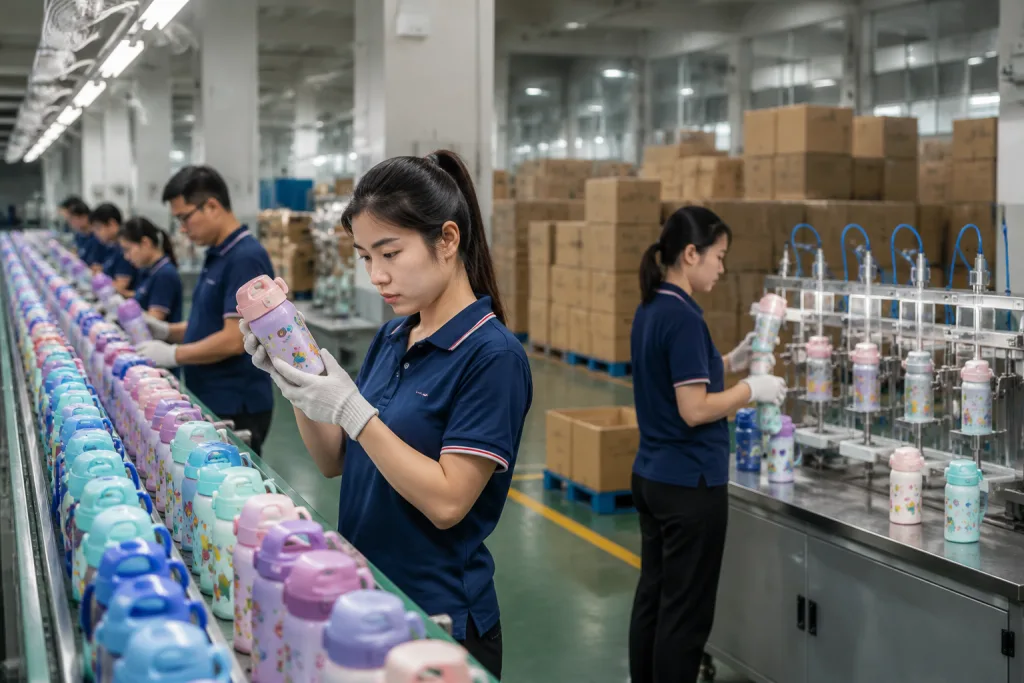
When you source a supplier kids drink bottle, the real question is not “what is the cheapest unit price?” It is whether the factory can hold a stable spec, pass safety checks, and still ship on time when your season hits. We see that gap fast in the line: one loose cap gasket, one bad pad-print plate, and the whole carton plan slips. In Zhejiang and across China, the pain shows up in mold fees, decoration choices, cap parts, and the days before your cartons are packed.
If you buy for a brand, distributor, or retailer, treat kids bottles like a cost-and-timeline problem, not a catalog problem. A simple 500 ml Tritan bottle with one-color print may start around USD 1.20 to 1.80 FOB at 3,000 units, while a more complex insulated model can land above USD 4.50. The buyer flags the same thing every time: MOQ, tooling setup, and QA flow decide whether you get a clean launch or a late ship. At BottleForge in Hangzhou, Zhejiang, we run about 300,000 units per month, and QC pulled the sample more than once when a cap logo drifted 1.5 mm.
What drives the unit cost
I’ll rewrite the prose in place, keep the HTML structure untouched, and make the pricing language sound like a factory-side sales engineer.For a supplier kids drink bottle, unit cost usually comes down to five items: body material, cap structure, decoration method, test scope, and packaging. A single-wall PP or Tritan bottle runs cheaper than a double-wall insulated build; we skip vacuum forming, extra welding, and the 100% leak test on the line. Add a silicone spout, straw, carry handle, or dust cap, and the part count goes up fast.
Here is the range I quote buyers from Europe and North America: a plain 350 ml-500 ml kids bottle with one-color silk screen print usually lands at USD 1.10-1.60 FOB for 3,000 units. Add laser engraving, a metallic finish, or a custom-shaped lid and the number moves to USD 1.70-2.40. If you want a customized drinkware pack with box printing and insert cards, budget another USD 0.20-0.60 per set. A canteen custom job with a simple sport cap follows the same math; a more complex custom canteen with three accessories does not. The buyer flagged the $0.18 lid delta on one PO, and he was right.
- Material: Tritan, PP, stainless steel, or aluminum
- Decoration: silk screen, UV print, pad print, laser
- Cap parts: one-piece cap is cheaper than two- or three-piece
- Compliance: FDA, LFGB, REACH, phthalate-free testing
- Packing: bulk carton is cheaper than retail-ready custom box
If a quote looks too low, check whether it leaves out testing, spare parts, or color matching. We run into this all the time in Zhejiang: the headline price looks clean, then QC pulled the sample and found the valve leak at 12 kPa, and the savings were gone. That is the wrong question to ask; the real number is landed cost, not the first sheet.
MOQ tiers that actually matter
I’ll rewrite the section in place, keep the HTML structure intact, and make the copy sound like a real factory-side sales engineer.MOQ is the point where the math starts to work. For a basic supplier kids drink bottle, 1,000 units is possible if we already have the mold, cap, and bottle color on the line. Once you ask for a new mold, a special Pantone color, or a branded cap, the real MOQ usually moves to 3,000 to 5,000 units. We see that every week in Hangzhou. For OEM work in China, that is normal.
Here is how the tiers behave in practice. At 1,000 units, you pay for setup time and tighter labor allocation. At 3,000 units, the first real price break shows up. At 5,000 units and above, the buyer can usually push for better packaging or a lower print charge. A canteen customizable order or a customizable canteen follows the same rule: a unique lid, color, or shape pushes the MOQ up. For a distributor drinkware program, this is where you decide between one hero SKU and three colorways. The buyer flagged it once on a PO typo, and the whole carton plan had to be redone.
Practical rule: if the factory says “low MOQ” but cannot show a real sample, test report, and packing spec, the quote is not ready for purchase order stage.
For a standard kids bottle line, 3,000 units is the safest commercial MOQ. That gives enough volume to hold cost and still keeps the risk sane if sell-through runs 12 days instead of 18. QC pulled the sample, checked the lid fit with a 0.2 mm gap gauge, and that is the kind of detail that tells you whether the offer is real.
Lead time by production stage
I’ll rewrite the section in place, keep the HTML structure intact, and make the copy sound like a factory-side sales engineer wrote it.Lead time is where a lot of buyers blow the season. A supplier kids drink bottle with existing tooling and no structure change can usually move from artwork sign-off to ship-ready cartons in 20 to 35 days. That covers file confirmation, resin or stainless buy, line production, assembly, and packing. If you need a new cap mold, a custom body, or a different accessory set, plan on 45 to 60 days. We have seen sample loops add 7 days each when the buyer flags a logo color typo or asks for a tighter lid fit.
For buyers comparing a canteen supplier and a canteen manufacturer, ask for stage timing, not one blended number. That is the wrong question to ask. On our line, the bottle body can be done in 7 to 10 days, but cap molding, leak checks, and carton approval still eat calendar days. If your program includes a custom drinkware bundle with 3 SKUs, the slowest part sets the ship date. A custom growler or customizable growler follows the same rule, and the insulation test adds another QC round with the vacuum gauge.
- Sample confirmation: 5-10 days
- Tooling if needed: 15-25 days
- Mass production: 10-20 days
- Final inspection and packing: 3-5 days
- Ocean booking buffer: 7-14 days depending on port load
If you are selling into a launch window, leave at least 2 extra weeks for approvals and freight changes. We run this buffer on every tight order. The math works, and the pallet labels get checked twice before the truck leaves the warehouse.
Testing, compliance, and failure risk
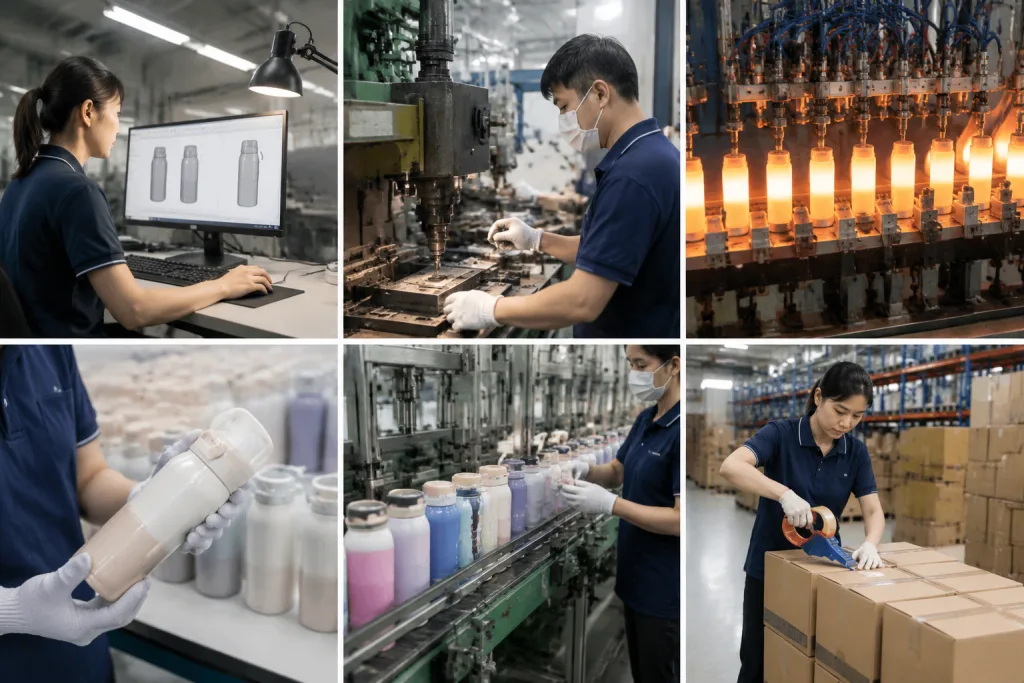
I’ll rewrite the section in place, keep the HTML tags and structure untouched, and make the wording sound like a factory-side sales engineer—more specific, less generic.Compliance is not optional on kids drinkware. For Europe and North America, we expect REACH material declarations, LFGB where needed, FDA food-contact support for the US market, and migration testing when the buyer asks for it. On the line, we also run a 24-hour leak test and a 1.2 m drop test. For stainless and plastic kids bottles, closure strength and bite-valve integrity matter more than a glossy finish.
Ask the canteen factory for its in-house QC flow. At minimum, we want incoming material checks, in-process checks, and final inspection at AQL 2.5 for major defects and 4.0 for minor defects. A Zhejiang canteen manufacturer should handle that without drama. A serious canteen vendor or canteen vendors should also lock down color tolerance, cap torque, and carton drop limits. For a canteen promotional run, “promo” is not a free pass to skip tests; we’ve seen that go sideways fast.
One more point: if a factory offers a paper-thin price and says “no test needed,” the math does not work. QC pulled the sample, found a loose cap at 0.8 N·m, and the buyer flagged it before shipment. That is not savings. That is returns, chargebacks, or a delayed listing.
Packaging and freight change your margin
I’ll rewrite the section to sound like a factory-side sales engineer, keep the HTML exactly as-is, and preserve the original tags and structure.Packaging can swing landed cost more than most buyers expect. A plain bulk carton is the cheapest route, but once you sell into retail or Amazon, you start adding polybags, inner boxes, barcode labels, or an FSC-style retail carton. For a supplier kids drink bottle, we’ve seen packaging add USD 0.15 to 0.80 per unit, depending on print coverage and how many inserts the buyer wants stuffed in. One PO had “gift box” typed twice and no size callout; QC pulled the sample, and the carton spec had to be fixed before the line could run.
Freight changes the math fast. In a normal season, a 20-foot container from China to the US or Europe can work for a larger distributor drinkware order, but air freight will crush margin on low-price SKUs. Buyers like to focus on FOB, and that’s the wrong question to ask. A product at USD 1.40 FOB can land around USD 2.10-2.60 after freight, duty, and destination fees. North American distributors usually compare a canteen distributor quote and a canteen distributors quote on landed cost, not just FOB. We ship enough of these to know the math does not lie.
- Bulk carton: lowest cost, fastest packing at the line
- Retail box: better shelf appeal, higher labor and carton cost
- Barcode/FNSKU: needed for Amazon and similar channels
- Master carton spec: drives cube, pallet count, and freight cost
If your customer is price-sensitive, put the money into the print and carton first. Skip the decorative extras nobody will see.
How to choose the right factory
I’ll rewrite the section in-place, keep the HTML tags untouched, and make the prose sound like a factory-side sales engineer wrote it.You do not need the biggest factory; you need the one that can repeat your spec. A good canteen supplier or canteen suppliers will answer three questions fast: exact MOQ, tested lead time, and what sits inside the FOB price. We run into this every week — a buyer sends a PO with “blue bottle, 5k pcs,” then the sample sign-off shows Pantone 286 C and a 2 mm logo emboss, so the math no longer matches. If they cannot show a sample schedule and a QC plan, they are not set up for a real launch. That is the wrong question to dodge.
For buyers in Europe and North America, check factory history, export volume, and monthly capacity before you compare color options. A factory in Zhejiang that ships 300,000 units per month can usually protect lead time better than a small workshop, but only if the line has clear process control. Ask for BSCI if your retailer requires it, ask for REACH and food-contact declarations, and ask to see one recent container sample, not a polished catalog. QC pulled the sample on one 18/410 cap last month because the torque was off by 0.3 N·m; that kind of finding tells you more than a brochure. If you are sourcing a canteen distributor or distributor canteen program, the same rule applies: pick the seller who can keep stock moving, not the one with the lowest quote.
For brand launches, customized canteen and customizable drinkware projects work best when one person owns sample approval, artwork, and shipment booking. Split ownership is where delays happen. We have seen a PO typo on “lid” versus “leak-proof lid” add 12 days because the buyer flagged it after pre-production. One owner. One file. That keeps the line moving.
Get a factory quote with real numbers
Send your target volume, cap style, and packaging spec. We will return FOB pricing, MOQ, and lead time from our Hangzhou, Zhejiang production team.
Frequently asked questions
What is a realistic MOQ for a supplier kids drink bottle?
For a standard supplier kids drink bottle with existing mold and one-color print, 3,000 units is the realistic commercial MOQ. Some Zhejiang factories can do 1,000 units if the tooling already exists, but pricing is usually weaker and setup costs stay high. If you need a new mold, custom cap, or special Pantone body color, expect 5,000 units or more. For retail buyers, 3,000 units usually gives the best balance of cost and inventory risk.
How much should I budget per unit FOB?
A basic 350 ml to 500 ml kids bottle usually lands around USD 1.10-1.80 FOB at 3,000 units. Add more for a stainless build, a more complex lid, or premium printing. A double-wall insulated version can move past USD 4.50 FOB. If you need retail packaging, testing, and barcode labels, add USD 0.20-0.80 per set depending on the pack format.
How long does production take in China?
For stock tooling, plan on 20 to 35 days from sample approval to finished cartons. If the project needs new tooling or multiple sample rounds, 45 to 60 days is more realistic. In China, the factory may make the bottle quickly, but cap testing, packing approval, and booking freight add time. If you are shipping into a seasonal launch, keep a 2-week buffer.
What compliance documents should I request?
Ask for material declarations, REACH-related statements for Europe, food-contact support documents, and test reports if the product uses plastic, silicone, or stainless steel. For kids drinkware, request leak test records, drop test data, and QC inspection reports using AQL 2.5 for major defects. If the supplier has BSCI or similar social compliance, that helps with retailer audits, but it does not replace product testing.
Can I order customized drinkware with multiple colorways?
Yes, but each colorway affects MOQ and lead time. A common split is 1,000 units per color or a total 3,000-unit run across three colors, depending on the factory. More colorways mean more packing SKUs, more labeling work, and higher risk of leftover inventory. If you also want a customized growler or canteen custom range, keep the decoration strategy simple so your replenishment stays manageable.