Key Takeaways
- A practical supplier kids bottle MOQ starts at 1,000 units per color and logo, with better pricing above 5,000 units
- Custom mold or lid tooling usually adds USD 800-3,500 and 15-25 days before sampling
- Most bulk kids water bottle projects need 35-55 days from artwork approval to FOB China shipment
- Food-contact testing, drop testing, and AQL inspection should be budgeted before the PO, not after production
A supplier kids bottle quote looks clean on page one. Ask for a leakproof lid, Pantone 297C body color, cartoon logo, LFGB testing, and shipment before the school term, and the USD 1.20 bottle can turn into a USD 2.85 landed problem. We have seen this go sideways when the buyer chose PP for a hot-fill request, then QC pulled the sample and found lid seepage after a 30-minute inverted test.
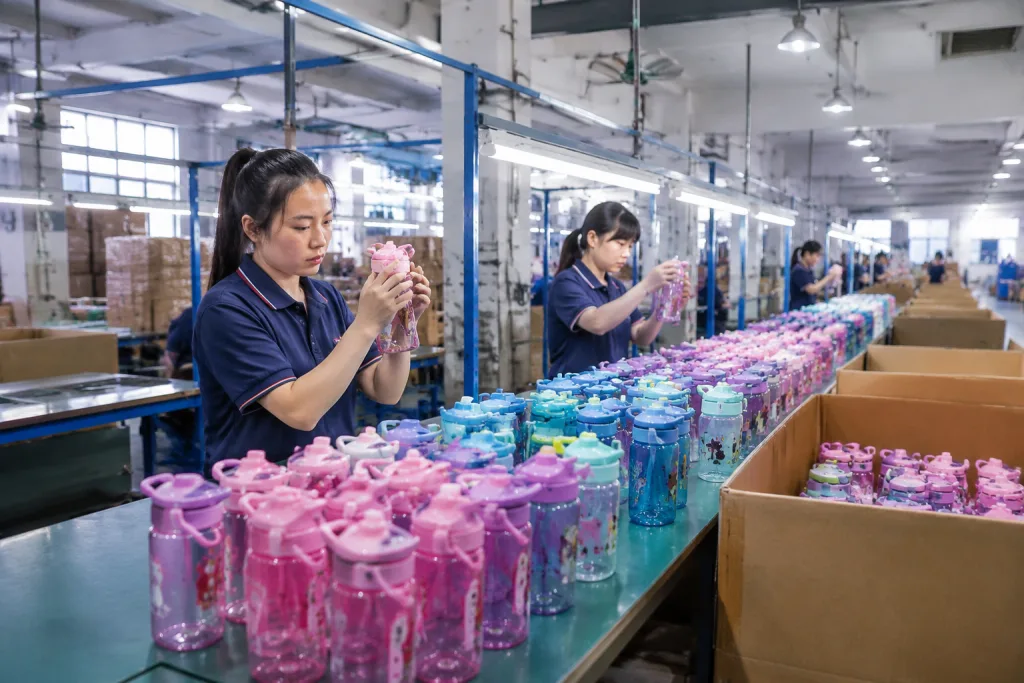
If you buy for a school district, a children water bottle distributor, or a kids-product importer, the quote needs to show cost, lead time, and risk before anyone promises a launch date. Our Hangzhou, Zhejiang team ships from China to Europe and North America, with typical MOQ from 1,000 units per design and production capacity around 450,000 kids bottles per month. On the line, one common buyer pushback is “can you cut MOQ to 500?” For custom color and logo, the math usually does not work once we run injection setup, color matching, and carton printing.
Start with the bottle type
For a school or youth retail program, the cheapest bottle is not always the lowest-risk bottle. We judge a supplier kids bottle by age range, how the child drinks, how the parent cleans it, and the import market. Small detail, big trouble. A 5-year-old needs a one-hand flip lid with a lighter spring; a 12-year-old can handle a screw cap or chug lid. On our leak bench, QC pulled 32 backpack samples last month and found 3 straw lids weeping after a 30-minute upside-down test. A bulk school water bottle that rides next to books needs a stricter leak check than a sports-day giveaway used for 2 hours on the field.
The main material choices are PP, Tritan, stainless steel, and aluminum. PP is usually the lowest factory cost, often USD 0.95-1.60 FOB China at 3,000 units, but it scratches faster; after 20 rubs with a 3M pad, the surface already looks tired. Tritan is clearer and tougher, so buyers use it for children water bottle custom projects, usually USD 1.65-2.90 depending on capacity and lid structure. Stainless steel gives better shelf value and insulation, but a vacuum custom kids water bottle normally starts around USD 3.20-5.80 FOB at 3,000 units because we run double-wall forming, vacuum pumping, and 100% air-pressure checks on the line. Aluminum sits between plastic and stainless steel, but this is where we push back: the inner coating is the wrong place to save USD 0.08 if the order needs food-contact compliance.
Capacity changes cost more than some buyers expect. Common kids sizes are 350 ml, 400 ml, 500 ml, and 600 ml. For school district buyers, 400-500 ml is the safer range because it fits lunch bags and 72-78 mm side pockets we see on most student backpacks. For retail importers, 500-600 ml gives stronger shelf value. The math doesn't work if a PO asks for a 720 ml bottle with a flip straw, handle, silicone boot, and name label area, then compares it with a plain 400 ml PP squeeze bottle; we saw one RFQ typo last season list “720 ml” in the spec sheet and “420 ml” in the artwork file, and the buyer flagged the carton size only after sampling.
What really moves the price
Most buyers ask for the unit price first. Fair enough, but this is the wrong question to ask on day one. We calculate unit price after the BOM is locked: material weight, lid parts, decoration, packaging, test requirements, and order split. On the line, a 420 ml Tritan body with 2.0 mm average wall can use 18-22 g more resin than a thin sample, and the caliper tells the story fast. A children water bottle factory can make a low-cost bottle by cutting wall thickness, but kids products punish that shortcut. For Tritan bodies, we normally look at 1.8-2.5 mm wall thickness depending on shape. For stainless steel kids bottles, 0.4-0.5 mm inner and outer wall gauge is common for vacuum construction.
Lids are where 6 out of 10 cheap quotes get slippery. A simple screw cap may add USD 0.20-0.35. A flip straw lid with silicone valve, carry handle, dust cover, and safety lock can add USD 0.60-1.20. Last April, QC pulled the sample after a 30-minute upside-down leak test because one supplier used a soft 45 Shore silicone seal instead of the agreed 55 Shore ring. If you need a bulk children water bottle for younger pupils, do not remove the silicone seal just to save USD 0.06. The math doesn't work. That is where leakage complaints start.
Decoration changes the quote faster than buyers expect. One-color silkscreen may be USD 0.08-0.18 per unit, but we still need a film, fixture, and 24-hour tape test before mass production. Full wrap heat transfer can be USD 0.35-0.75. UV printing for a custom logo kids bottle may sit around USD 0.20-0.50 depending on coverage. Laser engraving works well on stainless steel, but not on transparent plastic bodies. For a children water bottle promotional order, simple logo placement is usually enough; for retail, buyers often ask for a children water bottle customized with Pantone brand colors, hangtag, barcode, and retail carton. We have seen this go sideways when the PO says “blue” and the artwork file says Pantone 2925 C.
Packaging is not free. A polybag and white box may add USD 0.08-0.18. A printed color box can add USD 0.25-0.55 at 3,000 units, and the carton supplier usually needs 5-7 days after artwork approval. We ship marketplace orders with FNSKU labels scanned by zebra printer before sealing the master carton, because relabeling 120 cartons after packing burns a full afternoon. If you sell through marketplaces, add FNSKU labeling and carton marks early, not after packing.
MOQ tiers that make sense
I’ll rewrite the section in place, keep the HTML intact, and make the MOQ logic sound like a factory-side sales engineer wrote it.MOQ is not a penalty line from the factory. It is the point where resin buy-in, machine setup, Pantone mixing, screen prep, labor booking, and QC paperwork stop bleeding cash. On the line, we see it every week. For a supplier kids bottle project, we split MOQ by stock shape, custom color, print method, and new mold.
For stock bodies with one logo, 1,000 units per design works in Zhejiang if the bottle is already running in production. The price will sit higher because setup cost is spread over fewer units. At 3,000 units, FOB usually looks cleaner and the pack-out opens up. At 5,000-10,000 units, the children water bottle supplier can buy resin, 304 stainless coil, cartons, and silicone parts in one shot. That is where a bulk kids bottle order starts making business sense.
Color splits are where buyers get surprised. If you order 3,000 units and ask for six colors, each color lands at 500 units. QC pulled that sample before, and the buyer flagged the mix as too thin for stable matching. A practical setup is 2-3 colors at 3,000 units, or 4-5 colors above 10,000 units. For a custom made kids bottle with a new lid or body mold, MOQ often starts at 5,000-10,000 units because tooling, validation, and first-run scrap are real money.
Here is the blunt version: 1,000 units fits pilot programs, school fundraisers, and children water bottle wholesale sampling orders. 3,000 units fits a distributor test buy. 10,000 units is where children water bottle manufacturers can lock cost and reserve a production slot with less drama. If you are a children water bottle vendor serving several districts, pool the forecast into one run and split delivery by carton mark. The math works better that way.
A realistic production calendar
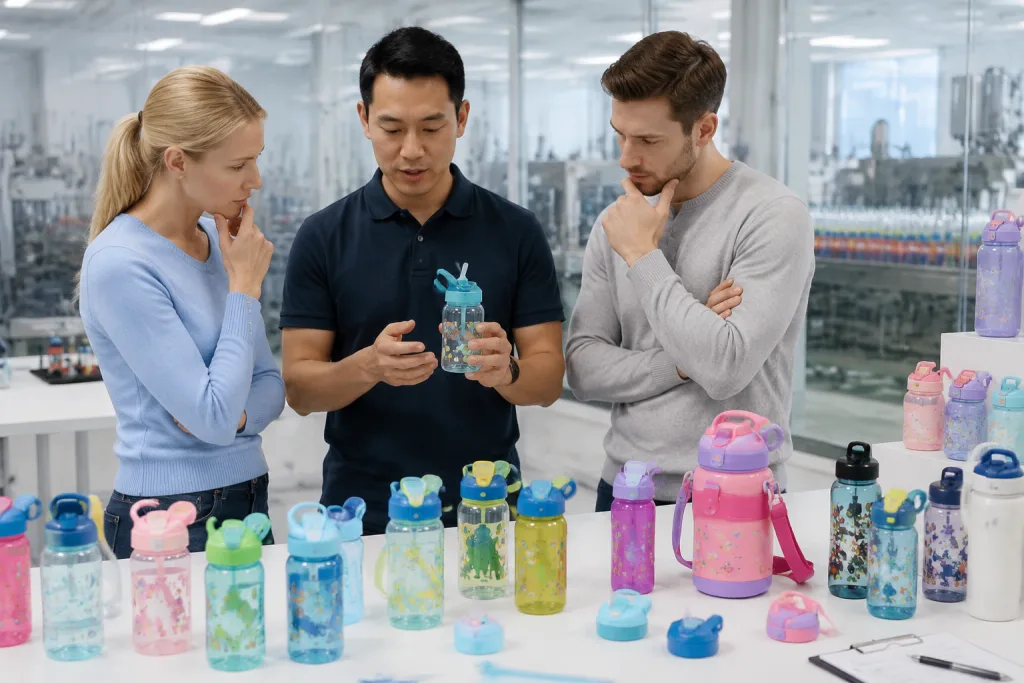
I’ll rewrite the four paragraphs in a supplier voice, keep the HTML exactly as-is, and make the timing feel like it came from a factory quote sheet—not a template.Lead time starts only after we have usable artwork, confirmed specs, deposit, and carton files. It does not start when the first inquiry lands in our inbox. For a custom kids bottle order from China, stock molds usually run 35-55 days after sample approval. If the buyer asks for new tooling, add 25-40 days before the line can start mass production.
The calendar is pretty clear once you break it down. Spec check and quotation take 1-3 working days if the request includes capacity, material, logo size, quantity, target market, and packaging; if the PO says “kids bottle” without a capacity, we have to bounce it back. Artwork fixes take 1-2 days. Physical sampling takes 5-10 days for stock items with logo, or 15-25 days when color matching and lid changes are in the mix. Lab testing usually needs 5-12 working days for REACH, LFGB, FDA food-contact, CPSIA, or ASTM requirements. Mass production is usually 25-35 days for 3,000-10,000 units. Final inspection, packing correction, and export booking add another 3-7 days.
Shipping is the other half of the schedule. FOB Ningbo or Shanghai is common for a Zhejiang supplier like us. Air freight to North America or Europe can take 5-9 days after pickup, but the math does not work for low-cost bulk kids water bottle orders. Sea freight to the US West Coast is usually 18-28 days port to port; East Coast and many European ports are often 30-45 days port to port. Then you still need customs clearance, trucking, and warehouse receiving.
If the launch date is fixed, count backward. For August back-to-school delivery, a custom school water bottle PO should usually be placed by late April or May. We’ve seen this go sideways when buyers wait until June, then ask for air freight and a price that still looks like sea shipment. QC pulled the sample; the calendar does not care.
Compliance is part of cost
I’ll rewrite just the HTML prose, keep the tags intact, and tighten the language so it reads like a buyer-facing factory note.Kids products need tighter thinking than adult promo bottles. A children water bottle supplier should talk about food-contact standards, small parts risk, coating adhesion, cap torque, and carton drop tests without blinking. If the answer is just “no problem,” we keep asking.
For Europe, the usual ask is LFGB or EU food-contact testing, REACH screening for restricted substances, and packaging rules that change by country. In the United States, FDA food-contact rules come up often, and children’s programs may require CPSIA checks for lead and phthalates. Some school buyers also ask for ASTM physical safety testing. Canada may need bilingual labeling plus importer paperwork. This is not exotic. It just needs to be planned before the line starts.
Budget for testing. A basic food-contact test usually costs USD 180-450 per material and color group. Full children water bottle customized testing can land at USD 600-1,500 depending on scope. If your bottle has a plastic body, silicone straw, PP lid, printed logo, and painted stainless part, the lab may split them into separate contact or accessible materials. We had a buyer flag a PO because the lid was quoted as “one part” when the lab treated it as three.
Quality control belongs in the PO. We run AQL inspection, usually AQL 2.5 for major defects and 4.0 for minor defects, with critical defects rejected. For children water bottle bulk orders, inspection should cover leak tests, lid function, odor checks, logo adhesion, barcode scans, carton strength, and random capacity measurement. Skipping a cheap inspection on a 10,000-unit order is the wrong math; we’ve seen that turn into recalls and chargebacks. QC pulled the sample once and found a 1.5 mm cap gap that the buyer would have caught the same day.
How to compare supplier quotes
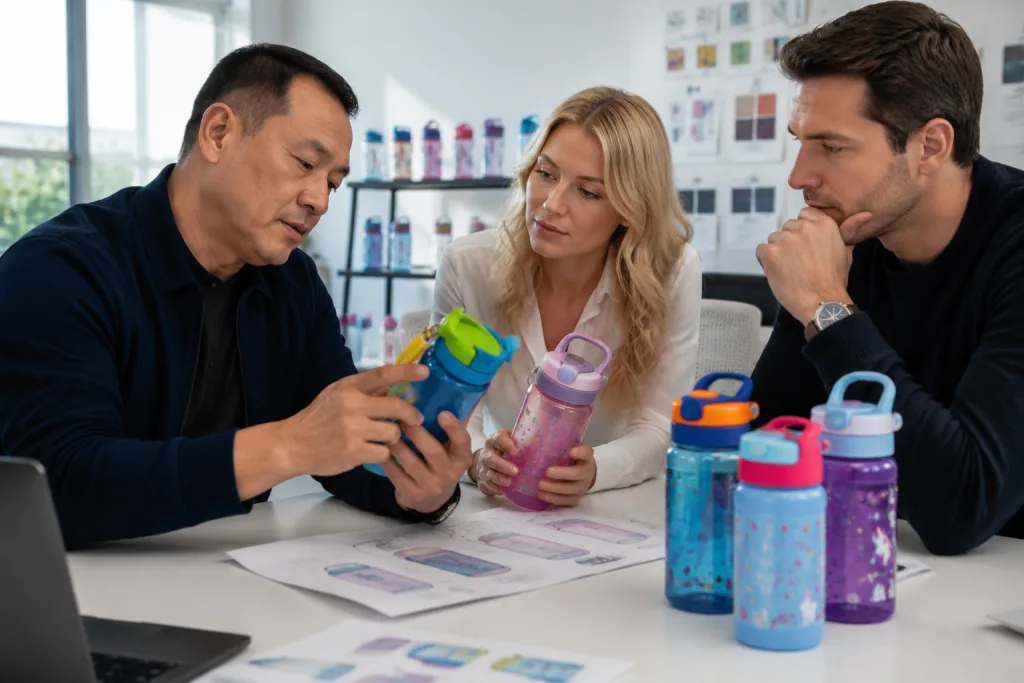
I’ll rewrite the section in-place, keep the HTML exactly as-is, and tune the prose to sound like a factory-side sales engineer.When you compare children water bottle suppliers, keep the quote sheet dull and specific. That is how you catch hidden costs. Ask each children water bottle vendor to quote the same capacity, material, lid, color count, logo process, packaging, test standard, MOQ, and Incoterm. `FOB China`, `EXW`, `CIF`, and `DDP` are different numbers, not a style choice. We have seen a quote look `USD 0.30` lower and then lose once export cartons, inner boxes, and testing were added back.
For school district buyers, ask for a sample that matches mass production. A stock piece is fine for hand feel, but it does not prove your custom children water bottle will match the ordered color, logo, or lid seal. One buyer flagged a `2 mm` logo shift on the sample and the PO still had the wrong Pantone code. For importers and children water bottle distributors, ask about repeat-order stability: mold ownership, spare parts, color records, carton dimensions, and whether the factory can hold the same lid structure for `12-24 months`. If the answer is vague, the math does not work.
Factory audits matter, but read them the right way. `BSCI` or `ISO 9001` tells you something about management discipline; it does not make every bottle leakproof. You still need product-level QC. Our Hangzhou, Zhejiang line uses incoming material checks, first-piece approval, in-line inspection, and final `AQL` before shipment; QC pulled the sample with a `500 ml` fill test on the bench, not in a report. That is normal work for a children water bottle manufacturer, not a bonus feature.
If you are a children water bottle distributors group buying across multiple regions, standardize the body and change only color or logo. That keeps tooling stable and cuts unit cost. If you need a children water bottle customizable platform for many schools, pick one proven bottle family and build the decoration rules around it. Too much customization at low MOQ is where delays start. We’ve seen artwork rework go sideways on a typo in the PO, and that costs more than the mold change.
Send your kids bottle spec for a factory quote
Share quantity, capacity, logo, market, and delivery date. We will return MOQ, FOB pricing, sample timing, and testing options.
Frequently asked questions
What is the usual MOQ for a custom kids water bottle?
For a stock bottle with one logo, a realistic MOQ is 1,000 units per design. If you need a custom color, plan on 3,000 units per color because resin color matching, machine cleaning, and scrap must be covered. For a custom made kids bottle with new mold work, MOQ is usually 5,000-10,000 units. Small pilot runs are possible, but the FOB unit price can be 15-35% higher than a 5,000-unit order. If you need five school colors, do not split a 2,000-unit order into five tiny batches. It creates cost and lead-time problems.
How long does a children water bottle custom order take?
For a stock mold with custom logo and standard packaging, allow 35-55 days from final sample approval to FOB China shipment. Before that, add 5-10 days for sampling and 1-3 days for artwork checking. If you need custom color matching, special lid parts, or retail packaging, sampling can move to 10-20 days. New tooling adds about 25-40 days before mass production starts. Sea freight then adds 18-45 days depending on destination. For an August school launch, place the PO by April or May.
Which material is best for a bulk school water bottle?
For younger pupils, Tritan or PP with a reliable flip straw lid is often the most practical choice. Tritan costs more than PP, often USD 1.65-2.90 FOB at 3,000 units, but it looks clearer and handles drops better. PP can work for budget programs around USD 0.95-1.60 FOB, especially for simple promotional use. Stainless steel is stronger for premium programs, but vacuum styles often start around USD 3.20-5.80 FOB. The best choice depends on age group, target price, dishwashing expectations, and whether insulation is required.
Can we put different school logos on one bulk kids bottle order?
Yes, but you need to manage decoration MOQ and packing carefully. If the bottle body and color stay the same, multiple logos can often be produced in one run. For silkscreen, each logo needs a screen, usually adding USD 30-80 per design. UV printing may be more flexible for short logo splits, but the unit cost is higher. For 5,000 bottles split across 10 schools, carton marks, FNSKU or SKU labels, and packing lists must be confirmed before production. Late logo changes are a common reason for 3-7 day delays.
What should importers check before choosing a children water bottle factory?
Check whether the factory understands your market standards, not just whether it can quote a low price. Ask for material certificates, previous LFGB or FDA food-contact reports, AQL inspection records, and production photos from similar children water bottle wholesale orders. Confirm monthly capacity, normal lead time, MOQ per color, and whether the quoted price includes packaging and export cartons. For kids bottles, also check lid leakage, silicone part odor, logo adhesion, and drop resistance. A good children water bottle supplier in China should give specific answers within 1-3 working days.