Key Takeaways
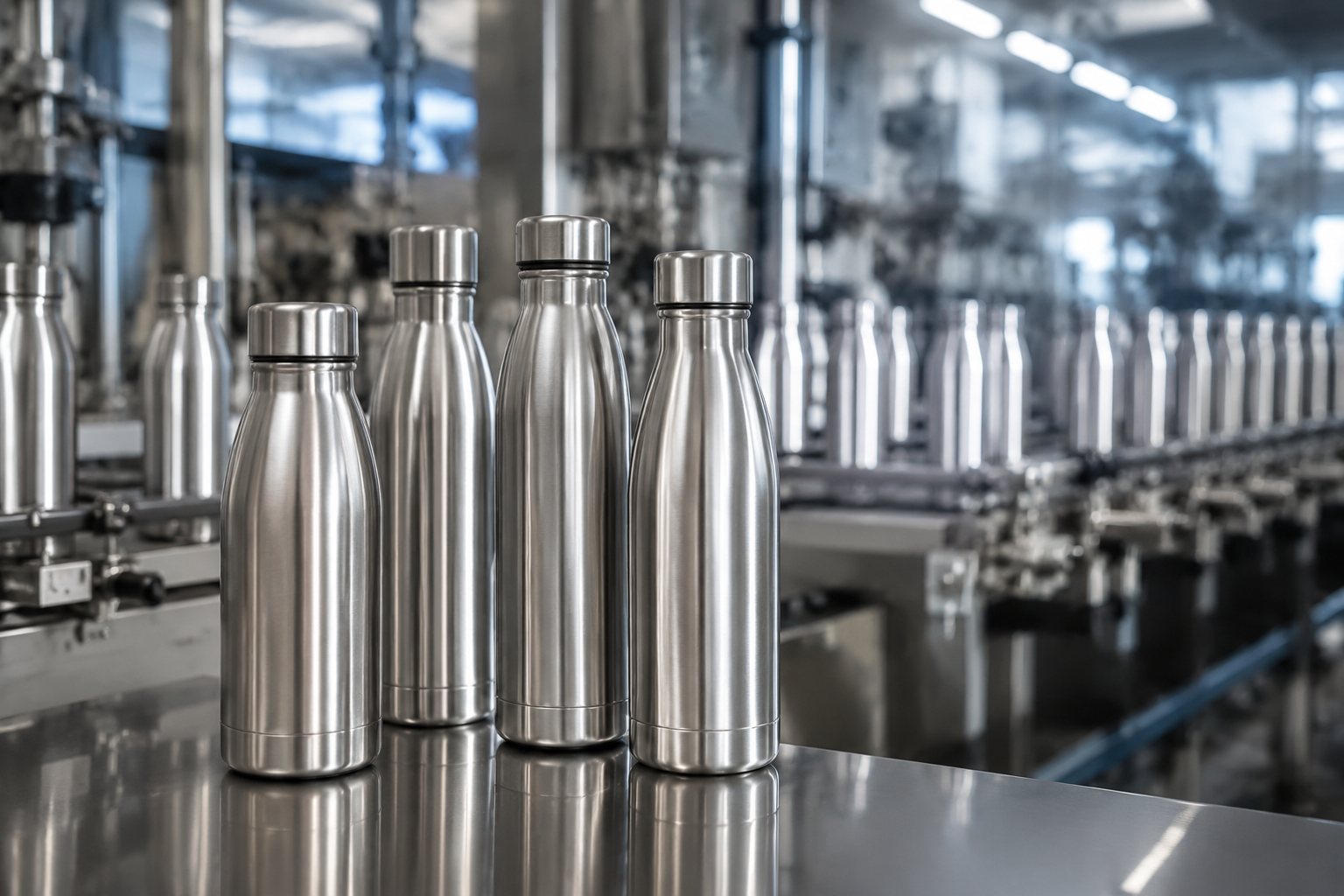
- For a new 500 ml stainless thermos, plan 1,000 pcs MOQ for standard colors and 3,000 pcs for custom Pantone coating
- 304 stainless steel at 0.4-0.5 mm inner wall thickness is the safer baseline for food-contact vacuum bottles
- AQL 2.5 major / 4.0 minor inspection should include leak, vacuum, coating, logo, and carton drop checks
- Normal production lead time is 30-40 days after deposit and approved pre-production sample
You are not buying a “bottle.” You are buying a sealed stainless item that must hold heat, survive 5-layer export cartons, pass FDA or LFGB checks, carry your logo without ghosting, and land before the retail launch or promo handout date. We’ve seen 23 first bulk thermos orders go sideways because the buyer asked only for unit price; this is the wrong question to ask. On the line, QC pulled the sample after a 1.2 m carton drop and found one lid thread shaving stuck near the silicone gasket.
Let’s use one real-size order: 3,000 pieces of a 500 ml custom thermos for an outdoor retailer or promotional brand. Simple enough. I’ll use the same checks our Hangzhou, Zhejiang team runs when quoting a supplier insulated water bottle project for Europe or North America, from 304 stainless coil thickness at 0.5 mm to logo position tolerance within 1.5 mm on the laser jig. A buyer once flagged a PO typo that said “mat black” instead of “matte black”; catching that before mass production saved 18 cartons of rejected stock.
The purchase brief starts narrow
A strong supplier insulated water bottle inquiry is boring and specific. Good. If you ask for a “premium thermos,” 6 thermos vendors will quote 6 different bottles, then your price sheet is useless. For this buyer scenario, you are an outdoor retailer ordering 3,000 pcs of a 500 ml stainless vacuum flask with powder coating, one-color logo, individual kraft box, and export master cartons. We had one PO last month where the buyer wrote “matte black” but attached a glossy reference photo; QC pulled the sample under a D65 light box before the line wasted 1,200 shells.
Start with use case. A hiking shop usually needs a slim bottle that fits 72-78 mm backpack side pockets and standard car cup holders. A promotional thermos for corporate gifting needs clean logo space, often 45 x 60 mm, plus a gift box that does not crush in a 12 kg master carton. A distributor thermos range should share one lid system across 500 ml and 750 ml sizes to cut spare-part headaches. We have seen this go sideways when buyers chase a special lid shape first; the math does not work if replacement lids need a separate mold and 5,000 pcs MOQ.
For BottleForge in Zhejiang, China, a practical starting specification is: 304 stainless steel inner wall, 201 or 304 outer wall depending on budget, 0.4-0.5 mm wall thickness, double-wall vacuum insulation, PP lid with food-grade silicone gasket, and powder coating tested by cross-hatch adhesion. Our monthly stainless thermos capacity is about 450,000 units, but capacity does not fix a vague brief. On the floor, we run a 3M tape pull after the cross-hatch cut; if coating lifts at the shoulder radius, the buyer will flag it after the first shelf display.
Send the supplier thermos team a one-page RFQ with capacity, target FOB price, logo method, packaging, market, inspection standard, and delivery date. If you already know your retail price, say it. A factory thermos quote for a USD 9.90 retail bottle is built differently from a USD 24.90 retail bottle. This is the wrong place to be shy. We ship cleaner when the RFQ includes AQL 2.5, carton drop test level, barcode position, and the real delivery window, such as 12 days for sample approval and 35 days for mass production after deposit.
Costing the 3,000 piece order
Price pressure is normal. The wrong question is “how cheap can you go?” For a 500 ml custom thermos, a realistic FOB Ningbo or Shanghai quote from China usually sits at USD 3.20-5.80, depending on 304 stainless thickness, lid parts, powder coating, logo method, retail box, and test scope. Last month a buyer flagged a USD 2.86 offer for a “premium matte” bottle; after QC pulled the sample, the inner wall measured 0.28 mm instead of the 0.35 mm we run for that style. If a quote lands far below the range, ask which part was cut.
In this order, the buyer wants matte olive powder coating, laser logo, kraft retail box, and 24 pcs per master carton. At 3,000 pcs, standard mold use is free. A new cap mold may cost USD 2,000-6,000 and take 20-30 days, not 12 days, because CNC trial, silicone gasket fitting, and leak testing all sit before mass production. Custom Pantone powder coating usually needs 3,000 pcs per color; the coating line loses about 18-25 kg of powder during cleaning and color change. Standard black, white, navy, and steel can often start at 1,000 pcs.
The quote should separate bottle price, logo charge, sample charge, testing cost, and carton mark requirements. One hidden unit price looks tidy on a PO, then goes sideways when the buyer changes the logo from laser to full-wrap artwork. For promotional brands, laser engraving may be USD 0.15-0.35 per pc, while single-color screen printing may be USD 0.08-0.18 per pc. Full-wrap heat transfer can add USD 0.45-0.90 per pc and needs tighter artwork control; our prepress guy once caught a 1.5 mm barcode shift before film output.
If you are a thermos distributor buying mixed sizes, ask whether 350 ml, 500 ml, and 750 ml models can share lid components. Shared lids cut defect variables and simplify after-sales support. Not glamorous. It saves money. We ship fewer spare parts, QC checks one gasket size with the same go/no-go gauge, and your warehouse avoids three bins for parts that look almost identical.
Samples prove the supplier
The sample stage turns a supplier thermos promise into numbers on a bench. For this 3,000 pc order, approving from photos is the wrong question to ask; photos hide thin steel, loose lids, and weak spray coating. Ask for one plain stock sample first, then one pre-production sample with final logo, final coating, final lid, and final packaging. We run the stock sample to check shape, hand feel, drinking flow, and basic insulation; QC pulled one last month where the lid gasket sat 0.6 mm proud and leaked on the tilt test. The pre-production sample locks the order.
A sample report should record weight, capacity to brim, practical fill capacity, height, diameter, mouth opening, lid torque, coating color, logo size, and packaging dimensions, with caliper readings instead of “same as sample” notes. For a 500 ml bottle, 280-330 g net weight is normal depending on steel gauge and lid structure. Light is not automatically bad. If production drops 35 g from the approved sample, the math doesn't work; either the inner wall changed, the lid structure changed, or the PO line got quietly “optimized.” We once caught this on a 0.01 kg tabletop scale before packing 18 cartons.
For insulation, use a test both buyer and supplier thermos team can repeat on the same counter. Fill with 95°C water, close the lid for 6 hours at 20°C room temperature, then record remaining temperature with a probe thermometer. We ship good 500 ml vacuum bottles that hold 65-75°C after 6 hours. Cold retention can be checked with 4°C water over 12 hours. These are not laboratory claims, but they expose weak vacuum units fast; on the line, QC marks the bad ones with red tape before they reach logo printing.
For a customized thermos, check logo position against a drawing, not by eye. Allow ±2 mm for most single-position logos, and put the reference point on the artwork file so the pad-printing jig has a real target. If your brand guide requires tighter control, say it before mass production. Zhejiang factories can hold tight tolerances when they are specified and inspected, but we’ve seen this go sideways when the buyer flagged a 3 mm logo shift after cartons were sealed.

Compliance is not optional
Outdoor retailers and promotional brands often write “FDA approved” or “EU approved” on the RFQ. That wording is loose. The better question is which food-contact and chemical tests the sales market needs. For the EU, buyers usually ask for LFGB or EU 1935/2004 food-contact testing, plus REACH SVHC screening on coating, PP lid parts, silicone gaskets, and the powder coat. For the US, FDA food-contact expectations and California Proposition 65 may apply by sales channel. We have seen a PO say “FDA certificate for whole bottle,” then QC pulled the sample and found the buyer actually needed the silicone ring tested separately.
If the product is for children, the risk profile changes. CPSIA, ASTM F963 checks on accessible coatings, and small-parts review can come into play. A bottle that looks like an adult SKU on the drawing can be treated differently after artwork is added. A 350 ml pastel model with cartoon animals, a straw lid, and a 28 mm removable plug will get more questions from retailers than a 750 ml hiking bottle. Tell your thermos suppliers the sales channel and age positioning before tooling or artwork approval. We run this check before opening the mold, because fixing it after T1 samples is where the math does not work.
Factory audits matter too. European and North American distributors often ask for BSCI, Sedex, or ISO 9001 documentation before they release a deposit. An audit does not make every bottle perfect, but it shows whether the thermos factory has working systems for labor records, batch traceability, caliper calibration, and corrective action. On the line, this means the inspector can trace a 304 stainless coil batch back from a carton label, not just point to a clean office folder. BottleForge works from Hangzhou, Zhejiang, with partner production lines in China that support standard export documentation, material declarations, and third-party inspections.
One practical habit: put test responsibility in the purchase order. State who pays for first testing, who pays for retesting after failure, and whether shipment can move before reports are issued. Be blunt. Silence on testing creates delays when 1,200 cartons are already packed, the forwarder has booked the vessel, and the buyer flags one missing REACH report at 6:40 p.m.
QC happens before cartons close
Final inspection is not a beauty contest at the warehouse door. For a 3,000 pc thermos bulk order, we run AQL sampling before shipment, commonly AQL 2.5 for major defects and 4.0 for minor defects. Major defects mean leakage, weak vacuum, sharp rim burrs over 0.2 mm, wrong material, unreadable logo, cracked lid, odor, or coating peel bigger than the signed limit sample. Minor defects are small dust spots, slight color shade drift against the Pantone chip, or carton scuffs inside the approved range. QC pulled a sample last month where 7 bottles passed photos but failed the 30-second upside-down shake. Photos did not catch it. The line did.
The QC checklist needs at least five physical tests. Start with a leak test: fill, close, invert, and shake for 30 seconds. Then check vacuum with 95°C hot water on sampled pieces, touching the outer wall after 5 minutes for abnormal heating. Check lid fit and gasket seating by removing and reinstalling silicone rings; torn gaskets usually show at the pull tab. Run coating adhesion with a cross-hatch cutter and 3M tape on coated samples. Finish with a carton drop test: usually 1 corner, 3 edges, and 6 faces from 60-80 cm depending on carton weight. If a 13.5 kg master carton splits on the first edge drop, the math does not work for sea freight.
Do not rely on one golden sample sitting in the sales office. Pull samples from sealed cartons across at least 3 production time slots, not just the top layer from yesterday’s packing. A thermos manufacturer may run coating on Monday and assembly on Thursday, so defects cluster by batch. We have seen this go sideways when black powder coating from line 2 looked fine under office light but showed orange peel under the QC lamp. Ask for production photos showing raw bottle bodies, coating, logo application, vacuum testing, packing, and sealed cartons.
For Amazon FBA or retail distribution, carton labels must be checked during inspection too. Wrong FNSKU, missing country of origin, or an unreadable barcode can cost more than a small bottle defect. One buyer flagged a PO typo where “Made in China” was missing on 42 outer cartons, and relabeling took 2 extra days before the truck could leave Hangzhou.
Shipping and reorder planning
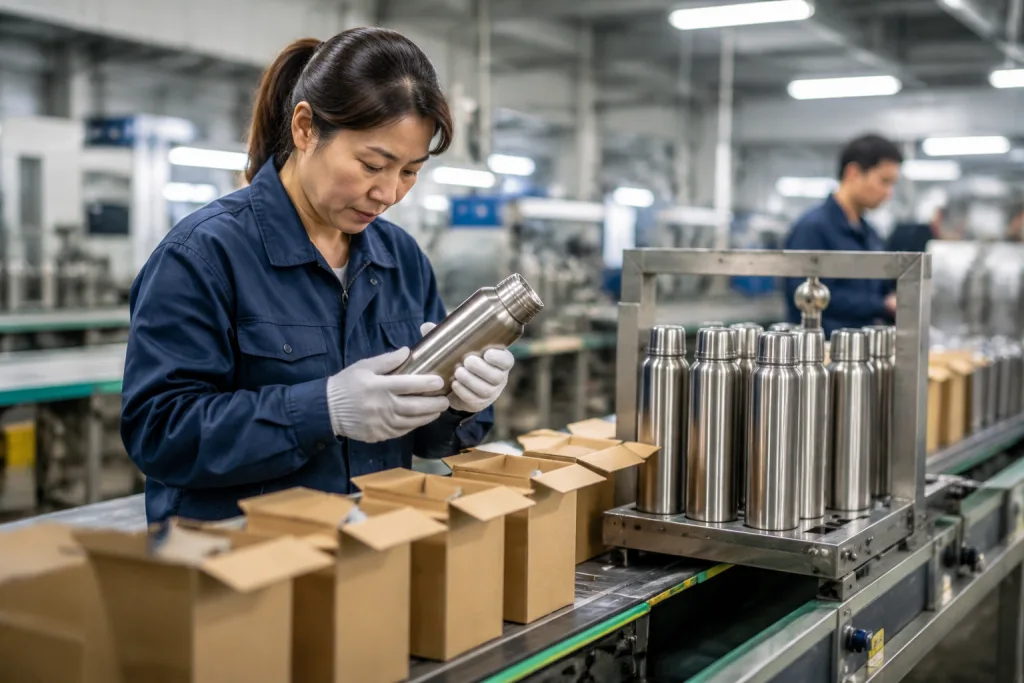
Once QC signs off, the order is no longer a bottle problem. It is a carton problem. A 500 ml stainless thermos with retail box often packs 24 pcs per master carton. For a 3,000 pc PO, we usually stack about 125 cartons, around 3.5-5.0 CBM depending on box height and insert thickness. Last month QC pulled the packed sample and the carton measured 47 x 32 x 41 cm, which changed the CBM quote by 0.4 CBM. Sea freight is the sensible choice for distributor thermos orders. Air only makes sense when the buyer has a fixed promo date and the math still works.
Typical timing from China gets underestimated. Pre-production sample approval may take 7-12 days, and that assumes the logo file is clean, not a 72 dpi JPG pasted into the PO. Mass production is normally 30-40 days after deposit and sample sign-off. Booking, customs, and vessel departure can add 7-10 days before the container even moves. Ocean transit to Europe may be 30-40 days port to port; to North America, 18-35 days depending on coast and route. We build the retail launch calendar from the delivery date backward, not from the factory finish date forward. This is the wrong question to ask: “When can the line finish?” Ask when cartons can land at your warehouse.
For the purchase order, write the Incoterms clearly: FOB Ningbo, FOB Shanghai, CIF, DDP, or FCA if your forwarder collects inland. FOB is common because supplier thermos responsibility stays clear up to China port loading, and your forwarder controls the freight. We have seen this go sideways when a PO said “FOB China” with no port, then the buyer flagged a USD 380 inland trucking charge after booking. DDP looks convenient. Check who handles duties, anti-dumping review if applicable, and importer-of-record obligations before you approve it.
Reorders are where planning saves real time. Keep the approved sample, color code, logo file, carton layout, and inspection checklist unchanged unless there is a real reason to touch them. On the second PO, we ask our merchandiser to match the Pantone card, dieline file, barcode position, and AQL 2.5 checklist against the last shipment folder before the line opens. A thermos customized project runs faster and with fewer surprises when the reorder repeats controlled specs instead of restarting the whole discussion.
Send your thermos spec and target delivery date
We will check MOQ, FOB pricing, logo method, sample timing, and inspection points before you commit to production.
Frequently asked questions
What MOQ should I expect for a custom stainless thermos order?
For most supplier insulated water bottle projects, 1,000 pcs is a workable MOQ if you use an existing bottle shape, standard lid, standard coating color, and simple logo. For custom Pantone powder coating, 3,000 pcs per color is more realistic because the coating line has setup loss. If you need a new lid mold or unusual capacity, the MOQ may move to 5,000 pcs or more. A mixed-size thermos bulk order can sometimes share a total MOQ if the same finish and packaging are used.
Is laser engraving better than screen printing for outdoor retail bottles?
Laser engraving is usually safer for outdoor retail because it does not scratch off like ink on rough use. It works well on powder coating and stainless finishes, with a typical cost of USD 0.15-0.35 per pc for one position. Screen printing is cheaper, often USD 0.08-0.18 per pc, and gives stronger color, but adhesion must be tested on the coating. For a promotional thermos with a short campaign life, printing can be fine. For a premium custom thermos, laser is usually the cleaner choice.
How do I compare quotes from different thermos manufacturers?
Force every thermos supplier to quote the same specification: capacity, steel grade, wall thickness, lid material, coating, logo method, packaging, test requirements, MOQ, lead time, and Incoterm. A USD 3.60 quote with 201 outer wall, thin coating, no LFGB test, and plain carton is not equal to a USD 4.40 quote with 304 inner wall, powder coating, retail box, and AQL inspection. Ask for net weight too. A 25-40 g weight difference on a 500 ml bottle often explains a price gap.
What defects should I reject during pre-shipment inspection?
Reject leakage, failed vacuum performance, wrong material, strong odor, sharp rim, broken lid thread, loose silicone gasket, unreadable logo, incorrect barcode, and coating peel as major defects. Use AQL 2.5 for major defects and 4.0 for minor defects unless your retailer requires stricter limits. For a 3,000 pc order, inspection usually samples about 125-200 pcs depending on the chosen standard table. Do not accept “we checked already” as proof; ask for photos, records, and third-party inspection if the order value justifies it.
Can one supplier handle both retail and promotional thermos packaging?
Yes, but you need to define packaging early. Retail packaging may need a printed color box, barcode, warning text, country of origin, and shelf-ready carton. Promotional thermos packaging may use kraft boxes, gift sleeves, or bulk inner cartons to reduce cost. A box size change affects carton count, CBM, freight cost, and drop-test performance. For 3,000 pcs, switching from plain white box to printed retail box can add USD 0.18-0.45 per pc and 7-10 days for artwork approval and printing.