Key Takeaways
- Lock body material first: Tritan, borosilicate glass, or 304 stainless changes FOB cost by USD 0.60-2.40 per unit
- A realistic MOQ for a custom logo infuser bottle is usually 1,000-3,000 units per color
- Ask for AQL 2.5/4.0 inspection and 1.2 m carton drop testing before shipment
- Normal Zhejiang production lead time is 25-35 days after deposit and sample approval
A supplier infuser bottle looks simple until you place 5,000 units and find the basket twists, the lid starts weeping after a 90°C hot-fill test, or the logo scuffs off in an Amazon carton. We run into this all the time. Wellness brands and hydration startups usually want the clean look first, but the real question is what spec sheet the factory is quoting, not the catalog photo.
At BottleForge Industrial in Hangzhou, Zhejiang, we see the same RFQ mistake every week: buyers compare FOB prices before they lock resin grade, filter mesh, gasket material, carton drop test, or logo method. The math does not work otherwise. China can ship a sharp custom infuser bottle, but the line needs the buying rules before sampling, or QC will catch the problem after the PO is already typed.
Start With Body Material
I’ll rewrite the section in place, keep the HTML untouched, and tighten the copy so it sounds like a factory-side sales engineer.The first line on your spec sheet should not be capacity or color. Put body material first. Everything else follows from it: tooling, unit weight, test reports, freight, shelf price, and complaint rate.
For a bulk fruit infuser bottle, most wellness launches pick Tritan copolyester because it is clear, impact resistant, BPA-free, and lighter than glass. A 700 ml Tritan body usually runs 120-150 g before the lid and infuser basket. We run 1.8-2.2 mm wall thickness for a bottle that feels solid without turning the mold into a price problem. One buyer once pushed for the cheapest quote; QC pulled the sample, and the part was AS, not Tritan. It looked fine in a photo. It failed the drop test.
Borosilicate glass fits a custom tea infuser bottle when flavor neutrality and hot-water use matter. A 500-600 ml borosilicate body usually uses 2.0-2.5 mm wall thickness. It sells into tea, spa, and office programs, but the math changes fast because the inner pack has to take the hit. For a distributor tea infuser bottle, that extra carton size can matter more than the unit price. We’ve seen that go sideways on a PO with one typo: “5000 pcs” turned into “500 pcs,” and the freight quote no longer worked.
Stainless steel is the right call when you want insulation or a sports-positioned custom made infuser bottle. Use 18/8 304 stainless steel for food-contact parts, usually 0.4-0.5 mm for the inner wall and 0.5 mm for the outer wall on vacuum models. For Europe, ask for LFGB or EU food contact paperwork. For North America, FDA food contact declarations and any California Proposition 65 screening may come up with larger retailers. We ship these with a simple rule: if the spec says 304, keep the mill cert on file, because a buyer will ask for it later.
Capacity Is Not Just Volume
I’ll rewrite this section in a more field-tested B2B sales voice, keep the HTML structure intact, and preserve the existing specs and headings.Capacity sounds simple until QC pulls the sample and the basket eats into the drink space. A bottle sold as 750 ml can end up with 620-680 ml of usable liquid once the infuser insert is in place. If your brand promise is hydration tracking, that gap matters.
For a factory infuser bottle RFQ, state both nominal capacity and usable capacity with infuser installed. We usually write 700 ml nominal, 600 ml minimum usable, and the buyer flags it early if the math does not work. For a bulk tea infuser bottle, 450 ml or 500 ml is often the better call because tea is sipped, not slammed after a gym set. For a distributor fruit infuser bottle aimed at fitness retail, 700-850 ml moves better on shelf.
The mouth diameter needs the same discipline. Fruit infusers usually need 55-65 mm so users can drop in lemon slices, berries, cucumber, and ice without fighting the opening. Tea infusers can run at 45-55 mm if the basket is long and narrow. If the opening is too tight, the bottle looks clean but turns into a cleaning headache, and that is how you get one-star reviews.
Check the height-to-diameter ratio too. A tall slim custom fruit infuser bottle fits a car cup holder, but it can tip on a desk if the base is too narrow. A wider body feels steady, though it may miss cup holder fit in the US market. We run a 70-75 mm cup holder test on the line for wellness subscriptions, corporate gifting, and online hydration programs, because this is the kind of detail buyers remember after the PO typo is already fixed.
Infuser Basket Details Matter
I’ll rewrite this section in-place, keep the HTML tags intact, and tune the prose to sound like a factory-side sales engineer.The basket is where a lot of cheap bottles fail. It is also the spot where a buyer can win product differentiation without opening a new mold. Your spec sheet should call out basket material, hole size, basket length, locking method, and whether it comes out from the top or bottom.
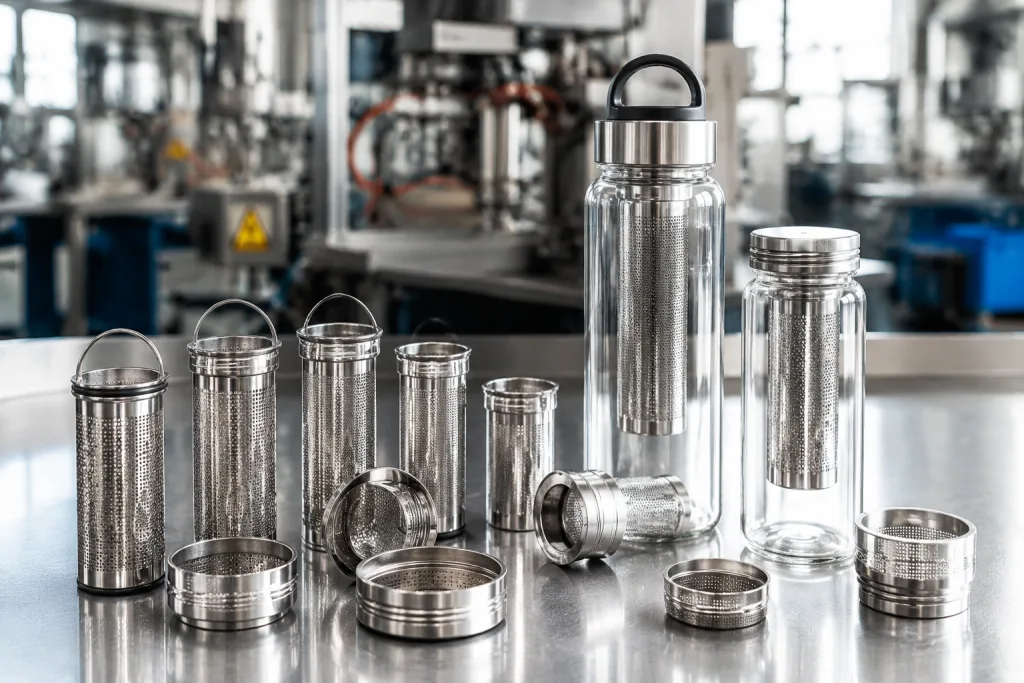
For fruit, injection-molded Tritan or PP baskets are standard. A 2.0-3.0 mm hole size keeps pulp and seeds in place while water still moves through. For tea, stainless mesh is the better call. A customized tea infuser bottle should use 304 stainless steel mesh, with 60-80 mesh for loose tea. Too open, and leaves escape. Too tight, and QC will hear about cleaning complaints on the first carton.
Basket length changes flavor strength. A short 70 mm basket in a 750 ml bottle can look fine in photos, but it does not give enough fruit surface area. For a customizable fruit infuser bottle, 110-140 mm is the range we run most often. For tea, the basket can be shorter, but it still has to let the leaves open up. Tea buyers spot this fast. The math does not lie.
The basket locking system is not the flashy part, but it saves you from returns. A screw-in basket holds well, yet it adds assembly time on the line. A snap-fit basket is faster and cheaper, but it has to pass repeated removal checks. We normally test 300 open-close cycles for lid and basket assemblies during development. If you are buying a factory direct infuser bottle for subscription boxes, ask the supplier for a short video of basket insertion, shaking, inversion, and removal. You will catch weak designs in 30 seconds.
Lid, Seal, And Leak Claims
I’ll rewrite the four paragraphs in-place, keep the HTML untouched, and tune the tone toward a factory-side sales engineer with concrete sourcing details and tighter leak-claim language.“Leakproof” gets abused in drinkware sourcing. We do not take that word at face value. Turn it into a test spec: gasket material, thread engagement, pressure test, inversion time, and whether the bottle is cleared for carbonated drinks. On our line, QC pulled the sample after a buyer flagged a tiny seep at the cap ring; the fix was a 0.3 mm gasket change, not a new marketing line.
Most infuser bottles run better with silicone gaskets because silicone holds odor down and handles heat better than low-grade TPE. Ask for food-grade silicone and give the hardness, usually 50-60 Shore A. Too soft, and the seal can creep after a few wash cycles. Too hard, and the cap needs so much torque that the buyer complains the lid feels stiff. We’ve seen that go sideways on a 58 Shore A sample where the PO typo called for “5-60,” and the wrong compound nearly slipped through.
For a custom logo infuser bottle, we suggest a plain leak test: filled bottle, cap tightened to normal hand torque, inverted for 4 hours at room temperature. If you want stronger proof, add a 30-minute horizontal shake or vibration test. Online shipping is rougher than shelf display. A bottle that passes a calm office inversion test can still leak after parcel drops and carton compression. That is the wrong question to ask if the buyer only wants a photo of the sample on a desk.
Hot water needs its own spec. Tritan infuser bottles are often sold for warm water, but not every lid or gasket likes boiling water. For tea use, set a maximum, such as 90°C for 30 minutes, and check lid deformation after the soak. A factory tea infuser bottle should never be approved on body material alone. The lid, basket, carry loop, and gasket all need the same test. We ship a lot of 500 ml tea units, and the first part to fail is usually the cap, not the cup.
Logo Process And Surface Finish
I’ll rewrite the section in-place, keep the HTML untouched, and tighten the sales-engineer voice while preserving the technical details and numbers.Logo choice changes cost, wear life, and how the bottle reads on shelf. For a first-order customized infuser bottle, buyers usually pick silk screen printing because it is cheap and clean on flat or lightly curved surfaces. One-color silk screen on Tritan often adds USD 0.08-0.18 per unit, depending on artwork size and order quantity. Multi-color work needs tighter registration, so we run a sample first before mass production.
Laser engraving fits stainless steel lids or stainless bodies, not transparent plastic. It holds up well and looks clean, but it will not give you bright color. Heat transfer can cover larger artwork, yet the setup cost is higher and the print needs abrasion testing. For a customizable tea infuser bottle with a premium feel, a stainless lid with laser logo and a glass body usually looks far more expensive than the BOM jump says. The buyer flagged this on a 500 pcs trial, and the math held.
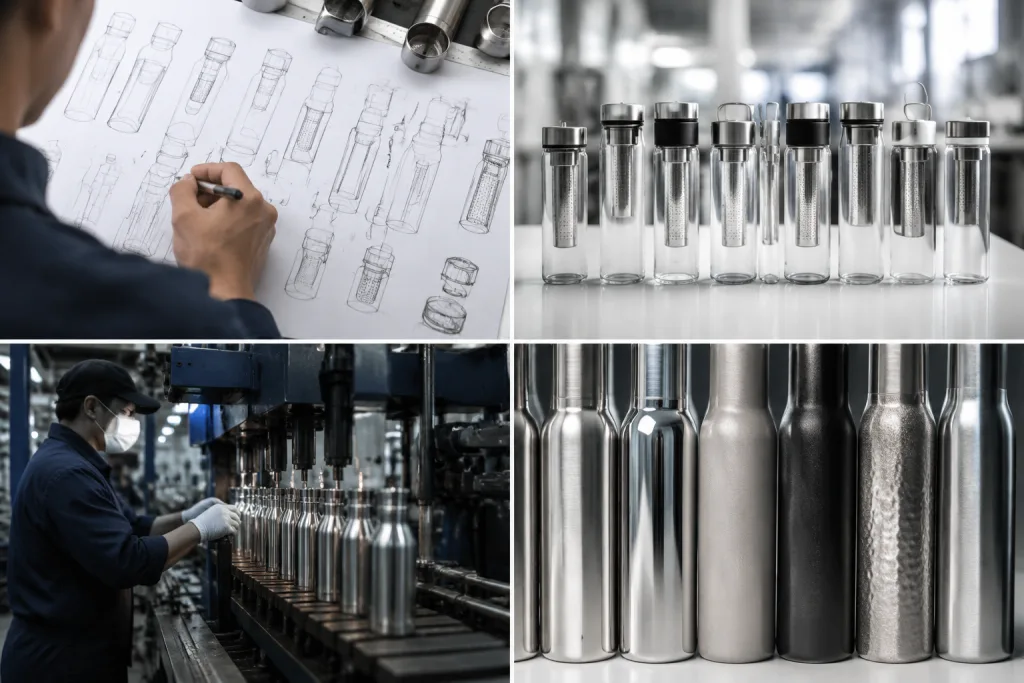
Surface finish needs to be written into the PO. Frosted Tritan hides scuffs better than clear glossy Tritan, but it cuts the fruit view a bit. Powder-coated stainless gives strong color choices, yet the coating result depends on pretreatment and curing. Ask for cross-hatch adhesion testing if the bottle will ride in cup holders, clip to bags, or ship as outdoor wellness gear. QC pulled the sample with a scratch at the 3rd cycle.
Color matching is another place where orders slip. Pantone on plastic is not exact unless you approve a physical chip or a pre-production sample. In Zhejiang production, a workable target is Delta E under 2.0 for controlled plastic parts, but caps, silicone rings, powder coating, and printed logos still move a bit. If the packaging, website images, and bottle color must match line for line, add extra sampling time. We’ve seen this go sideways from a typo on the PO: "PMS 18-4051" became the wrong blue.
Compliance, QC, And Packing Lines
I’ll rewrite the HTML in place, keeping tags intact and tightening the language for a real factory-sales tone. Then I’ll do a quick pass to make sure the compliance, QC, and packing details still read like a sourcing guide, not generic copy.For Europe and North America, compliance should be on the RFQ from day one. A serious supplier infuser bottle quote should list the food-contact documents on hand, any social audit status the buyer asks for, and the inspection standard used before shipment.
For plastic and silicone food-contact parts, ask for FDA food contact support for the US and LFGB or EU 1935/2004-related testing for Europe. For chemical safety, retailers sometimes ask for REACH and RoHS even when the bottle is not electronics. If children may use the product, ASTM or CPSIA-related checks can apply, especially for coatings, small parts, and packaging claims. For a kids-positioned custom fruit infuser bottle, adult drinkware files are not enough.
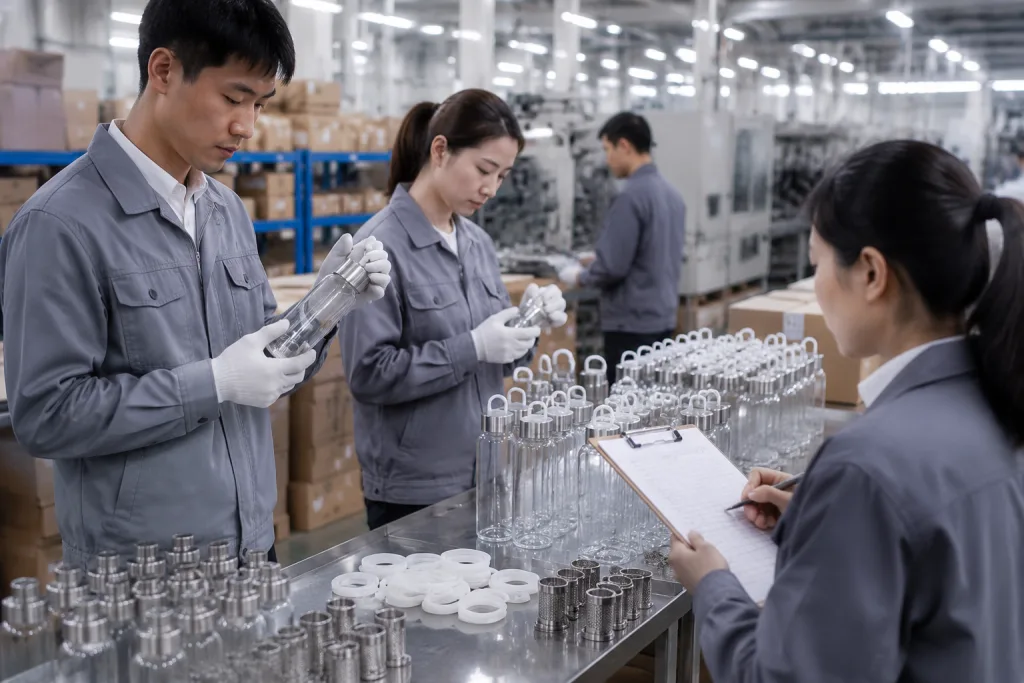
Quality control should be written as AQL, not as “factory checks before shipping.” We usually quote AQL 2.5 for major defects and 4.0 for minor defects, with critical defects set at 0. Major defects include leakage, broken lids, sharp edges, wrong logo, wrong capacity, and badly scratched bodies. Minor defects are small cosmetic marks inside the agreed limit sample. QC pulled the sample, and that is where the buyer usually sees the difference between a clean line and a sloppy one.
Packing deserves its own line. For e-commerce, use an individual polybag or tissue wrap, color box, and 5-ply export carton. For Amazon FBA, add FNSKU labeling, carton labels, and drop-test readiness. We run 1.2 m carton drop tests on 6 faces, 3 edges, and 1 corner for glass and premium orders. BottleForge Industrial in Hangzhou, Zhejiang can produce around 450,000 drinkware units per month across stainless, plastic, glass, and infuser lines, but we still push buyers to approve packing before mass production. The math does not work the other way around. China factories can ship fast; they cannot fix weak cartons after the container has left Ningbo or Shanghai.
Price, MOQ, And Sampling Reality
I’ll rewrite this section to sound like a factory-side sales engineer, keep the HTML intact, and tighten the pricing/sampling language with a few concrete shop-floor details.FOB pricing only works once the spec sheet is locked. For a 700 ml Tritan fruit infuser bottle, a bulk order usually lands around USD 1.35-2.40 FOB Ningbo, depending on resin grade, lid structure, logo method, and carton style. A borosilicate glass tea infuser bottle often sits at USD 2.10-4.20. A stainless insulated model with infuser can reach USD 4.50-8.50 or more when the powder coating and lid finish are upgraded. We run quotes off the actual BOM, not guesses.
MOQ moves with the level of customization. For a stock-color bulk infuser bottle with a one-color logo, 1,000 units is workable. For a custom Pantone color, 3,000 units per color is the usual floor because resin mixing, silicone color match, and line setup all need their own run time. If you want a custom made infuser bottle with a new mold, tooling can run USD 3,000-12,000 for a simple plastic body, and more once the lid has multiple parts. The buyer flagged this before on a PO typo, and the math still did not work.
Sampling is real work. A logo sample usually takes 7-10 days after artwork approval. A modified component sample may need 15-20 days. Mass production is normally 25-35 days after deposit and approved pre-production sample. QC pulled the sample at 1.2 mm logo depth and sent it back once, so if you need a distributor infuser bottle program for a seasonal launch, leave at least 10 days for inspection, booking, and export paperwork.
The clean sourcing path is simple: send a line-by-line spec, ask for FOB price and EXW backup, approve physical samples, freeze one golden sample, inspect before balance payment, then ship. Buyers who skip the golden sample save a week and hand the order back to chance. We’ve seen that go sideways on a 5,000-unit run, and that is the wrong trade.
Send Your Infuser Bottle Spec Sheet Today
Share capacity, material, logo, packaging, and target price. We will return a practical China factory quote with MOQ and lead time.
Frequently asked questions
What MOQ should I expect for a supplier infuser bottle order?
For a stock mold with one logo, expect 1,000-3,000 units per SKU. If you need a custom Pantone body, silicone ring, or lid color, 3,000 units per color is more realistic because the factory must purchase resin, pigment, and packaging materials in minimum batches. For a fully custom made infuser bottle with new tooling, MOQ often starts at 5,000 units, plus tooling cost. If you are a hydration startup, begin with one body color and one logo method. Splitting 3,000 units into six colors usually raises defect risk, setup cost, and lead time.
Is Tritan better than glass for a custom fruit infuser bottle?
Tritan is usually better for gyms, outdoor wellness, subscriptions, and commuter use because it is lighter and more impact resistant. A 700 ml Tritan bottle may weigh 180-230 g finished, while a glass version can exceed 400 g before packaging. Glass is better for tea, spa, and premium desk use because it resists odor and feels cleaner for hot drinks. If your product is a custom tea infuser bottle, borosilicate glass with a 304 stainless basket is a strong choice. If your product is a bulk fruit infuser bottle for active users, Tritan usually gives fewer shipping and drop complaints.
How do I compare FOB quotes from different China factories?
Do not compare FOB numbers until the material, capacity, basket, lid, logo, packaging, and testing standard are identical. One factory may quote AS plastic, 1.5 mm wall thickness, thin carton, and no inspection. Another may quote Tritan, 2.0 mm wall thickness, silicone gasket, color box, and AQL inspection. Those are not the same product. Ask each China supplier to confirm resin grade, stainless grade, gasket material, usable capacity, carton size, gross weight, and included tests. A USD 0.25 cheaper unit can become expensive if the bottle leaks or the carton fails parcel delivery.
Can I order a custom logo infuser bottle for Amazon FBA?
Yes, but specify the FBA packing requirements at RFQ stage. The factory needs to know whether each unit needs a color box, suffocation warning polybag, FNSKU label, set label, or carton label. For bottles with glass, request a 1.2 m carton drop test and inner protection approval before production. For plastic bottles, check that the logo passes rub testing and that caps do not loosen during vibration. A typical FBA-ready custom logo infuser bottle order adds USD 0.05-0.20 per unit for labeling and packing work, depending on box style and SKU complexity.
What documents should a distributor tea infuser bottle supplier provide?
For a distributor tea infuser bottle, ask for food contact documents covering the bottle body, lid, silicone gasket, and stainless mesh basket. For Europe, LFGB or EU food contact testing is often requested. For the US, FDA food contact support is common. If the product has coating, printing, or colored plastic, REACH and Proposition 65 screening may also be needed depending on your sales channel. Ask for BSCI or similar audit information if you sell to larger retailers. Documents should match the exact material family and supplier, not a random old test report for a different bottle.