Key Takeaways
- A realistic supplier hydration bottle MOQ is usually 1,000 pcs, with 25-35 days lead time after approval
- For stainless custom canteen projects, 304 steel at 0.5 mm wall thickness is a safer baseline than vague 'food grade' claims
- Plan for FOB China pricing around USD 1.2-4.8 per unit depending on size, lid, coating, and print method
- Ask for REACH, LFGB, FDA, and AQL 2.5 inspection data before you approve any canteen customized order
If you are buying a supplier hydration bottle program for retail, corporate gifting, or Amazon, the hard part is not picking a color. It is choosing a factory that can hold spec, ship on time, and stand up when a buyer in Germany opens a claim. A cheap quote from a canteen supplier looks fine until the lid leaks, the coating chips, or the carton crushes in transit.
In Zhejiang and across China, the lines that stay busy answer the real questions fast: what is the MOQ, what is the lead time, what steel grade are you running, and which tests do you pass? We have seen a 10 mm lid detail get missed on a PO and turn into a week of back-and-forth with QC. If you want customizable drinkware that ships like a repeatable supply chain, not a one-off sample, this is the wrong question to ask: “Can you do it cheap?”
What are you actually buying?
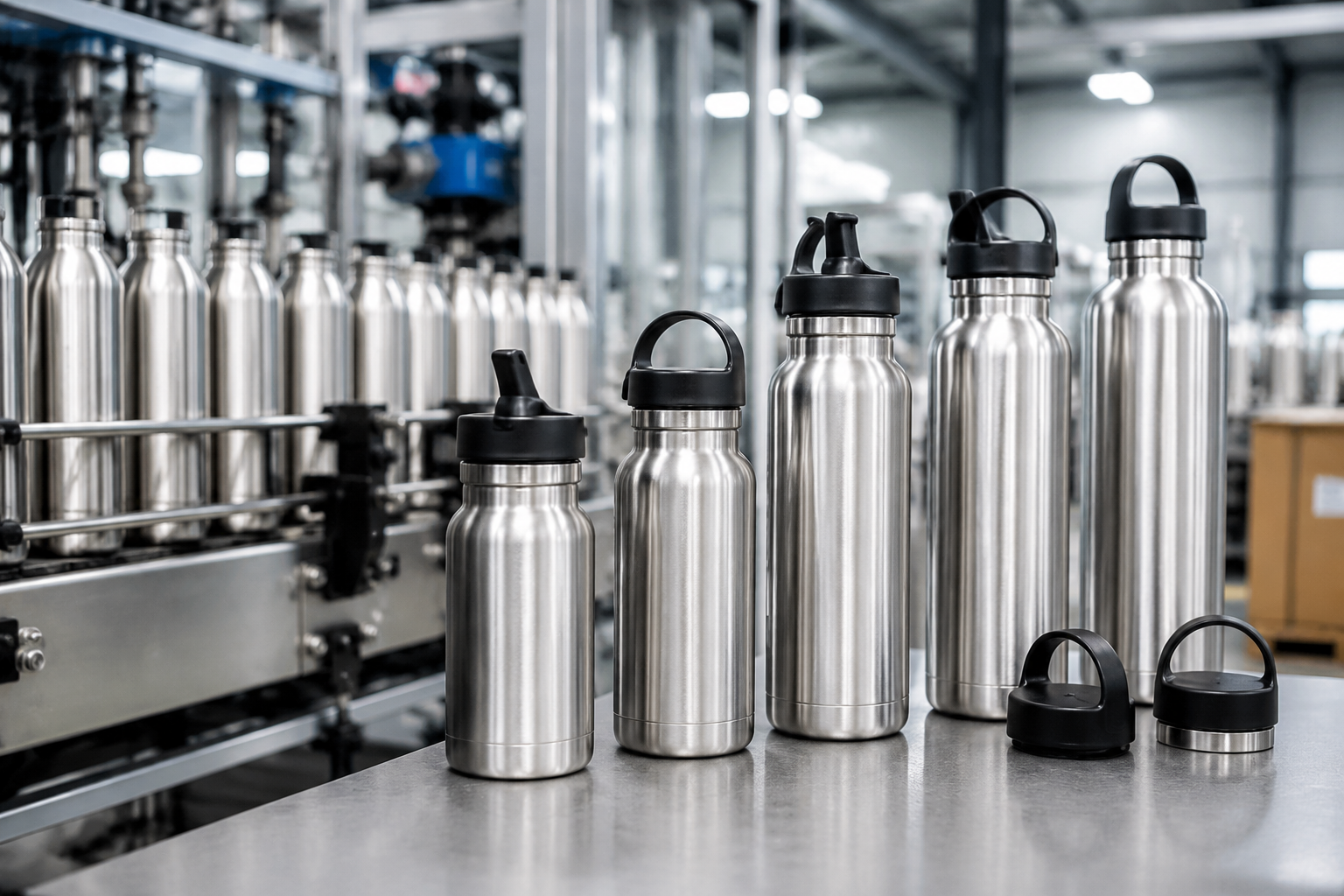
I’ll rewrite the section in place, keeping every tag and list structure intact while making the copy sound like a factory-side sales engineer wrote it.When buyers say supplier hydration bottle, they usually mean one of three builds: a stainless sports bottle for retail, a promo bottle for events, or a tough canteen custom job for outdoor channels. On our line, that turns into different neck sizes, lid molds, and carton packs. The name on the PO matters less than the build.
A serious canteen manufacturer should be able to tell you:
- Body material: 304 stainless, 316 stainless, Tritan, or aluminum
- Wall thickness: 0.4 mm, 0.5 mm, or 0.6 mm
- Capacity: 500 ml, 750 ml, 1 L, or 64 oz
- Lid system: screw cap, straw lid, flip lid, or leakproof sport cap
If you are sourcing for a distributor drinkware program, ask straight out whether the bottle is insulated or single-wall. A double-wall bottle with vacuum sealing usually carries a higher unit cost, and that math works when the buyer needs stronger shelf appeal and fewer price fights. We’ve seen this go sideways when QC pulled the sample and found a 2 mm gap at the seam; the outside looked fine, but the heat test failed. A canteen vendor in Zhejiang can offer the same silhouette in three finishes, but weld quality decides whether you get repeat orders or a stack of returns.
Do not let customizable canteen blur the spec sheet. We once caught a PO typo that changed 500 ml to 500 oz, and the buyer flagged it before the line cut steel. Your sample has to match the production drawing, not just the marketing photos.
Which factory numbers matter most?
I’ll rewrite the prose in-place, keep the HTML exactly as-is, and sharpen it to sound like a factory sales engineer. Next I’m drafting with concrete shop-floor details and no filler.Good buyers do not start with the whole factory story. They ask for numbers that tell you if the canteen factory can cover your order. For a normal China supplier, a workable baseline is 300,000 units per month across bottle lines, with 1,000 pcs MOQ for stock molds and 3,000-5,000 pcs for full customization. If a canteen distributor claims less than that, the math does not work; check whether they are a trader or a real canteen factory. QC pulled the sample in our line at 9:20 a.m. for this exact reason.
Lead time is the other number buyers ignore until it slips. For a standard customized canteen with one-color print, 25-35 days after sample approval is normal. Add 7-12 days if you want custom packaging, gift boxes, or a special coating. For a custom growler with laser engraving or a new lid mold, plan on 45-60 days. We ship by the calendar, not by hope.
Ask these questions in the RFQ:
- What is your monthly output by SKU?
- How many filling and leak tests do you run per batch?
- What is your in-line defect rate before packing?
- Which AQL standard do you use for final inspection?
A canteen manufacturer that answers with AQL 2.5 major and 4.0 minor, plus real batch records, is safer than a canteen supplier sending glossy catalog pages. We’ve seen this go sideways when a buyer accepted a clean PDF and the PO had a typo on the lid spec. In Zhejiang, the exporters who last are the ones with capacity, records, and a line that can prove it.
How should you compare materials?
I’ll rewrite the section in place, keeping the HTML structure unchanged and tightening the wording so it reads like a factory-side sales engineer.Material choice is where most custom drinkware jobs go off the rails. A buyer takes the lowest quote, then QC pulls a sample with a thin wall, a scuffed finish, or a metallic taste after the first ship test. For hydration bottles, 304 stainless is the standard pick. Use 316 only when the bottle faces salt, sweat, or harsher service. For lightweight promos, Tritan works, but it is a different animal from a metal canteen for outdoor retail.
Compare by use case, not by trend. A trade-show canteen can be fine at USD 1.20-1.80 FOB if it is single-wall and pad printed. A premium custom growler or insulated bottle with powder coating and laser logo may sit at USD 3.20-4.80 FOB. The gap is normal. The math has to match the build.
Quick material checklist
- 304 stainless: the main retail choice, good cost and performance balance
- 316 stainless: better corrosion resistance, higher cost
- Tritan: lightweight, clear body, good for lifestyle SKUs
- Powder coat: better grip, better abrasion resistance than basic paint
If you buy from a canteen supplier in China, ask for wall thickness in millimeters, not “thick body.” We run 0.5 mm and 0.35 mm through the same line, and they do not behave the same after drawing, welding, and polishing. The buyer flagged it on a PO once because “0.5mm” was typed as “0.05mm,” and that typo would have caused a mess. That is the difference between a stable custom canteen and a weak one.
What proof should you demand?
I’ll rewrite the section in place, keeping the HTML tags and the heading structure intact, and I’ll make the copy sound like a real export salesperson with sharper factory-floor detail.Never approve a supplier hydration bottle order on looks alone. Ask for compliance papers before you lock color chips or logo placement. For Europe, we ask for REACH declarations and, when the bottle touches food or drink, LFGB support from the bottle maker. For North America, ask for FDA contact-material statements and any ASTM references tied to the item. If your buyer is strict, ask for migration data, the lab name, and the report number. We had a PO once that said “FDA OK” in the note field. That does not count.
Check the pack-out too. A carton that looks clean in the sample room can split on the truck. We ask for drop-test results, ISTA-style pack validation if they have it, and a packing spec with carton size, gross weight, and units per carton. For a 500 ml bottle, one extra insert can add 0.8 kg and change the freight math fast. This is the wrong question to skip when distributor canteen or distributor growler orders are on the table, because damage wipes out margin.
“If the supplier cannot show a batch record, they are asking you to trust a sample, not a system.”
The good Zhejiang factories know this. They will show the weld photo, the lid torque test, the leak test, and the final inspection sheet from QC. On one line, QC pulled a sample and found a 0.3 mm gap at the mouth ring. If they cannot show that paper trail, treat them like a trading company, not a production partner. The difference shows up in the first claim.
Can you customize without creating chaos?
I’ll keep the HTML structure intact and rewrite the copy with a more sales-engineer tone, concrete factory details, and fewer generic phrases.Yes, if you keep the variables tight. A custom drinkware run goes sideways when the buyer changes bottle shape, finish, lid, logo method, and packaging in one round. We see this on the line all the time. Lock the body first, then confirm decoration, then close the carton spec. That keeps the first order moving instead of dragging into a second proof cycle.
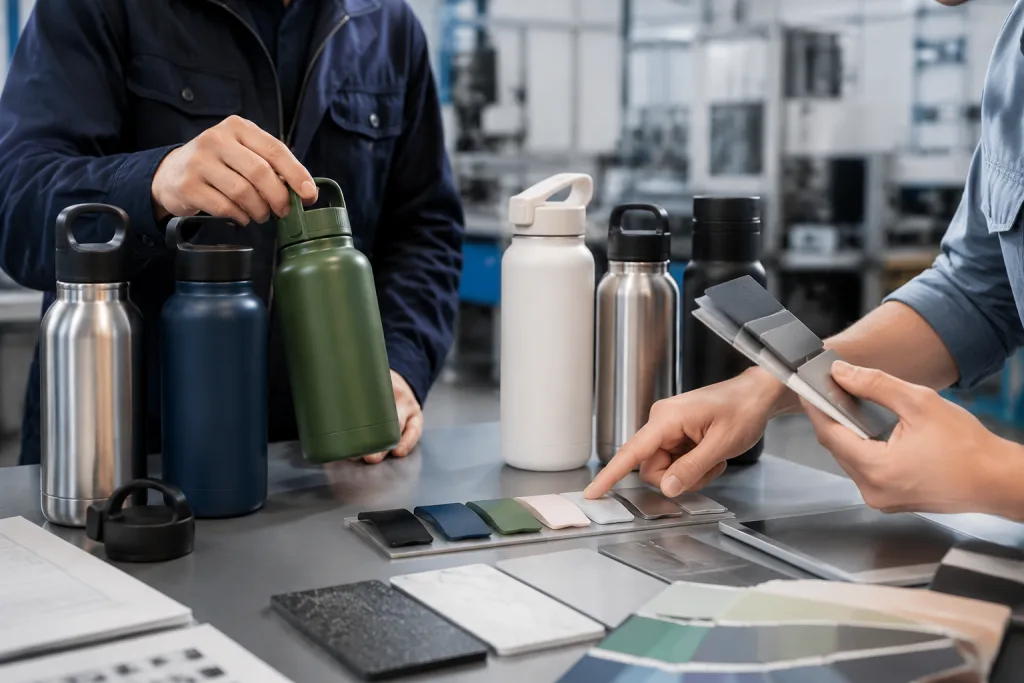
For logo work, silkscreen is usually the lowest-cost route for simple one- or two-color art. Laser engraving gives a cleaner mark on 304 stainless and holds up better after 20 wash cycles. Full-wrap UV print works for louder branding, but it needs cleaner artwork files and tighter color control. If your file has thin lines or small type, the buyer flagged it before because the 0.3 mm strokes washed out. Compare your artwork against the process in silkscreen vs laser engraving for custom drinkware.
Use this order of operations:
- Confirm bottle body and lid
- Approve sample color under daylight
- Lock logo size and placement
- Approve carton and FNSKU or retail label if needed
For Amazon-style launches, ask if the factory can handle FNSKU stickers, polybags, or master carton barcodes on the packing table. For retail distributors, ask if they can hold repeat stock and reprint cartons without reopening the mold. We ran one PO where the buyer typed the wrong FNSKU by one digit, and QC pulled the sample before packing. The math does not work if you fix that after shipment. Control the spec up front and you cut the scrap, the delay, and the back-and-forth later.
What does a good ordering checklist look like?
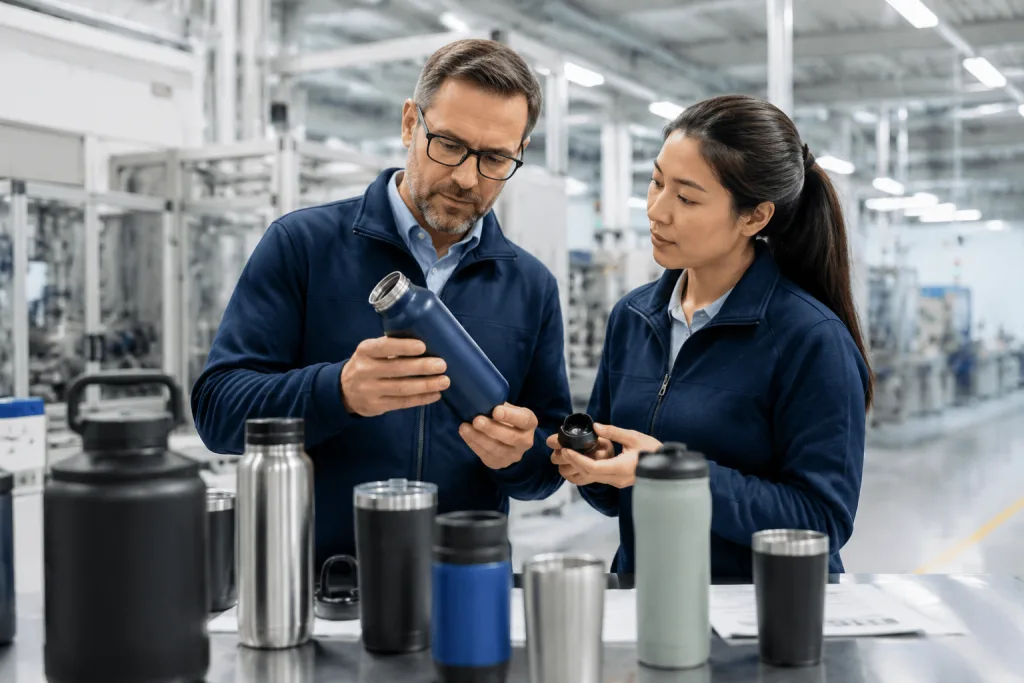
I’ll rewrite the section in-place, keep the HTML tags and links unchanged, and tighten the copy so it sounds like a factory-side sales engineer wrote it.Run the checklist before you release the deposit. It makes the supplier put every promise in writing and gives QA, logistics, and sales one sheet to work from. For a supplier hydration bottle program, one page is enough if the wording is tight. Loose wording causes disputes. We’ve seen a buyer lose 3 weeks because “sample approved” did not match the PO.
- Product name and capacity: 500 ml, 750 ml, or 1 L
- Material and thickness: 304 stainless, 0.5 mm wall
- Decoration: one-color print, laser logo, or full-wrap artwork
- Compliance: REACH, LFGB, FDA, and agreed test report date
- Packaging: inner box, master carton count, drop-test requirement
- Commercials: MOQ, FOB price, payment terms, and lead time
Ask for pre-production samples before mass production and keep the sign-off trail. On the line, QC pulled the sample against the artwork sheet, not the email thread. If you are comparing canteen manufacturers, price alone is the wrong question. Check defect handling, spare lid policy, and sample turnaround instead. A solid canteen supplier in China can usually send a confirmed sample in 5-8 days and correct artwork within 48 hours. That schedule matters when your buyer has a launch date and the carton count must match the booking.
If you want a broader factory view, review how to source custom drinkware from China and compare it with the actual product range on stainless bottle and thermos options.
Send your bottle spec for a fast quote
We will check MOQ, material, decoration, and compliance before you waste time on samples that cannot scale.
Frequently asked questions
What MOQ should I expect for a supplier hydration bottle order?
For standard stock molds, 1,000 pcs is realistic. For a fully customized canteen with new printing setup or special packaging, 3,000 pcs is more common. If you want a new lid mold, expect 5,000 pcs or more before a canteen factory will price it properly. Lower MOQs usually mean trader stock, not real factory allocation.
How much does a custom drinkware bottle cost FOB China?
A simple canteen promotional bottle can start around USD 1.20-1.80 FOB China. A double-wall stainless model with powder coat and logo work usually lands at USD 2.40-4.80 FOB. The final number depends on steel grade, lid complexity, print method, and carton spec. Zhejiang factories often quote fast, but you should always confirm what is included.
What documents should a canteen manufacturer provide?
Ask for material declarations, REACH support for Europe, LFGB if the bottle touches food, and any FDA contact-material statement for North America. You should also request the factory QC report, leak-test record, and AQL inspection plan. A serious canteen manufacturer will share batch-level proof, not just a PDF catalog.
How do I reduce leakage risk in customized drinkware?
Specify the lid model, gasket material, and torque target in writing. Then require 100% leak checks on critical SKUs or at least a documented sampling plan. For a custom growler or sports bottle, ask the factory to test upside-down leakage for 24 hours and confirm the results before mass production. Small details matter more than logo placement.
Can one canteen supplier support both retail and distributor orders?
Yes, if the factory is set up for repeat production and packaging variation. A good canteen supplier can make a customized canteen for retail, then switch to distributor canteen cartons or Amazon FNSKU labeling without changing the body mold. The real question is whether they can hold the same color, weld quality, and lead time across reorders.