Key Takeaways
- Set hip flask MOQ at 3,000 pcs for custom logo and 5,000 pcs for custom mold color boxes
- Specify 304 stainless steel, 0.4-0.5 mm wall thickness, and leak test method before pricing
- Use AQL 2.5 for major defects and AQL 4.0 for minor defects on pre-shipment inspection
- Plan 7-10 days for sampling and 30-40 days for mass production after artwork approval
You are not buying a sample hip flask for a gift shop shelf. You are buying 3,000 to 20,000 units that have to match a brand brief, pass incoming inspection, and land without carton crush or logo complaints. A supplier hip flask order looks easy until you lock in steel grade, cap fit, decoration, inner cleaning, and packaging.
We manufacture custom drinkware in Hangzhou, Zhejiang, and the same buyer mistakes show up again and again: vague artwork, loose capacity tolerance, no AQL plan, and a PO that says stainless steel without thickness. We ran one 8,000-piece order last month, and QC pulled three samples before release because the cap torque was off by 0.3 N·m. Here is how I would walk you through a real B2B order from inquiry to shipment in China.
Start with the buyer brief
I’ll rewrite this section in place, keeping the HTML tags and original structure intact while making it sound like a real sales engineer wrote it. Then I’ll sanity-check that I didn’t change any required codes, numbers, or tags.Assume you are a European distributor buying 5,000 pcs for a winter promotion. Your client wants a matte black 6 oz hip flask with laser engraved logo, individual gift box, and delivery before a fixed campaign date. That is enough to open the discussion. It is not enough to quote the job.
A solid supplier hip flask brief should name capacity, body shape, steel grade, finish, decoration area, packing, compliance market, and delivery term. If you only ask for best price, most canteen vendors and flask factories will quote the cheapest common build, usually 201 stainless steel with thin walls and generic packaging. We see this go sideways all the time. QC pulled a 0.35 mm shell on one sample, and the buyer flagged the denting after one carton drop test. Fine for a low-cost giveaway. Wrong for a retailer expecting 304 stainless steel and REACH-compliant coating.
For this buyer scenario, I would write the RFQ like this: 5,000 pcs, 6 oz hip flask, 304 stainless steel, 0.45 mm body wall, satin black powder coating, laser logo 45 mm wide, screw cap attached with hinge arm, individual 350 gsm paper box, 24 pcs per export carton, FOB Ningbo. Target market: Germany and Netherlands. Required documents: material declaration, REACH statement for coating, and final inspection report. The math does not work if the PO says “black flask” and expects a sample match at the line.
That level of detail lets a canteen manufacturer or hip flask line quote the same item, not five different interpretations. It also helps you compare a canteen factory in Zhejiang with another China supplier on construction, not just a USD 0.12 price gap that later turns into rejects. We had one buyer send a PO with “6oz” typed as “60z”; the carton mark was wrong, and the shipment sat for 3 days while the buyer fixed it.
Lock the material specification
I’ll keep the HTML structure intact and rewrite each paragraph in a sharper supplier voice, with concrete shop-floor detail and no AI filler.Hip flasks are small, so buyers like to treat material as a side issue. It is not. Wrong steel or wrong wall thickness changes dent resistance, corrosion behavior, weight, and how the flask feels in hand. For export custom drinkware, we usually put 304 stainless steel on the liquid-contact side. On a 6 oz flask, 201 stainless steel can cut cost by about USD 0.08-0.18 per pc, but it is less forgiving in humid warehouse storage and after alcohol sits in the bottle.
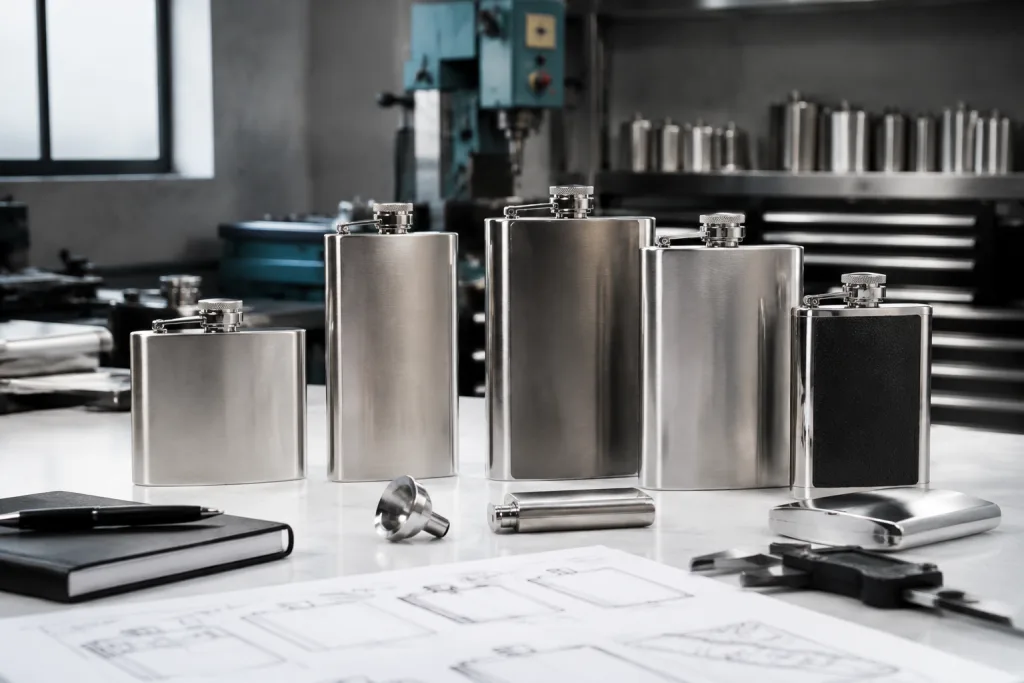
For a mid-market supplier hip flask, we run 0.4-0.5 mm body thickness, 304 stainless steel, a food-contact safe cap liner, and a deburred mouth edge. A 0.30-0.35 mm flask is cheaper on paper. On the line, that spec comes back fast if cartons take a drop in inland trucking; QC pulled the sample and the dent showed through the satin finish. If you sell to a canteen distributor or a promo buyer, the math does not work.
Capacity tolerance needs to be written down. A 6 oz flask should hold about 177 ml. We normally set functional tolerance at ±5 ml after forming and welding. If the buyer flagged a regulated kit, tighten the band and expect more inspection time. For surface finish, powder coating should be called out by color reference and gloss level, for example matte black at 10-20 GU. Brushed steel needs grain direction on paper too; mixed grain on the body and cap looks like a PO typo, not a finished product.
Ask your canteen supplier to confirm whether the flask is single-wall stamped and welded, whether the cap thread is rolled or machined, and whether ultrasonic cleaning runs after polishing. One buyer once sent a PO with “304 cap liner” instead of “304 body,” and that small typo created a week of back-and-forth. These are boring questions. They stop late-stage arguments.
Price the order without guessing
I’ll keep the HTML structure intact and rewrite the prose so it sounds like a factory-side sales engineer, with concrete pricing, MOQ, and carton details.For this 5,000 pc case from our Hangzhou, Zhejiang line, a 6 oz 304 stainless steel flask with laser engraving and a paper gift box usually lands at USD 1.65-2.35 FOB Ningbo, depending on coating, carton strength, and logo detail. We ran a batch last month at 1.82 and the buyer flagged the box insert, not the steel. A plain 201 stainless version comes in lower. A premium boxed set with funnel, PU sleeve, and rigid box can go above USD 3.20. If a quote sits far under that, ask what got cut.
MOQ is not just factory mood. It comes from coating loss, fixture setup, logo program time, box printing, and QC labor at the packing table. BottleForge can ship 3,000 pcs MOQ for a standard custom canteen or hip flask logo order, but custom color box printing works better from 5,000 pcs. For a fully new shape, tooling runs USD 1,200-4,500 and takes 25-35 days before sample sign-off. The math does not lie.
Payment terms should be clear. We usually work on 30% deposit and 70% balance before shipment after passed inspection. For repeat canteen distributors with steady volume, other terms can be discussed, but the first order should not run on trust alone. Use a proforma invoice that repeats the material, decoration, packaging, inspection standard, and delivery term. If the PI only says hip flask, black, logo, QC will have nothing solid when the buyer comes back with a claim.
Do not stare at unit price and forget the export carton. A carton changed from 5-ply B flute to stronger double-wall board may add USD 0.03-0.06 per pc equivalent. We have seen crushed gift boxes after a 40-day ocean run to Europe, and that bill is uglier than the carton upgrade. Spend the cents at the factory, not the dollars at destination.
Approve samples like an inspector
I’ll rewrite the four paragraphs in place, keep the tags intact, and tighten the copy so it sounds like a factory-side sales engineer, not marketing text.Sampling is where a smart buyer slows down. For a supplier hip flask order, we usually need 7-10 days for a logo sample if the base flask and coating color are on hand. If you need a new powder color, special plating, or a customized canteen accessory set, plan 12-18 days. The sample is not a souvenir; it is the physical spec for mass production.
Check it the same way every time. Fill it with water for 30 minutes, lay it on white tissue, and turn it in four positions. Run the cap through 20 open-close cycles and feel the thread. Measure logo width with a ruler or caliper, not by eye. Compare coating against your color reference under daylight and office light. We accept a small visual shift between a laser engraving sample and the bulk run, but the position tolerance should be written down, such as ±1.5 mm from approved artwork.
For gift packaging, approve the dielines and material at the same time. Buyer complaints usually start when the flask gets approved and the box is left to the canteen vendor. Specify box paper weight, insert type, barcode, recycling mark, warning text if needed, and carton shipping mark. If you sell through a distributor canteen channel or online fulfillment, add FNSKU or retailer label requirements early. Add labels after final packing and you burn 2-4 extra working days; we’ve seen that typo on the PO turn into relabeling at the line.
Keep one approved sample with you and require the factory to keep a signed golden sample. On a run in Zhejiang or anywhere else in China, QC pulls that reference faster than they can dig through a long email chain. One pocket note helps too: the approved sample number and date. That beats guesswork.
Control decoration and packaging
I’ll rewrite the section in place, keep the HTML structure intact, and make it sound like a factory-side sales engineer wrote it.Decoration drives both unit cost and reject risk. Laser engraving stays sharp on 304 stainless steel and coated bodies, and for a 1-color logo on a hip flask it is usually the cleanest call. Silk screen printing can hold solid brand color, but we always pull an adhesion test first, especially on powder coating or a curved shell. Pad printing fits smaller curved marks. Full-wrap artwork on a small flask can work, but the seam miss shows fast; on a larger custom growler or customizable canteen, the eye forgives more.
For a 5,000 pc matte black order, I would pick laser engraving unless the brand color is non-negotiable. The file needs to be vector, usually AI, PDF, EPS, or CDR, with all fonts outlined. We want size, position, and direction fixed on a flat template before the line starts. If the buyer asks for 5,000 different names, that is a variable-data job, not a normal print job, and the math changes on both price and QC.
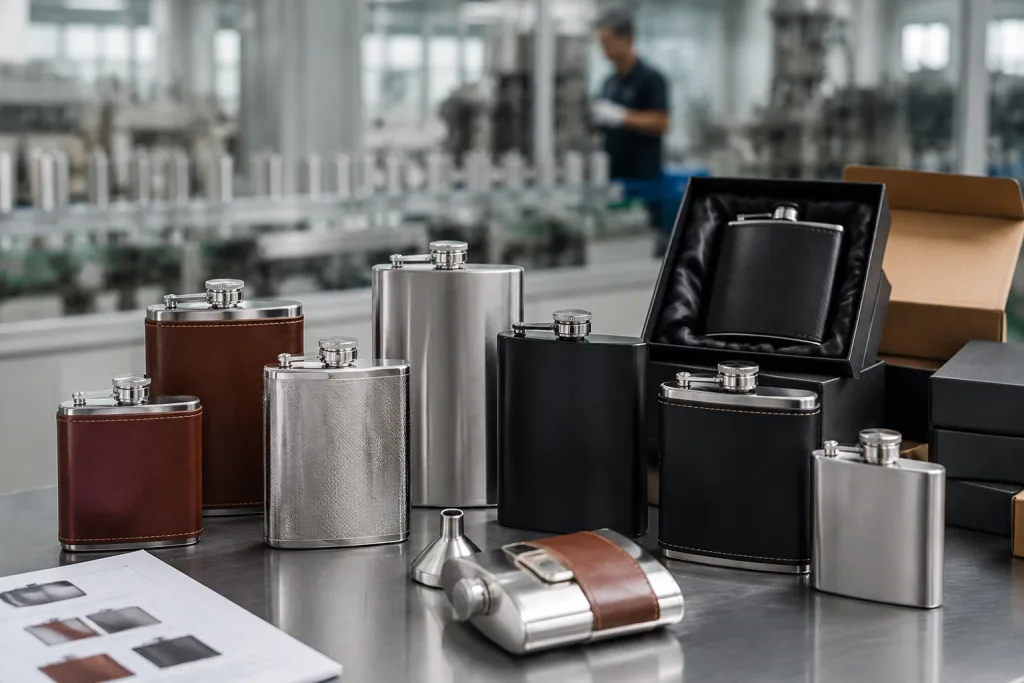
Packaging needs the same discipline. Individual polybag, paper wrap, molded pulp tray, white box, kraft box, color box, and rigid gift box each sit in a different cost band and damage rate. For B2B promo orders, a 350 gsm color box with an inner paper insert is usually enough. For retail, we check for EAN barcode, multilingual care copy, batch code, and shelf strength; one buyer once sent a PO with the barcode field blank, and QC flagged it before we ran the line. North American buyers may also ask for Prop 65 review depending on coating and accessories.
If your program also includes canteen promotional items, distributor growler orders, or customizable drinkware sets, do not push every SKU into one pack spec. A hip flask is compact and heavy for its size; a customized growler needs more drop protection, often a molded tray instead of a simple insert. Standardize the artwork system. Do not standardize weak packaging.
Inspect before the balance payment
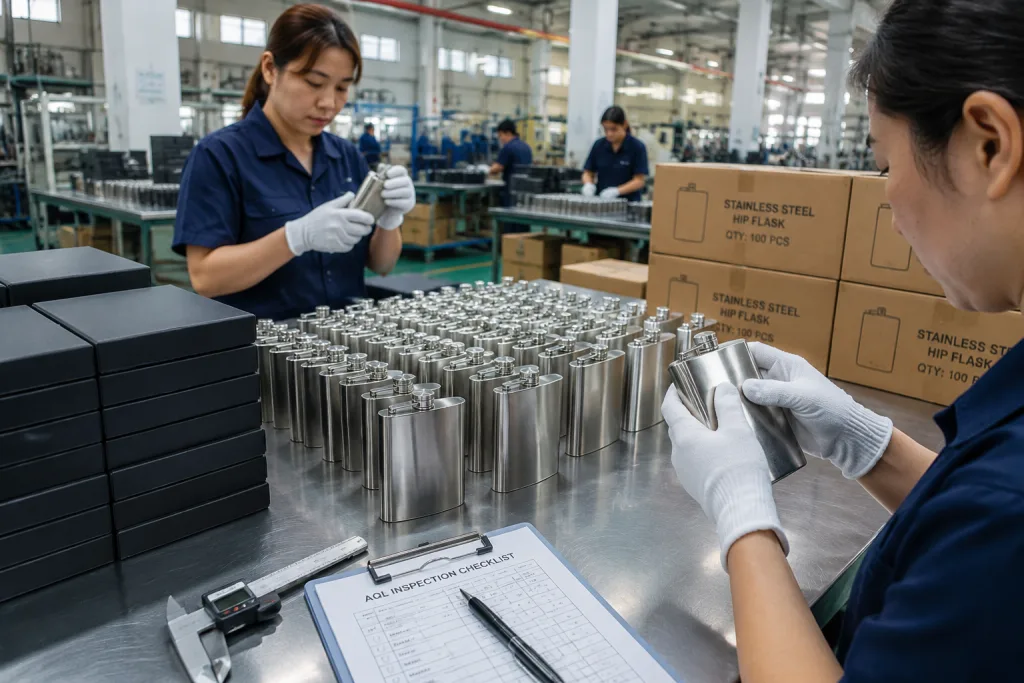
I’ll keep the HTML structure intact and tighten the prose so it reads like a field note from a factory-side sales engineer. Next I’m rewriting the four paragraphs with more concrete QC language, numbers, and buyer pushback.Pre-shipment inspection is not a box to tick. It is your last cheap chance to catch mixed logos, leaking caps, scratches, wrong cartons, and missing labels. On a 5,000 pc order, we run the check when 100% is made and at least 80% is packed. Use ANSI/ASQ Z1.4 or ISO 2859-1 sampling with AQL 2.5 for major defects and AQL 4.0 for minor defects. Critical defects, like sharp edges or contamination inside the flask, stay at zero.
A practical QC checklist covers capacity test, leak test, cap torque feel, coating adhesion with a 3M tape cross-hatch sample, logo position, surface scratch grade, box print, barcode scan, carton drop check, carton count, gross weight, and shipping marks. For flasks that touch alcohol, odor inspection matters. We once had a buyer flag a faint oil smell from polishing residue at the packing table; they were right. A metallic smell can wash out, but oil residue should never leave the line.
BottleForge Industrial can produce about 300,000 drinkware units per month across stainless bottle, tumbler, canteen customized, and flask programs, but output does not replace QC discipline. The math does not work that way. A clean order file and a clear inspection standard matter more than headline capacity. QC pulled the sample on one batch with a 0.8 mm logo shift, and the buyer rejected it fast. We have also seen buyers accept weak carton sealing because they were rushing a vessel booking.
If inspection fails, agree on sorting, rework, replacement quantity, and re-inspection cost before paying the balance. A serious canteen manufacturer will not enjoy the delay, but will understand it. The buyer flagged this before balance payment for a reason. A supplier who pushes you to ship before checking is asking you to carry their risk, not theirs.
Ship with documents ready
I’ll rewrite the four paragraphs in a more field-tested B2B sales tone, keep the HTML exactly as-is, and make sure the shipping/doc details sound like a factory handoff note.Once inspection passes, check the packing list against the commercial invoice before the forwarder books pickup. For FOB Ningbo or FOB Shanghai, we handle export customs and deliver to the port; your side or your forwarder takes over ocean freight. For DDP, nail down duties, VAT, the importer of record, and last-mile delivery before the PO goes out. DDP works for a 300 pc trial run, but the math gets blurry fast when a distributor needs landed cost by line item.
For a 5,000 pc hip flask order, plan on about 210-250 cartons if we pack 24 pcs per carton, depending on the gift box size. Get carton dimensions early so your freight team can work out CBM; we ship better when that number is fixed before the line starts boxing. Our standard lead time is 30-40 days after deposit and approved sample. Add 3-5 days for booking and warehouse handover, then ocean transit based on destination. If your promo date is locked, don’t approve samples late and then ask us to win back two lost weeks. We’ve seen that go sideways more than once.
The document set should cover the commercial invoice, packing list, bill of lading or telex release, certificate of origin if needed, and any compliance declarations written into the PO. For retailer or marketplace programs, add carton labels, FNSKU, inner labels, and photo proof before shipment. If the order sits inside a wider custom drinkware rollout with custom canteen, canteen customizable, and customized growler SKUs, keep batch codes split by SKU. Mixed tracking is a headache when a buyer flags one compliance point six months later. QC pulled the sample, and one wrong carton mark was enough to stall release.
A good supplier relationship is built on clean specs, sane timing, signed samples, and inspection data both sides can stand behind. Cheerful emails don’t clear a container. A complete PO does.
Send us your flask spec before you quote
Share capacity, logo file, MOQ, packaging, and delivery market. We will return a practical China factory quote with risks flagged.
Frequently asked questions
What MOQ should I expect for a supplier hip flask order?
For a standard 6 oz or 8 oz hip flask with one logo, 3,000 pcs is a practical MOQ at our Zhejiang operation. If you need a printed color box, special powder coating, or bundled funnel set, 5,000 pcs is more realistic because packaging factories and coating lines have setup loss. For a new flask shape, expect tooling of USD 1,200-4,500 and a higher first run, often 8,000-10,000 pcs. Small trial orders can sometimes use stock goods with laser engraving, but the unit price will be higher and packaging choices narrower.
Is 304 stainless steel always required for hip flasks?
For mid-market export orders, I recommend 304 stainless steel for the liquid-contact body because it gives better corrosion resistance than 201 stainless steel. Some low-cost promotional flasks use 201, and that can work for short-term giveaways if the buyer accepts the trade-off. The price difference on a 6 oz flask is often around USD 0.08-0.18 per pc, depending on steel market movement. If your customer sells into Europe or North America under a brand name, 304 stainless steel plus a clear material declaration is the safer route.
Which logo method is best for a customized canteen or flask?
For a hip flask, laser engraving is usually the most stable method because it resists rubbing and does not rely on ink adhesion. Silk screen printing is better when you need a specific brand color, but you should request tape testing and rub testing on the actual coating. Pad printing is useful for small curved areas. For a customized canteen, customizable growler, or larger bottle, the decision changes because the print area is bigger and curvature is different. Always approve a physical sample, not only a digital mockup.
How do I inspect a canteen factory before placing the order?
Start with documents, then verify production reality. Ask for business license, export experience, BSCI or social audit status if required, monthly capacity, main equipment, and recent inspection report format. A capable canteen factory should explain incoming material checks, welding or forming process, polishing, coating, assembly, leak testing, and packing flow. For a first order above 5,000 pcs, I suggest a third-party or buyer-side factory audit if the supplier is new. The audit does not need to be dramatic; even a half-day check can reveal storage, traceability, and QC habits.
Can one supplier handle hip flasks, canteens, and growlers together?
Yes, but do not assume every canteen supplier is strong in every SKU. Hip flasks need small metal forming, cap fit control, and cosmetic finishing. A custom growler or distributor growler order needs larger body forming, insulation or sealing checks, and stronger cartons. At BottleForge Industrial in Hangzhou, China, we manage flask, canteen manufacturers, tumbler, bottle, and growler programs through matched production lines rather than forcing one line to do everything. For a mixed order, separate specs, samples, AQL checklists, and batch codes by SKU.