Key Takeaways
- Borosilicate glass bottles usually need 1.8-2.2 mm wall thickness for reliable daily-use retail programs
- A practical custom glass water bottle MOQ starts around 3,000 pcs per color or logo version
- Logo sampling normally takes 7-10 days; bulk production is commonly 30-40 days after approval
- Use AQL 2.5/4.0 plus a drop-test carton standard before accepting FOB China shipment
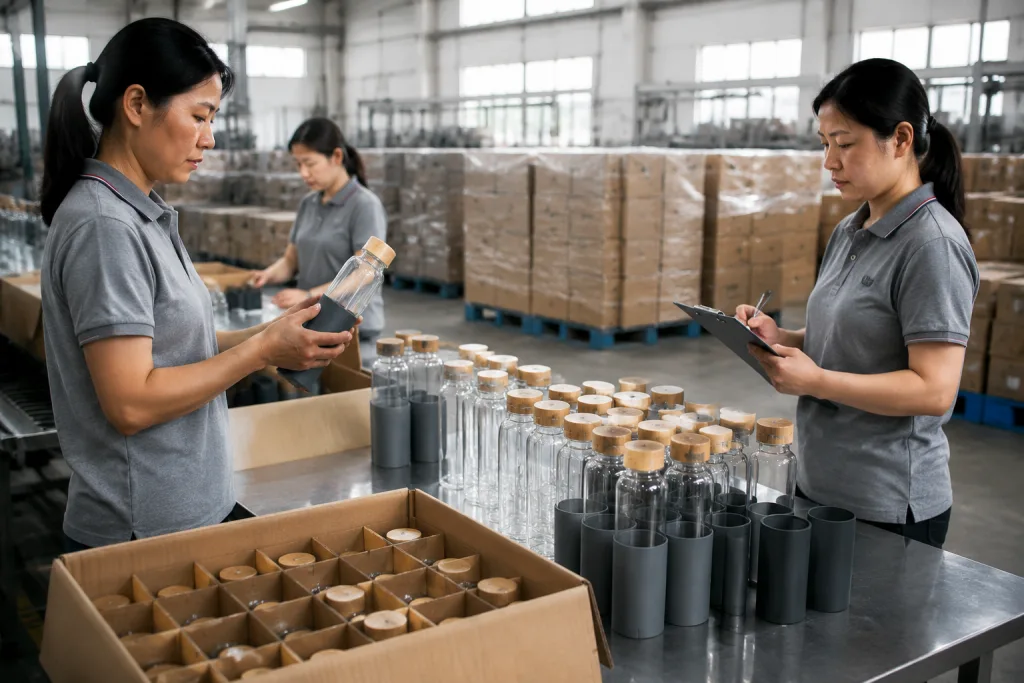
If you sell into wellness, refill, yoga, spa, or sustainable retail channels, glass looks simple until you place a real purchase order. The bottle has to feel premium, survive pallet drops, pass food-contact checks, and still land at a price the buyer signs off on. We’ve seen the wrong supplier glass water bottle choice show up late: chipped rims, loose sleeves, carton breakage, slow logo approval, or a line that cannot hold the same color on the second order.
From our Hangzhou office in Zhejiang, we see buyers make four calls first: glass type, cap system, decoration method, and packing standard. QC pulled a 300 ml sample with a 1.2 mm rim variation last month, and that kind of miss kills retail confidence fast. China has plenty of glass bottle traders, but not every borosilicate glass bottle factory is built for export-grade AQL inspection, REACH paperwork, or cartons that ship clean at 24 pcs per case.
Start with the bottle job
I’ll rewrite the prose only, keep the HTML exactly as-is, and tune the copy to sound like a factory-side sales engineer.Before you ask for a price, pin down what the bottle must do on shelf and in hand. A wellness studio giveaway, a sustainable retail SKU, and a corporate refill bottle are three different jobs. If you send only “500 ml glass bottle with logo,” most borosilicate glass bottle suppliers will quote the cheapest workable spec, not the one that protects your margin.
For most wellness brands, the first call is soda-lime glass or borosilicate glass. Soda-lime costs less and shows up a lot in jars and beverage packs. Borosilicate takes temperature swings better, feels lighter at the same capacity, and is usually the better pick for a reusable custom glass water bottle. For a 500 ml bottle, a real borosilicate wall is about 1.8-2.2 mm. Go thinner and you might save USD 0.08-0.15 per piece, but we’ve seen breakage jump in filling, packing, and retail handling. QC pulled a 20-piece sample once, and 3 cracked at the neck after a 1.2 m carton-drop test. That math does not work.
The next call is product role. A borosilicate glass bottle promotional order can run with simpler packaging and one-color print. A retail bulk glass water bottle program needs tighter cosmetic grading, better sleeve fit, and printed or branded cartons. If you are a borosilicate glass bottle distributor selling into multiple accounts, build for repeat runs: standard sizes like 350 ml, 500 ml, 650 ml, and 750 ml are easier to replenish than odd molds. We ship these every week, and the line moves cleaner when the neck finish stays the same. A buyer once sent a PO with “6500 ml” by typo; the sample room caught it before tooling, which saved a messy rework.
Do not start with the logo. Start with capacity, wall thickness, cap material, sleeve need, and carton drop requirement. Decoration comes after the bottle itself is stable.
Choose glass grade and capacity
I’ll rewrite the prose in-place, keep the HTML exactly as-is, and tighten the sales-engineer tone with concrete sourcing detail.A solid supplier glass water bottle quote should spell out the glass grade, not just say “high borosilicate.” In China, that label gets used loosely, so we ask for the composition spec, thermal shock data, and whether the bottle is drawn from tubing or formed in a mold. Tubing runs suit slim cylindrical bottles and usually give cleaner clarity. Molded shapes open up more distinctive silhouettes, but the tooling needs tighter control and sampling often takes 12 days instead of 18.
For borosilicate glass bottle bulk orders, capacity changes more than fill volume. It changes carton weight, shelf height, sleeve size, and freight cost. A 500 ml bottle is usually the safer retail size for wellness programs because it fits yoga bags and cup holders better than many 750 ml designs. A 650 ml or 750 ml bottle looks heavier on shelf, but it can push the inner-box size past what some buyers will take. We had one buyer flag a 750 ml PO because the carton hit 8.2 kg, and the math just didn’t work.
Typical FOB China reference pricing for a plain 500 ml borosilicate bottle with bamboo or PP cap may sit around USD 1.45-2.20 at 3,000-5,000 pcs, depending on sleeve, cap seal, and packaging. A 750 ml version often adds USD 0.20-0.45. Those are working ranges, not promises, and they help you catch fantasy quotes fast. If one borosilicate glass bottle manufacturer is 30% cheaper than the rest, check wall thickness, cap gasket, carton strength, and whether the quote includes individual boxes. QC pulled the sample on one job because the wall was 1.2 mm at the shoulder and 1.8 mm at the base.
For sustainable retailers, think about the full claim set. Glass is recyclable, but a silicone sleeve, stainless cap, bamboo insert, or coated color finish changes how the product reads in the market. A customizable glass water bottle should match the sustainability story, not just the Pantone. We’ve seen this go sideways when a buyer wanted a “zero-plastic” launch but kept a PP inner liner in the cap.
Caps decide user complaints
I’ll rewrite the section in-place, keeping the HTML structure intact and tightening the sales-engineer tone. Next I’m making the prose more concrete with factory-floor details and removing the AI-style filler.Most bad reviews on reusable bottles are not about the glass. They come from leaks, stale smells, caps that are hard to wash, cracked lids, or sleeves that slide off. We see this on the line all the time. A serious borosilicate glass bottle supplier treats the cap as a system, not a side part.
Bamboo caps sell well in wellness channels, but the spec has to be clear. Ask if the bamboo is solid, veneer over plastic, or veneer over stainless steel. Ask what gasket material we run, usually food-grade silicone. Ask whether the food-contact face is stainless steel, PP, or exposed bamboo. Exposed bamboo can hold odor, and that choice does not fit every market. For the EU and North America, we usually recommend a cap with a food-contact PP or stainless inner face plus a removable silicone sealing ring.
Stainless steel caps are tougher and easier to place in premium retail. PP caps keep cost down and fit promo orders. Strap lids improve carry comfort, but every hinge, ring, and handle adds a failure point. If you are sourcing a customized glass water bottle for a subscription box or wellness chain, run 50 open-close cycles on pre-production samples. QC pulled the sample at 48 cycles once and found the thread starting to bite. Cheap test. Saves a headache.
- Leak test: fill to 95%, invert for 30 minutes, then shake 20 times.
- Thread check: cap should close smoothly without grinding or cross-threading.
- Odor check: seal samples in a carton for 48 hours, then inspect smell.
- Dishwasher claim: confirm if it applies to glass only, cap only, or full bottle.
Some borosilicate glass bottle vendors can turn out a clean-looking sample. Holding the same gasket hardness and cap fit across 20,000 units is the real test. We’ve seen that go sideways when the buyer flagged a 0.3 mm thread mismatch between sample and mass production.
Customization has real limits
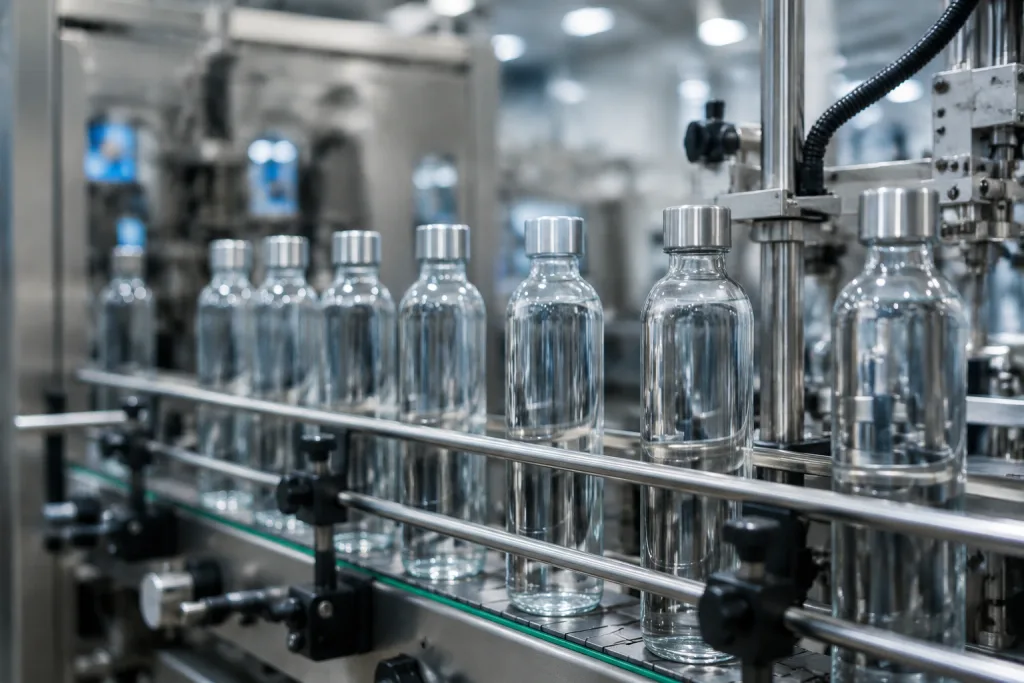
I’ll rewrite the section in place, keep the HTML structure unchanged, and tune the tone to sound like a factory-side sales engineer.A borosilicate glass bottle custom project usually starts with logo, sleeve color, cap color, packaging, or a private mold. Each choice moves MOQ and lead time. In our Zhejiang line, the usual MOQ is 3,000 pcs for a standard bottle with one logo and an existing cap color. Silicone sleeve colors often need 3,000-5,000 pcs per Pantone color because the mixer, cutter, and trim station do not pay off on tiny runs. Private mold work can start around USD 1,200-3,500 for simple glass tooling, but a sharper shape means more steel, more sampling, and more days on the line.
Decoration has to match the surface and the job. Silk screen printing is the cleanest choice for one to three solid colors, and it works well on a custom borosilicate glass bottle with simple branding. Laser engraving looks good on stainless caps and some coated parts, but it is the wrong answer on many glass bodies. Decals give you more artwork detail, yet they add firing or curing steps and QC pulls more rejects when registration is off. If the retail box carries the full-color story, the bottle stays cleaner and the math works better.
If you need a borosilicate glass bottle customizable across several retail accounts, keep the bottle body fixed and change sleeves, caps, or packaging. That cuts inventory risk and keeps repeat orders moving. We have seen this go sideways when a buyer wants one unique shape, one odd cap, and one special sleeve for a chain; then the forecast slips and the buyer flags the stock. A borosilicate glass bottle customized that way can look sharp, but you carry the cost if the chain changes course.
For artwork control, send vector files in AI, PDF, or EPS. Put Pantone codes, print position in millimeters, and logo size on the file. “Centered on front” is not production language. We had a PO once with the logo typoed by one letter, and the buyer caught it only after the digital proof. A good borosilicate glass bottle manufacturer should send a digital proof first, then a physical pre-production sample before mass production.
Inspect like a retailer
I’ll rewrite the section in place, keep the HTML exactly as-is, and tighten the tone to sound like a factory-side sales engineer.Glass bottles need a different quality mindset than stainless steel drinkware. A faint mark that passes on industrial packs will get flagged by wellness and sustainable retailers, because they check clarity, symmetry, clean rims, and sleeve fit on the shelf. We set the inspection line before production starts, not after the buyer complains.
Use AQL on mass production. A common setup is AQL 2.5 for major defects and AQL 4.0 for minor defects. Critical defects stay at zero tolerance. Sharp edges, cracked glass, foreign matter inside the bottle, leaking caps, unsafe odor, and failed food-contact documents all count as critical. Major issues include obvious logo shift, unstable standing, severe bubbles, cap thread failure, or a loose sleeve. Minor issues cover small bubbles within agreed limits, light scuffs, or slight color variation. QC pulled the sample at 10:30, and that is where the argument usually starts.
Carton testing matters as much as bottle inspection. For distributor glass water bottle orders, we normally suggest a 5-ply export carton, individual box or paper wrap, dividers when needed, and a real drop test. For a 500 ml bottle packed 24 pcs per master carton, gross weight often hits 10-13 kg. If the carton spec is weak, the line can ship a perfect bottle and the buyer still receives broken goods in Rotterdam. We have seen that go sideways.
Compliance also needs early checking. For EU, ask for LFGB or the right food-contact test, REACH for coatings and silicone, and packaging waste rules. For the US, many buyers ask for FDA food-contact compliance and, in some cases, California Proposition 65 screening. If the bottle is for children, ASTM and CPSIA may apply. A borosilicate glass bottle vendor that cannot explain the test scope is not ready for retail, and the math does not work for your PO.
Compare suppliers by control
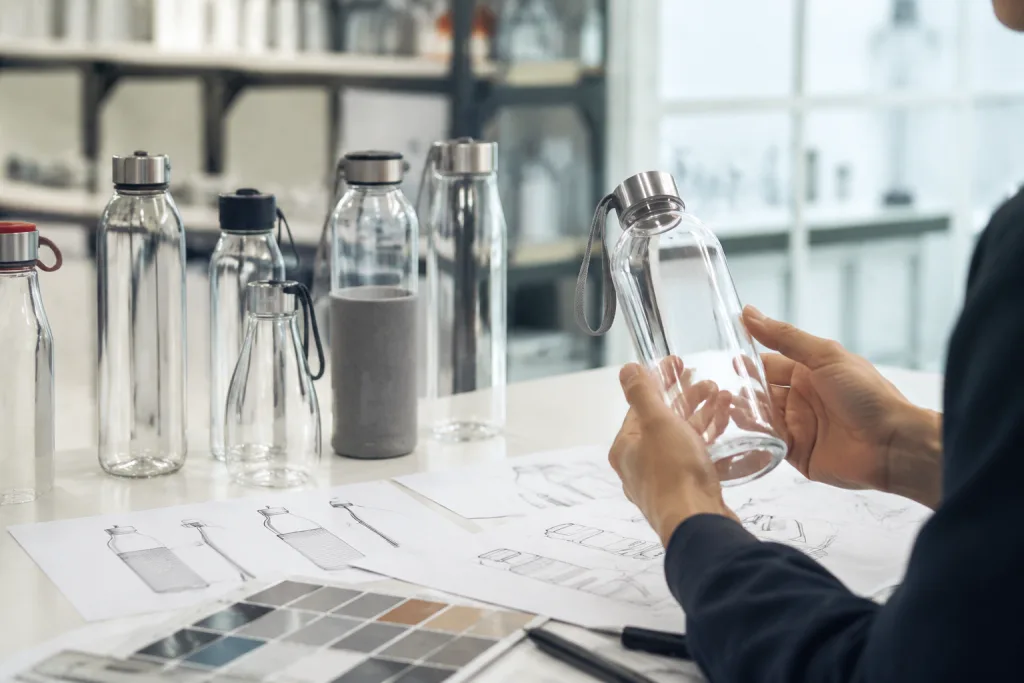
I’ll rewrite the section in-place, keep the HTML exactly as-is, and tune the prose to sound like a working sales engineer—more specific, less polished, and with a few factory-floor details.The phrase borosilicate glass bottle manufacturers covers real factories, assembly workshops, trading companies, and hybrid exporters. None of those models is bad by default. The real question is who controls the risk points: glass forming, cap sourcing, sleeve production, printing, packing, inspection, and export documents.
If you are buying borosilicate glass bottle wholesale for retail distribution, ask direct control questions. Who owns the glass line? Who buys the caps? Is printing done in-house or sent out? Can they show incoming inspection records for silicone sleeves and gaskets? What is their normal monthly capacity? Last month one PO had a sleeve color typo, and QC pulled the sample before packing. As a reference, BottleForge coordinates glass bottle programs in Zhejiang and nearby China supply clusters with partner output up to 300,000 reusable bottles per month, depending on season and component mix.
A borosilicate glass bottle factory may give you better technical access, but a capable exporter can sometimes handle multi-component orders better. We have seen this go sideways when an exporter only forwards photos and cannot push back on the factory. For a borosilicate glass bottle distributor or sustainable retailer, communication speed matters less than decision accuracy. A fast wrong answer is still wrong.
Use a simple scorecard. Give weight to sample accuracy, documentation, defect handling, packing design, and repeat-order stability. Price should be one column, not the whole sheet. A reliable borosilicate glass bottle supplier should accept a written spec, confirm tolerances, and talk through trade-offs before taking your deposit. If every answer is “yes, no problem,” that is the wrong question to ask.
Set terms before deposit
I’ll rewrite the section in place, keep the HTML untouched, and tighten the wording so it sounds like a real factory-side sales engineer.Commercial terms set the pain level when a delay or defect shows up. For a first order from China, 30% deposit and 70% balance before shipment is standard. Some larger buyers push for balance after passed inspection; we do that sometimes, but only when the order value and buyer history justify it. FOB Ningbo or FOB Shanghai fits Zhejiang supply. EXW looks cheaper on paper, yet it shifts local trucking, customs handoff, and export docs to you or your forwarder.
Lead time changes with the build. An existing bottle, standard cap, and one-color logo usually runs 30-40 days after sample approval. A new sleeve color adds 5-10 days. New mold work can take 45-70 days before the line is stable. We ship fast in low season; in the Q4 rush, the calendar fills up early. If you approve artwork in September and expect smooth November delivery, the math does not work.
Your purchase order should spell out capacity, material, wall thickness target, cap structure, gasket material, decoration method, Pantone colors, packing method, carton size limit, inspection standard, documents required, Incoterm, and delivery port. For Amazon or marketplace programs, add FNSKU labeling, carton barcode rules, and drop-test expectations. For retail chains, add master carton marks and pallet configuration if required. We’ve seen a PO typo on carton size turn into a week of rework at the packing table.
For bulk borosilicate glass bottle programs, we prefer a paid sample, signed golden sample, pre-production check, mid-line photo report, and final third-party or buyer inspection. QC pulled the sample on one 2,000-piece run and caught a cap torque miss before packing; that saved a lot of noise later. This process costs a few days, but it beats explaining 2,000 leaking caps to a wellness retailer after the goods have landed.
Send your glass bottle brief for factory review
Share capacity, logo, market, MOQ, and target price. We will check feasibility, risks, and FOB China options before you commit.
Frequently asked questions
What MOQ should I expect for a custom glass water bottle?
For a standard borosilicate glass body with your logo, a realistic MOQ is usually 3,000 pcs per design. If you need a custom silicone sleeve color, expect 3,000-5,000 pcs per Pantone color. A custom cap color may also require 3,000 pcs or more depending on material. Private mold projects are different: the tooling fee can start around USD 1,200-3,500 for simple shapes, and the first production run is often 5,000-10,000 pcs. Smaller trial orders are sometimes possible using stock bottles and neutral packaging, but the unit price will be higher and customization choices will be limited.
Is borosilicate glass better than regular glass for water bottles?
For reusable drink bottles, borosilicate is usually the safer commercial choice. It handles temperature change better than ordinary soda-lime glass and can be lighter at the same capacity. That matters when customers carry a 500 ml or 750 ml bottle daily. It is still glass, so it can break if dropped on tile or concrete. The practical spec is not only the glass type; wall thickness, rim finishing, annealing, and packing all matter. For a retail 500 ml bottle, we normally look for about 1.8-2.2 mm wall thickness and clean rim polishing before approving bulk production.
How do I compare borosilicate glass bottle suppliers fairly?
Send the same written specification to each supplier: capacity, wall thickness target, cap material, gasket material, logo method, packaging, AQL level, and FOB port. Then compare more than price. Check sample accuracy, documentation speed, whether they explain trade-offs, and how they handle defect definitions. Ask if they are a borosilicate glass bottle factory, trading company, or managed supplier network. None is automatically wrong, but you need to know who controls printing, cap sourcing, sleeve production, and final packing. A quote that is USD 0.25 cheaper can disappear quickly if carton breakage reaches 3-5%.
What tests should I request before shipping glass bottles?
At minimum, request visual inspection under AQL 2.5/4.0, leak testing, cap thread testing, odor checking, and carton drop testing. For EU retail, ask for applicable food-contact reports such as LFGB or equivalent scope, plus REACH checks for coatings, inks, silicone, and packaging where relevant. For the US, FDA food-contact compliance and Proposition 65 screening may be needed depending on your sales channel. If the bottle is marketed to children, discuss ASTM and CPSIA requirements early. Testing should be tied to the exact materials used in bulk production, not just a similar old sample.
How long does a borosilicate glass bottle customized order take?
A normal customized borosilicate glass bottle order takes about 7-10 days for logo sample preparation and 30-40 days for bulk production after approval. Add 5-10 days if you need a new silicone sleeve color or special packaging materials. A new mold can push development to 45-70 days before mass production is stable. Sea freight to Europe or North America usually adds several weeks depending on port and season. If you have a fixed retail launch date, work backward from delivery and leave at least 14 days for inspection, booking, and document correction.