Key Takeaways
- A supplier fruit infuser bottle RFQ should name 8 line items, not just one unit price
- Most bulk fruit infuser bottle projects need 3,000-5,000 pcs MOQ to keep tooling and decoration stable
- A practical sample lead time from China is 7-12 days, with bulk lead time of 25-35 days
- For export, ask for REACH test data, AQL 2.5/4.0 inspection terms, and carton/FNSKU details before you pay deposit
If you are buying a supplier fruit infuser bottle for a wellness brand or hydration startup, the hard part is not finding a nice bottle. The hard part is getting a unit that fills cleanly, seals tight, passes REACH, and still leaves room for a workable FOB after decoration, packaging, and freight. In China, especially Zhejiang, plenty of factories can show a clean render. Fewer can hold a 3,000-piece run steady across cap torque, silicone fit, and fruit chamber alignment.
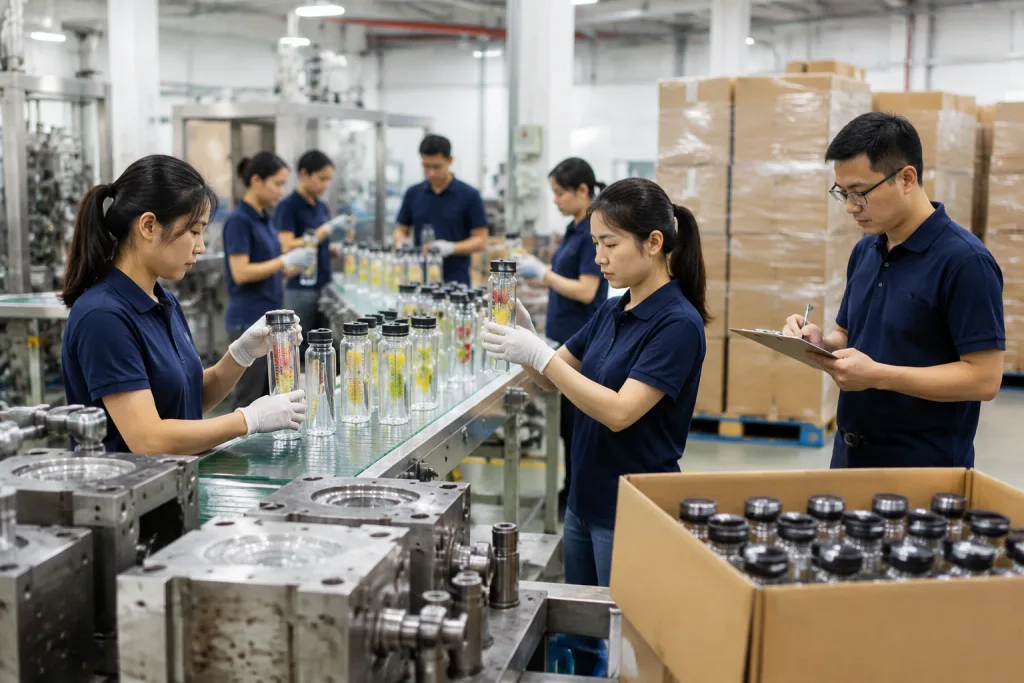
The clean way to buy is simple: RFQ, sample, pilot batch, then bulk PO. Basic on paper. That is where buyers save or lose money. A factory direct infuser bottle supplier should quote each line item clearly, give a realistic MOQ, and show where the hidden cost sits. At BottleForge Industrial in Hangzhou, Zhejiang, we run 500,000 units per month across drinkware lines, and we still see the same PO typo, cap-spec mismatch, and packaging overrun come back from the buyer. The math does not work if you skip the process.
Start with a precise RFQ
I’ll rewrite the section in-place, keep the HTML tags untouched, and make the prose sound like a factory-side sales engineer wrote it. Then I’ll do a quick pass to keep the numbers and buying terms intact.Your RFQ is not a shopping list. It tells us whether you have your specs together and whether the quote will hold after the first sample. For a supplier fruit infuser bottle project, put the bottle capacity, material, lid style, infuser chamber type, color, decoration, and packaging in black and white. If you send only “custom infuser bottle price,” the line gives you a loose number and the real cost shows up later.
Use actual specs: 650 ml Tritan body, PP cap, 304 stainless infuser tube, silicone gasket, matte transparent finish, one-color logo on the body, and individual kraft box. If you need a custom logo infuser bottle, state the print area and the method. Screen print usually runs USD 0.08-0.15 per color per piece, while laser engraving on metal parts lands around USD 0.20-0.40 depending on area. QC pulled a sample with a 38 mm logo panel last week; that was enough to keep the buyer from arguing later. For Zhejiang factories, this is normal. For middlemen, it often is not.
Put the commercial terms in the RFQ too: target MOQ, FOB Ningbo or FOB Shanghai, sample charge, and whether you want a factory direct infuser bottle quote or a distributor quote. If you are comparing a distributor fruit infuser bottle offer with a factory fruit infuser bottle offer, match the carton size, test standard, and logo method first. We’ve seen this go sideways when the PO says “same as sample” but the carton count is 24 pcs instead of 36 pcs. Then the math doesn’t work.
Ask for the quote to be broken into unit price, logo cost, packaging cost, sample fee, and mold fee if any. If the supplier cannot do that, the quote is not ready for purchasing.
Check construction before style
I’ll rewrite the section with tighter B2B sales-engineer tone, keep the HTML structure intact, and preserve all existing tags and key numbers.Fruit infuser bottles look simple. The construction decides whether they sell or come back as returns. We run Tritan, PETG, copolyester, or stainless steel bodies with an inner fruit chamber, and Tritan is still the safer all-round pick for wellness brands because it stays clear, takes impact, and holds odor better than cheap PC. On a 450-700 ml bottle, 2.2-2.8 mm wall thickness is the range we trust on the line. Go thinner and you get flex plus cap leaks; go thicker and the bottle feels bulky and pushes freight up.
For a bulk fruit infuser bottle, the insert matters more than the print. Check the perforation size, chamber length, and whether the fruit basket floats or locks. We’ve seen a buyer flag a loose chamber after QC pulled the sample and found pulp at the sip opening. A good customized fruit infuser bottle keeps the chamber 2-4 mm away from the spout path so fruit pieces do not jam the cap. If you are sourcing a bulk tea infuser bottle too, ask for a stainless mesh or perforated tube with 0.8-1.2 mm openings. That works for tea leaves and still handles citrus slices.
Practical PO line items at this stage:
- Material grade: Tritan, PP, 304 stainless steel, silicone
- Capacity and tolerance: 650 ml ± 15 ml
- Wall thickness: 2.5 mm body, 1.2 mm lid components
- Color standard: Pantone code, not “close to blue”
- Test standard: 50-cycle leak test, 1.2 m drop test
Do not let the factory hide behind “custom made infuser bottle” language. Custom means every measurable point gets written down, down to the mold cavity mark on the lid. If the PO says “nice blue,” we stop it there.
Request samples like a buyer
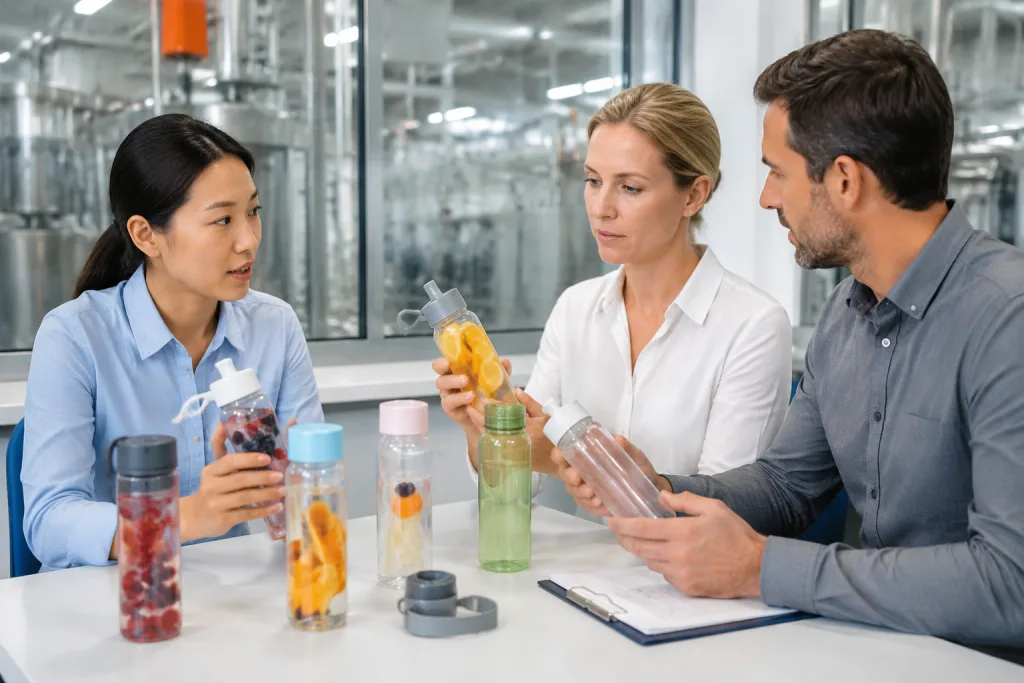
I’ll keep the tags intact and rewrite the prose to sound like a buyer-side factory note, with tighter language and a few concrete factory-floor details.Sampling is where you find out if the supplier can ship what they promised. A solid China factory should turn a functional sample in 7-12 days after artwork confirmation. If the lid or chamber needs a new mold, plan on 15-25 days. For a custom fruit infuser bottle, we ask for two samples every time: one pre-production sample for structure, one decorated sample for print or logo check. QC pulled the sample on the line and caught lid gap issues before mass run.
Watch the sample fee policy. We’ve seen factories quote USD 30-80 for a standard sample, then credit it back on the bulk order. Shipping stays separate. If you are testing a custom tea infuser bottle or customizable tea infuser bottle, use 90-95°C water only when the material spec allows it. The buyer flagged this on a PO once: they tested boiling water on the wrong resin, and the sample warped. The math doesn’t work if you skip the spec sheet.
When you review samples, use this checklist:
- Cap opens and closes smoothly after 30 cycles
- Silicone seals seat flat, not twisted
- Fruit chamber locks without rattling
- Print stays sharp after alcohol wipe
- No odor after warm-water soak for 24 hours
If you are building a customizable fruit infuser bottle line for retail, ask for one neutral sample and one brand-color sample. You need both. It shows how the bottle photographs under natural light and how it reads in ecommerce images; a 2 mm color shift can look fine in hand and ugly on screen.
Turn samples into a pilot PO
I’ll rewrite this section in place, keeping the HTML structure intact and making the wording sound like a factory-side sales engineer.The pilot order is where a buyer finds out whether the supplier can run production, not just samples. For a bulk infuser bottle or bulk tea infuser bottle, 500-1,000 pcs per SKU is the normal pilot size. That gives us enough cartons to check drop resistance, print alignment, and color drift. We once saw a 780-pc pilot pass molding, then fail because the inner tray crushed at 1.2 mm under load. That is the wrong place to save money. For a distributor infuser bottle program, we usually run one pilot for the bottle and a second one for retail-ready packing, because the line usually breaks at packout, not at the mold.
Your pilot PO should copy the bulk order line by line, just with lower quantity. Leave out nothing. Carton marks, barcode position, spare gasket count, and even the tape spec should be on there. If the SKU is going to Amazon, put FNSKU labeling and master carton size in the PO; QC pulled a sample last month where the buyer had typed the FNSKU one digit off, and the carton got held. A practical FOB factory quote for a mid-range customized infuser bottle from Zhejiang sits around USD 1.20-2.40 at 3,000 pcs, depending on material and decoration. Add a complex lid, double-wall body, or gift box, and the math changes fast.
PO line items to lock now:
- SKU name and capacity
- Unit price by quantity tier
- Logo method and location
- Packaging spec and insert sheet
- Inspection standard: AQL 2.5 major, 4.0 minor
- Lead time and shipment window
For a customized tea infuser bottle or customizable infuser bottle program, ask the factory to keep the same cap mold and only change the chamber insert if the structure allows it. We run that setup often. It cuts tooling cost, keeps the line stable, and makes the next replenishment a lot cleaner. One buyer pushed for a new cap just for a logo tweak; we said no, because that extra mold would slow the whole program down.
Negotiate bulk pricing properly
I’ll keep the HTML exactly as-is and rewrite only the prose, tightening the pricing language and adding a few concrete factory-floor details.Bulk pricing on a fruit infuser bottle bulk program is not just about squeezing the unit price. We run the math on material grade, logo method, packaging, and line capacity. On the line in Zhejiang, a quote can look sharp in February and turn messy in July if you lock a rush order for peak months. One buyer flagged a 12-day slip because they skipped the 6-month validity clause. Ask for that clause, or ask for a stepped table by volume.
A usable price ladder looks like this: 1,000 pcs at USD 1.85, 3,000 pcs at USD 1.48, 5,000 pcs at USD 1.32, FOB Ningbo. Not every plant will hit that number, but it gives you a clean benchmark. The cheapest factory infuser bottle quote usually leaves out carton upgrades, then the invoice grows once artwork and pack spec change. We’ve seen a PO typo on “inner box” turn into an extra USD 0.06 per set. The wrong question is “What is your lowest price?” Ask “What is included at 3,000 pcs?”
If you are a distributor tea infuser bottle buyer or a distributors infuser bottle buyer handling several channels, push for price breaks by color and mixed SKUs. One mold can cover two colorways, and we’ve accepted a combined MOQ when the body tooling stays the same. That is the clean way to run a custom tea infuser bottle and a fruit version under one launch. QC pulled the sample last month and the lids matched within 0.3 mm, so the setup was sound.
Freight changes the deal. A bottle that saves USD 0.10 on unit price but adds 18% more carton volume is a bad trade. We ship enough export cartons to know cube eats margin fast, especially once the master carton hits 58 x 38 x 42 cm. In export drinkware, the math does not bend.
Lock quality control before production
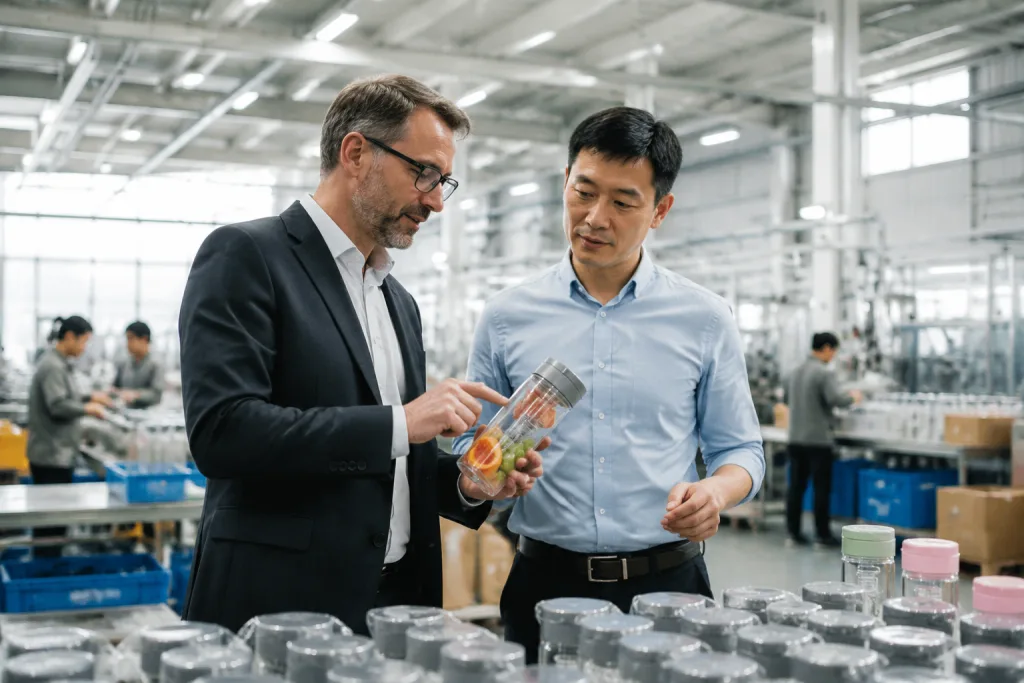
I’ll rewrite the section in place, keep the HTML structure intact, and make the prose sound like a factory-side export sales note.Quality control has to be set before the line starts, not after the first leak comes back from a buyer. For a customized fruit infuser bottle order, we run a pre-production sample sign-off, inline checks, and final inspection at AQL 2.5 for major defects and 4.0 for minor defects. That is the right bar for export work. It catches leakage, print offset, and cap fit before cartons are sealed.
Ask the factory to test the bottle in the same way your customer will use it. For a cold-infuse wellness bottle, we test with citrus, berries, and ice water on the bench. For a customizable tea infuser bottle, we check hot water, steam around the cap, and handle comfort. QC pulled the sample, and the first complaint was simple: the cap was too hot to hold after 15 minutes. Ask for records too—leak test sheets, drop test photos, and material papers such as REACH for Europe. If you sell into North America, ask for FDA-related material declarations where applicable, even if the product itself is not “FDA approved.”
For a serious distributor fruit infuser bottle program, require photos of the first-off, mid-run, and packed cartons. Put sampling frequency in the PO: one inspection every 2,000 units or one per line change. We once saw a PO typo that said “2000 pcs” on the spec page and “20,000 pcs” in the email thread; the math does not work, and the buyer flagged it before loading. This is basic factory discipline, and it is easier to hold a Zhejiang supplier to it when they ship export cartons every week than when a trading layer just forwards files.
Quality checks that actually matter:
- Leak test at 80-100 kPa
- Cap torque consistency
- Print adhesion after tape test
- Carton compression and drop resistance
- Color variance within Delta E 2.0-3.0
Prepare the shipment for retail
I’ll rewrite the HTML in place, keep the tag structure unchanged, and tighten the copy so it sounds like a factory-side sales engineer wrote it.The last step is packing the order so it lands ready for shelf or warehouse. A factory direct infuser bottle shipment should leave with carton marks, product labels, and the pallet layout fixed before the truck rolls out. If you ship to Amazon or a 3PL, build the PO around retail logistics, not just the line output. We check unit carton count, master carton size, barcode position, and whether each retail box needs an FNSKU. Last month, the buyer flagged a 2 mm barcode shift and we had to redo the outer box art.
For a custom logo infuser bottle launch, the box often shapes the first impression more than the bottle itself. A plain kraft box runs about USD 0.18-0.35; a printed color box usually sits around USD 0.45-0.90, depending on paper and finish. If you are a startup, spend on leak control and logo clarity first. Fancy embossing looks nice, but the math doesn't work if the bottle leaks at the fulfillment center. QC pulled the sample after a 48-hour upside-down test and one cap seeped at the thread.
When you handle a custom made infuser bottle reorder, keep the archived PO, approved sample, and test records in one folder. That cuts the back-and-forth when you place the same spec again six months later with a factory in Hangzhou or another China supplier. We run repeat jobs this way because it keeps MOQ, artwork, and carton spec from drifting. On one reorder, the buyer typed 5,000 as 5000 pcs in the PO, then asked why the carton count did not match the booking.
Close the job only when the cartons are counted, labeled, and matched to the booking. Simple. That is where sourcing turns into operations.
Get a real quote, not a vague estimate
Send your spec sheet, target MOQ, and packaging needs. We will quote your supplier fruit infuser bottle project in clear line items from China.
Frequently asked questions
What MOQ should I expect for a supplier fruit infuser bottle?
For a standard custom fruit infuser bottle, expect 3,000 pcs MOQ if you want normal factory pricing and stable decoration. Some factories in Zhejiang can do 1,000 pcs for a simple stock mold, but the unit price usually rises 12%-25%. If you need mixed colors, ask whether the MOQ is per color or shared across the same mold. For a fully custom lid or chamber, 5,000 pcs is more realistic because tooling and setup costs need volume to make sense.
How long does sampling usually take in China?
A functional sample from a China factory usually takes 7-12 days after artwork and spec approval. If the project needs a new mold, add 15-25 days. For a custom tea infuser bottle or custom logo infuser bottle, decoration samples may need one extra round if you are matching Pantone colors or testing laser engraving. Freight is usually 3-7 days by courier to Europe or North America, depending on customs clearance and the city you ship to.
What documents should I ask for before paying deposit?
Ask for the quote with line items, a sample photo set, material declaration, and a basic compliance pack. For Europe, REACH-related documentation is important; for North America, ask for material statements and any available third-party test reports. If you are buying a bulk infuser bottle for Amazon, also confirm carton dimensions, barcode format, and FNSKU labeling. A serious supplier fruit infuser bottle factory should provide these without hesitation.
Is a distributor fruit infuser bottle order different from a factory order?
Yes. A distributor fruit infuser bottle quote often includes an extra margin and sometimes faster communication, but the product spec can be less transparent. A factory direct infuser bottle quote is better when you need exact control over material, print, packaging, and lead time. If you are buying 3,000 pcs or more, factory direct usually gives better value. If you need one carton of samples or a small mixed run, a distributor may be more convenient.
What is a realistic lead time for bulk production?
After sample approval and deposit, a bulk fruit infuser bottle order usually needs 25-35 days. If the order includes new packaging, custom molds, or a busy season slot, 40 days is not unusual. A Zhejiang factory with 500,000 units per month capacity may still need extra time if your project requires special printing or multi-step assembly. Always confirm the shipment window in the PO, not just in email chat.