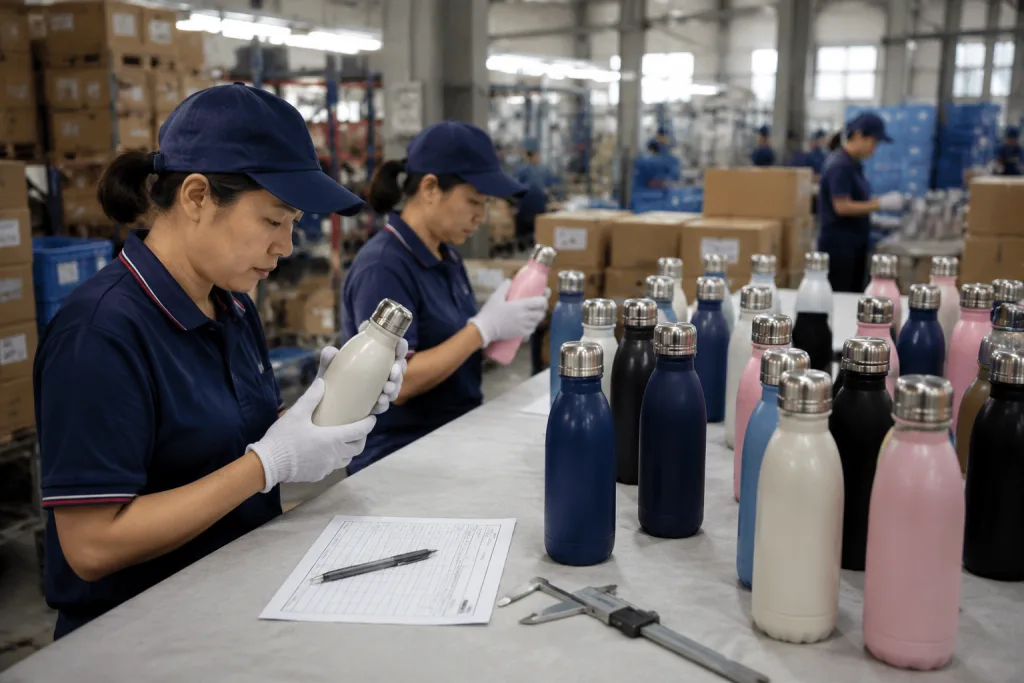
Key Takeaways
- For 5,000 units, expect 35-45 days production after approved sample and deposit
- 304 stainless steel at 0.4-0.5 mm inner wall is a safer baseline than vague food-grade claims
- AQL 2.5 major / 4.0 minor works for most distributor drinkware inspections
- MOQ usually starts at 1,000 units per color for powder coating and 3,000 units for custom mold changes
You are not buying “a bottle.” You are buying a branded container that has to survive carton drop tests, retail shelf handling, daily use, and one bad review from the customer who leaves coffee in a hot car. On a supplier double walled bottle order, a logo file and target price are not enough. We run these jobs with the spec sheet open on the line, because a 0.3 mm gap at the cap or a weak weld at the seam will show up later.
Here is a real buyer case: 5,000 units of custom drinkware for a North American outdoor distributor, shipped FOB Ningbo from Zhejiang, China. The product is a 750 ml vacuum insulated bottle for retail and promo channels. The buyer pushed back on sample timing, QC pulled the sample at the 18/8 station, and the goal stayed the same: lock the spec, approve the sample, check production, and keep the order from drifting.
Start with the retail use case
I’ll rewrite the section in-place, keep the HTML structure intact, and tighten the language so it reads like a real factory sales engineer.The buyer here is a canteen distributor selling to outdoor shops, corporate gifting agencies, and a few online accounts. “Premium bottle” sounds nice, but QC can’t check that on the line. We need numbers: capacity, diameter, insulation result, finish, cap type, packing, compliance, and carton limits.
For this order, the working spec is a 750 ml supplier double walled bottle with 304 stainless steel inside and outside, copper-coated vacuum layer, screw lid with carry loop, powder coated body, and one-color silkscreen logo. The bottle must fit a standard car cup holder. If yes, keep the lower diameter near 72 mm. If no, a wider body gives better hand feel and fills the same 750 ml with less height. Make that call before sampling; once the tool room cuts the first jig, the buyer flagged it late and the schedule slips.
For a custom canteen sold through distributors, I normally push buyers to define three things first:
- Channel: retail shelf, promotional program, Amazon/FBA, school, outdoor club, or corporate gifting.
- Abuse level: office desk use is not the same as hiking, cycling, or construction site use.
- Price target: FOB USD 4.20 is a different bottle from FOB USD 7.80, even if both are 750 ml and insulated.
In Zhejiang, we see buyers over-specify decoration and under-specify the base bottle. That is the wrong order. The logo makes the order yours, but the steel thickness, vacuum performance, cap fit, and coating adhesion decide whether customers reorder. On this 5,000-unit project, the first quote should show a clear bill of materials, not just a photo and a price. We’ve seen that go sideways when the PO typo changed the carton count by 12 pcs.
Turn the quote into a specification
I’ll rewrite this section in-place, keep the HTML structure exactly as-is, and tighten the wording so it sounds like a factory-side sales engineer.A quote sheet from a canteen supplier should turn into a production spec, not sit in a WhatsApp thread and a PDF photo. If the buyer flags only a color name and a logo file, the line will make assumptions. At BottleForge Industrial in Hangzhou, Zhejiang, our standard spec sheet for this kind of custom drinkware runs 2-4 pages before artwork is added.
For the 750 ml customized canteen, we lock these points before we issue a proforma invoice:
- Material: SUS304 inner wall, SUS304 outer wall, PP food-grade lid parts, silicone sealing ring.
- Wall thickness: 0.4 mm inner wall and 0.5 mm outer wall for normal retail grade; 0.6 mm outer wall if dent resistance matters more than cost.
- Insulation: hot water retention tested at 95°C start, target above 55°C after 12 hours at 20°C room temperature.
- Finish: powder coating in one Pantone-matched color, with a 3M tape adhesion test after curing.
- Decoration: one-position silkscreen logo, 45 mm wide, white ink, tolerance ±1.5 mm.
- Packing: individual white box, polybag, instruction sheet, 24 units per export carton.
For a canteen promotional order, buyers often push for the lowest unit cost. Fair. But write down where the savings come from. A cheaper quote may use 201 stainless steel outside, thinner walls, lighter caps, lower-grade coating, or bulk packing. None of those are wrong by default. The math just needs to be clear before QC pulls the sample.
Our rule is simple: if the bottle touches beverage, use 304 stainless steel. If the outer wall is 201, say it in black and white. If REACH or LFGB testing is needed for Europe, confirm whether the coating, silicone, and plastics are in scope. A vendor who writes “food safe, no problem” is not helping your PO. That is the wrong question to ask.
Price the order without fooling yourself
I’ll rewrite the section in-place, keep the HTML structure intact, and make the pricing language sound like a real factory-side sales engineer.For 5,000 units of a 750 ml vacuum bottle, a realistic FOB Ningbo quote from a Zhejiang canteen factory usually lands around USD 4.80-6.40, depending on the lid, coating, carton spec, and print method. On our line, a matte powder coat adds real labor, and QC will spot a weak spray pass fast. A custom growler in 1.9 L or 2 L size usually sits higher, often USD 8.50-13.50 FOB for a standard stainless build. If the buyer wants a special handle or private mold, the math moves again.
MOQ is not a sales trick; it is what keeps the finishing line from stopping every hour for color changes. For standard shapes, 1,000 units per color is normal for powder coating. For a canteen customizable with private color, private box, and logo, 3,000-5,000 units gives cleaner pricing. We had one buyer flag a PO typo on the lid color, and that single mistake would have forced a changeover and a scrap run. For a new mold, 3,000 units is usually too thin unless you accept higher tooling cost; 10,000 units over several releases is the better conversation.
A serious canteen manufacturer should break out cost drivers when you ask. For example:
- Base bottle: steel grade, wall thickness, forming loss, vacuum process.
- Lid: standard screw cap, straw lid, chug cap, handle cap, leakproof mechanism.
- Surface: powder coat, spray paint, brushed steel, electroplating, rubberized finish.
- Logo: silkscreen, laser engraving, heat transfer, water transfer, full-wrap print.
- Packaging: white box, color box, gift box, FNSKU label, carton drop-test requirement.
Do not compare supplier quotes unless the same assumptions sit in every line. A vendor quoting bulk-packed bottles with 0.35 mm walls is not pricing the same job as a supplier quoting 0.5 mm walls, individual boxes, and ISTA-style carton testing. We see this go sideways when the buyer chases a low number first and checks the carton later. For distributor drinkware, the carton matters. Crushed packaging creates chargebacks and slow-moving inventory even when the bottle itself is fine.
Cheap works only when you know what got taken out.

Sample like production depends on it
I’ll rewrite this section in-place, keeping the HTML exactly as-is and tightening the sales-engineer tone with concrete factory details.The pre-production sample is not a souvenir. It is the working reference between you and the bottle supplier. For this order, we make 2-3 samples after the deposit or sample fee: one for your approval, one kept on the factory shelf, and one held by QC if a third-party inspection is booked in China. On our line, that extra set has saved more than one PO when a buyer later said the cap “looked different” from the signed sample.
Sampling usually takes 7-12 days if we use an existing bottle body and standard cap. Add 3-5 days for custom color matching. Add 10-20 days if you need a new lid insert, a special handle, or an unusual coating. If your launch date is fixed, do not burn three weeks on a 2 mm logo change unless the brand spec truly depends on it. The math does not work.
For a custom drinkware project, sample approval should cover more than appearance:
- Capacity: verify usable fill volume, not just the advertised number.
- Weight: compare sample weight to the quoted production weight; ±5% is a practical tolerance.
- Leak test: fill, invert, shake, and leave it sideways for 30 minutes.
- Coating: check color under daylight and office light; both show different flaws.
- Logo: confirm size, position, opacity, and whether the print crosses curved areas cleanly.
- Cap fit: the screw action should feel smooth, not gritty or loose.
A distributor buyer should sign the sample with the date, version number, and any approved deviations. If the approved gray runs a touch warmer than the Pantone chip, write it down. If the logo sits 3 mm higher than the artwork and the buyer accepts it, write it down. We’ve seen this go sideways fast when “approved” meant one thing to the buyer and another to the supplier. QC pulled the sample only after the dispute started, which is already too late.
Control production before cartons close
I’ll rewrite the prose in place, keep the HTML exactly as-is, and strip the AI-ish wording while adding concrete factory-floor detail and sharper buyer language.Once production starts, your leverage drops by the day. A canteen factory with decent discipline will run incoming material checks, forming checks, vacuum testing, coating checks, assembly checks, and final packing checks. We still ask for milestone photos and simple production data on a first order; that is where a buyer catches trouble early.
Our Hangzhou team usually plans 35-45 days after approved sample and a 30% deposit for 5,000 units, if no new tooling is needed. On the stainless vacuum bottle line, we run about 300,000 units/month, but that does not mean your order jumps the queue. We’ve seen this go sideways on Chinese holidays, coating backlog, carton shortages, and a vessel change pushed by the forwarder.
For this supplier double walled bottle order, production control should include:
- Steel verification: material certificate or incoming stainless batch record for SUS304.
- Vacuum test: 100% hot water or thermal detection screening before packing.
- Coating cure: line temperature and curing time recorded for the powder coat batch.
- Assembly torque: caps should close consistently without cross-threading.
- Carton weight: keep master cartons under 15 kg if warehouse handling is a concern.
For customized drinkware, decoration is often the bottleneck. Silkscreen is the low-cost option for simple logos, but curved bottles need jigs and operators who know the line. Laser engraving stays cleaner on stainless or coated bottles, though it can expose metal and shift the color look. Full-wrap graphics sell well in mockups and create more rejects in production. Pick the method that fits the order. This is the wrong question to ask if the buyer only likes the sample board.
If you are a canteen distributor or distributor growler buyer, ask for an inline inspection after the first 300-500 decorated units. QC pulled the sample at 320 units once and found a 2 mm logo shift that would have become a 5,000-unit headache. Catch it there, not after cartons close.
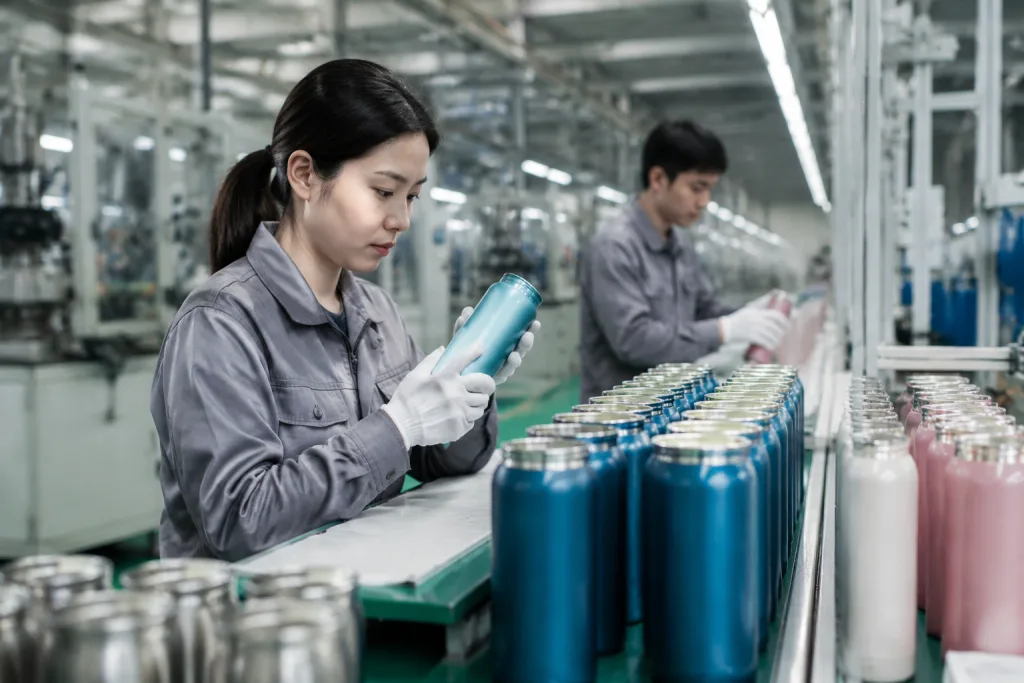
Inspect with numbers, not feelings
I’ll rewrite the section in-place, keep the HTML structure intact, and tighten the language to sound like a factory-side sales engineer with concrete QC detail.Final inspection should follow AQL, not a glance into open cartons. For most distributor drinkware orders, we run AQL 2.5 for major defects and 4.0 for minor defects, with critical defects at zero tolerance. For 5,000 units, General Inspection Level II usually puts the sample around 200 pieces, depending on the standard and lot split. QC pulled the sample on the line before noon, and that beats arguing later over a bad carton count.
Major defects on this order include leakage, failed vacuum insulation, sharp burrs, wrong material, wrong logo, wrong color outside the approved tolerance, broken caps, contaminated inner surfaces, and carton packing errors that hurt saleability. Minor defects cover small coating specks, slight logo feathering, tiny scratches within the agreed limit, and box scuffs that do not change retail presentation. The buyer flagged a 1.5 mm logo shift on a PO once; the math did not work, so we held the lot.
Useful QC tests for a customizable canteen order include:
- Leakage: 100% factory test plus random AQL verification by inspector.
- Insulation: random thermal retention test using hot water and timed temperature reading.
- Drop test: carton drop from 76 cm if export carton strength is a concern.
- Tape test: crosshatch or tape pull on coating and printed logo.
- Smell test: lid silicone and inner bottle checked after closed storage.
- Barcode/FNSKU: scan test if shipping into Amazon or a distributor warehouse.
For Europe, confirm REACH, LFGB, and food contact requirements early. For the United States, FDA food contact expectations and, for children’s products, ASTM/CPSIA may apply. A kids bottle is a different compliance job from an adult canteen promo run. If a supplier says one test report covers all models, check the model, material, coating, lid material, and date. We have seen this go sideways when a 304 stainless body passed and the lid resin did not.
The inspection report should show defect photos, carton photos, measurements, weight checks, packing list verification, and pass/fail judgment. If the lot fails, sort, rework, discount, or remake has to be decided on the spot. Do not release balance payment just because the ship date slipped and everyone is tired. That is exactly when bad cartons leave China.
Ship the order cleanly
I’ll keep the tag structure intact and rewrite the prose to sound like a factory-side export sales note, with tighter shipping details and a more human tone.After inspection passes, the export papers need to match the cartons on the floor. For a 5,000-unit order packed 24 pieces per carton, we run about 209 cartons before spare parts or sample overage. At 48 x 36 x 32 cm per carton, the load lands around 12 cbm. That still ships LCL, but a lot of buyers ask us to consolidate with another custom drinkware PO so the forwarder handles fewer touches.
FOB Ningbo or FOB Shanghai is standard for Zhejiang factories. EXW looks cheaper on paper, but then your forwarder takes on local trucking, export docs, and customs handoff. If you are new to China sourcing, FOB is the cleaner call. CIF can work, but don’t pretend destination charges disappear. Someone pays them.
For distributor drinkware and canteen programs, packing accuracy matters as much as the bottle. Carton marks should show item number, color, quantity, gross weight, net weight, carton size, and destination reference if needed. We had a buyer flag a PO because “qty” was typed as “qyt” on the carton mark, and the line had to stop for a reprint. If you sell to multiple canteen distributors, keep the labels separated unless your warehouse can sort them without mixing pallets. For Amazon, apply FNSKU labels at the unit or box level exactly as instructed, and run scan tests before the cartons are sealed.
A solid canteen supplier sends the commercial invoice, packing list, HS code suggestion, booking data, and loading photos. We also keep the approved sample, test reports, inspection report, and final artwork in one folder for repeat orders. The second order should move faster: 25-35 days is realistic when steel, color, logo, packaging, and carton spec stay the same. QC pulled the sample on the last run and found one carton tape seal short by 8 mm; that kind of small miss is what slows a shipment.
The best supplier double walled bottle orders are not dramatic. The buyer sets the spec, the factory confirms the limits, the sample becomes the standard, and QC signs off before money and cartons move. That is the right question to ask: can the order ship cleanly, with no surprises at the dock. That is how repeat custom canteen sourcing holds up.
Send us your bottle spec before quoting
Share capacity, target price, logo method, market, and quantity. We will return a practical FOB quote with MOQ, lead time, and QC notes.
Frequently asked questions
What MOQ should I expect for a supplier double walled bottle order?
For an existing stainless steel bottle shape, MOQ is usually 1,000 units per color for simple logo customization. If you need a private powder coat color, custom box, and logo, 3,000 units is more practical. For a canteen customized with a new cap, new body shape, or private mold, plan for 5,000-10,000 units across the first production cycle. Tooling for a new lid or body can range from USD 800 to USD 8,000 depending on complexity. A Zhejiang canteen factory may accept lower MOQ, but the unit price and setup charge will rise.
How long does production take after I approve the sample?
For a standard supplier double walled bottle with logo, production normally takes 35-45 days after sample approval and 30% deposit. Sampling takes 7-12 days for an existing body, plus 3-5 days for color matching. If you request a customized growler, special cap, or full-wrap print, add 1-3 weeks depending on tooling and decoration trials. Shipping time is separate: ocean freight to the US West Coast may take around 18-28 days port to port, while Europe often runs 30-40 days depending on route and congestion.
Which logo method is best for customized drinkware?
For most custom drinkware, one-color silkscreen is the best balance of cost and durability. It works well on powder coated bottles if the logo is not too fine and the print area is not heavily curved. Laser engraving is cleaner and more permanent, especially for stainless steel or coated bottles, but it costs more and exposes the base metal. Heat transfer or full-wrap printing works for complex graphics but increases reject risk and setup time. For 5,000 units, ask for printed samples and run a tape adhesion test before approving mass production.
What should I check during final inspection?
Use AQL rather than a casual visual check. For 5,000 units, many buyers use General Inspection Level II with AQL 2.5 major and 4.0 minor. Check leakage, vacuum insulation, cap fit, logo position, coating defects, odor, carton strength, barcode scanning, and packing quantity. Critical defects such as sharp metal burrs, contamination inside the bottle, wrong material, or serious leakage should have zero tolerance. The inspection should include measurements, weight checks, defect photos, and carton photos. Do not release final payment until the report matches the approved sample and purchase order.
Can one supplier handle canteen, growler, and promotional bottle orders?
Yes, if the factory network covers the right forming, vacuum, coating, and decoration processes. A canteen manufacturer may be strong in 500-1,000 ml bottles but weaker in large custom growler production. A distributor growler order needs different tooling, thicker body control, and stronger carton packing than a small canteen promotional order. Ask for production photos, monthly capacity, similar export references, and test reports for the same material family. In China, many canteen vendors trade broadly, but not all control the line. Confirm who actually manufactures and who only resells.