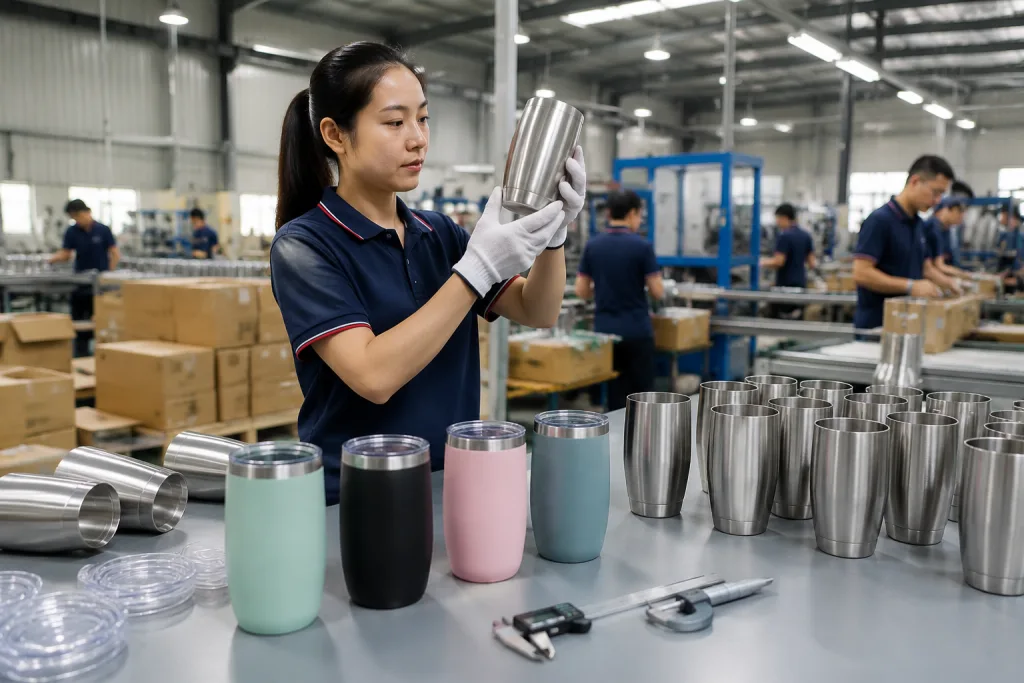
Key Takeaways
- A practical wine tumbler MOQ starts at 1,000 pcs per color for powder coating and 500 pcs for laser logo on stock colors
- 304 stainless steel at 0.4-0.5 mm wall thickness is the safer baseline for export wine tumblers
- FOB China pricing often shifts by USD 0.35-0.80 per unit depending on lid, coating, and logo method
- Plan 7-10 days for sampling and 30-45 days for mass production after artwork approval
Typing supplier directory wine tumbler into a sourcing platform throws up too many listings and not enough signal. The photos all look alike, the quotes sit within a few cents, and every factory says factory-direct stainless steel drinkware. The real job is not finding a supplier. It is matching the wine tumbler spec to your buyer, channel, and margin before you ask for samples.
We run custom drinkware out of Hangzhou, Zhejiang, and we see the same miss week after week: buyers check unit price before they check construction. A 10 oz wine tumbler for retail gifting is a different order from a 14 oz powder-coated tumbler for a distributor program. One PO last month even came in with “14oz” typed as “14ozs”; QC pulled the sample, and the carton count did not match. The better comparison is straight down the line: material, insulation, decoration, carton pack, compliance, MOQ, and lead time.
Start With Channel Fit
I’ll rewrite just the prose, keep the HTML structure intact, and tighten it so it reads like a real sales engineer note.A supplier directory wine tumbler search should start with the sales channel, not the catalog photo. Same cup, different outcome. For corporate gifting, we run clean logo placement, stable carton packing, and repeatable color. Retail needs a better lid, barcode control, drop-test packing, and a finish that does not scuff on shelf. If you sell through distributor drinkware programs, stock continuity and reorder stability matter more than an odd shape.
For most B2B buyers, the comparison is simple: retail wants stronger perceived value, promotional buyers want lower defect risk, and online fulfillment wants tight packing discipline. A canteen distributor or distributor canteen program may accept a basic body shape if the supplier can hold color tolerance across 20,000 pcs. A wine tumbler is less forgiving. Buyers touch the rim, inspect the coating up close, and catch wobble fast. We’ve seen a 1.5 mm base offset get flagged on the first sample review.
At BottleForge in Zhejiang, we split projects into three lanes: stock-body customization, semi-custom molding, and full custom drinkware development. Stock-body customization is the quickest lane, usually 7-10 days for samples and 30-35 days for production after deposit. Full custom shapes need tooling and usually take 25-35 days before a production sample is ready. If your selling season is inside 60 days, a new mold is the wrong question to ask. Pick a proven body and put the risk budget into decoration and QC. QC pulled one sample last month because the powder coat missed the edge by 2 mm; that is the kind of miss that kills a launch.
Specification Table Buyers Actually Need
I’ll rewrite the section in place, keep the table structure untouched, and tighten the prose so it reads like a factory-side sales note.Directory listings hide the line items that decide profit. A wine tumbler page may say “double wall vacuum insulated,” but that tells you nothing about 304 or 201 steel, lid resin, coating method, logo tolerance, carton burst strength, or whether polishing stays in-house. We run into this every week. Ask for the spec table before you talk price.
| Spec | Promotional fit | Retail fit | Distributor fit |
|---|---|---|---|
| Capacity | 10 oz or 12 oz | 12 oz or 14 oz | 10 oz stock shape |
| Steel | 304 inside, 201 outside acceptable only if disclosed | 304 inside and outside preferred | 304 inside, consistent wall gauge |
| Wall thickness | 0.4 mm baseline | 0.5 mm better dent resistance | 0.4-0.5 mm for repeat orders |
| Lid | PS slide lid | Tritan or PP splash lid | Stock lid for reorder stability |
| Finish | Silkscreen or laser | Powder coat, UV print, laser | Powder coat stock colors |
| MOQ | 500-1,000 pcs | 1,000-3,000 pcs | 3,000 pcs per SKU |
Use the table to compare offers from canteen suppliers, canteen vendors, and any canteen manufacturer that also turns out tumblers on the same line. We’ve seen buyers fixate on a USD 0.18 lower quote, then discover the carton dropped from 2 mm to 1.5 mm, or the lid changed from Tritan to cheap PS. The math doesn’t work. For FOB Ningbo or Shanghai shipments from China, those small cuts hit complaint rate fast if the tumbler leaks in a gift campaign.
Wine Tumbler Versus Canteen
I’ll keep the HTML structure intact and rewrite the three paragraphs in a more grounded supplier-directory voice, with concrete factory details and fewer AI-style phrases.Wine tumblers and canteens run through the same stainless steel line for parts of the build, but the sale is judged on different points. A custom canteen gets picked apart on capacity, carry comfort, and how the cap seals after a drop test. A wine tumbler gets judged on hand feel, rim polish, coating consistency, and whether it looks good in a gift box. We’ve seen buyers mix them up on the first RFQ, and that is the wrong question to ask. Even if both come out of China and both use 304 stainless steel, the best factory for one is not always the best factory for the other.
For outdoor use, campus programs, and field sales, canteen custom orders make sense. A canteen customizable with a strap, cap, carabiner, or wide-mouth lid gives you real functional choices, not just decoration. For hospitality, wineries, corporate gifting, and event merchandise, a wine tumbler usually sells easier because it looks lighter on the table and ships well in a 0.35 kg gift box. On one line check, QC pulled the sample at 65 mm from rim to base, and the buyer flagged a lid typo on the PO before we cut the carton. A customized canteen is practical; a customized drinkware wine tumbler often reads more premium at the same landed cost.
The choice is clear. Pick wine tumblers when the buyer wants gift packaging, seated use, or a small logo area with a clean finish. Pick canteen customized designs when the brief says hiking, sports, schools, or utility. Pick both only if your supplier can keep color matched across categories; we’ve seen that go sideways when a powder-coated wine tumbler and a canteen promotional bottle land in two different navy tones. For premium retail, we set Delta E under 1.5; for promotional orders, under 2.0. That saves arguments at receipt.
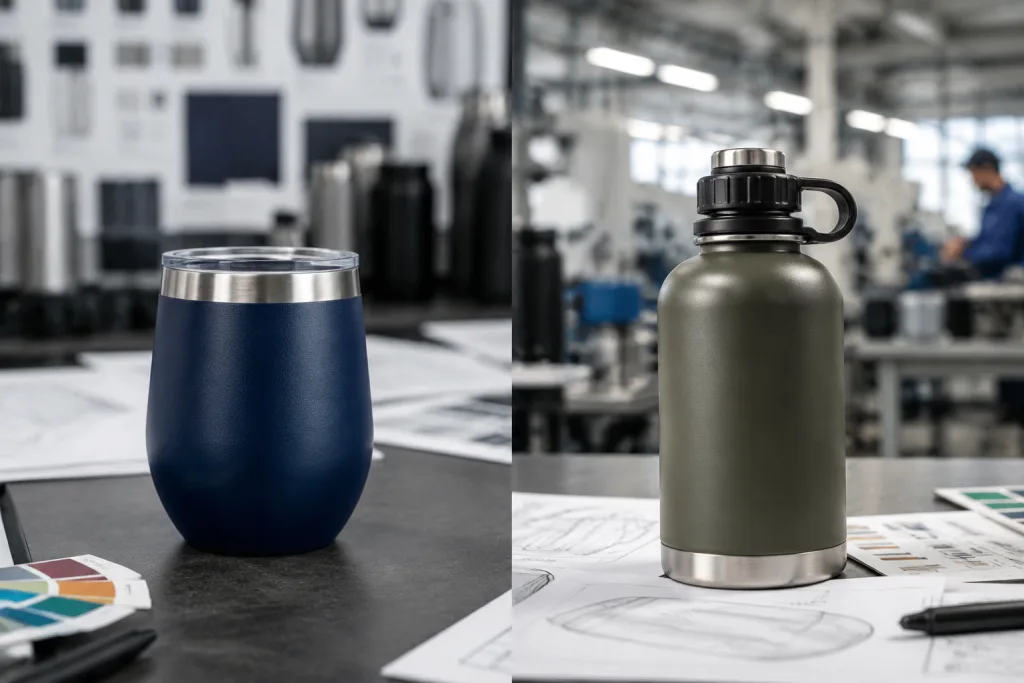
Decoration Changes The Real Price
I’ll rewrite the section in place, keep the HTML tags intact, and tighten the sales-engineer tone with concrete pricing and factory-floor details.Most sourcing mistakes show up after the base price looks fine. Decoration sets the real cost, the reject rate, and the ship date. A one-color silkscreen logo on a straight tumbler body usually adds USD 0.08-0.18 per unit. Laser engraving on powder coat adds USD 0.12-0.28. Full-wrap UV printing can add USD 0.45-0.95, depending on artwork coverage and curing time. If a supplier gives you the same price for all three, the math does not work.
For custom drinkware, the body shape is the trap. Wine tumblers taper, so full-wrap artwork needs distortion control. A logo that looks centered on a flat proof can drift after printing. For supplier directory wine tumbler projects, ask for a printed pre-production sample, not just a digital mockup. QC pulled the sample on our line and checked logo size, position tolerance, coating texture, lid fit, and carton barcode if the buyer sells through retail or Amazon-style fulfillment.
The same rule applies to customizable drinkware and customizable canteen programs. A canteen vendor may run laser logos on curved bottles all day and still stumble on multi-color UV over a tapered cup. A customizable growler supplier may handle large-format engraving but miss tight registration on small wine tumblers. Ask for photos of the last three similar orders, not showroom shots. We had a buyer flag a PO typo on the Pantone code once, and that one digit would have killed the run. If you need canteen promotional products and wine tumblers in one PO, lock the Pantone target, logo method, and inspection standard before deposit. Change decoration after sampling, and mass production slips 5-12 days.
Compliance And Inspection Decide Risk
I’ll rewrite the prose only, keep the HTML structure intact, and make it sound like a real sales engineer wrote it.For Europe and North America, compliance is not end-of-job paperwork. Stainless steel drinkware touches food, clears customs, and can land in children’s channels or alcohol retail. For wine tumblers, we usually prepare LFGB or FDA food-contact reports by market, plus REACH screening for coating and packaging when the buyer asks. If the order targets children’s assortments, ASTM or CPSIA checks can come up, even when the cup is not a toy.
AQL has to be set before the line starts. For standard B2B drinkware, a lot of buyers lock in AQL 2.5 for major defects and 4.0 for minor defects. Major defects mean vacuum loss, a sharp rim, wrong logo, coating peel, cracked lid, or barcode mismatch. Minor defects are small specks, light scratches, or color drift inside the agreed limit. For 5,000 pcs, an inspection plan costs less than a rejected launch. The math doesn’t work the other way.
Factory audits matter, but read them for what they do and do not prove. BSCI, ISO 9001, and Sedex-style files show management discipline; they do not guarantee a wine tumbler passes vacuum testing. Ask how the factory tests. At our Zhejiang plant, QC pulls hot-water retention samples and does random destructive checks on the line; monthly drinkware output runs about 450,000 units across tumblers, bottles, canteens, and growlers. Capacity only helps when the AQL sorting is tight. We’ve seen a big canteen factory ship mixed custom drinkware because the inspection desk was sloppy.
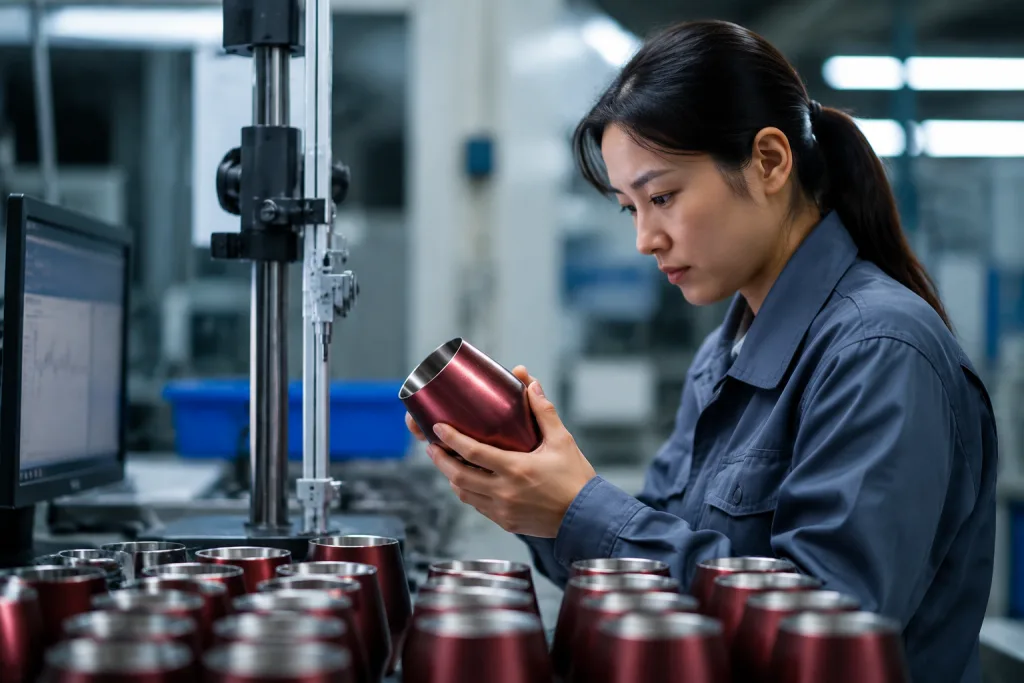
Supplier Directory Shortlist Rules
I’ll rewrite the section in place, keep the HTML tags unchanged, and sharpen the buyer language so it sounds like a factory-side sales engineer.When you compare canteen manufacturers, canteen suppliers, or a canteen supplier that also lists wine tumblers, filter hard. A real factory answers technical questions without hiding behind catalog pages. Ask for steel grade, wall thickness, vacuum test method, coating type, lid material, MOQ by color, sample time, production lead time, carton dimensions, and FOB port. If the sales contact cannot send that within 24-48 hours, the line will be slow when there is a problem.
Use a simple scorecard. Give 30% weight to technical fit, 25% to decoration capability, 20% to compliance and QC, 15% to communication, and 10% to price. That sounds blunt because it is. The lowest FOB quote from a canteen vendor is often not the lowest landed cost if you lose 2 weeks fixing artwork or repacking cartons. For distributor growler, custom growler, or customized growler projects, the math does not change: capacity and consistency beat a $0.12 unit-price win. QC pulled the sample, and the 1.2 mm wall thickness was off by 0.15 mm—small miss, big headache.
There is also a trading-company versus factory question. Trading companies help when you need mixed small orders across canteen vendors, glass bottles, and accessories. Factories are better when you need repeatable SKUs, private tooling, and faster corrective action. For a supplier directory wine tumbler program above 3,000 pcs, we push direct factory communication, even if you keep your sourcing agent in the loop. For a test order under 500 pcs, a distributor canteen or distributor drinkware partner with stock may be the smarter call than forcing a factory MOQ. We have seen this go sideways when the buyer flagged a PO typo on the carton mark and the whole booking slipped 5 days.
Landed Cost Beats Unit Price
I’ll rewrite the prose in-place, keep every HTML tag intact, and make it sound like a working supplier-side sales engineer wrote it. Then I’ll do a quick consistency pass for numbers, shipping details, and the required insider tone.A wine tumbler quote is not done until you have landed cost. A 12 oz stainless wine tumbler often lands at USD 2.10-3.40 FOB China, depending on steel thickness, coating, lid style, and logo method. Then you add the individual box, master carton, inspection, inland trucking, ocean freight or air freight, duty, warehousing, and any relabeling. We had a buyer flag a PO typo once because the carton count was written as 240 instead of 24. If you sell to retail, barcode application and carton drop-test requirements go on the bill too. If you sell online, FNSKU labels and carton weight control matter from day one.
Packaging is where a cheap quote turns into a bad quote. A 24 pcs master carton over 15 kg is a headache for some warehouse rules, and a weak 5-ply carton can crush in LCL shipping. We saw that on the line with a matte tumbler that arrived with rub marks because it had no polybag or tissue wrap. For a wine tumbler, we usually run individual white box or kraft box, then 24 pcs per export carton, with carton size confirmed before freight booking.
If you are comparing canteen distributors, canteen factory quotes, and direct China manufacturer quotes, normalize every line. Same capacity, same steel, same lid, same coating, same logo, same box, same inspection level, same port. QC pulled the sample and found the lid fit was 1.5 mm off, and that one detail changed the whole price story. The math does not work unless you compare like for like. The real target is not the lowest line in the directory. It is a supplier who can ship the same approved product 30-45 days after artwork approval, hold defect rates under your AQL agreement, and pick up the next reorder without drama.
Send your wine tumbler spec for factory review
Share capacity, logo method, target MOQ, market, and delivery date. We will return a practical FOB China quote and sampling plan.
Frequently asked questions
What MOQ should I expect for a custom wine tumbler order?
For a stock-body wine tumbler, a realistic MOQ is 500 pcs for laser engraving on existing colors and 1,000 pcs per color for powder coating or silkscreen. If you need a new Pantone-matched coating, many China factories will ask for 1,000-3,000 pcs because coating setup and color cleaning take time. Full custom molding is different; expect 5,000 pcs or more, plus tooling cost. For mixed programs with a customized canteen or custom growler, the MOQ may be calculated by body type and color, not by total PO quantity.
How do I know if a supplier directory listing is a real factory?
Ask for the factory business license name, production address, audit documents, and a short video showing your requested wine tumbler process: forming, polishing, coating, or packing. A real canteen manufacturer or tumbler factory should also provide wall thickness, steel grade, lid material, MOQ, lead time, and FOB port without vague answers. You can request a live video call from the workshop. For orders above 3,000 pcs, consider a third-party audit or at least a pre-shipment inspection using AQL 2.5/4.0.
Is 304 stainless steel required for wine tumblers?
For export custom drinkware, 304 stainless steel on the inner wall is the safe baseline because it contacts the beverage. Some low-cost products use 201 stainless steel on the outside, but it should be disclosed because corrosion resistance is lower. For retail or premium distributor drinkware programs, we recommend 304 inside and outside with 0.4-0.5 mm wall thickness. If your product will be used for wine, cocktails, or acidic drinks, do not compromise the interior steel. Ask for food-contact test reports matched to the material batch.
Which logo method is best for a wine tumbler?
Laser engraving is durable and works well on powder-coated stainless steel, especially for corporate gifts and distributor programs. Silkscreen is cheaper for simple one-color logos, often adding USD 0.08-0.18 per unit, but it can scratch sooner if the coating or ink is poor. UV printing is best for full-color artwork, but it costs more and needs careful registration on tapered bodies. For canteen promotional sets or customizable canteen orders, choose the logo method after seeing a physical pre-production sample, not only a digital proof.
What lead time should I plan before peak season?
For a standard wine tumbler with stock mold and existing coating color, plan 7-10 days for samples and 30-45 days for mass production after deposit and artwork approval. Add 5-12 days if you need Pantone coating, full-wrap UV artwork, or special packaging. Ocean freight to Europe or North America can add 25-40 days depending on route and port congestion. If you need delivery before a fixed event, start sourcing at least 90 days ahead. China public holidays, especially Chinese New Year, can add serious delay.