Key Takeaways
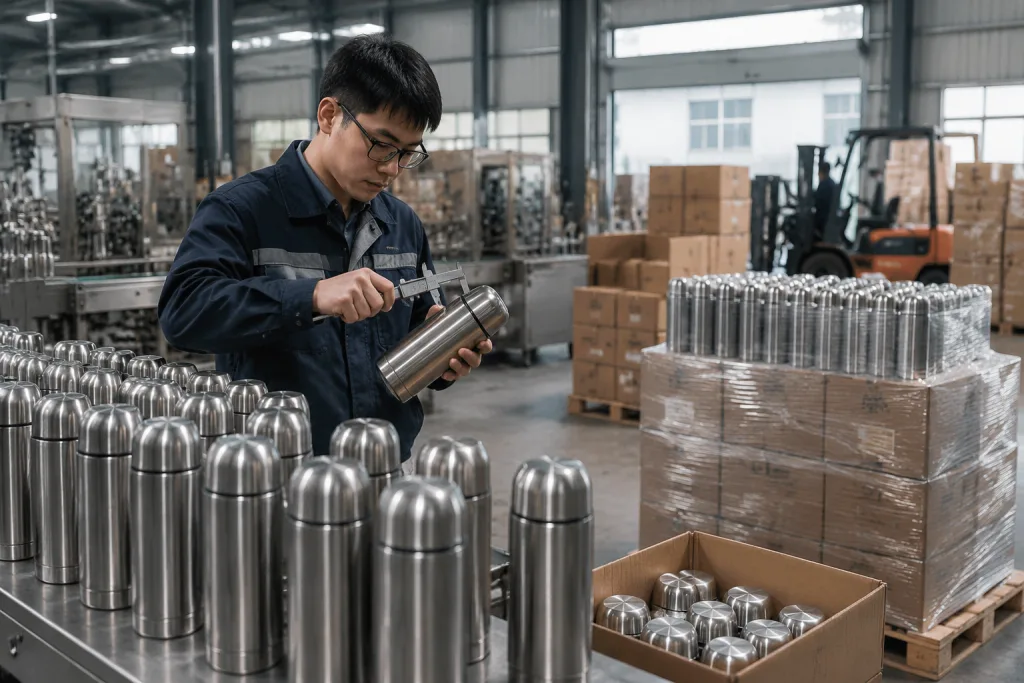
- Standard 500 ml stainless vacuum bottles often land at $3.20-$5.60 FOB China at 1,000-3,000 pcs.
- MOQ is usually 500-1,000 pcs for logo-only orders and 3,000 pcs for full-color packaging or custom lid tooling.
- Typical lead time is 15-25 days for stock models, 30-40 days for customized thermos orders, and 45-60 days with new tooling.
- A Zhejiang thermos factory with 200,000 units/month capacity can support repeat distributor thermos programs without long gaps.
If you are building a supplier directory vacuum bottle shortlist, do not chase the lowest quote first. That is the wrong question to ask. A stainless thermos looks simple on paper, but the price moves fast once you add 304 or 316 steel, a double-wall vacuum body, powder coating, lid tooling, and the logo method. On our line in Zhejiang, a 500 ml bottle can land at $3.20 or $7.80, and the gap is usually in the specs, not the sales pitch.
Lead time is where buyers get burned. We have seen a launch slip because the PO had the carton size typo, then QC pulled the sample for a leak check, then the buyer wanted a new lid color. A real bulk thermos order is sample approval, packaging sign-off, carton drop testing, and export booking, not just machine time. If you sell through outdoor retail or promo channels, you need a clear cost ladder and a date you can defend, or the math does not work.
What really sets the quote
I’m rewriting the prose only, keeping the HTML structure intact and stripping the AI-ish phrasing. I’ll tighten the numbers, add a few shop-floor details, and keep the heading/blockquote unchanged.When you price a supplier directory vacuum bottle, do not lump every stainless thermos together. The quote usually sits on five cost drivers: steel grade, body finish, lid complexity, decoration method, and packaging. On our line, a basic 500 ml vacuum bottle with 201 outer / 304 inner steel can start around $2.40-$3.10 FOB if the model is already in production. Move to full 304 inside and outside, and the number usually lands closer to $3.60-$4.80. Step up to 316 inner steel for stronger corrosion resistance, and the gap is often another 12%-18%.
Decoration moves the price more than a lot of buyers expect. One-color silkscreen may add only $0.08-$0.18 per unit, while laser engraving often sits at $0.15-$0.35 depending on coverage. We had one buyer flag a PO because the artwork called for a 38 mm logo ring, but the print file showed 35 mm; that 3 mm mismatch changed the jig and held the line. A matte powder-coated custom thermos adds process cost, but it also lifts retail value and hides scratches better. For outdoor retailers, that finish usually beats a glossy body. For promo brands, a simpler factory thermos with one clean logo is the smarter margin play.
Packaging is the quiet price driver. A white box can cost $0.12-$0.22, a color gift box $0.35-$0.75, and an insert-heavy retail pack more. If you want a thermos customizable enough for chain stores, ask for carton drop-test compliance and transit-ready inner packing early. QC pulled the sample on a 76 cm drop once because the inner tray shifted, and that saved a headache later. In Zhejiang, we quote packaging as part of unit price only after we see the artwork and carton count.
Practical rule: if a quote is 20% below the next supplier thermos offer, check steel grade, lid gasket quality, and coating thickness before you celebrate.
MOQ tiers that make sense
I’ll rewrite the section in place, keeping the HTML exactly as-is and sharpening the sales-engineer tone with more concrete factory detail.MOQ is where a lot of buyers read the market wrong. A thermos supplier in China may quote one number, but the real MOQ follows the setup behind it. For a stock bottle with logo only, 500 pcs is workable if you stay on existing colors and common lids. For a custom logo plus custom box, 1,000 pcs is a normal entry point. For a customized thermos with an exclusive lid, new handle, or special finish, 3,000 pcs is the honest floor.
At BottleForge in Hangzhou, we run 200,000 units a month across stainless drinkware, so repeat thermos bulk orders do not choke the line. QC pulled the sample with a 0.3 mm lid gap last week, and that is the kind of detail that tells you where the real cost sits. The MOQ tier still has to match the channel. Outdoor retailers usually need 1,000-5,000 pcs per SKU because sizes and colors split fast. Promotional thermos programs can start lower, but once you drop below 800 pcs, the unit cost climbs. If a thermos manufacturer offers 300 pcs with deep customization and a fair price, the buyer should ask what gets removed from the spec.
For distributors, split the order into a launch batch and a replenishment batch. A first order of 1,000 pcs lets you test sell-through, then a 3,000 pcs reorder brings per-unit cost down by 8%-15% because setup and packaging spread out better. We have seen this go sideways when the buyer tried to save on the first run and then paid more on the second. The math does not work any other way.
- 500 pcs: stock model, logo only, lowest risk
- 1,000 pcs: most practical for custom thermos launch programs
- 3,000 pcs: best for thermos custom colors, packaging, or lid changes
- 5,000+ pcs: strongest pricing for manufacturers and distributors with steady demand
Lead time from sample to ship
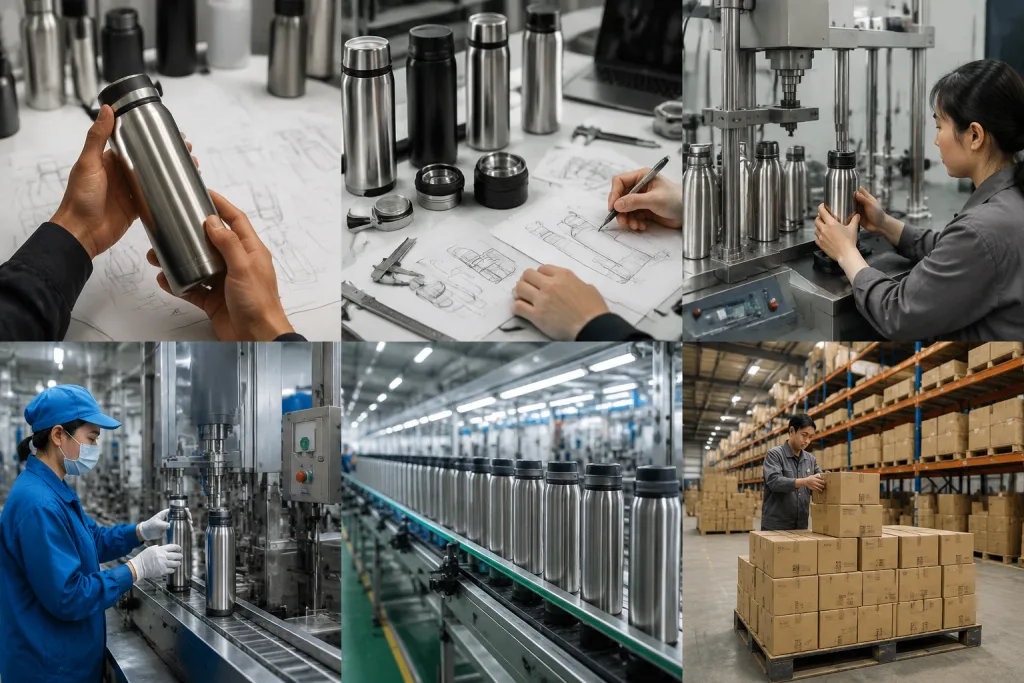
I’ll rewrite the three paragraphs in-place, keep the HTML untouched, and make the copy sound like a factory-side sales engineer with concrete timing and floor details.Lead time is a chain, not one number. For a stock thermos, we can ship a sample in 3-7 days by courier if that model is already on the rack. Once the buyer signs off, 1,000-3,000 pcs usually run 15-25 days on the line. Add a custom lid or special color, and 30-40 days is the real range. New tooling pushes it to 45-60 days, and a tight lid mold with 0.1 mm tolerance can stretch that again.
The export side eats days too. Carton confirmation, drop test, REACH review for contact materials, and final pack-out all sit on the critical path if you sell into Europe or North America. A bulk thermos order should still leave 5-10 days for booking and inland transfer after production. If you need Amazon prep, FNSKU labels, or retail master carton setup, add another 3-7 days. We’ve seen buyers skip that buffer and then ask for air freight; the math does not work.
A Zhejiang thermos factory should give you a split schedule: sample, production, QC, loading. That is the right way to quote. We ran one order where silkscreen approval took 2 days and lid torque testing took 4 more, and the buyer flagged the delay before it hit shipping. QC pulled the sample at AQL 2.5, checked the vacuum hold, and the schedule stayed clean. A supplier quote without those milestones is not a serious quote.
Price bands by order size
I’ll rewrite the section in place, keeping the HTML structure and the quoted price bands intact while stripping the AI-ish wording and adding more buyer-side, factory-floor language.If you need a usable sourcing model, compare price bands by volume instead of judging one sample quote. For a 500 ml stainless thermos with standard vacuum structure and a single-color logo, FOB China usually lands around $3.20-$4.10 at 1,000 pcs, $2.85-$3.70 at 3,000 pcs, and $2.55-$3.35 at 5,000 pcs. We run these numbers against real carton loads, not a brochure. Once you move to a premium powder-coated customizable thermos with better lid sealing and a nicer retail box, expect $4.80-$6.90 at 1,000 pcs and $4.10-$5.80 at 3,000 pcs.
Capacity shifts the quote too. A 350 ml promo model is usually 6%-12% cheaper than a 500 ml version, while a 750 ml bottle can be 8%-20% higher depending on steel thickness and insulation performance. Wall thickness is not a cosmetic point; it changes dent resistance and heat hold. On the line, 0.35 mm stainless is fine for promotion, while 0.40-0.45 mm is the more common spec for retail outdoor use. QC pulled the sample on a 0.33 mm body once, and the buyer flagged it the same day.
For distributors and brands, this is the wrong question to ask: “What is the cheapest price?” Ask what keeps landed cost safe after freight, duty, and fulfillment. If your landed cost target is $6.50, then an FOB bottle at $3.90 can work, but a $5.20 bottle usually blows the model once you add packaging and freight. We have seen that go sideways on a PO with a typo in the carton count, and the math stopped working fast. A supplier who ships export orders every week will build that cost sheet before you place the order.
- 1,000 pcs: entry pricing, good for testing demand
- 3,000 pcs: best balance of unit cost and inventory risk
- 5,000 pcs: stronger pricing for repeat distributor thermos demand
Quality checks before payment
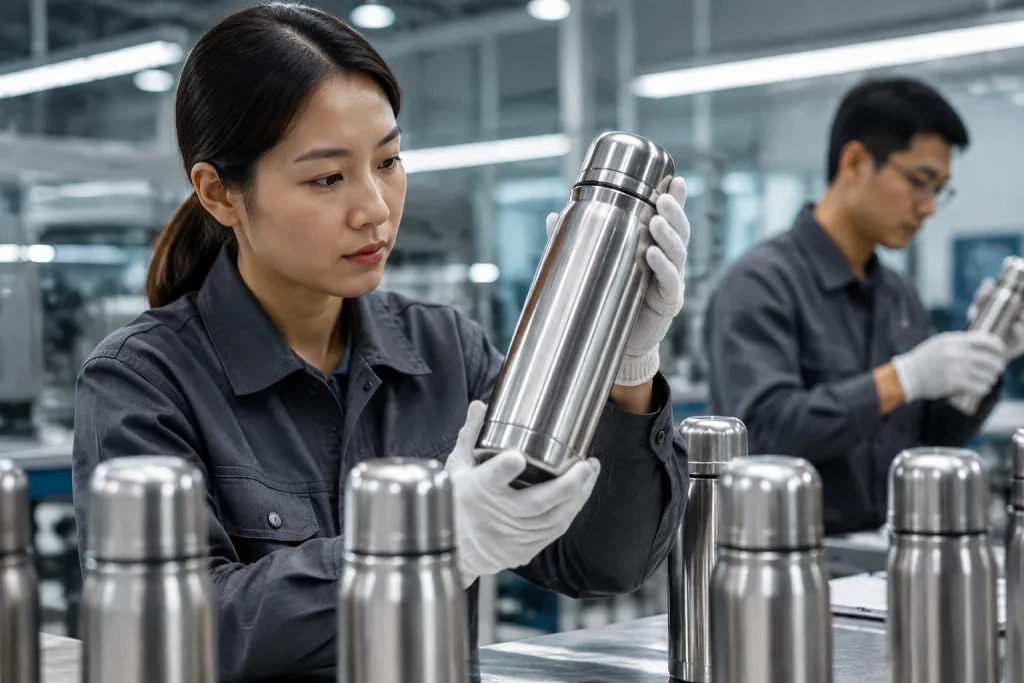
I’ll rewrite the section in-place, keeping the HTML tags and structure unchanged while cutting the AI-ish phrasing and adding more factory-floor specificity.Cheap gets expensive the moment a lid leaks or the vacuum drops out after 3 months. Before you pay the deposit, ask for four checks: vacuum retention, drop test, lid torque, and coating adhesion. On our line, we expect a decent bottle to keep hot water above 60°C after 6 hours under normal test conditions, though capacity and lid structure change the numbers. If a supplier says every bottle is “perfect” but cannot show test data, that is marketing, not production.
For U.S. and EU buyers, material compliance matters as much as heat retention. Ask for food-contact declarations, REACH paperwork when needed, and carton specs if the order goes to a retail chain. The buyer flagged a PO typo on carton dimensions once, and the compliance file failed on that detail. Real bulk thermos programs run on AQL 2.5 for major defects and AQL 4.0 for minor defects on appearance-heavy items; the math does not work any other way.
Do not ignore the lid. A strong body with a weak PP cap, silicone ring, or threaded insert still fails in the field. We run a lid cycle test at 3,000-5,000 open-close cycles depending on channel, and QC pulled the sample the first time a spring ring started binding at cycle 2,400. If you sell promotional thermos units at events, a simpler lid can pass. If you sell outdoor retail, it should not.
If the sample looks clean but the lid squeaks, binds, or leaks, the production lot will not fix itself.
How to brief a factory
I’ll rewrite the three paragraphs in place, keep the HTML exactly as-is, and make the language sound like a seasoned factory-side sales engineer.Most delays start with a thin brief. A proper RFQ for a supplier directory vacuum bottle should list capacity, target price, logo method, finish, lid preference, carton spec, and destination market. If you want a thermos customizable enough for shelf appeal, send Pantone refs and placement size in millimeters, not “large logo.” If you want a thermos promotional run, say whether it is for trade show giveaways, retail bundles, or corporate gifting, because each one drives a different packout and drop-test target. We have seen buyers lose a week on a typo in the PO, then ask why the line stopped.
Ask the thermos supplier for a split quote: stock model price, custom logo price, custom packaging price, and tooling cost if any. That shows the real step-up from a standard bulk thermos to a thermos custom program. The math does not work if you mix those numbers together. One buyer flagged a “cheap” quote, then QC pulled the sample and found the lid print was a 2-color pad print, not laser engraving. The best thermos vendors will also tell you what to leave alone. Changing body color can cost less than a new lid mold and still give you the retail difference you need.
If you compare manufacturers across Zhejiang and other Chinese provinces, process control matters more than the map pin. Zhejiang factories often run export schedules every week for North America and Europe, but you still need sample lead time, defect policy, and spare part availability in writing. We run a 24-hour lid fit check on the line, and that catches the kind of wobble a brochure never shows. A serious thermos suppliers brief should close with a written timeline and a QC standard; a verbal promise is how you end up chasing cartons.
Request your custom thermos quote today
Send capacity, logo, packaging, and target market. We’ll quote a supplier directory vacuum bottle with clear MOQ, price bands, and lead time from Zhejiang.
Frequently asked questions
What is a normal MOQ for a custom stainless thermos?
For a logo-only custom thermos, 500 pcs is often workable if the body and lid are already in production. For a customized thermos with new color, box, or lid detail, 1,000 pcs is the more realistic floor. If you want new tooling or a special function, plan for 3,000 pcs or more. In China, especially Zhejiang, many thermos manufacturers price best at 3,000-5,000 pcs because setup costs spread better across the run.
How much does a bulk thermos cost FOB China?
A standard 500 ml bulk thermos usually lands around $3.20-$4.10 FOB at 1,000 pcs, then drops toward $2.85-$3.70 at 3,000 pcs. Better finishes, 316 inner steel, or gift packaging can push it to $4.80-$6.90. If a supplier thermos quote is much lower than that, check steel grade, coating, and lid quality. A price gap of 15%-25% usually reflects a real spec difference, not magic savings.
How long does production take?
For a stock factory thermos, sample dispatch can take 3-7 days and production 15-25 days after approval. A custom thermos with logo and standard packaging often needs 20-30 days. Add 10-15 extra days if you need new color matching, tooling, or complex retail cartons. If you also need Amazon prep, FNSKU labels, or third-party inspection, build in another 3-7 days so you do not rush freight.
What quality checks should I require?
Ask for vacuum retention, lid leak testing, drop testing, and coating adhesion results. For many import programs, AQL 2.5 is used for major defects and AQL 4.0 for minor defects. If the thermos distributor you use cannot provide inspection data, you are taking on too much risk. For EU and U.S. sales, request food-contact declarations and REACH-related documentation where applicable.
Can I get different pricing for promotional and retail orders?
Yes. A promotional thermos usually uses simpler packaging, standard colors, and one-color decoration, so the unit price can be 10%-20% lower than a retail-ready version. A retail custom thermos with gift box, matte coating, and stronger lid usually costs more but sells better. If you are working with outdoor retailers, ask for two quotes: one for display-grade packaging and one for giveaway-grade packaging. That gives you a real margin comparison.