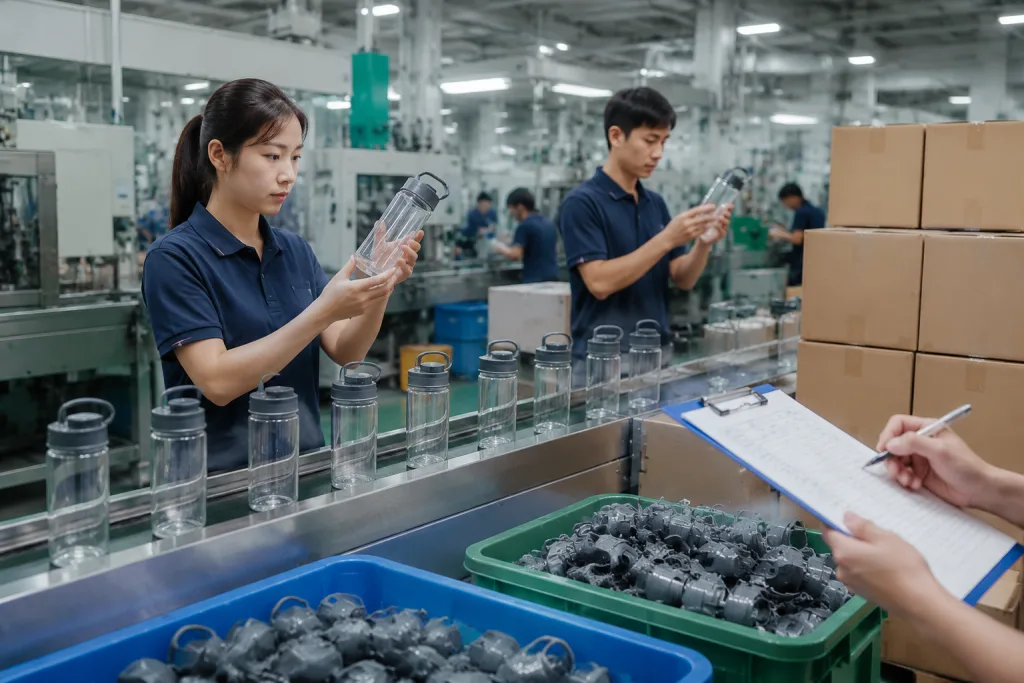
Key Takeaways
- A standard 600-750 ml Tritan bottle usually lands at USD 1.35-3.20 FOB China at 3,000-10,000 pcs
- Logo sampling takes 5-7 days; new mold development can add 25-40 days before mass production
- Practical MOQ is 1,000 pcs for stock-color logo orders and 3,000-5,000 pcs for custom colors
- AQL inspection, REACH/LFGB/FDA documents, and packaging specs should be locked before deposit
Type supplier directory tritan bottle into a sourcing site and you get pages of names, not buying clarity. The real job is sorting a bottle factory from a trading office or a catalog reseller that adds 15% to 25% and still cannot show you the line.
For B2B drinkware buyers, the two questions that matter are cost and ship date. From our Hangzhou, Zhejiang plant, we see buyers burn 10 to 20 days when they ask for a quote before locking capacity, lid type, print method, packaging, and the target market; that order is backwards, and the math does not work.
Directory Quotes Need Filtering
I’ll rewrite this section in place, keep the HTML intact, and tighten the sales-engineer voice while preserving the structure and original technical terms.A supplier directory tritan bottle search works for the first shortlist, but directory pricing is rarely the buy price. Most listings show a low base price for a plain bottle: no logo, no retail box, no spare straw, no color match, no destination paperwork. Fine for browsing. Not enough for a purchase order.
Split the supplier types early. A canteen manufacturer or canteen factory controls injection molding, assembly, leak testing, and packing. A canteen vendor may hold stock and outsource printing. A canteen distributor can work for low volume, but it usually cannot change wall thickness, resin grade, or mold details without sending the job back to China production anyway. None of these models is wrong; the question is whether the supplier can break down cost and timing line by line.
For Tritan bottles, ask for the resin grade, body capacity tolerance, lid material, gasket material, and whether the body is made by injection blow molding or extrusion blow molding. Tritan is bought by kilogram, so a bottle using 95 g of body resin will not price like one using 125 g. QC pulled the sample on a 5 g scale for a reason. If the supplier cannot state bottle weight within 5 g, treat the quote as a placeholder.
At BottleForge Industrial in Zhejiang, we quote FOB Ningbo or FOB Shanghai so factory cost stays separate from ocean freight. Our drinkware lines run about 450,000 units/month across plastic, stainless, and glass programs, but lead time depends more on color, logo process, and packaging than on the headline number. The buyer flagged a PO typo on packaging once, and that one line added 4 days.
Base Bottle Cost Drivers
I’ll rewrite the section in place, keep every tag and heading structure unchanged, and tighten the sales-engineer tone with concrete factory details. Then I’ll return only the HTML.The biggest cost driver is not the logo. It is the bottle itself. A 500 ml Tritan sports bottle with a PP screw lid can land under USD 1.50 FOB China at 5,000 pcs. A 1,000 ml gym bottle with carry handle, flip straw, silicone sleeve, time markers, and a locking lid can climb to USD 2.60-3.80. If you ask five canteen suppliers for “the same bottle” without a drawing or sample, you will get five different wall thicknesses and five different lids. We’ve seen that go sideways on the line.
Tritan body weight changes the math because copolyester resin costs more than standard PP or PET. On most reusable bottles, wall thickness sits around 1.2-2.0 mm, depending on capacity and shape. QC pulled a sample at 1.1 mm last month, and it passed drop test once, then split at the shoulder on the second run. A thicker wall feels better and survives shipping abuse more easily, but it raises resin cost and cycle time. For a distributor program, that extra USD 0.15-0.30 per unit can work. For a mass promo order, the math does not work.
Lid complexity is the second driver. A plain screw cap may add USD 0.20-0.35. A flip lid with button lock, hinge pin, silicone straw, and dust cover can add USD 0.55-0.95. Every gasket, spring, and pin gives QC another point to check in assembly and AQL inspection. One buyer once flagged a PO typo on the lid code, and we had to recheck 3,000 pcs against the wrong drawing. If your product is for kids, fitness, or travel retail, do not save USD 0.08 by using a weak hinge. Returns cost more than plastic.
Packaging changes the landed cost too. Bulk polybag packing is cheap. A color box can add USD 0.18-0.45 depending on paper gauge, print coverage, and carton quantity. Insert cards, barcode labels, FNSKU labels, and Amazon carton rules add labor at packing station 2. A good canteen manufacturer should break these out as separate lines, not bury them in one unit price. Otherwise the buyer thinks the quote is clean, then the freight carton count and label rework blow up the margin.
MOQ Tiers Change the Math
I’ll keep the tags unchanged and rewrite the four paragraphs to sound like a factory-side sales engineer, with tighter numbers and a few shop-floor details.MOQ is where directory promises usually fall apart. A listing may show 100 pcs, but that number is for stock goods with a quick laser mark or silkscreen handled by a canteen vendor. Factory custom drinkware is a different run. For Tritan bottles, our usual MOQ in Zhejiang is 1,000 pcs for an existing mold, stock color, and one-position logo. If you want PMS color matching on the body or lid, plan on 3,000 pcs per color. For a new mold or a canteen-customized shape, 10,000 pcs is the starting point, not the finish line.
At 1,000 pcs, the fixed setup gets squeezed hard. A silkscreen plate, color mixing, pre-production sample, carton artwork setup, and QC paperwork can add USD 0.20-0.45 per unit versus a 5,000 pcs order. We run this every week on the line. At 5,000 pcs, resin buying and assembly slots start to look normal. At 10,000 pcs, the price can drop another 5-12%, but only when the color stays stable and the packing method stays the same. The buyer flagged it once on a 2,000 pcs PO with three pack styles; the math did not work.
For a 650 ml customizable canteen in Tritan with a one-color logo and standard carton packing, the tiering is more useful than a single quote: 1,000 pcs may land around USD 2.10-2.70 FOB; 3,000 pcs around USD 1.75-2.35; 5,000 pcs around USD 1.55-2.10; 10,000 pcs around USD 1.45-1.95. QC pulled the sample with a 0.5 mm lid gap on one trial, so these are guardrails, not promises.
If you are a canteen distributor testing a new market, do not chase the lowest unit price and ignore inventory risk. A slow 10,000 pcs order locks cash, floor space, and color exposure. We’ve seen that go sideways fast. A controlled 3,000 pcs launch with clear reorder terms is usually the better call than a cheap container of the wrong SKU.

Decoration and Packaging Add Days
I’ll rewrite this section in-place, keep the HTML structure unchanged, and tighten the sales-engineer tone with concrete lead-time details and factory-floor language.Updating the plan now: one pass on the prose, then I’ll return the rewritten HTML only.Custom decoration is where lead-time slips show up. A plain stock Tritan bottle can move fast, but once the buyer asks for logo placement, color control, and pack-out specs, we run a sample first. Silkscreen printing is usually the cheapest logo option, often USD 0.05-0.12 per position for one color at normal volume. It fits straight walls or light curves. On tapered bottles or across deep ridges, the print will skew unless the artwork is reworked.
Pad printing handles small logos on curved caps or lids, usually USD 0.06-0.15 per color. Heat transfer or full-wrap film gives a stronger shelf hit and can run USD 0.25-0.70 depending on coverage. Laser engraving is less common on Tritan bodies, but it works on metal plates or stainless lid trims. On one project, the buyer wanted a 3-color logo on a domed lid; QC pulled the sample and the edge break was off by 1.5 mm, so we changed the placement. For a canteen promo run, one-color print is enough. For retail custom drinkware, the box can matter as much as the bottle.
Sampling time needs a real allowance. Digital mockups take 1-2 days. A physical logo sample usually takes 5-7 days after artwork approval. PMS color matching for a canteen custom body or lid adds 3-5 days because the masterbatch has to be tested under molding conditions, not guessed from a screen. If your brand team sits on comments for 7 days, the line does not wait. We’ve seen that go sideways more than once.
Retail packaging can add another 4-8 days at the front end. Color boxes need dielines, artwork checks, print proof approval, and barcode placement review. For North American e-commerce, confirm FNSKU label position and carton drop-test targets before mass packing. For Europe, check multi-language recycling marks and importer details before we print 10,000 boxes with the wrong address. The math does not work if the PO typo is caught after the cartons are on the line.
Realistic Production Timeline
I’ll rewrite the section in-place, keep the HTML exactly as-is, and tighten the factory timeline so it reads like someone who actually runs orders.A clean timeline starts before the deposit hits our account. If you send a full RFQ package, a serious canteen supplier in China should turn around a structured quote in 24-48 hours. We run faster when the package includes capacity, target quantity, bottle photo or drawing, logo file, PMS colors, packaging type, destination market, and the test standard you want. Send only “best price for Tritan bottle,” and the reply may come fast, but the math does not work.
For an existing mold custom canteen order, the line follows a known path. Quote and spec confirmation: 2-3 days. Artwork and sample prep: 5-7 days. Buyer approval: 1-5 days, depending on how fast your side signs off. Material purchase and production scheduling after deposit: 3-7 days. Mass production: 15-25 days for 3,000-10,000 pcs. Final inspection and export packing: 1-2 days. Trucking to Ningbo or Shanghai port from Zhejiang: usually 1-3 days. QC pulled the sample on a 2.0 mm wall check, and that is the kind of detail that keeps the schedule real.
That puts a realistic factory lead time at 25-40 days after artwork approval for most canteen customizable programs. If you need a custom growler, customized growler, or larger distributor growler with new tooling, the schedule changes fast. New mold design and CNC work can take 25-40 days before the first T1 sample. Mold adjustment may add another 7-14 days. We’ve seen buyers ignore this because directory listings make every product look ready, then the PO lands with a typo on the size spec and the buyer flags it after the tools are already moving.
Peak season changes the board. Before summer promotions, back-to-school, and Q4 retail shipments, injection molding lines get booked early. If you need goods in a European warehouse by May, do not approve samples in late March and expect a clean handoff. Ocean freight to Europe or North America can take 25-45 days port to port, not counting customs or inland delivery. One week lost at the start is not one week lost at the end.

Compliance and Inspection Budget
I’ll rewrite the section with tighter buyer-language, keep the HTML intact, and preserve the technical terms and numbers already in place.Tritan sells because it looks clear, takes a knock, and stays BPA-free, but the paperwork still has to match the target market. For the EU, we ask for LFGB food-contact testing, EU 10/2011, REACH SVHC, and migration results on the exact color and all contact parts. For the United States, FDA food-contact compliance and California Proposition 65 review may be needed. For kids items, ASTM and CPSIA can apply, depending on the design and the age grade.
Testing costs money. A basic third-party food-contact report usually runs USD 180-500 per material or color group. A fuller compliance package climbs fast once the lid uses silicone, PP, TPE, stainless pins, and printed decoration. If a bottle supplier says every certificate is free, ask for the report number, issue date, tested material, and applicant name. We’ve seen old reports from a different resin or a different Pantone shade get the buyer flagged at customs.
Inspection belongs in the budget too. Most B2B buyers run AQL 2.5 for major defects and 4.0 for minor defects, with critical defects set to 0. On drinkware, QC pulls the sample for leakage, odor, sharp edges, lid function, print adhesion, capacity, barcode scan, carton drop condition, and assortment accuracy. A third-party inspection in China often costs USD 250-350 per man-day. For a 10,000 pcs order, that is cheap insurance.
We tell buyers to lock defect rules before the line starts. A light flow mark on the bottom may pass. A leaking lid will not. A 1 mm logo shift may work on canteen promo stock, but it misses the mark on premium customized retail. This is the wrong question to ask after packing; by then the vessel closing date is 48 hours away and the math does not work.
How to Compare Supplier Offers
I’ll rewrite the section in-place, keep the HTML exactly as-is, and tighten the sales tone with concrete factory details and fewer generic phrases.When you compare canteen manufacturers, do not rank them by unit price alone. Put every quote into the same sheet: resin and body weight, capacity, lid structure, logo method, packaging, MOQ, sample fee, sample time, mass lead time, FOB port, payment terms, compliance documents, and inspection policy. A USD 1.62 quote and a USD 1.78 quote can be different products, not a simple price gap.
Ask straight whether the supplier is quoting from existing mold inventory or from fresh tooling assumptions. Existing molds cut cost and lead time, but they lock you into the shape on the shelf. If your brand needs a new silhouette, custom canteen tooling is the clean route, and a basic Tritan bottle set can run USD 2,000-8,000 before you touch a complex lid. We run into buyers who skip tooling ownership language, then the line starts making “their” mold on someone else’s order.
Payment terms change the risk math. Most China factories run 30% deposit and 70% balance before shipment. For repeat distributor drinkware buyers, terms can improve after 2-3 clean orders. If a canteen vendor offers a tiny deposit and a rock-bottom price in the same quote, the buyer flagged it for a reason; the math does not work, and we have seen that go sideways when the supplier is short on cash or does not control production.
A practical RFQ should end with a short decision table, not a pile of chat screenshots. If you are comparing a canteen distributor, canteen factory, and canteen supplier, make each one answer the same questions. The best partner is the one that says “no” clearly when your cost target, compliance demand, and delivery date do not fit together.
Send Your Tritan Bottle RFQ for Factory Pricing
Share capacity, quantity, logo, packaging, and market. We will return a practical FOB China quote with MOQ and lead-time notes.
Frequently asked questions
What is a realistic MOQ for a custom Tritan bottle?
For an existing mold Tritan bottle, a realistic MOQ is 1,000 pcs if you accept stock body and lid colors with a simple one-position logo. If you need PMS color matching, plan for 3,000 pcs per color because resin mixing, machine setup, and color approval have fixed costs. For a canteen customized shape or a new lid design, 10,000 pcs is a more practical commercial MOQ. Some canteen vendors advertise 100-300 pcs, but that usually means stock goods with limited printing and higher unit cost. For distributor canteen testing, 1,000-3,000 pcs is often the safest first order.
How long does a custom Tritan bottle order take from China?
For an existing mold order from China, budget 25-40 days after artwork approval and deposit. The typical breakdown is 2-3 days for quote and specification confirmation, 5-7 days for logo sample, 3-7 days for material preparation, 15-25 days for mass production, and 1-2 days for final inspection and export packing. Trucking from Zhejiang to Ningbo or Shanghai port normally takes 1-3 days. If you add custom color, retail box proofing, or third-party testing, build in another 5-12 days. New mold projects can add 25-40 days before mass production even starts.
What price should I expect for a Tritan canteen with logo?
For a 600-750 ml Tritan canteen with one-color logo and standard carton packing, a normal FOB China range is about USD 1.55-2.70 depending on quantity and lid complexity. At 1,000 pcs, you may see USD 2.10-2.70 because setup costs are spread over fewer units. At 5,000 pcs, the same bottle may fall to USD 1.55-2.10. A flip straw lid, silicone sleeve, color box, or full-wrap print can add USD 0.30-1.20 per unit. Always compare body weight, lid parts, packaging, and test documents before accepting the lowest offer.
Which compliance documents do European and North American buyers need?
For Europe, ask for LFGB food-contact results, EU 10/2011 migration testing, and REACH SVHC information for the resin, lid, gasket, and decoration. For North America, FDA food-contact compliance is common, and California Proposition 65 review may be needed for retail. Kids drinkware can trigger CPSIA and ASTM requirements depending on design and intended age. A basic third-party test can cost USD 180-500 per material group, while a broader package costs more. Do not rely on a generic certificate unless the tested material, color, and applicant match your order.
Should I buy through a supplier directory or contact factories directly?
A supplier directory is useful for building a shortlist, but direct factory contact gives you better control over cost, lead time, and technical detail. Use the directory to identify canteen suppliers, then ask each one for resin grade, body weight, MOQ, sample time, FOB port, AQL standard, and compliance documents. A real canteen manufacturer should answer these within 24-48 hours for a normal RFQ. If you need only 200 pcs fast, a canteen distributor may be fine. If you need 3,000-50,000 pcs of customized drinkware, factory communication usually reduces surprises.