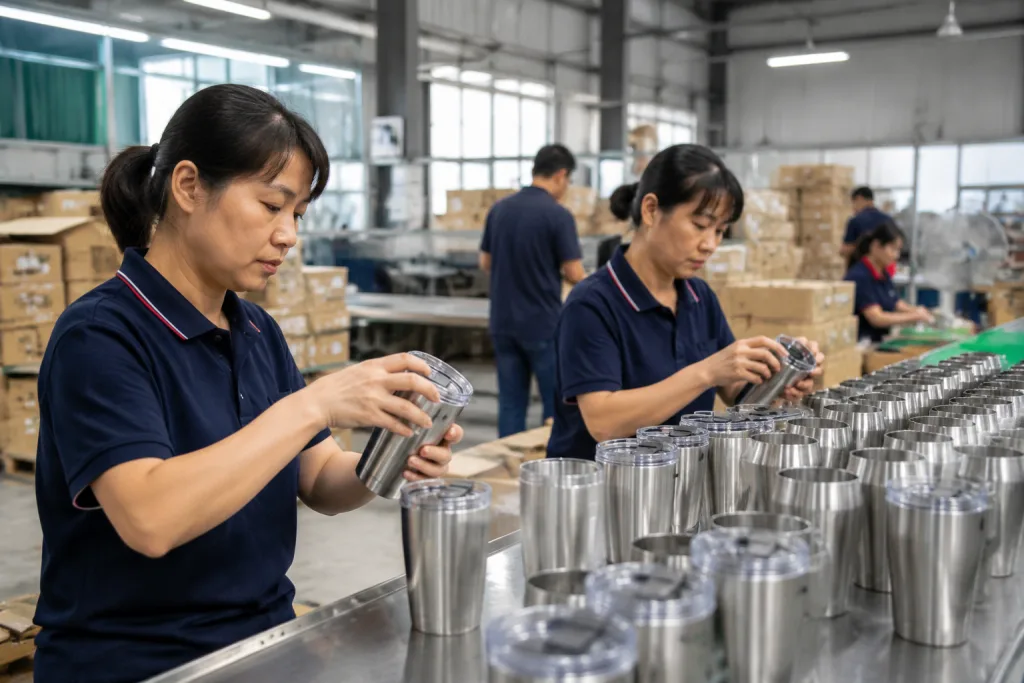
Key Takeaways
- For factory-direct travel tumblers, practical MOQ is usually 1,000-3,000 units per color
- 304 stainless steel with 0.4-0.5 mm inner wall suits most coffee programs
- Laser engraving is slower but has lower failure risk than large wrap printing
- Normal custom production from Zhejiang, China runs 30-45 days after sample approval
A supplier directory travel mug search throws up plenty of names, then leaves you to sort out the real engineering gaps. Coffee brands want a tumbler that keeps aroma in place, takes a logo without smearing, and survives a 3 km commute without a lid leak. Corporate-gift buyers want stable lead times, food-safe materials, and packaging that lands clean on arrival.
From our Zhejiang factory network, the hard part is not finding a coffee mug supplier. The hard part is matching wall thickness, lid structure, coating, and print method to the channel you sell into. We run that check on the line with calipers and a 2 mm sample wall, because a retail shelf bulk coffee travel mug is a different job from a budget bulk travel mug for an event pack.
The Spec Table Buyers Actually Need
I’ll rewrite the prose in place, keep the HTML structure intact, and make the copy sound like a real factory-side buyer note.Most coffee mug supplier directory pages stop at capacity, color, and a lifestyle shot. That is not enough for buying. If you compare a bulk coffee mug or bulk coffee tumbler, line the options up by use case, not by catalog name.
| Spec choice | Retail coffee brand | Corporate gift buyer | Distributor stock program |
|---|---|---|---|
| Capacity | 16 oz or 20 oz | 14 oz or 16 oz | 20 oz and 30 oz |
| Steel grade | 304 inside, 201 or 304 outside | 304 inside, 201 outside acceptable | 304/201 mix for price control |
| Wall thickness | 0.4-0.5 mm inner, 0.5 mm outer | 0.35-0.4 mm inner | 0.4 mm inner standard |
| Lid | Slider or flip lid, leak-resistant | Press-fit splash lid | Two lid options for SKUs |
| Finish | Powder coating or ceramic-look coating | Powder coating | Powder coating plus stainless |
| Decoration | Laser, pad print, or 1-color screen | Laser or 1-color logo | Blank stock plus print-on-demand |
If you are buying coffee mug promotional products, do not load on spec just because the sample looks premium on a table. We had a buyer flag a press-fit lid after a commuter test: fine on a desk, bad in a bag. If you sell through cafes, a base that clears a car cup holder beats an extra 2 hours of heat retention. That is the wrong question to ask.
Our Hangzhou-area line runs 300,000 stainless tumblers per month, with 1,000 units MOQ for existing shapes and 3,000 units for custom colors. QC pulled the sample last week with a 0.3 mm paint variance on one batch, and that is the number buyers should care about. That metric matters more than a glossy profile page.
Factory Direct Versus Directory Middlemen
I’ll rewrite the section in place, keeping the HTML structure unchanged and tightening the sales-engineer tone. Then I’ll do a quick pass to make sure the wording stays concrete and free of the banned AI filler.A factory direct quote for a coffee mug should break out product cost, tooling, decoration, packaging, testing, and freight term. If a listing only says “best price” or “OEM welcome,” press for a line-item quotation. We run into this on the line all the time. You need the real cost stack before you compare suppliers.
Here is the clean split. A coffee mug factory in China controls welding, vacuuming, polishing, coating, assembly, and packing. A trading company helps when you buy mixed categories, but it can blur who made the quality call. A coffee mug distributor or coffee mug distributors group works for small domestic replenishment, yet the landed price usually carries local warehousing and a margin you do not get to avoid. That is the wrong question to ask if you want factory pricing.
For a bulk travel tumbler, FOB Ningbo or Shanghai is the fairest comparison. A 16 oz powder-coated stainless travel tumbler might quote at USD 3.20-4.80 FOB, depending on steel grade, lid complexity, coating, and carton packing. QC pulled the sample on a 0.3 mm lid gap before we shipped one order last month. A simpler bulk coffee mug with single-wall stainless or plastic can come in lower, but it sits in a different channel.
Ask any coffee mug manufacturer for these documents before sampling: business license, BSCI or Sedex audit if relevant, material declaration, LFGB or FDA food-contact test history, and AQL inspection standard. For Europe, REACH and LFGB discussions should happen before mass production. For North America, FDA food-contact compliance and Prop 65 review may be needed depending on the destination state and material choices. We had a buyer flag a PO typo on the test spec once, and the whole launch slid by 12 days.
Do not choose a supplier because they appear first on a coffee mug supplier list. Choose the factory that can explain the failure modes of your chosen mug.
Which Tumbler Fits Your Channel
I’ll rewrite the section in-place, keep every tag and structure intact, and tune the prose so it sounds like a factory-side sales engineer.The right supplier directory travel mug result depends on the channel. A coffee brand selling at USD 24.99 retail should not buy the same build as a corporate onboarding gift with a USD 6.50 landed budget. The shell can look the same. The use case is not.
For cafe retail, we run 16 oz and 20 oz tapered bodies with 304 stainless interior, vacuum insulation, and powder coating plus laser engraving or a tight 1-color screen logo. That is where coffee mug custom work earns its keep. The buyer holds it every day, feels the lid click, and a weak coating gets called out in reviews. On one run, QC pulled the sample after an adhesion rub test at 50 cycles, and the finish held. For coffee mug private label or coffee mug private labeling, spend the extra USD 0.25-0.45 on lid fit and coating adhesion. The math works.
For corporate gifts, the job is risk control. A coffee mug customizable program with 2-4 approved colors, one logo position, and a standard gift box is easier to ship than ten Pantone colors and messy artwork. We had one buyer flag a PO typo on the lid code, and that delay cost 6 days. If the deadline is a trade show, skip new tooling. Use an existing coffee mug customized model and lock artwork before the sample stage.
For distributors, stock depth matters more than flashy options. A coffee mug in bulk program usually works best with black, white, navy, and stainless finishes. Keep blank inventory, then decorate locally or at the China factory depending on order size. A coffee mug bulk plan with 5,000 units split across four colors is easier to replenish than 500 units across ten colors. Your sales team may ask for variety; the warehouse will ask for fewer SKUs, and they are right.
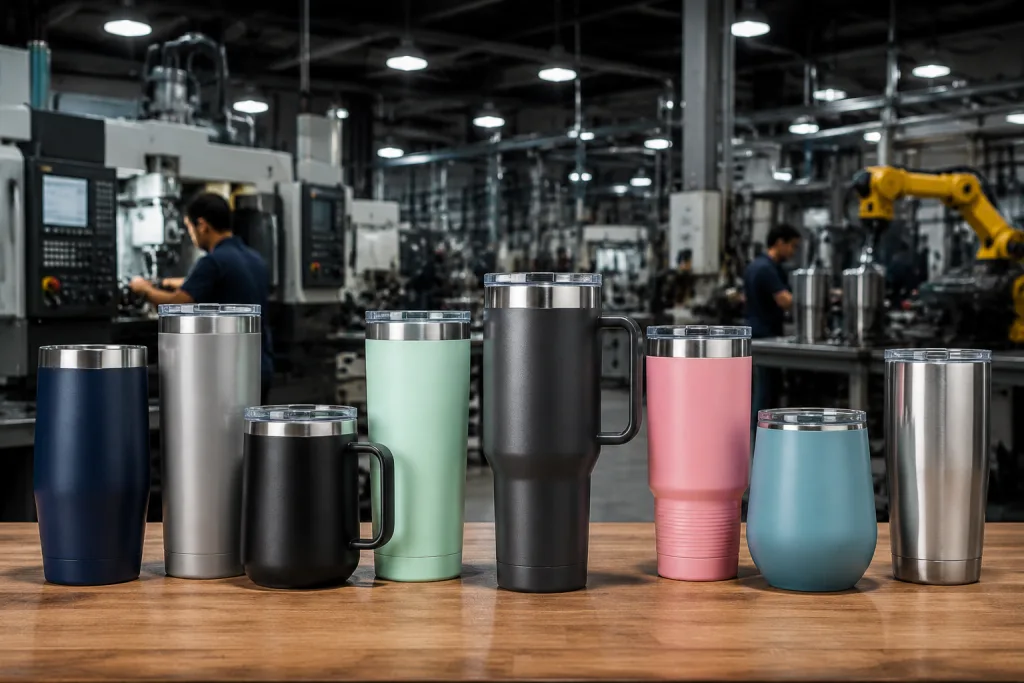
Decoration Head-To-Head
I’ll rewrite the section in-place, keep the HTML untouched, and tighten the sales-engineer tone with concrete shop-floor details and cleaner buyer language.Decoration is where a lot of coffee mug custom made jobs lose days. Buyers look at logo size; we look at the curve, coating texture, register tolerance, curing temp, and scratch wear. A mark that looks clean on a flat PDF can drift on a tapered travel mug, and we have seen that go sideways on the line.
- Laser engraving: Best for powder-coated stainless tumblers and corporate logos. It burns off the coating to show the steel under it. Setup is usually USD 30-60, and unit cost is often USD 0.15-0.35. Durable. No full-color art.
- Silkscreen printing: Good for 1-2 color logos on smooth surfaces. It works well at 1,000+ units, often USD 0.12-0.30 per color per position. Large wraps need a trial run, because the 0.8 mm wall curve can pull the edge off.
- Heat transfer: Better for multi-color graphics and promo runs. Color range is wider, but the process has more variables. Expect USD 0.45-1.20 per unit, depending on coverage. QC pulled one sample last month for a 2 mm misregister.
- Water transfer or full-wrap coating: Good for retail, not a great fit for rush corporate-gift orders. Sampling takes 12 days vs 7 days for laser or screen print, and rejection can climb above 3% when the artwork is busy.
If you are sourcing coffee mug promotional products, stay practical. A one-position laser logo on a matte black 16 oz tumbler is not flashy, but it ships clean. If you are building a coffee mug oem manufacturer relationship for retail, then custom coating, embossed lid details, and printed sleeves can justify the extra development time. This is the wrong question to ask if the deadline is tight.
Our usual pre-production sample cycle in Zhejiang is 7-10 days for laser or screen print, and 12-18 days for transfer or custom coating. The buyer flagged a PO typo once—16 oz written as 16 ml—and the line held the job for a day. That gap matters when the launch date is fixed.
Quality Checks Before The Deposit
I’ll rewrite the section in place, keeping the HTML tags and tightening the prose to sound like a factory-side sales engineer. Then I’ll do a quick pass for the banned filler words and keep the technical specifics intact.A serious coffee mug manufacturer should talk quality before you wire the 30% deposit. If the answer is only “do not worry,” walk. We see the same failures on the line: weak vacuum, leaking lids, coating chips, rust near weld seams, poor logo adhesion, silicone odor, and crushed cartons.
For vacuum stainless tumblers, ask for heat-retention data with one fixed test method. We run a simple shop test: fill with 95°C water, close the lid, then check the temperature after 6 hours. A 16 oz travel tumbler often lands around 55-65°C, depending on lid design and room temperature. A slider lid loses heat faster than a screw lid, and that is the wrong thing to blur in a quote.
For incoming inspection, use AQL instead of “check everything.” A workable spec is AQL 2.5 for major defects and 4.0 for minor defects. For premium retail, some buyers ask for AQL 1.5 major, and the math works only if you accept slower sorting. Define critical defects as zero tolerance: sharp edges, failed vacuum, leakage when inverted, wrong material, and unsafe odor.
Packaging needs its own check. A single kraft box works for domestic repacking, but e-commerce needs drop resistance. If you sell on Amazon or ship gift units, use 5-layer export cartons, inner dividers, and ask for ISTA-style carton testing. Before packing, confirm FNSKU barcode placement and scan grade; we’ve seen one PO with the wrong barcode size by 2 mm, and the buyer flagged it on first receipt. A coffee mug supplier who treats packaging as an afterthought will cost you more than a slightly higher unit price.
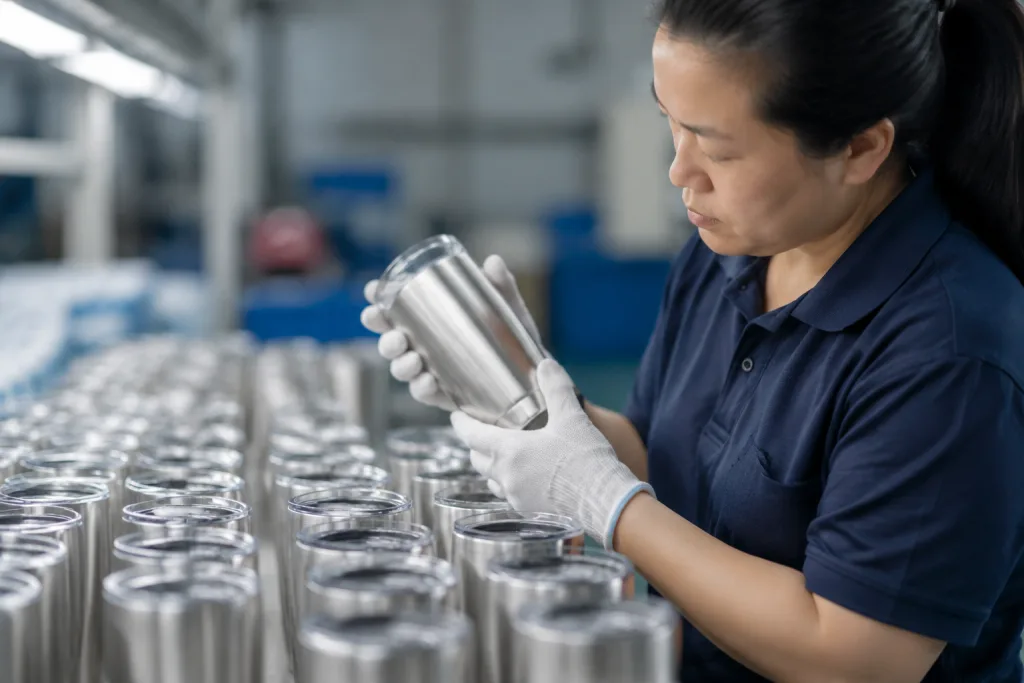
Pricing And MOQ Reality
I’ll keep the HTML exactly as-is and rewrite only the prose with tighter sales-engineer wording, concrete factory details, and fewer AI-ish fillers.Directories make it look like every coffee mug supplier can take any quantity at any price. On the floor, that math does not work. Stainless steel, coating setup, carton printing, logo fixtures, and final inspection all have hard minimums. We run the line by batch, not by wish list.
For an existing travel tumbler mold, 1,000 units per model and color is a realistic MOQ. We have taken 500-unit trial orders before, but the buyer flagged the unit price jump fast, usually 8-15%, and the color choice stayed on stock powder. For Pantone-matched coating, 3,000 units per color is the cleaner number because the spray booth has cleaning loss and color-change waste. A new mold or custom lid needs 5,000-10,000 units, plus tooling from USD 1,500 to USD 8,000 depending on the lid structure and cavity count. That is the wrong question to ask if someone wants factory-level pricing on a tiny run.
Price ranges need context too. A simple 12 oz stainless coffee mug in bulk may sit around USD 2.40-3.50 FOB. A 16 oz vacuum bulk coffee travel mug may run USD 3.20-4.80. A 20 oz premium bulk travel tumbler with textured coating, a better lid, and retail box often lands around USD 4.80-7.20 FOB. Add USD 0.15-1.20 for decoration and USD 0.25-0.90 for packaging upgrades. QC pulled a sample last week with a lid gap of 0.6 mm, and that kind of issue is exactly what pushes a cheap quote into a bad order.
Payment terms for China factory orders are usually 30% deposit and 70% before shipment after inspection. Lead time is normally 30-45 days after sample approval for standard items, or 50-70 days when new tooling, custom color, and printed retail packaging are all in the order. If your event date is inside 45 days, simplify the spec instead of trying to squeeze the line. We’ve seen that go sideways more than once. One PO typo can cost a week when the carton mark or lid color code is wrong.
Send us your travel tumbler RFQ today
Share capacity, logo, MOQ, market, and deadline. We will return factory-direct options with realistic pricing, lead time, and compliance notes.
Frequently asked questions
How do I compare suppliers from a travel mug directory?
Start with a controlled RFQ. Send the same capacity, material, lid, coating, logo, packaging, inspection, and FOB port requirements to every coffee mug supplier. Ask for MOQ by color, sample time, mass lead time, and test reports. A serious coffee mug factory will answer with line-item pricing and production assumptions. If one quote is 20% lower than the others, check steel grade, wall thickness, lid material, and carton quality before celebrating. For coffee brands, request 2 physical samples: one blank production sample and one decorated sample. For corporate-gift buyers, also ask for a packed carton photo and carton dimensions so freight can be estimated correctly.
What is a reasonable MOQ for custom travel tumblers?
For an existing coffee mug factory direct model, 1,000 units per color is a reasonable MOQ in Zhejiang and other China manufacturing areas. Some suppliers accept 500 units using stock colors, but you should expect a higher unit price and less control over finish. Pantone powder coating usually starts at 3,000 units per color. New mold projects normally need 5,000-10,000 units, plus tooling cost from about USD 1,500 to USD 8,000. If you need several logos for different departments, keep the same tumbler color and change only the decoration. That keeps the production line efficient and reduces leftover stock.
Which logo method is best for corporate coffee mug promotional products?
For corporate coffee mug promotional orders, laser engraving is usually the safest option on powder-coated stainless tumblers. It is durable, clean, and avoids ink adhesion risk. The common cost is USD 0.15-0.35 per unit after a small setup charge. Silkscreen is better when you need a specific brand color, but curved surfaces limit artwork size and registration tolerance. Heat transfer works for multi-color campaigns, though it adds cost and production risk. If your order is under 2,000 units and the deadline is tight, choose one-position laser engraving. If the mug is for resale and the artwork is part of the product story, test screen or transfer samples before approval.
Can I use one supplier for private label and bulk distributor orders?
Yes, but separate the specifications. A coffee mug private label range usually needs retail packaging, stricter color control, barcode labeling, and cleaner finish standards. A bulk distributor order may prioritize price, stock colors, and fast replenishment. One coffee mug oem manufacturer can handle both if the factory has stable capacity and clear QC records. Use different SKUs and inspection rules. For private label, you may choose AQL 1.5 major and 2.5 minor; for bulk promotional stock, AQL 2.5 major and 4.0 minor is common. Do not let a low-cost distributor spec quietly replace your retail spec. The complaints will come back to your brand.
What certifications should I request for travel mugs sold in Europe or North America?
For Europe, request LFGB food-contact testing, REACH-related material review where applicable, and a supplier audit such as BSCI or Sedex if your customer requires social compliance. For North America, FDA food-contact compliance is the baseline, and Prop 65 review may be needed for California exposure. If the product is for children, additional ASTM and CPSIA-related checks may apply, but most travel tumblers are adult products. Ask for test reports tied to the actual material: 304 stainless steel, lid plastic, silicone gasket, coating, and printed ink. A coffee mug manufacturer should not send a random report for a different model and expect you to accept it.