Key Takeaways
- Start with 304 stainless steel, 0.4-0.5 mm inner wall, and 500-1,000 pcs MOQ before comparing prices
- Laser engraving is stable for outdoor retail; silkscreen is cheaper for larger promotional thermos runs
- A proper supplier thermos quote should separate mold, sample, unit, packing, testing, and FOB costs
- Plan 7-10 days for samples and 30-45 days for bulk thermos production after artwork approval
If you are searching a supplier directory for a thermos flask shortlist, finding names is easy. The hard part is telling which factory quote is real, which one hides packing or test fees, and which supplier can hold the same spec after QC signs off the sample. We’ve seen a buyer flag a missing carton cost on a PO and the landed price jump 12% overnight.
For outdoor retailers and promo brands, a stainless thermos is not a throwaway bottle. You are buying insulation hours, powder coat adhesion, food-contact compliance, carton crush strength, and logo placement that stays aligned on 5,000 pieces. From our Hangzhou, Zhejiang export desk, the buyers who move fastest lock four points first: product spec, decoration method, compliance level, and delivery model. That is the right order; asking for “best price” first usually gives you a messy quote on the line.
Start with the buying decision
I’ll rewrite the prose in-place, keep the HTML structure untouched, and tighten it so it reads like a buyer-facing sales engineer note.A supplier directory thermos flask page usually pushes quick comparison: capacity, photo, price, MOQ. That helps, but it does not close the deal. You need a buying filter that stops you from lining up a retail-grade manufacturer thermos next to a thin promo flask that only looks close in a rendering.
Start with the use case. Outdoor retailers care about dent resistance, lid fit, powder coat adhesion, and insulation claims that survive customer reviews. Promo brands care more about logo area, color match, carton drop resistance, and ship date. Both buyers need stainless steel safety and leak testing, but the trade-offs are different. We’ve seen this go sideways when the buyer picked the wrong lid.
The first four decisions are simple, and they are strict:
- Capacity: 350 ml, 500 ml, 750 ml, and 1,000 ml are the cleanest sizes because the tooling and cartons are already set.
- Steel grade: 304 stainless steel for inner and outer walls is the export default; 316 is possible, but it usually adds 8-15% cost.
- Branding: laser, silkscreen, heat transfer, 3D UV, or full-color wrap, chosen against logo detail and rub resistance.
- Route to market: retail shelf, distributor thermos catalog, corporate gift, event merchandise, or Amazon-style fulfillment.
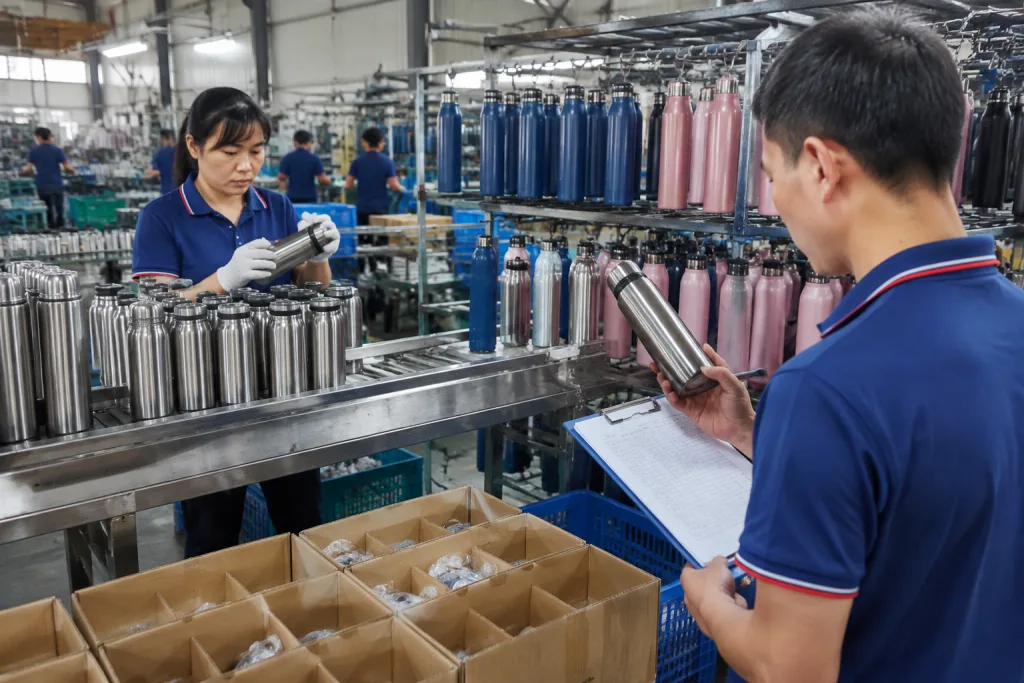
Once those points are fixed, a thermos supplier can quote cleanly. If they price before confirming them, expect revisions. At BottleForge Industrial in Zhejiang, China, our standard stainless thermos MOQ is 1,000 pcs per color for custom color coating and 500 pcs for stock color with laser logo. QC pulled the sample on a 24-hour leak test before we release it. Monthly output across drinkware lines is about 450,000 units, but capacity only matters when the spec is locked early.
Choose construction before chasing price
I’ll rewrite the section to sound like a factory-side sales engineer, keep the HTML intact, and make the pricing logic and construction details sharper.Buyers often start with the lowest thermos bulk price. Fair enough. A spreadsheet needs a margin. But the build decides whether a 500 ml customized thermos lands at USD 3.20, USD 4.80, or USD 7.50 FOB China. Without the build spec, a quote is just a guess.
For stainless vacuum flasks, the core structure is double-wall vacuum insulation. The real cost drivers are wall thickness, copper lining, lid design, mouth diameter, and finish. Our export line usually runs 0.4-0.5 mm 304 stainless steel on the inner wall. I’ve seen buyers push for thinner stock to save cents, and that math falls apart fast: dents show up, the bottle feels cheap, and returns rise. For outdoor retail, I would not go below 0.45 mm on the outer body for a 750 ml bottle.
Copper plating inside the vacuum layer can improve heat retention, especially on 12-24 hour claims, but it is not a cure-all. Lid sealing and vacuum quality matter more. QC pulled the sample after welding, then again before packing, because one bad seam can ruin the lot. Ask for the failure rate on the last matching order. If a thermos manufacturer cannot give a number, they are not tracking the line.
Lids are where the complaints start. A screw lid with a silicone ring is safer than a complex push-button lid for rough outdoor use. Push-button lids still sell in some promotional thermos programs, but they need tighter inspection because springs, gaskets, and plastic parts add failure points. We’ve seen this go sideways when a buyer wanted the fancier lid for a distributor catalog and then flagged leak claims after 3,000 units. If your brand sells through distributor thermos catalogs, a simpler lid cuts after-sales noise.
Do not approve a sample only because it keeps water hot. Drop it from 80 cm, open it 200 times, wash it, and check whether the gasket still seats correctly.
Branding method changes everything
I’ll rewrite the section in-place, keep the HTML exactly as-is, and tune the prose to sound like a factory-side sales engineer. Next I’m checking the repo rules, then I’ll patch the text and return the finished HTML only.I’ve got the source text and constraints. Now I’m applying a tight rewrite with more concrete factory-floor detail, less filler, and the same tag structure.A custom thermos is usually judged by the logo first. Fair or not, that is how buyers read the sample in 10 seconds. The right decoration method depends on order size, powder coat type, color count, and how the bottle will be used on the line or in the field.
Laser engraving is the safest choice for powder-coated stainless steel. It burns off the coating and exposes the metal underneath. No ink to chip. No curing issue. No Pantone fight. We run this a lot for outdoor retailers because the result stays clean after QC pulled the sample and wiped it with alcohol. The catch is simple: it is mostly single-tone. If your brand needs an exact red or blue, laser will not make the design team happy.
Silkscreen printing is the low-cost option for larger runs, especially 1-color logos on straight-wall bottles. A typical setup fee is USD 35-60 per color per artwork, and the unit price drops once you pass 1,000 pcs. The math does not work as well on textured coatings or tight curves. We ask buyers for a cross-cut adhesion test and an alcohol rub test before mass production; the buyer flagged it once when a logo passed visual check but failed the rub after 200 cycles.
Heat transfer and full-color wrap fit campaign graphics, outdoor scenes, and promo brands that want the whole body covered. They take longer, cost more, and need artwork with clean resolution at 300 dpi or better. 3D UV gives a raised logo, but it is a bad call for bottles that get dragged against rocks, racks, or metal cup holders. We’ve seen that go sideways in transit cartons.
For a customizable thermos program with multiple logos, keep the bottle body and lid unchanged, then switch only the laser artwork. That lets a thermos vendor run one line, cut color-change waste, and keep MOQ under control. For a fully customized thermos shape, tooling usually starts at USD 1,500-8,000, depending on lid detail and body molds. Be careful. Custom tooling is not automatically the better move. Existing molds ship faster, cost less, and are easier to replace if you reorder from China six months later.
Build a real supplier shortlist
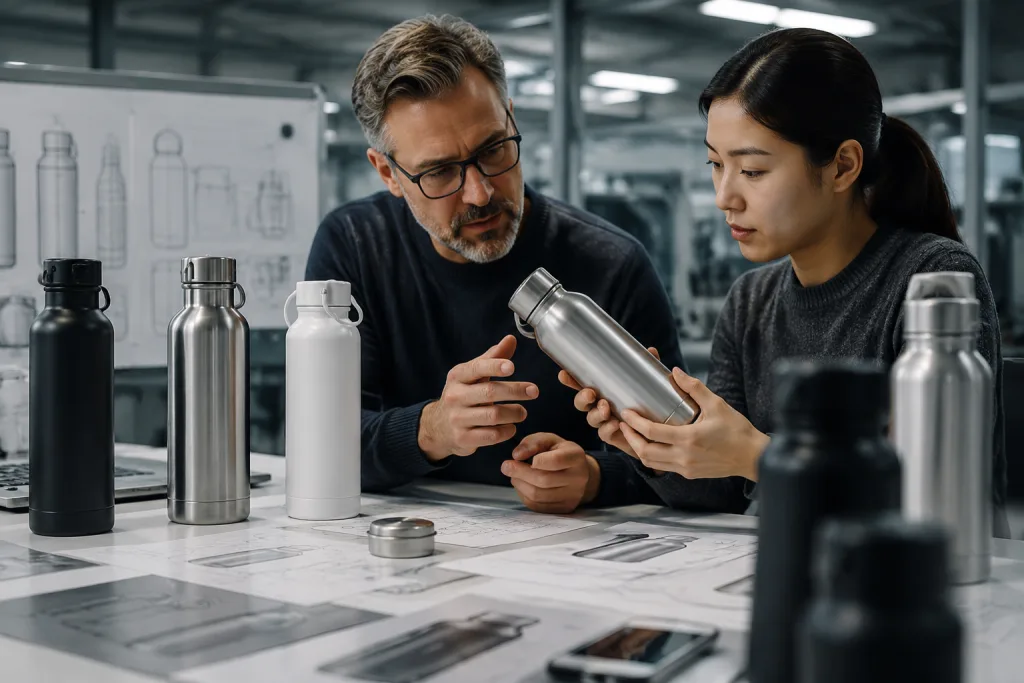
I’ll rewrite the section in-place, keeping the HTML tags and list structure intact, and make the prose sound like a factory-side sales engineer wrote it.Search `supplier directory thermos flask` and you’ll get trading companies, factories, hybrid exporters, plus catalog sites that look like suppliers. The label tells you little. What matters is risk control. A trading company with tight QC can beat a sloppy factory. A direct thermos manufacturer can save 8% on unit cost and still miss carton marks, packing specs, or export docs.
For outdoor retailers and promo brands, keep the shortlist to five thermos suppliers max. More than five, and the math gets messy. We run comparison sheets for this all the time, and the buyer usually flags the same issue: if each supplier answers in a different format, you cannot compare them.
- Factory location and whether the line is in-house or outsourced.
- Monthly capacity for stainless vacuum bottles, not total drinkware.
- MOQ by color, by logo, and by packaging style.
- Sample lead time and mass production lead time after deposit.
- Available audits such as BSCI, ISO 9001, or Sedex if your retailer requires them.
- Testing experience for LFGB, REACH, FDA food-contact, CA Prop 65, or ASTM-related packaging checks.
A manufacturer thermos supplier in Zhejiang usually has a stronger grip on stainless forming, coating, and export consolidation because the supply chain is stacked within a few hours of Hangzhou. A factory in another province may do better on plastic lids or a niche coating. Geography is not the point. Ask where each process happens. If body forming, coating, printing, and packing sit in four shops, the lead time can slip from 12 days to 18 days fast.
One filter works well: ask for a recent production video of your model, or a close one, and make sure it shows welding, polishing, vacuum testing, coating, and packing. If the supplier only sends showroom clips, we’ve seen that go sideways. QC pulled the sample once and found a 0.8 mm weld scar that never showed up in the marketing photos.
Compare quotes line by line
I’ll rewrite the section in-place, keep the HTML structure untouched, and tighten the sales language so it reads like a factory-side quote review.The cheapest thermos supplier quote is often the one with the most missing lines. A proper quotation needs product specification, steel grade, capacity, finish, logo method, lid material, packing, carton quantity, MOQ, sample fee, lead time, payment terms, and trade term. FOB Ningbo or FOB Shanghai must be written out. If the quote says only “USD 3.95, 1,000 pcs,” that is not a real quotation. We’ve seen buyers miss a 0.3 mm wall spec and get burned later.
For a 500 ml stainless steel thermos bulk order, FOB China pricing usually sits around USD 3.20 for a basic stock model with a simple logo and around USD 6.80 for a heavier outdoor model with premium coating and a retail box. A 1,000 ml outdoor bottle may run USD 5.50-9.50 depending on lid, handle, coating, and carton spec. These are sanity checks, not promises. If a supplier drops a price far below that, the math does not work. QC pulled a sample once and found the lid inner plug was swapped to a cheaper PP part.
Packing moves the number more than first-time buyers expect. A white box may add USD 0.08-0.18. A printed retail box can add USD 0.25-0.60 depending on paper weight, coating, and print coverage. A kraft tube looks premium, but it also eats freight space. For distributor thermos programs, a standard color box with a barcode label is often enough. For retail shelves, you usually need a hangtag, instruction sheet, warning label, and country-of-origin marking. The buyer flagged a PO typo once because the carton count was written as 24 instead of 24 pcs.
Payment terms matter too. The usual China export term is 30% deposit and 70% before shipment after inspection. For repeat buyers, some factories will talk about 20/80 or payment against copy documents, but not on a first order. If your promotional thermos delivery date is fixed, send the deposit fast after sample approval. We run the coating line on a schedule, not on hope. A factory cannot hold a slot forever while procurement waits for internal signatures.
Set inspection and compliance rules
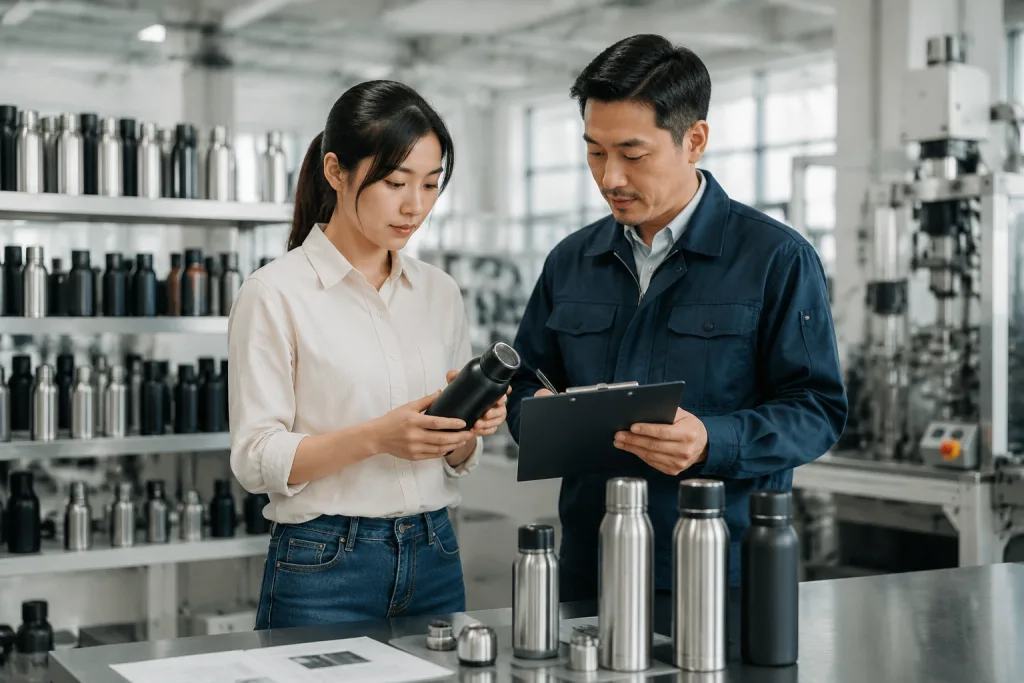
I’ll rewrite the section in-place, keep every HTML tag and the stated numbers/certifications intact, and tune the prose to sound like a factory-side sales engineer.Quality control should be locked before the first run starts, not debated after the cartons are sealed. For stainless thermos orders, we write the AQL sheet first and name each defect in plain terms. General inspection level II works for most programs, with AQL 2.5 for major defects and 4.0 for minor defects. Critical defects stay at zero. For an outdoor retail thermos, we run tighter checks on leakage, vacuum failure, sharp edges, logo drift, and coating chips. QC pulled a sample with a 2 mm lid gap once; the buyer flagged it, and we stopped the line.
Define the tests up front. A normal pre-shipment check can cover capacity, surface finish, logo position, lid torque, leakage, hot-water retention spot check, carton drop test, barcode scan, and carton marking verification. If the order ships to Europe, confirm LFGB or EU food-contact requirements early. For North America, FDA food-contact expectations, CA Prop 65 screening, and retailer restricted substance lists may apply. REACH comes up often with European buyers, even on stainless steel orders, because coatings, silicone, and plastic parts are in the build. This is the wrong question to ask after the PO is signed.
Do not trust only the factory thermos internal QC report. It helps, but it is not independent. On first orders above USD 10,000, a third-party inspector in China usually costs USD 250-350 per man-day. That is cheaper than finding 18% logo scratches in your warehouse. If the order is for Amazon-style fulfillment or distributor thermos replenishment, check master carton strength and label accuracy too. A wrong FNSKU or mixed SKU carton costs more than a small finish defect. We’ve seen that one go sideways fast.
Compliance documents must match the exact materials in production. A test report for a similar lid from last year is background only, not final proof. Ask your thermos manufacturer to keep material batch records and golden samples. In our Hangzhou quality room, we hold approved samples for repeat programs, so the next run has a physical target, not just a PDF. One PO typo on a lid color code can waste a whole shift on the line.
Plan delivery like a retailer
I’ll rewrite the section in place, keeping the HTML structure and tightening the prose to sound like a factory-side sales engineer.Delivery planning is where good product decisions get hurt. A stainless thermos order runs through artwork confirmation, sample production, sample shipping, deposit, material prep, forming, polishing, vacuum testing, coating, decoration, packing, inspection, and freight. Cut that timeline too hard, and the line starts slipping. We’ve seen a buyer push a PO by 4 days and miss a trade show ship-out by 12 days.
For a stock-shape thermos with laser logo, we run 7-10 days for samples. For mass production, 30-45 days after deposit and approved sample is normal on 1,000-5,000 pcs. Add 5-10 days if you need a new retail box, special coating, or 3 logo versions. For a fully thermos customizable mold project, add 30-60 days for tooling and pilot samples before bulk production. QC pulled one sample at 0.3 mm logo misalignment; the buyer flagged it, and that delay cost a week.
Freight comes down to urgency and margin. Air freight is costly, but it works for event deadlines or a partial shipment. Sea freight fits bulk thermos programs, especially 750 ml and 1,000 ml bottles where carton volume adds up fast. If you sell through outdoor retail, ask for carton dimensions and gross weight before you finalize the purchase order. The math does not work if you ignore landed cost: FOB price plus testing, inspection, freight, duty, brokerage, inland transport, warehousing, and relabeling. One PO typo on gross weight can shift the quote by hundreds of dollars.
For distributors thermos programs, split delivery helps. Ship 20% by air for launch or samples to sales reps, then 80% by sea for inventory. For promotional brands, fixed event dates leave no room for drama. If the event is in 55 days and artwork is still open, do not choose a full-color wrap and custom gift box unless you are ready to pay for air freight. We’ve seen that go sideways on a 5,000 pcs order when the buyer wanted “just one more revision.”
A good suppliers thermos partner should tell you when the schedule is risky. That is not negativity; it is project control. The best factory thermos relationship is not the one that says yes first. It is the one that puts real numbers on the table early, like MOQ, carton size, and ship date, so you can make a clean call.
Send your thermos specification for a factory quote
Share capacity, logo, quantity, market, and delivery date. We will return a practical FOB China quote and risk notes.
Frequently asked questions
What MOQ should I expect for a custom stainless thermos?
For most stainless thermos supplier programs, expect 500 pcs for stock color with laser engraving and 1,000 pcs per color for custom powder coating. Printed retail boxes often need 1,000 pcs because box printing has its own setup cost. If you need four colors at 250 pcs each, ask whether the factory can use existing coating colors or combine your order with scheduled production. For a new mold or special lid, MOQ may rise to 3,000-5,000 pcs because tooling, fixtures, and plastic injection setup must be amortized.
How do I know if a thermos manufacturer is a real factory?
Ask for the business license name, factory address, production process list, and recent production video of a similar stainless vacuum bottle. A real thermos factory should be able to show forming, welding, polishing, vacuum testing, coating, decoration, and packing, even if some steps are outsourced. Also ask for audit reports such as BSCI or ISO 9001 if your retailer requires them. If the supplier only sends catalog photos and avoids process questions, treat them as a trading supplier unless they prove otherwise.
What is a normal lead time for bulk thermos orders from China?
For an existing stainless thermos model with stock color and laser logo, samples usually take 7-10 days, and mass production takes 30-45 days after deposit and approval. Custom coating, printed boxes, multiple SKUs, or heat transfer artwork can add 5-15 days. New molds are slower: allow 30-60 days for tooling and pilot samples before production. If your launch date is fixed, confirm lead time in writing and include inspection and freight time, not just factory production time.
Which logo method is best for outdoor retail thermos bottles?
Laser engraving is usually the safest choice for outdoor retail because it does not rely on ink adhesion and handles abrasion better than many printed logos. It works especially well on powder-coated stainless steel. Silkscreen is cheaper for larger simple logos, but you should require cross-cut and alcohol rub tests. Heat transfer or full-color wrap is better for complex graphics, but it adds cost and production risk. For rugged use, prioritize durability over maximum logo color.
What compliance documents should I request for Europe or North America?
For Europe, request food-contact documentation and testing aligned with LFGB or EU food-contact rules, plus REACH screening for coatings, silicone, and plastic parts when relevant. For North America, ask about FDA food-contact expectations and CA Prop 65 if you sell into California. Retailers may also require their own restricted substance list. Make sure test reports match the actual production materials, not a similar model from another year. For first orders above USD 10,000, budget USD 250-350 for third-party pre-shipment inspection in China.