Key Takeaways
- A practical MOQ for customized thermos orders is 1,000 pieces per color or finish
- 304 stainless steel is standard for inner walls; 316 is useful for saltwater or acidic drink positioning
- For retail thermos bulk orders, plan 35-50 days after artwork and sample approval
- AQL 2.5/4.0 inspection should include vacuum retention, leak testing, coating adhesion, and carton drop checks
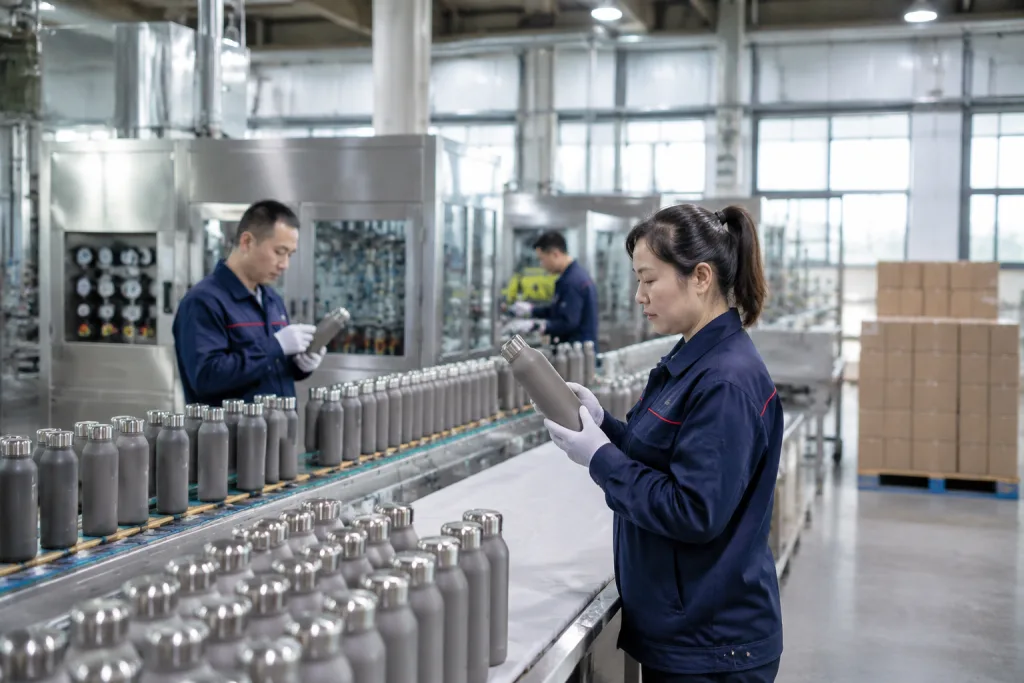
A supplier directory thermos bottle page can show 40 factories in five minutes. Finding a factory is not the hard part. The hard part is writing a spec the line can run without guessing at wall thickness, coating code, or lid torque. Outdoor retailers ask us for bottles that pass a 1.2 m drop test and a 45-day winter shelf cycle with no coating cracks; QC still checks the base ring at the packing table with a 3M tape pull. Promotional buyers usually start with print registration held within 0.5 mm on the rotary screen printer and export cartons that come through 18 kg stack testing without crushed corners.
From our Hangzhou, Zhejiang production base, we see the same buying mistake about 9 times a month: buyers judge a 500 ml custom thermos by FOB price first. Wrong question. That FOB line can hide 304 stainless thickness, vacuum hold time, powder-coat adhesion, lid leakage, and who pays when QC pulls 80 samples under AQL 2.5. We had one PO last quarter with “matte balck” typed in the color field; the buyer flagged it only after pre-production samples came off the spray line. A USD 0.35 saving looks clean on the PO, but the math does not work if it turns into a 6% return problem after delivery in Europe or North America.
Spec Table Before Supplier Shortlisting
I’ll rewrite the prose in place, keep the table and tags intact, and strip the AI-sounding filler while adding a few factory-floor specifics.A supplier directory thermos bottle page usually gives you photos, capacity, and a short contact form. That is not enough to place an order. You need a spec check by use case. A trade-show promo thermos and a retail thermos for outdoor shelves do different jobs, even when both are labeled 500 ml double-wall stainless steel.
| Buyer use case | Recommended spec | Typical FOB China | Risk if underspecified |
|---|---|---|---|
| Outdoor retail | 304 inner, 201 or 304 outer, 0.45-0.55 mm wall, powder coat, leakproof lid | USD 4.20-6.80 | Paint chips, poor shelf reviews, returns |
| Promotional campaign | 304 inner, 201 outer, 0.40-0.45 mm wall, silk screen or laser logo | USD 2.90-4.60 | Logo scratches, inconsistent colors |
| Premium gift set | 304/304 steel, 0.50 mm wall, gift box, optional copper lining | USD 5.50-8.50 | Weak perceived value |
| Amazon or e-commerce | Retail carton, barcode/FNSKU label, ISTA-style carton testing | USD 4.80-7.20 | Warehouse rejection or transit damage |
At BottleForge Industrial in Zhejiang, China, we run about 180,000 stainless thermos units a month, and the usual MOQ is 1,000 pieces per color for most custom programs. QC pulled the sample on a 0.45 mm wall run last week, and the caliper stayed within 0.02 mm. That is the check that keeps complaints off the line. If a thermos vendor offers 300 pieces with full-color coating, a private mold lid, a gift box, and a low price, the math does not work. We’ve seen buyers flag that PO typo before production even starts. Ask where they cut cost: steel thickness, coating line time, or final inspection.
Outdoor Retail Versus Promotional Fit
I’ll keep the HTML structure exactly as-is and rewrite only the prose, tightening the sales-engineer tone and removing the AI filler.Outdoor retail orders live or die on returns. Promo orders live or die on ship dates. That switch changes the spec sheet fast.
For an outdoor retailer, we ask the thermos factory for vacuum retention at 6 hours and 12 hours, not a polished sample photo. We run 95°C water, lid on, then check the thermometer at 6 hours. On a 500 ml bottle, a solid retail unit should stay above 65°C after 6 hours, but mouth size and cap design change the result. QC pulled a 55 mm wide-mouth soup thermos and a 30 mm narrow-mouth bottle the same morning; the wide mouth cooled faster. Same steel. Different outcome.
For promotional thermos orders, we can accept weaker heat hold if the bottle is headed for offices or event handouts. Print is the real fight. Silk screen should pass a 3M tape adhesion test after curing, and we pull samples at the line before packing. Laser engraving needs clean edges and no black scorch unless the buyer asked for that look. Heat transfer printing also needs a wrap test on the curved body, not just flat artwork approval. We’ve seen that go sideways when a logo looks fine on PDF and ugly on the bottle.
A supplier thermos quote needs to split product cost, logo cost, packing cost, and inland freight to port. If the factory throws one round number on the table, the math doesn’t work. A distributor thermos buyer should ask for carton size and gross weight on day one; on one 40HQ shipment, a 2 kg carton difference moved freight more than a USD 0.18 unit price gap. One PO even came through with the carton count typo’d as 420 instead of 240. That kind of miss costs real money.
Steel Grade And Wall Thickness
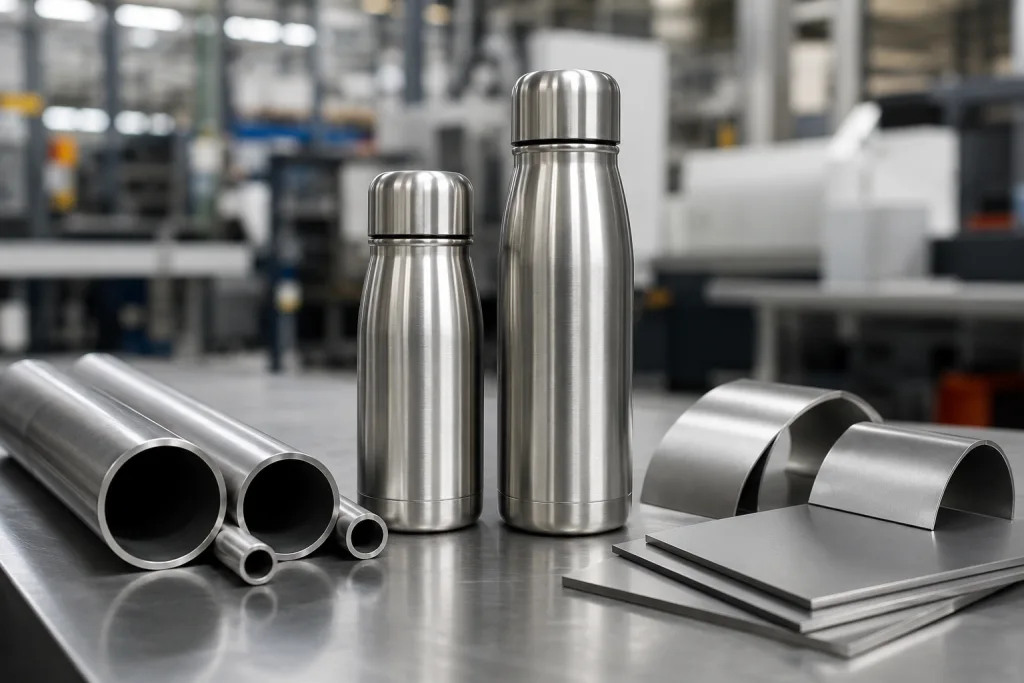
I’ll rewrite the section in place, keep every tag intact, and tighten the copy so it reads like a factory-side sales engineer wrote it.Most stainless thermos suppliers lead with “304 stainless steel” because it sounds safe on a spec sheet. Ask where the 304 sits. On most orders, the inner wall is food-contact 304 stainless steel. The outer wall is often 201 stainless steel on price-led promo thermos runs, or 304 stainless steel when the buyer wants better corrosion resistance and a cleaner retail story.
Wall thickness is where first-time buyers get caught. A 0.35 mm outer wall can look fine on a sample table, but it dents faster in transit and warehouse handling. For outdoor retail, we usually run 0.45-0.55 mm, based on capacity and body shape. For a lightweight promo order, 0.40 mm can work if the carton and inner packing are tight. Thicker is not a free win. It adds weight, pushes cost up, and makes forming harder on the line.
For acidic drinks, saltwater branding, marine clubs, or premium wellness positioning, 316 stainless steel is worth a look. It is not needed for every custom thermos, and we say that straight. One buyer pushed for 316 on a 500 ml bottle, and the margin math did not work. In China, 316 material can add about USD 0.30-0.80 per piece, depending on bottle size and steel price. Don’t pay for it unless the use case earns it.
Check weld quality and the vacuum base finish too. A clean bottom plug, even polish, and a stable standing surface tell you more than a glossy catalog ever will. QC pulled one sample with a tiny weld mark and the buyer flagged it on the spot. A real thermos factory should show cut samples, production-line photos, and material declarations when you are moving toward a serious bulk thermos order.
Decoration Choices Head To Head
I’ll rewrite the section in-place, keeping every tag and table structure intact, and tighten the copy so it reads like a factory-side sales engineer.Logo method is where a custom thermos looks sharp or ends up looking cheap. The right pick depends on order size, coating, artwork detail, and how the bottle gets handled after it leaves our warehouse. On our line, a 12 mm laser mark and a 0.2 mm screen gap show the difference fast.
| Decoration | Best for | MOQ reality | Practical note |
|---|---|---|---|
| Laser engraving | Outdoor, corporate, premium retail | 500-1,000 pcs | Durable, but color shifts with coating and metal reaction |
| Silk screen | Simple promotional logos | 1,000 pcs | Good cost, limited gradients and wrap precision |
| UV print | Full-color brand graphics | 1,000 pcs | Needs adhesion testing on powder coat |
| Heat transfer | Large wrap designs | 2,000 pcs | Strong visual impact, tighter setup control needed |
| Embossed or molded logo | Private lid or silicone parts | 3,000-5,000 pcs | Tooling cost and longer lead time |
For a thermos customizable program, do not sign off from a digital mockup alone. Ask for a pre-production sample with final coating, final logo, and final packaging. We had a buyer flag a PO typo once because the logo sat 2 mm off-center on a retail SKU; on a giveaway cup, nobody cares, but on a shelf with three variants, it looks sloppy. For repeat distributors thermos orders, we keep approved color panels and logo-position records, because the line remembers what the screen forgot.
If you need Pantone matching, budget extra time. Powder coating is not paper printing. A Delta E tolerance under 2.0 is tight and usually costs more; Delta E 3.0-4.0 is what we see on a lot of drinkware finishes after QC pulls the sample and checks it under the light box. If the forecast is thin, asking for luxury-cosmetics color control on a low-cost thermos bulk program is the wrong question; the math does not work.
Factory Capacity And Lead Time
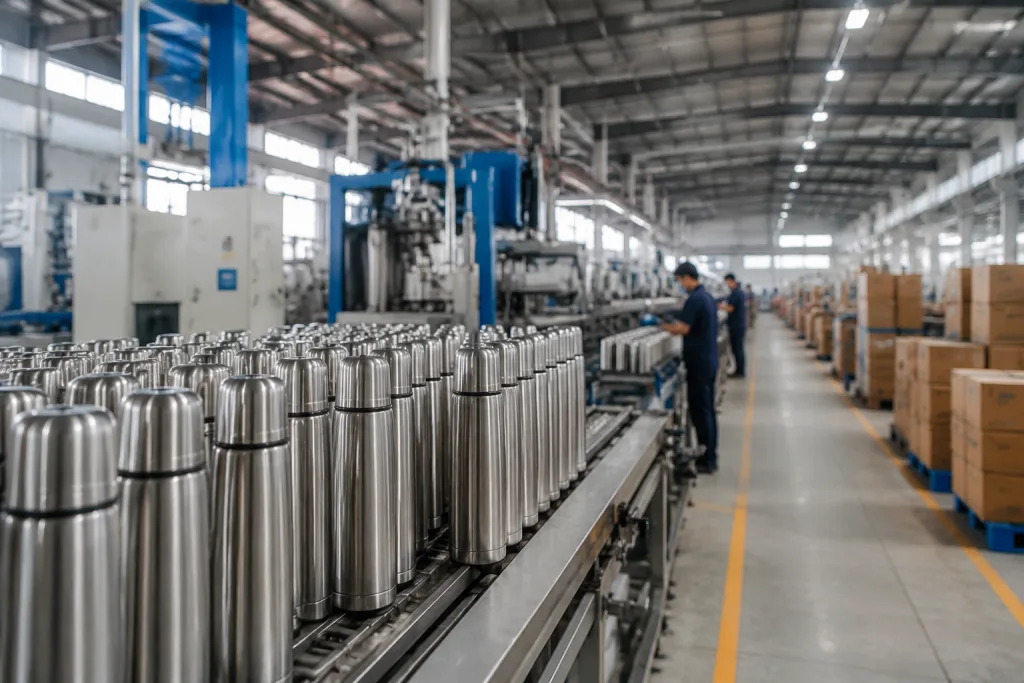
I’ll rewrite the section in place, keep the HTML tags untouched, and tighten the language to sound like a factory-side sales engineer.A real thermos partner talks bottlenecks, not “fast delivery.” Stainless thermos runs move through tube cutting, necking, laser welding, vacuuming, mirror polishing, spray coating, logo printing, assembly, packing, and final inspection. The slow point shifts with the season. Before Q4, coating booths and logo lines pile up in Zhejiang because promo brands and retail importers all hit the same window. We’ve seen one line lose 2 days just waiting for a spray slot.
For a standard custom thermos with existing molds, plan 7-10 days for sampling after artwork confirmation, then 35-50 days for mass production after sample approval and deposit. If you need a private mold lid, add 20-30 days for tooling and trial adjustment. A 10-color order at 1,000 pieces each is not the same job as one color at 10,000 pieces; every color change eats line time, and QC pulled the sample twice on the last job because the cap emboss was 0.4 mm off.
First orders usually run on 30% deposit and 70% before shipment or against inspection pass. FOB Ningbo or FOB Shanghai are common for Zhejiang factories. EXW looks cheaper on paper, but then inland trucking and export handling land on your desk. For newer importers, FOB is the cleaner move because the supplier books customs and gets the cartons to port. One buyer missed a PO typo on the shipper name, and that caused a 3-day hold at booking.
Ask how many units the factory ran last month in models like yours, not the headline capacity across every product line. A thermos maker saying 500,000 units per month tells you little if your bottle shape is new to the line. You want proof on your exact bottle diameter, finish, and lid structure. A 28 mm neck and a flat lid do not behave like a wide-mouth travel mug. The math does not work any other way.
Compliance And Inspection Discipline
I’ll rewrite the section in place, keep the tags exactly as-is, and make the wording sound like a real factory-side sales engineer.For Europe and North America, compliance is not paperwork for the drawer. It keeps the channel open. For stainless drinkware, buyers ask for LFGB or EU food-contact files, REACH screening for coatings and outside parts, FDA food-contact support for the U.S., and sometimes California Proposition 65 checks depending on the sales channel. For children’s drinkware, CPSIA and ASTM rules can apply when painted surfaces, small parts, or straw parts are in the build.
Social compliance comes up too. BSCI, Sedex, or ISO 9001 audits are common asks from larger retailers. A 3,000-piece promo thermos order may not need a full audit, but the end client may still ask where the product was made. We’ve seen this go sideways when that question lands after the cartons are sealed, so we pin it down before the line starts. That saves a headache.
Inspection should sit on the purchase order, not get treated like a spare part. A normal setup is AQL 2.5 for major defects and 4.0 for minor defects, with critical defects rejected outright. Critical checks cover leakage, sharp edges, wrong material, blocked lid function, strong odor, and unsafe packaging issues. Major checks cover coating scratches, bad logo registration, weak vacuum retention, wrong carton marks, and missing accessories. The buyer flagged a “logo centering” typo on one PO last month; that kind of thing still turns into a claim if nobody catches it early.
We check at least 80 pieces for temperature retention on a mid-size order, and we keep one smaller lab-style sample at the factory. For thermos supplier programs above 20,000 pieces, we add in-line inspection during coating and logo printing. QC pulled the sample on one 30,000-piece run and found adhesion drift on the first shift, 12 days before ship date instead of 18 days after. That is the wrong problem to leave for final inspection.
Choosing The Right Supplier Path
I’ll rewrite the section in-place, keep the HTML tags intact, and tighten the sales-engineer tone with concrete factory details.A supplier directory thermos bottle search usually gives you three paths: trading company, drinkware supplier with mixed categories, or direct thermos factory. The first quote can look close, but the back end is not. On our Hangzhou line, a 40oz bottle uses a different neck gauge, lid torque setting, and carton drop-test result than a cheap promo flask. Pick the route by reorder rhythm, inspection risk, and how much control you need before mass production starts.
If you are filling a promo catalog with 20+ categories, a trading company can bundle the order and chase paperwork. If you buy stainless bottles every season, a direct thermos manufacturer gives cleaner control over tooling, 304 stainless steel, production slots, and defect feedback. For an outdoor retailer working on 3 to 5 core SKUs, this is the wrong question to ask: “Who has the lowest FOB?” Ask who can fix a lid tolerance at 0.2 mm before 5,000 sets hit assembly.
Here is the test we run with buyers: ask your thermos vendor why one lid leaks at 30 kPa air pressure and another holds. Ask how they check powder coat curing at 180-200°C with the oven log, not just by touching the bottle. Ask what they do if vacuum failure passes 1.0% in a 5,000-piece run and QC pulls 50 samples from the line. If the answer is “do not worry, quality is good,” walk away. We’ve seen this go sideways.
For BottleForge Industrial in Hangzhou, Zhejiang, the better projects are not the biggest first order. They are the ones where the buyer shares target retail price, sales channel, packaging spec, and the exact failure they want to avoid. On one job, QC pulled the sample because the PO said “mat black” instead of “matte black,” and that typo would have caused a carton sticker reprint and a 3-day delay. Give us the real inputs, and a China-based thermos team can tell you whether the math works for a rugged retail bottle, a price-led promo thermos, or a distributor model with clean repeat orders.
Send Your Thermos Brief For Factory Review
Share capacity, target price, logo method, order volume, and market. We will return a practical spec and FOB China estimate.
Frequently asked questions
What MOQ should I expect for a custom stainless thermos?
For most custom thermos orders, 1,000 pieces per color is realistic when using existing molds and standard finishes. Laser engraving may be possible at 500 pieces if the bottle is in stock or scheduled with another run. For customized thermos colors, UV printing, heat transfer wraps, or special lids, expect 1,000-3,000 pieces. Private mold caps or silicone parts usually start around 3,000-5,000 pieces because tooling and line setup need to be amortized. Be careful with very low MOQ offers on fully customized projects; the supplier may be using mixed stock, manual decoration, or weaker coating controls.
How long does a bulk thermos order take from China?
For an existing stainless thermos model, plan 7-10 days for a decorated sample and 35-50 days for mass production after sample approval and deposit. Add 20-30 days if you need private tooling for a lid, handle, base, or silicone part. Q3 and early Q4 are busier for China drinkware factories, so reserve capacity earlier if you sell outdoor or holiday promotional programs. Sea freight to North America or Europe can add 25-45 days depending on port, routing, and customs handling.
Is 304 stainless steel enough for a retail thermos bottle?
Yes, 304 stainless steel is enough for most food-contact inner walls in retail thermos bottles. Many retail bottles use 304 inside and either 201 or 304 outside. If your product will be marketed for marine use, saltwater environments, acidic beverages, or premium technical positioning, 316 stainless steel may be worth considering. It can add about USD 0.30-0.80 per piece depending on capacity and steel price. Do not specify 316 only because it sounds better; spend that budget on better coating, lid design, or inspection if your normal use case does not require it.
What should I ask a thermos supplier before ordering?
Ask for steel grade by component, wall thickness, thermal retention test method, leak test process, logo method, coating type, carton dimensions, gross weight, compliance documents, and AQL inspection standard. Also ask whether the quoted price is EXW, FOB Ningbo, FOB Shanghai, or another Incoterm. For a supplier directory thermos bottle lead, request factory photos, production capacity for similar models, and a pre-production sample using final artwork. A professional thermos supplier should answer with numbers, not just say “good quality” and send more catalog photos.
Can one thermos model work for retail and promotional channels?
Sometimes, but the spec must be chosen carefully. A 500 ml powder-coated stainless thermos with 304 inner wall, 0.45 mm outer wall, leakproof lid, and laser logo can work for both retail and higher-end promotional programs. The packaging may need to change: retail needs shelf-ready box artwork, barcode, warning text, and stronger presentation; promotional orders may use plain white boxes or kraft boxes to reduce cost. If your promotional price target is very low, do not force the same spec into retail. Returns and reviews will cost more than the savings.