Key Takeaways
- Ask for MOQ by decoration method: 1,000 pcs for stock color print, 3,000 pcs for custom color, 5,000 pcs for private mold
- A serious China supplier should quote FOB, EXW, sample lead time, production lead time, carton specs, and AQL terms in writing
- Protein shakers need leak tests, odor checks, cup-body wall thickness control, and verified food-contact materials before mass production
- For custom drinkware programs, budget 7-10 days for samples and 30-45 days for production after deposit and artwork approval
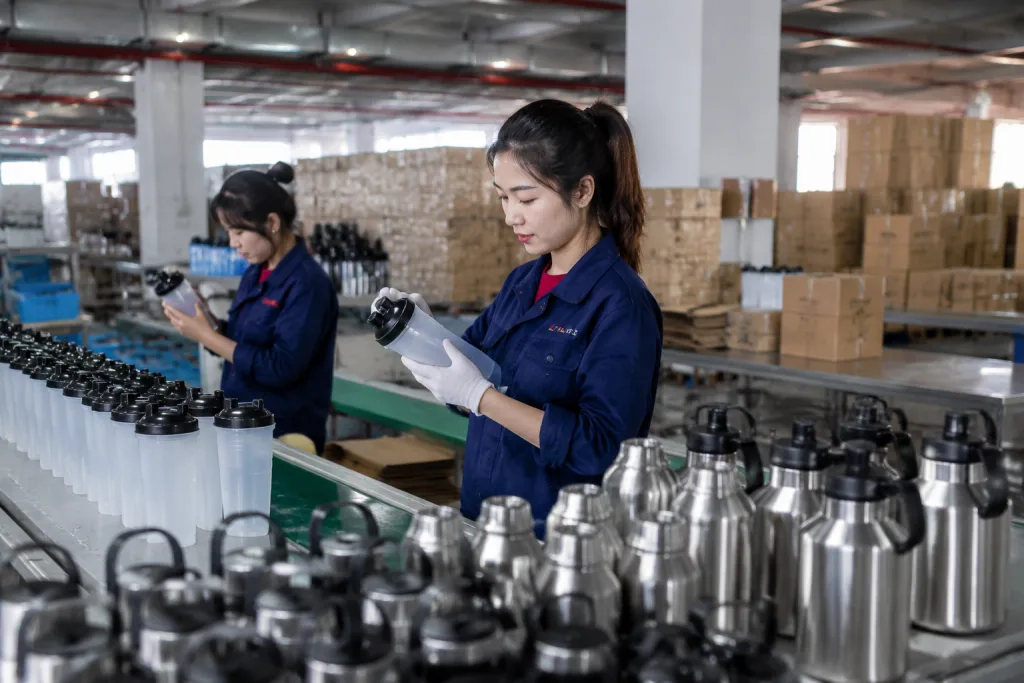
A supplier directory protein shaker search looks simple until every listing claims OEM capacity, food-grade material, fast delivery, and factory pricing. Your job is to separate real production capability from trading-company copy. We check this on the floor with a 0.5 mm leak ring, mold code, and a QC report, because the math does not work if the supplier cannot hold the same spec after sample approval.
We manufacture drinkware in Hangzhou, Zhejiang, China, and we see the same procurement mistakes every month: buyers compare only the unit price, skip gasket testing, approve weak logo files, or ask for a canteen customized project without defining lid torque, carton drop standard, or AQL. QC pulled one sample with a 2 mm flash on the thread last week, and the buyer flagged it. The right supplier makes those details plain, not buried in sales talk.
Start With Directory Questions
I’ll keep the HTML structure intact and rewrite the prose to sound like an experienced export sales engineer, with tighter factory-floor detail and cleaner buyer questions.When you search a supplier directory protein shaker listing, do not open with “What is your best price?” That line usually gets you a low number with half the terms missing. Start with a short qualification check. Ask whether the supplier runs a canteen factory, canteen manufacturer, or export trader. A trader is not automatically a bad choice, but you need to know who owns resin buying, molding, assembly, inspection, and carton packing.
For a protein shaker, ask the basic spec first: PP or Tritan body, stainless mixing ball or plastic grid, screw cap or flip lid, ml and oz markings, dishwasher temperature claim, and whether the gasket comes out for cleaning. If the listing also shows canteen custom, custom growler, or customizable drinkware, ask which items are made on site and which ones are outsourced. We’ve seen a 12-item catalog where only 3 molds were theirs. The rest was brokered.
- Factory identity: business license name, export license, factory address in China, and audit reports such as BSCI or ISO 9001.
- Capacity: injection machines, assembly lines, monthly output, and peak-season schedule.
- Quality system: incoming resin check, leak test percentage, AQL level, and retained samples.
- Commercial terms: MOQ, sample cost, mold fee, FOB port, payment terms, and lead time.
At BottleForge Industrial in Zhejiang, we run about 600,000 units/month across standard drinkware programs on the shaker and canteen line. For most distributor drinkware orders, the math is simple: MOQ starts at 3,000 pcs per color for custom color and 1,000 pcs for stock color with logo print. QC pulled the sample at 2.5 bar and the cap held, so we ship with that number.
What Should A Shaker Cost
I’ll keep the HTML structure exactly as-is and rewrite the prose to sound like a real sales engineer, with tighter numbers and a few factory-floor details.Protein shaker pricing swings more than most buyers expect. A 600 ml PP shaker with single-color silkscreen sits around USD 1.10-1.80 FOB Ningbo or Shanghai at 3,000-5,000 pcs, but that number moves with lid design, resin grade, carton count, and whether QC asks for AQL 2.5 on the first lot. A Tritan body with locking lid, silicone gasket, measurement scale, and stainless mixing ball usually lands in the USD 2.40-4.20 range. Add a powder compartment or pill box and the line slows down; you get more parts, more hand assembly, and more chances for a cap to come back with a bad snap fit.
Do not compare a low quote from one canteen vendor with a detailed quote from another canteen supplier unless the spec sheet matches line by line. Wall thickness is the first thing we check with calipers. A 1.8 mm body feels different from 2.3 mm, and a thin lid thread may survive 100 uses but fail inside an e-commerce return window. We’ve seen the buyer flag a leak on a PO typo alone, and we’ve seen that same issue turn into a chargeback. If you are buying for gyms, supplement brands, or promotional distributors, the math does not work in favor of saving USD 0.08 per unit.
Ask suppliers to quote the same spec sheet, not the same product name. “Protein shaker” is not a specification.
For canteen promotional projects, decoration changes the number too. One-color silkscreen is cheaper than full-wrap heat transfer, and laser engraving works on stainless steel better than plastic. For a customized growler or custom canteen, powder coating thickness, stainless grade, and vacuum testing on the line matter more than logo size. QC pulled a sample once where the coating hit 85 μm instead of the target 70 μm, and the buyer pushed back hard; that kind of gap shows up in the quote right away.
Checklist Before You Approve Samples
I’ll rewrite the section in-place, keep the HTML intact, and tighten the language so it sounds like a factory-side sales engineer wrote it.A sample sign-off should feel dull. That is the goal. You want to catch trouble before mass production, not after 1,000 cartons are on the water. For any supplier directory protein shaker candidate, ask for two samples: a stock mold sample for material and function, and a pre-production sample with your color and logo. If the order is urgent, do not skip the pre-production sample. We’ve seen that shortcut blow up a 5,000-piece PO.
Sample checklist
- Confirm the actual volume by filling to the printed ml line, then again to the brim.
- Shake for 60 seconds with water, protein powder, and the mixing insert installed.
- Invert for 30 minutes and check the gasket, cap, and spout for leaks.
- Open and close the lid 100 cycles to check thread wear and hinge stress.
- Check odor after 24 hours sealed at room temperature.
- Compare logo size, Pantone color, and print position against the artwork proof.
For canteen customizable and customizable canteen projects, add a handling test. A bottle can look fine on the QC table and still feel wrong in a bike cage, gym bag, or outdoor retail set. For distributor growler and customized growler orders, check filled weight, cap grip, and pour control. A 64 oz stainless growler with a narrow handle can pass an empty check and fail once it is full.
Typical sample timing from Zhejiang, China is 3-5 days for stock samples and 7-10 days for logo or color samples after artwork confirmation. If a canteen manufacturer promises a complex customized drinkware sample in 48 hours, ask what is already made and what is only a mock-up. The math does not work.
Materials, Compliance, And Claims
I’ll keep the tags exactly as-is and rewrite the prose to sound like a real sales engineer, with tighter claim language and a few factory-floor specifics.Your compliance file changes with the market. For Europe, ask for LFGB, REACH, and a food-contact declaration. For the United States, ask for FDA food-contact material statements and, if the product touches that line, a Prop 65 risk review. For kids drinkware, ASTM and CPSIA can come up fast. For stainless custom drinkware, confirm 304 stainless steel on the food-contact surface unless your spec says something else. For plastic shakers, pin down PP, Tritan, silicone, and the color masterbatch source.
Watch the claim sheet. “BPA free” is not a test report. “Dishwasher safe” needs a stated temperature and cycle count. “Leakproof” should tie to a method, such as inverted hold time, pressure simulation, or a drop test. The buyer flagged this on a 500 ml shaker order before, and the math does not work if the wording is loose. For canteen manufacturers and canteen vendors, the sharper supplier will ask for the claim basis before they accept the wording.
At our Hangzhou facility in Zhejiang, incoming resin gets batch paperwork checked at the hopper, and QC keeps a retained sample for each PO. On mass production, we run AQL 2.5 for major defects and AQL 4.0 for minor defects unless the buyer sets a tighter limit. Leak testing can run 100% on lids and assembled units when the design calls for it, but that needs to be locked before PI sign-off.
If you sell as a canteen distributor across several markets, do not assume one report covers every SKU, color, and lid. A new pigment, coating, gasket, or straw can change the file. We have seen that go sideways on a 2 mm gasket change, and the new sample failed the original declaration set.
Branding Choices That Survive Use
I’ll rewrite the section in-place, keep the HTML tags intact, and make the copy sound like a real sales engineer wrote it.Logo decoration is where a lot of custom drinkware jobs go sideways. Buyers send a low-res JPG, the supplier throws back a rough proof, and everybody acts like it will still look retail-ready. Don’t do that. Send vector artwork in AI, EPS, or PDF, lock the Pantone codes, and ask for a print-area drawing. If the order needs retail consistency, approve a physical logo sample. A screen mockup is not enough.
For protein shakers and custom canteen products, silkscreen works for simple logos on flat or lightly curved surfaces. Heat transfer handles gradients better, but it adds cost and more process control on the line. UV print can look sharp, yet adhesion depends on surface treatment and the plastic resin. Laser engraving fits stainless steel items such as customized canteen, custom growler, and customizable growler programs. We run into this a lot: powder-coated stainless needs the right laser power, or the mark looks pale; too deep, and you expose ugly metal texture.
For canteen promotional orders, ask how the supplier controls print registration and curing time. A logo that survives a finger rub at the factory can still fail after dishwasher exposure if the ink and surface prep are off. We usually call for a tape test, alcohol rub test, and cross-hatch adhesion check on higher-value orders. QC pulled the sample on a 2,000-piece shaker run last month and caught a weak edge before packing. For large distributor canteen programs, add a golden sample signed by both sides and held at the factory until shipment closes.
The artwork flow should stay simple: dieline, proof, pre-production sample, signed approval, mass production, inline check, final inspection. If a canteen supplier skips steps to save 3 days, you can burn 3 weeks on claims later. We’ve seen that math fail more than once.
Factory Or Trading Partner
I’ll rewrite the section in-place, keeping the HTML structure and tightening the sales tone while preserving the original meaning.There is no prize for buying only from a factory. Some trading companies work fine when you need mixed cartons, several categories, or a 200-piece trial run. But if you are building a repeat supplier directory protein shaker program, you should know whether your partner can control the line. A real canteen factory can talk through machine count, mold ownership, assembly flow, defect history, and packing capacity without hand-waving.
Ask for photos or video from the actual production line with today’s date, not just catalog shots. We had a buyer flag a PO typo on carton marks once, and QC pulled the sample before the line ran, which saved a 1,200-carton mess. Ask for the drop test method, packing spec, and pallet loading plan. If you ship to Amazon FBA, check whether the supplier applies FNSKU labels, carton labels, and suffocation warnings on the right 38 x 25 x 25 cm master carton. If you sell to retail chains, make sure they can place barcodes, print inner boxes, and mark cartons exactly as your routing guide says.
For distributor drinkware, mixed-SKU consolidation can matter more than a low unit price. A canteen vendor shaving USD 0.05 off the shaker but forcing three separate bookings can cost more in the end, and that math does not work. We’ve seen a buyer lose 12 days because the supplier could not load a custom canteen, sports bottle, and travel tumbler under one export schedule. In China, export coordination is part of the product. FOB Ningbo, FOB Shanghai, and EXW Hangzhou are not the same number on paper because inland freight, customs handling, and loading responsibility change.
Our view is simple: use a factory when you need technical control; use a sourcing partner only when they bring inspection, consolidation, or category management you cannot get direct. Otherwise, you are paying for another layer and still chasing the line.
Purchase Order Terms To Lock
I’ll keep the HTML structure intact and rewrite the prose to sound like a factory-side sales engineer, with concrete PO details and fewer generic phrases.Before you pay a deposit, make the PO painfully specific. Put the product code, capacity, material, color, logo method, logo size in mm, packaging, carton quantity, inspection standard, shipping term, and latest shipment date on the same page. For a canteen custom order, add the approved sample reference number and the exact artwork file version. For a drinkware program with 4 SKUs, attach a line-by-line matrix so the line does not guess which lid fits which body.
For new buyers, we usually see 30% deposit and 70% balance before shipment after inspection. A big account may push for OA or LC later, but that is not the first-order game. Standard custom drinkware runs 30-45 days after deposit and sample sign-off. Private mold work adds 25-45 days for tooling, trial shots, and final sample approval. The math does not work any other way.
Your PO should say what happens if inspection fails. Use AQL language and name who pays for reinspection. If major defects go over AQL 2.5, the supplier reworks the goods and covers the reinspection fee. If you changed artwork after approval, that cost stays with the buyer. On one run, QC pulled the sample at 6.2 kg carton weight and the buyer flagged a typo on the PO; that sort of miss is why we lock the terms early.
For canteen distributors and distributor growler buyers, ask for updates at three points: material arrival, first mass-production units, and packing start. No one needs daily chatter. You need proof the order is moving before the vessel booking deadline hits. We ship better when the buyer asks for one photo from the line, not a long chain of emails.
Send Your Shaker Spec For A Factory Quote
Share capacity, material, logo method, MOQ target, and market. We will return a practical FOB quote and production timeline.
Frequently asked questions
How do I know if a supplier directory protein shaker listing is a real factory?
Ask for the business license, factory address, export license name, and a short video showing injection molding, assembly, and packing with your company name or date on paper. A real canteen manufacturer should know its machine tonnage, monthly capacity, and current production schedule. For example, a factory quoting 500,000 units/month should explain how many lines support that number and whether it includes shakers, custom canteen items, and other drinkware. Also compare the PI bank account name with the business license. If every answer is delayed or generic, you may be dealing with a broker who has little control over production.
What MOQ should I expect for custom protein shakers?
For stock color protein shakers with one-color logo, 1,000 pcs is often workable. For custom Pantone body or lid color, 3,000 pcs per color is more realistic because resin mixing, machine setup, and color cleaning create waste. For a private mold, expect 5,000-10,000 pcs per first order plus tooling cost. Canteen customizable and customized drinkware projects follow the same logic: the more you change color, mold, lid, and packaging, the higher the MOQ. If a supplier accepts 200 pcs with full customization, check whether they are using existing inventory and hand decoration rather than real mass production.
Which is better for protein shakers, PP or Tritan?
PP is cheaper, lighter, and common for promotional and gym-channel shakers. It works well when the target FOB price is around USD 1.10-1.80 and the order is 3,000 pcs or more. Tritan usually looks clearer, feels more premium, and resists odor better, but the price can rise to USD 2.40-4.20 depending on lid and accessories. If your brand sells supplements at retail, Tritan may support a better shelf impression. If you are a canteen promotional buyer or distributor canteen program focused on volume, PP may be the practical choice. In both cases, test gasket fit and lid threading before approving mass production.
Can one supplier handle shakers, canteens, and growlers together?
Yes, but check what is made in-house. A supplier may manufacture plastic shakers but outsource stainless custom growler or customized canteen production. That can still work if they manage inspection and export consolidation properly. Ask for separate specifications, factory origin, test reports, and lead times by SKU. A combined distributor drinkware order may have 30 days for plastic shakers and 45 days for powder coated stainless growlers. If you need one shipment, the slowest item controls the schedule. Also confirm carton labeling, pallet dimensions, and whether the supplier can pack by SKU or by mixed retail set.
What inspection standard should I put on the purchase order?
Use AQL terms instead of vague wording like “good quality.” A common starting point is AQL 2.5 for major defects and AQL 4.0 for minor defects, with critical defects not allowed. Define major defects clearly: leakage, broken lid, wrong material, wrong logo, strong odor, sharp edge, or incorrect capacity marking. For protein shakers, add a leak test and lid function check. For custom drinkware, include decoration adhesion and carton drop requirements. If the order is over 10,000 pcs or goes to retail, a third-party pre-shipment inspection is worth the cost, usually a few hundred USD compared with a container of unsellable goods.