Key Takeaways
- A realistic MOQ for a custom canteen is 1,000-3,000 units per color depending on coating and logo method
- 304 stainless steel at 0.5-0.6 mm wall thickness is a practical baseline for most military-style canteens
- Plan 7-10 days for sampling and 30-45 days for mass production after deposit and artwork approval
- Use AQL 2.5 for major defects and AQL 4.0 for minor defects before releasing final balance
A supplier directory military canteen listing is only the starting point. The real job is turning a loose sketch into 3,000 pcs that pass AQL 2.5, protect your margin, and do not make your brand look cheap when QC cuts open the first carton with a 9 mm blade.
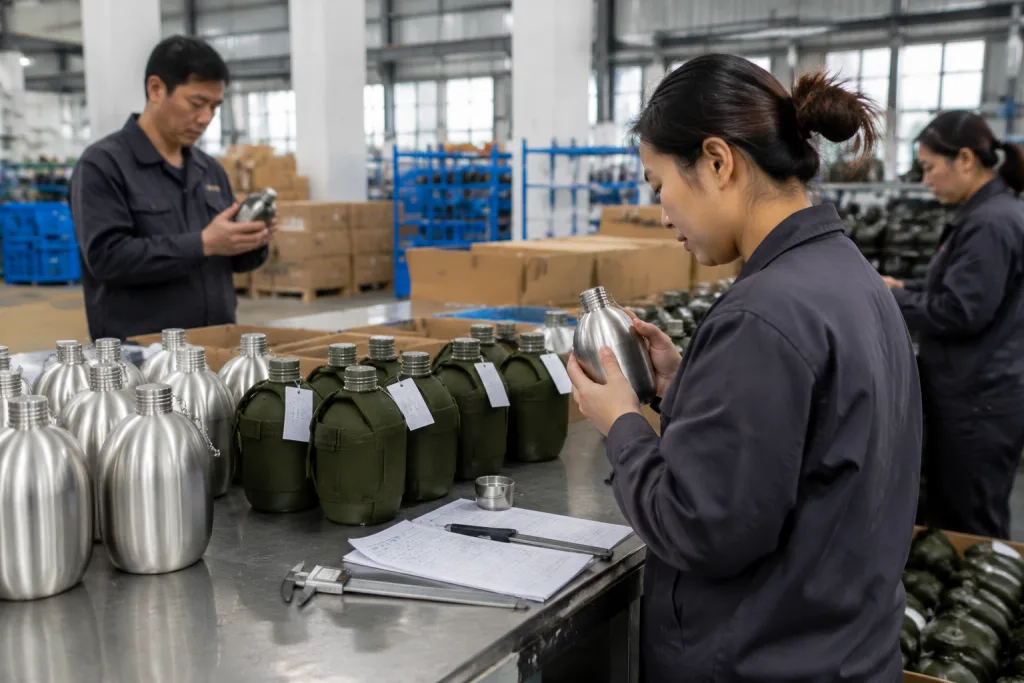
Here is a realistic order we run: a 750 ml stainless steel military-style canteen for a European outdoor distributor. The buyer asks for canteen custom branding, matte olive powder coating, screw cap, retail box, and REACH-ready materials. We write this from Hangzhou, Zhejiang, where we have seen projects go sideways over 304 stainless thickness at 0.5 mm vs 0.6 mm, powder coating cross-hatch failure, cap torque set 2 kgf·cm too loose, weak 5-layer cartons, and a factory name on the PO that does not match the line making the goods.
Start With The Use Case
The buyer scenario is simple: you are a canteen distributor supplying outdoor shops, cadet programs, and promo buyers. Your customer wants a military look, not a military-certified item. Big difference. A defense tender can ask for NATO stock references, IR signature controls, 1.2 m drop tests, and field paperwork that our normal export line will not include. A commercial military-style canteen needs safe materials, strong seam forming, coating that passes a cross-cut tape test, and logo placement we can repeat within 1.5 mm. Last month QC pulled the sample because the olive coating looked fine under office light but shifted too brown under the D65 light box.
Before you contact a canteen supplier, write the order brief in buyer language, not catalog language. For this order, the target is a 750 ml single-wall stainless canteen, kidney-shaped body, 304 stainless interior and exterior, matte olive powder coating, black PP cap with silicone seal, and a woven carry strap. Retail price target is USD 14.99-19.99, so the FOB China target must sit roughly between USD 3.20 and USD 4.80 depending on packaging. The wrong question is “what is your cheapest canteen?” We run the costing from steel thickness, cap set, coating loss, carton spec, and packing speed; a 0.6 mm body and a 0.5 mm body do not behave the same on the polishing wheel.
A supplier directory military canteen search will show canteen manufacturers, canteen vendors, and trading companies mixed together. Do not shortlist by the lowest visible price alone. Ask whether the quoted model is existing tooling, what the mold number is, and whether the factory has produced the same body shape within the last 90 days. Existing tooling usually keeps sample cost around USD 80-150 per logo version. New tooling can add USD 1,200-3,500 and 20-30 days. We have seen this go sideways when a buyer approved “same shape” from photos, then the PO had one digit wrong in the mold code and the strap lug came out 4 mm lower than the reference sample.
Turn Ideas Into A Spec Sheet
A custom canteen project needs a locked spec sheet before the line talks capacity, tooling, or lead time. If the RFQ says only “custom canteen, army green, logo printed,” the prices will not line up. We have seen 28 quotes like this in one month. One factory quotes 201 stainless steel at 0.4 mm because it keeps the FOB low; another quotes 304 stainless steel at 0.6 mm because the buyer asked for food-contact confidence. On a PDF, both look the same. QC only catches the gap when the caliper hits the body wall.
For this canteen, we would write the spec as 304 stainless steel with 0.5-0.6 mm wall thickness checked at body, shoulder, and base; 750 ml nominal capacity filled to the neck line; leakproof screw cap tested upside down for 30 minutes; food-contact silicone gasket with no odor after hot-water soak; powder coating thickness of 60-80 microns checked by coating gauge; logo size of 45 mm by 35 mm with exact placement from the bottom seam. If the order is for promotion, silkscreen keeps the math clean at USD 0.08-0.18 per position. Laser engraving looks cleaner and survives rough handling better, often USD 0.20-0.45 per position depending on area and coating. The wrong question is “which logo process is best.” Ask where the canteen will be used and how long the campaign has to last.
Packaging changes the quote fast. A plain white box may cost USD 0.12-0.20. A printed retail box with E-flute insert may cost USD 0.35-0.65. For North American distributor drinkware orders, an Amazon-ready carton usually needs FNSKU labeling, a carton gauge that can pass drop testing, and carton weight below 15 kg so the warehouse does not push back. We normally ask the buyer to approve artwork dielines before sample production in China; last season, QC pulled a sample where the PO spelled “canteen” correctly but the box dieline had “cantten,” and that tiny typo held the retail pack for 7 days.
Shortlist The Right Supplier Type
Directories help at the first filter, but they often mix up canteen factories with trading vendors and stock distributors. A real factory controls forming, welding, leak testing, coating, and final assembly in its own plant or with subcontractors we see on a fixed production schedule. A vendor might pull 6 models from 4 small workshops and send one blended quote. A distributor is fine for a 300-piece mixed carton order, but the math doesn't work when you need canteen customized production with the same cap torque, Pantone color, and kraft box layout every quarter. We have seen this go sideways when QC pulled the sample and found a 1.8 mm strap pin on the approval sample, then a 1.5 mm pin in bulk.
For a 3,000-unit first order, ask each canteen supplier for the business license name, clear photos from the exact workshop with today's line setup, and one recent inspection report for a similar drinkware order. If they claim BSCI, ISO 9001, or a social audit, request the certificate number and validity date; we once had a buyer flag a certificate where the factory name missed one Chinese character from the PO. For the EU, ask for LFGB or REACH material declarations tied to the model and coating. For the US, ask whether materials can support FDA food-contact expectations and whether the coating can pass a 3M tape adhesion test after cross-hatch cutting.
At BottleForge Industrial in Zhejiang, our stainless drinkware capacity runs about 180,000 units per month across bottles, tumblers, canteens, and custom growler projects. Capacity is not a promise. One week the powder coating line may be booked with 42,000 matte-black bottles, while the canteen welding station still has room for 6,000 bodies on the rotary seam welder. A practical MOQ for canteen promotional orders is 1,000 units for an existing model and 3,000 units if you need a special color, new strap, and retail packaging with barcode labels. Good canteen suppliers in China tell you the bottleneck before deposit; bad ones say yes, then ask for 12 days more after the buyer has already approved the ship window.
Sample Like You Mean It
The sample stage is where buyers save money by spending a little money. For this canteen customized order, ask for two physical samples: one bare production sample to check body shape, cap fit, weld line, and surface finish; one full pre-production sample with coating, logo, strap, gasket, retail box, barcode, and carton mark. No photo-only approval. We’ve had buyers flag a cap that looked fine in pictures but jumped thread on the torque meter at 1.8 N·m, and photos will not show coating texture, edge burrs, or a weak E-flute box corner.
A fair sampling timeline from Zhejiang, China is 7-10 days for an existing canteen body with custom logo, plus 3-5 days for international courier. If powder coating color must be matched to a Pantone reference, add 3-7 days. Physical color chips beat screen images every time. For matte olive, small color drift is common between lab sample and mass production, so write the tolerance on the PO before the line starts. A Delta E below 2.0 is tight; Delta E 3.0-4.0 is more practical for 8 out of 10 powder-coated drinkware runs we ship, based on how the curing oven holds temperature across the rack.
Check the sample with a boring checklist. Fill it with water for 12 hours upside down. Shake it for 60 seconds. Measure capacity to the usable fill line, not just brim capacity; a 900 ml canteen that only takes 830 ml below the neck will start a price argument later. Rub the logo 50 times with a dry cloth and 20 times with a wet cloth. Inspect the cap thread for flashing, especially around the first 2 mm of entry. We run a cross-hatch adhesion test on the coating with 3M tape. Pretty is not approval. If your custom drinkware buyer accepts a sample without abuse testing, mass production will find the weakness for you.
Price The Order Honestly
I’ll rewrite the section in-place, keep the HTML tags intact, and tune the prose to sound like a factory sales engineer wrote it.FOB pricing for a military-style custom canteen comes down to steel grade, body weight, surface finish, cap design, logo method, packaging, and order quantity. For a 750 ml 304 stainless single-wall canteen, a realistic FOB Ningbo or Shanghai range is USD 3.20-4.80 at 3,000 units. At 1,000 units, expect USD 3.80-5.60 because the coating setup, artwork setup, and line changeover get spread over fewer pieces.
Do not line up a USD 2.10 quote against a USD 4.20 quote until you check the spec sheet. We’ve seen the cheap sample use 201 stainless steel, a thinner wall, spray paint instead of powder coating, a low-grade gasket, and bulk packing. QC pulled one last month with a 0.6 mm wall and a cap that failed the leak test after 12 flips. Fine for a one-off giveaway. Wrong for retail or a distributor program, and the buyer will flag it fast.
Payment terms are usually 30 percent deposit and 70 percent before shipment after inspection. For repeat distributor drinkware buyers, terms can improve after 2 or 3 clean orders. If you are mixing canteen, custom growler, and sports bottle SKUs in one container, ask for line-item pricing and carton dimensions by SKU. The math on freight moves fast; a 750 ml canteen in a retail box may pack 24 units per master carton, around 12-14 kg gross weight. That is manageable for warehouse handling and export cartons, and it keeps the line from getting hit with a carton-size typo on the PO.
Control Production Before QC
I’ll rewrite the section in place, keep the HTML exactly as-is, and tune the prose to sound like an experienced factory-side sales engineer.Quality control starts before the inspector walks in. Once the pre-production sample is signed off, lock the golden sample, artwork, BOM, packaging dieline, and carton mark. Send one signed sample to the canteen factory and keep one with your buying team. If the canteen manufacturer swaps a gasket, strap buckle, coating powder, or box material, get written approval first. We’ve seen one loose substitution turn into a chargeback over a 3 mm cap gap.
For this order, production lead time should be 30-45 days after deposit and final artwork approval. Week one covers material prep and coating scheduling. Weeks two and three cover forming, welding if needed, polishing, coating, and cap assembly. The last week covers logo application, leak testing, packaging, and internal QC. China holidays throw the schedule off fast. If the order starts two weeks before Chinese New Year, the math does not work unless raw material and line slots are already locked; we had a PO typo once that moved ship date by 12 days.
Ask for in-process photos, but do not call that QC. Good updates include steel coil or body inventory, coating line setup, the first 50 finished units, logo position, packed inner boxes, and master carton marks. A serious canteen vendor should send date-stamped photos and short videos. For larger orders above 10,000 units, we prefer inline inspection at 20-30 percent completion, because QC pulled the sample and caught logo angle, coating dust, and cap fit before 8,000 pieces were boxed.
Inspect Before Final Payment
I’ll rewrite the prose only, keep the HTML exactly as-is, and make it read like a field-tested supplier note with concrete inspection details.For a 3,000-unit canteen custom order, run the final random inspection only when production is 100 percent finished and at least 80 percent packed. We use ANSI/ASQ Z1.4 sampling with AQL 2.5 for major defects and AQL 4.0 for minor defects. Critical defects stay at zero. That means sharp edges, contamination, leaking caps, broken parts, or the wrong food-contact material.
Check quantity, assortment, workmanship, function, packaging, labeling, and basic reliability tests. Pull samples from several cartons, not just the top row. We look at capacity, weight, coating marks, logo placement, barcode scan, carton drop resistance, cap torque, gasket presence, odor, and leakproof performance. QC pulled a sample last month and found a 5 mm logo drift on the left side; the buyer flagged it before shipment, and that was the right call. A logo problem is not decoration trouble.
If the order fails, split the issues into fixable and non-fixable. Dust in the coating, the wrong logo color, or leaking caps may need sorting or replacement. Weak outer cartons can usually be repacked in 2-4 days. Wrong steel grade or the wrong body shape is not a quick fix. Do not release the 70 percent balance until the corrective action is verified. We’ve seen this go sideways when a buyer paid early and tried to chase the factory after the line had moved on. Good canteen manufacturers know the drill, and serious canteen distributors and canteen vendors should accept it too.
Send Your Canteen Spec Before You Shortlist Suppliers
Share capacity, material, logo, packaging, MOQ, and target market. We will respond with practical FOB options and production risks.
Frequently asked questions
How do I know if a supplier directory military canteen listing is a real factory?
Ask for the Chinese business license name, production address, and photos of the forming, polishing, coating, and packing areas. Then compare the license scope with the products offered. A real canteen factory should know wall thickness, steel grade, coating thickness, cap material, and monthly capacity without checking three times. You can also request a live video call from the workshop during working hours in China. For a first order above 3,000 units, a third-party factory audit is worth the USD 250-600 cost. If the supplier refuses all workshop proof and only sends catalog pages, treat them as a trading canteen vendor, not necessarily a manufacturer.
What MOQ should I expect for a canteen custom order?
For an existing stainless steel canteen body, 1,000 units per color is a normal starting MOQ. If you need a custom powder-coated color, woven strap, retail box, and logo, 3,000 units is more realistic. New mold development usually starts around 5,000-10,000 units because tooling and testing costs must be recovered. For mixed distributor drinkware orders, some suppliers in Zhejiang can combine canteen, travel tumbler, and customizable growler SKUs in one shipment, but each SKU still has its own setup minimum. Below 500 units, expect higher pricing, limited decoration options, or stock-body solutions only.
Is 304 stainless steel necessary for a military-style canteen?
For retail and outdoor use, 304 stainless steel is the safer default. It has better corrosion resistance than 201 stainless steel, especially when users fill the canteen with electrolyte drinks, tea, or acidic beverages. A 0.5-0.6 mm wall thickness is a practical balance between durability and weight for a 750 ml canteen. 201 stainless can reduce FOB cost by roughly USD 0.20-0.50 per unit, but it increases complaint risk in humid markets. If your product is a short-term canteen promotional giveaway, 201 may be acceptable if labeled honestly. For long-term brand programs, use 304.
Which logo method works best for customized canteen orders?
For powder-coated stainless canteens, laser engraving is the most durable because it removes the coating and exposes the metal underneath. It usually costs USD 0.20-0.45 per position depending on size. Silkscreen is cheaper at about USD 0.08-0.18, but it can scratch if the ink and curing are poor. Heat transfer allows more colors but needs careful adhesion testing. For a military-style custom canteen, many buyers choose one-color print or laser engraving because the look is cleaner. Always approve a physical logo sample and run a 3M tape test, wet rub test, and visual check at 30 cm distance.
Can one supplier handle canteen, custom growler, and other custom drinkware?
Yes, but only if the supplier has a stable drinkware supply chain rather than one narrow workshop. A capable China canteen manufacturer may also run stainless bottles, travel tumblers, and customized growler orders, but the production lines and molds are different. Ask for SKU-level capacity, not just total capacity. For example, a factory may produce 180,000 drinkware units per month but only allocate 20,000 units to canteens because coating fixtures and body tooling are limited. If you are a distributor growler or distributor canteen buyer, combining SKUs can reduce export paperwork and freight handling, but QC must still be performed by SKU.