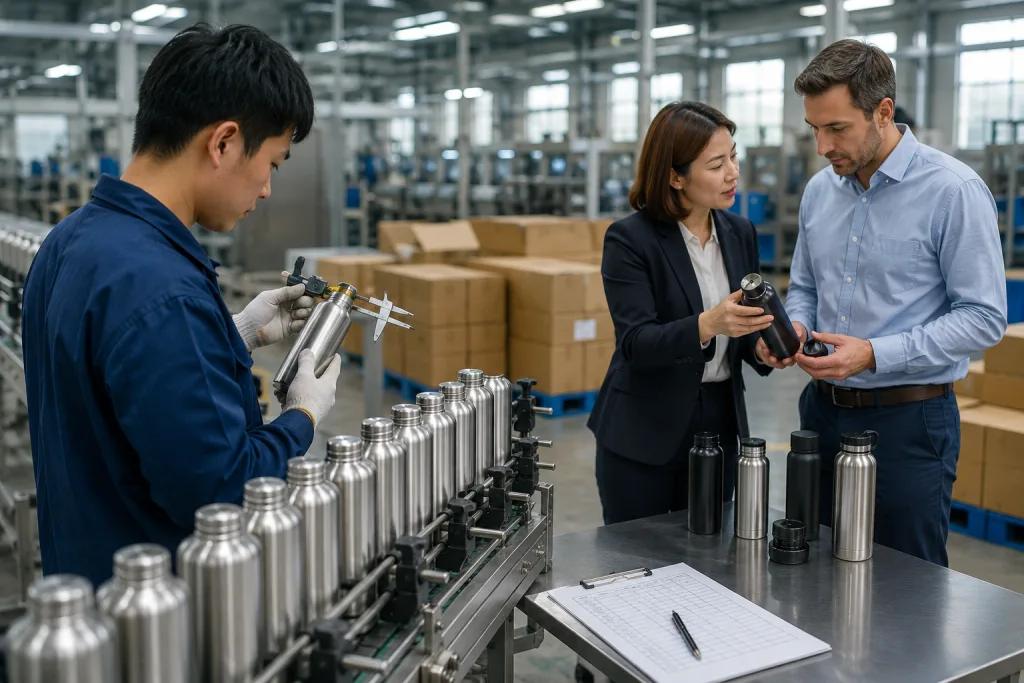
Key Takeaways
- For a new 750 ml stainless flask, expect MOQ around 1,000-3,000 pcs per color
- A proper pre-production sample normally takes 7-10 days after artwork confirmation
- Use AQL 2.5 for major defects and AQL 4.0 for minor defects on mass production
- FOB Ningbo or Shanghai lead time is usually 30-45 days after deposit and sample approval
You pull up three factories in a supplier directory hydration flask search. All three say 304 stainless steel, custom logo, fast delivery, and export experience. That does not solve the real issue. The hard part is telling a real canteen factory from a trading page that cannot control polishing, vacuum rate, coating adhesion, or carton drop tests. On our line, a 0.2 mm scratch gets flagged before packing.
Here is a normal order: 3,000 pcs of a 750 ml vacuum hydration flask for a European outdoor distributor. BottleForge Industrial sits in Hangzhou, Zhejiang, and this is the same checklist our export team uses before we quote. MOQ is 3,000 pcs, not a vague “flexible” promise. If you buy custom drinkware for retail, promotion, or distributor canteen programs, this is the path that usually holds up.
Start with the real order
I’ll rewrite the section in-place, keep the HTML structure intact, and strip the AI-ish phrasing while making it sound like a factory-side sales engineer.A buyer named Martin, procurement manager for a mid-sized outdoor distributor in Germany, sends an RFQ that looks simple: 3,000 pcs, 750 ml stainless hydration flask, powder coated, logo on one side, packed in individual kraft boxes. He found us through a supplier directory hydration flask listing and also contacted four canteen suppliers from Zhejiang and Guangdong. Normal starting point. We see this every week.
The first useful reply should not be a price only. If a canteen vendor quotes USD 2.10 without asking about steel grade, lid type, coating, carton drop test, or compliance market, the math does not work. We had one buyer flag a PO typo on the carton count and the shipment still went into a 2-day hold. For this order, we ask for these baseline details before pricing:
- Body: double-wall vacuum stainless steel, 304 inner and 201 or 304 outer.
- Capacity: 750 ml actual fill, not nominal mold size only.
- Wall thickness: typically 0.40 mm inner and 0.50 mm outer for a solid retail flask.
- Finish: matte powder coating with 3H pencil hardness target.
- Logo: one-color silkscreen, laser engraving, or UV print.
- Compliance: LFGB, REACH, and food-contact migration report for EU; FDA or CPSIA if relevant for North America.
At our Hangzhou, Zhejiang facility, a standard hydration flask line can run about 450,000 units/month across multiple models, but capacity means little unless the order is specified tightly. QC pulled the sample with a 0.8 mm lid gap and the buyer rejected it on sight. A canteen factory with machines but weak documentation will still create late-stage arguments. Get the spec locked before the deposit lands.
Turn directory listings into a shortlist
I’ll tighten the prose, keep the HTML exactly as-is, and make it sound like a factory-side sales engineer wrote it. Then I’ll return only the rewritten HTML.A supplier directory helps, but it is not a quality system. Treat every profile as a lead, not proof. A real canteen factory should answer technical questions in writing and show the same documents twice, not a polished PDF once. For a first custom canteen order, I would cut the list to 3 suppliers after the first RFQ round. Any more and the comparison turns into noise.
Ask each canteen supplier for a business license, export record, BSCI or Sedex audit if they have one, and a recent test report from the same material family. Do not use a 5-year-old report for a plastic lunch box as proof for stainless custom drinkware. If you are buying for Europe, REACH and LFGB matter. For a U.S. promo job, check FDA food-contact statements and California Proposition 65 risk if your distributor asks for it. QC pulled a sample on our line last month and found a lid gasket issue in 2 of 20 pieces; that is the kind of detail a real report should help you catch.
Price needs a clean basis. We quote FOB Ningbo or FOB Shanghai most often from Zhejiang, China. For Martin’s 3,000 pcs order, the gap between FOB and EXW looked small on paper, but EXW pushed trucking, customs declaration, and export handling onto the buyer. The math does not work if you compare EXW from one canteen vendor against FOB from another and call it a saving. We have seen that go sideways more than once.
My practical rule: if a supplier cannot give carton dimensions, gross weight, HS code, and lead time with the first serious quotation, they are not ready for distributor drinkware business.
For a 750 ml flask, a normal export carton might hold 24 pcs, measure about 49 x 33 x 52 cm, and weigh 12-14 kg depending on lid and box. Those numbers let you estimate sea freight, warehouse receiving, and pallet count before you place the order. One PO typo on a carton mark can cost a day at the dock, so we check those figures twice.
Lock the flask specification sheet
I’ll rewrite the HTML in-place, keep the tag structure exactly, and tighten the prose so it sounds like a factory-side sales engineer wrote it.Once Martin locks the model, we issue a spec sheet before sample making. This is not admin fluff. It keeps a custom canteen order from drifting between the sales desk and the line. One approved sheet should cover the drawing, key dimensions, material callouts, finish, logo placement, packing, barcode, and inspection limits.
For this sample order, the sheet reads: 750 ml double-wall vacuum flask, 304 stainless steel inner wall, 304 stainless steel outer wall, PP lid with silicone gasket, powder-coated body, one-color logo 55 x 38 mm on the front center, individual kraft box with EAN sticker, 24 pcs per master carton. Retention target: above 60°C after 6 hours with 95°C water at room temperature 20°C ± 2°C. Leak test: 100% inline water inversion test for 30 seconds. QC pulled the sample on the first run and checked the logo offset with a caliper.
For a customizable canteen line, decide this early: only the logo changes, or the lid, handle, box, sleeve, and color change too. This is the wrong question to ask at the end. A promo order can live with a stock lid and a plain print. A retail bottle for outdoor shelves usually needs a molded carry loop, hang tag, care sheet, and carton art that matches the body color. We’ve seen that split go sideways when the buyer flags it after pre-production.
On stainless bodies, 304/304 costs more than 304/201. On a 750 ml flask, the gap is about USD 0.18-0.35 per unit, depending on steel price and MOQ. I do not sign off on a 201 inner wall for food-contact drinkware. It saves pennies and invites corrosion claims later. If a quote comes in far below market, check the steel grade first. That’s where the math breaks.
Sample approval is not decoration
I’ll rewrite the section in-place, keep the HTML structure unchanged, and tighten the prose so it reads like a factory-side sales engineer wrote it.For Martin’s order, the pre-production sample takes 8 days after deposit, once sample cost and artwork are confirmed. We run two physical samples: one stays at the factory, one goes to the buyer. If the buyer asks for Pantone matching, we print color panels first because powder coating shifts a bit after curing. On most jobs, Delta E 1.5-2.0 is a workable tolerance if measured, though a lot of brands still sign off by eye under D65 lighting. QC pulled the panel twice on one run because the first batch sat 0.8 mm off the card edge.
Logo method changes cost and risk. Silkscreen fits one- or two-color artwork and usually adds USD 0.05-0.12 per unit. Laser engraving holds up on powder coat and usually lands at USD 0.08-0.18 per unit, depending on size. UV printing handles gradients, but it needs better abrasion testing. For a distributor growler or custom growler with a large wrap design, we would push rotary printing or heat transfer instead of pretending every logo method works for every artwork. That’s the wrong question to ask.
The sample approval checklist should cover capacity by water fill, lid fit, gasket removal, smell after hot water rinse, coating feel, logo position, box strength, barcode scan, and cap torque. We’ve seen orders go sideways on small misses: a logo 8 mm too low, a care label in the wrong language, a barcode printed across the carton seam, or a lid strap color that missed the approved photo. One PO typo on a carton spec can turn into a full rework at the line.
Do not approve samples by photo only for a first order with a new canteen factory. DHL, FedEx, or UPS sample shipping from China to Europe or North America usually takes 3-5 working days. That freight bill is cheap compared with finding a coating texture problem after 3,000 pcs are packed. We ship samples for a reason.
Mass production control points
I’ll rewrite the HTML in place, keep the tags untouched, and tighten the prose so it reads like a factory-side buyer note with concrete production details.After sample approval, mass production starts with material prep, body forming, welding, vacuuming, polishing, coating, logo application, assembly, leak testing, and packing. For a 3,000 pcs order, our normal lead time is 30-35 days after approved sample and 30% deposit, with no custom mold and standard color stock on hand. Bigger distributor drinkware programs or mixed-SKU canteen distributor orders often need 45-60 days. We run the line with a fixed daily target, and the buyer usually asks for speed before the carton count is stable. The math does not work.
The vacuum process is the heart of a hydration flask. A good canteen manufacturer tracks vacuum yield and pulls weak insulation units before packing. For this order, we run thermal sampling during production and 100% leak testing after assembly with a water tank and pressure hold check. Vacuum failure does not always show up on the shell. A bottle can look clean and still lose heat in hours. That is why thermal testing belongs in the control plan, not in the sales sheet.
Coating is the second common failure area. Powder coating needs controlled pre-treatment, curing temperature, and handling. We check adhesion with cross-cut tape testing based on ISO 2409 practice, plus rubbing or scratch checks to the buyer’s spec. On one canteen promotional order, the buyer wanted a softer finish to save cost on a giveaway SKU. We pushed back. A 0.2 mm paint lift at the rim turns into a brand complaint fast, and QC pulled the sample for a second check before the line kept moving.
During production, ask for inline photos, daily quantity reports, and first-packed-carton approval. If FNSKU labels are required for Amazon or 3PL routing, confirm label size and scanability before the first 200 cartons are packed. We once saw a PO typo on the FNSKU suffix, and that kind of mistake turns into relabeling in the U.S. warehouse. Re-labeling in China is annoying. Re-labeling in the U.S. costs real money.
Inspection before the balance payment
I’ll rewrite the section in place, keeping the HTML tags and structure intact while making the prose sound like a factory-side sales engineer wrote it.For this order, final inspection runs when the goods are 100% finished and at least 80% packed. That is the point for a third-party inspector or your own QA agent to pull random cartons under AQL. We usually lock in AQL 2.5 for major defects and AQL 4.0 for minor defects, with critical defects rejected outright. If the lot size is 3,000 pcs and General Inspection Level II is used, the sample size is usually 200 pcs under ANSI/ASQ Z1.4 or ISO 2859-1 tables. QC pulled the sample from 12 cartons on the line, and that simple check saves trouble later.
Major defects include leakage, poor vacuum performance, sharp edges, incorrect logo, wrong color, broken lids, missing gaskets, unreadable barcode, and wrong material marking. Minor defects include small dust points, slight logo blur within agreed tolerance, tiny carton scuffs, or a very small coating speck outside the main viewing area. Set these callouts before inspection. If you wait until the inspector is onsite, the buyer flagged it, and then everyone starts arguing over what counts.
For a canteen distributor or distributor canteen program, carton marking matters more than many buyers expect. Warehouse teams need SKU, PO number, quantity, gross weight, net weight, country of origin, carton number, and any routing labels. We once saw a PO typo on the carton mark: `CNTN` instead of `CANTEEN`, and the warehouse held the whole batch for 2 days. If you sell through multiple canteen distributors, do not let one generic carton mark cover every account unless the warehouse has signed off.
Balance payment should be tied to passed inspection and shipping document confirmation. Standard payment for a new buyer is often 30% deposit and 70% before shipment. For established buyers with stable order volume, terms can be discussed, but no serious canteen vendor in China will ship open account on a first custom order without credit support. The math does not work, and we have seen that go sideways on a 20,000 pcs flask order when documents were still under review.
Shipping, reorder, and supplier fit
I’ve got the section and the constraints. Next I’m rewriting the prose in-place, keeping every tag and the heading structure intact, while making it sound like a factory-side sales engineer wrote it.Once inspection passes, we book from Ningbo or Shanghai. For 3,000 pcs of 750 ml flasks, LCL sea freight is the usual move unless you can fill a cleaner container with other SKUs. Air freight only works for launch rescue quantities; we have seen freight bill out above the goods value on a small rush order. If the campaign date is fixed, count backward on paper: 8 days for samples, 3-5 days for sample transit, 3 days for approval, 35 days for production, 7 days for inspection and booking, then ocean transit and customs clearance.
A supplier directory hydration flask match is not the factory with the lowest first quote. It is the canteen maker that can repeat the approved bottle six months later without the buyer flagging a color shift. Reorder control means the same powder code, lid material, gasket hardness, logo file, carton layout, and test standard. BottleForge keeps the approved production file and golden sample for repeat customized drinkware orders; one distributor told us their program moved from 1 color to 3 colors after the first sell-through report, and that is where sloppy control starts to hurt.
If you plan to extend the line into a customizable growler, customized growler, or custom growler, ask about shared parts early. A 1.2 L growler using the same lid family as the 750 ml flask cuts spare-part mix-ups, and the MOQ math is cleaner. We run multiple custom canteen and distributor growler SKUs with shared lids and cartons, and the handling plus inventory load usually drops 3-6%. The buyer asked for separate cartons once; QC pulled the sample and the box codes were off by one digit, so we fixed it before the line moved.
The best buyer-supplier relationship is boring in the right way: written specs, realistic lead times, clear QC, passed inspections, and no surprise substitutions. That is the standard you should ask for from any canteen factory in Zhejiang, China, or anywhere else you source.
Send your flask spec and target landed cost
We will review material, MOQ, logo method, packing, and lead time before quoting FOB China for your next custom drinkware order.
Frequently asked questions
What MOQ should I expect for a custom hydration flask?
For a standard stainless hydration flask with your logo, MOQ is usually 1,000 pcs per design and 1,000-3,000 pcs per color, depending on coating and lid stock. If you need a custom molded lid, special handle, or fully printed retail box, the practical MOQ may rise to 3,000-5,000 pcs. A canteen customizable order using an existing mold is easier to start. At BottleForge in Zhejiang, China, we normally recommend first-time buyers begin with one body size and two colors rather than five small color splits that complicate QC and inventory.
How do I compare quotes from different canteen suppliers?
Put every quote on the same basis: FOB port, same steel grade, same wall thickness, same logo method, same packaging, same test requirement, and same payment terms. A USD 2.75 FOB Ningbo quote may be cheaper than a USD 2.55 EXW quote after trucking, customs declaration, and export handling are included. Ask for carton size, gross weight, sample lead time, mass production lead time, and validity date. If a canteen vendor refuses to specify 304 inner wall or only says “high quality stainless steel,” do not treat the quote as equal.
Which logo method is best for promotional canteen orders?
For canteen promotional orders, one-color silkscreen is usually the most economical at roughly USD 0.05-0.12 per unit on common flask bodies. Laser engraving costs more, often USD 0.08-0.18 per unit, but it is more durable and looks better on premium powder coating. UV print is useful for multi-color artwork but needs abrasion checks. If your order is 3,000 pcs for a corporate campaign, silkscreen is normally fine. If you sell retail customized drinkware at a higher price point, laser engraving is often worth the extra cost.
What inspection standard should I use before shipment?
Use AQL inspection instead of a casual photo review. For most custom drinkware, buyers use General Inspection Level II with AQL 2.5 for major defects and AQL 4.0 for minor defects. Critical defects such as unsafe sharp edges, contamination, or serious leakage should have zero tolerance. For a 3,000 pcs lot, the inspector may check around 200 pcs depending on the sampling table. Include leak testing, capacity check, coating defects, logo position, barcode scan, carton marking, and drop test if your distribution route is rough.
Can one factory supply flasks, canteens, and growlers?
Yes, many stainless drinkware factories can supply hydration flasks, custom canteen models, and custom growler lines, but do not assume all categories are equally strong. Ask for current production photos, mold lists, and test reports for each product family. A factory good at slim tumblers may not have the welding or lid experience for a 1.9 L customized growler. If you are a distributor drinkware buyer, it is efficient to build one supplier base, but qualify each SKU with samples and QC standards before combining everything into one large PO.