Key Takeaways
- For a 5,000-unit stainless bottle order, lock 304 inner steel at 0.40 mm before sample approval
- A supplier directory hydration bottle listing should be verified against factory audit, capacity, and export documents
- Custom logo method changes cost by roughly USD 0.08-0.65 per unit depending on finish and order size
- Use AQL 2.5 major / 4.0 minor inspection before paying the final 70% balance
You found a supplier directory hydration bottle listing, maybe on page 3, with clean renderings and a gold factory badge. Don’t issue a PO from that. Directory profiles often mix up a real canteen factory, a 6-person trading office, and a canteen vendor reselling stock bottles. We ask for the basics before quoting: material grade, logo process, carton size, drop-test requirement, AQL level, and Incoterms. Last month QC pulled a sample from a “factory direct” lead and found 0.38 mm inner wall thickness against the buyer’s requested 0.45 mm. That gap shows up fast on the line.
Here is a real order path: 5,000 stainless hydration bottles for a distributor drinkware program in North America. BottleForge Industrial runs production in Hangzhou, Zhejiang, and we see the same 8 mistakes every week. Buyers approve a good-looking mockup, then miss lid torque at 18–22 kgf·cm, FNSKU placement, inner wall thickness, or REACH documents. We’ve seen this go sideways. China can ship strong custom drinkware, but the math doesn’t work if the order is written like a shopping cart note instead of a production spec.
Start with the real order
Picture the PO first: a regional outdoor retailer needs one bottle for shelf sales, and the same body must pass as a canteen gift for corporate accounts. We run this spec often. 5,000 pieces, 750 ml, double-wall vacuum 304 stainless, powder coat, one-color logo, individual white box, export carton, FOB Ningbo. The landed budget is tight, so the ex-factory target usually lands at USD 4.20-5.60 per unit, mainly driven by lid tooling, handle parts, and coating yield. On the line, a flip lid with two silicone gaskets adds more trouble than buyers expect; QC pulled 37 lids last month because the gasket groove was 0.4 mm shallow.
This is where 8 out of 10 buyers using a supplier directory hydration bottle search lose time. They send one line: “Please quote your best price.” That is the wrong question to ask. A serious canteen manufacturer cannot price from that because bottle weight, coating loss, logo size, box paper, and carton drop-test grade all change the cost. A trading canteen vendor may quote anyway, then push the missing details into change fees after sample approval. We have seen this go sideways when a buyer’s PO said “black box” but the artwork file named “white_box_v3.ai”; production stopped for 2 days while both sides argued.
Your first RFQ should define the commercial and technical frame:
- Quantity: 5,000 units now, with a possible repeat order of 10,000 units per quarter so the factory can plan steel stock and carton space.
- Material: 304 stainless inner and outer, food-contact PP lid, silicone seal, with material reports tied to the actual batch.
- Capacity: 750 ml measured to brim, not marketing capacity, checked with a graduated cylinder during sample review.
- Finish: matte powder coating, 2 colors split 2,500/2,500, with color cards or Pantone references confirmed before mass spraying.
- Logo: one-color silkscreen, 70 mm wide, position tolerance ±2 mm, with a curved-body print test before bulk production.
- Compliance: LFGB or FDA food-contact, REACH for coating if selling into Europe, matched to the destination market rather than copied from an old file.
- Inspection: third-party or buyer QC using AQL 2.5/4.0, with leak test, coating adhesion cross-cut, and carton drop check included.
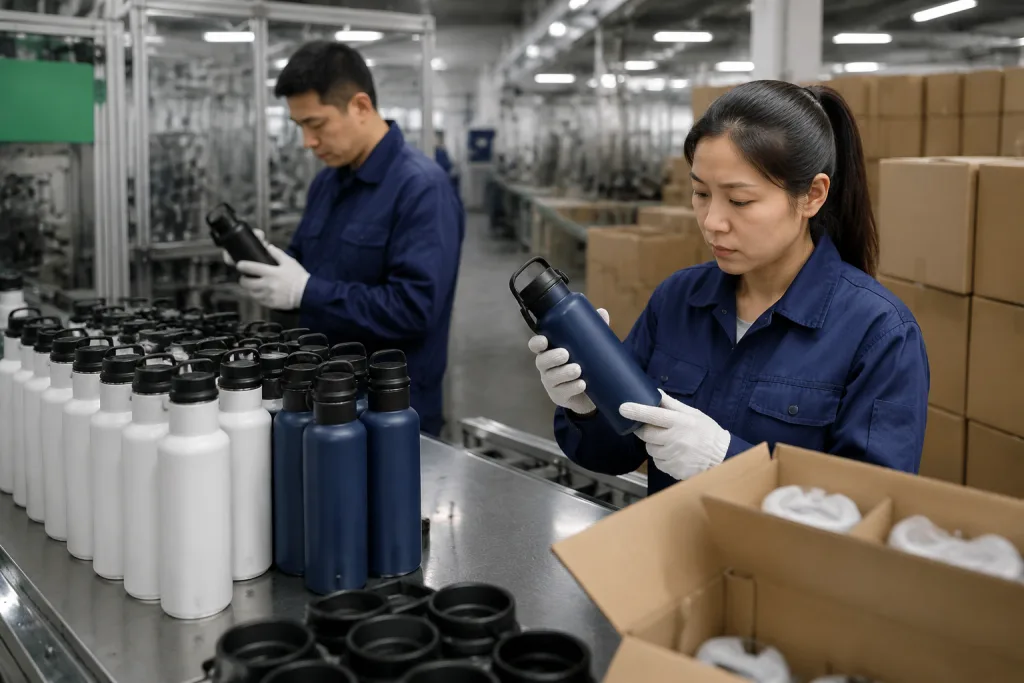
At BottleForge in Zhejiang, our practical MOQ for this kind of customized drinkware is 1,000 pieces per color for existing molds, but pricing works better above 3,000 pieces because setup loss gets spread out. Simple math. Our current stainless bottle line can handle about 420,000 units/month across standard sports bottles, travel tumblers, and custom canteen projects. The line uses vacuum leak testers, torque gauges for lids, and a 3M tape pull after powder coating; those checks decide shipment timing more than a nice directory profile does. A page claiming “unlimited capacity” is not a production plan.
Verify the supplier behind the listing
I’ll rewrite the prose in-place, keep the HTML exactly as-is, and tighten the language so it reads like a real buyer-facing sales engineer note.A supplier directory is a starting point, not a qualification file. Before you compare prices, figure out who carries the production risk. Is the company a bottle factory with forming, welding, polishing, coating, and packing under one roof? Is it a supplier that outsources coating? Is it a trading desk pulling listings from three or four workshops in China? None of these models is bad by default, but the risk profile changes fast.
Ask for documents and check whether the names line up. The business license, export license, BSCI audit, ISO 9001 certificate, test reports, proforma invoice, and bank beneficiary should not point to unrelated entities. If the listing says “manufacturer” but the test report belongs to another factory, ask why. A real bottle manufacturer can explain subcontracted steps in plain terms. A weak supplier hides behind “same group company.” We see that excuse a lot.
For this buyer case, you shortlist three suppliers from China. Supplier A is a real bottle factory in Zhejiang with in-house vacuum testing and powder coating. Supplier B is a distributor offering a lower MOQ but no audit report. Supplier C is a trading company with fast English replies and a suspicious USD 3.10 quote. The math does not work if you ignore risk, so do not. Price it in.
Use blunt verification questions:
- How many vacuum-insulated bottles did you ship last month?
- Which production steps do you run in-house?
- What is your standard leak test pressure and how long does it run?
- Can you send a recent SGS, Intertek, or TÜV food-contact report?
- What was the defect rate on your last 10 export orders above 3,000 units?
Good bottle manufacturers answer with numbers. Weak bottle suppliers answer with adjectives. We had a buyer flag a PO typo once because the factory name was missing one Chinese character, and QC pulled the sample before shipment. That saved 12 days. You are not being difficult; you are protecting your launch calendar.
Build the specification sheet
I’ll rewrite this section in place, keeping the HTML tags and the existing structure intact, then I’ll return only the cleaned HTML.Your spec sheet is the backbone of the deal. A custom canteen order should never run off a catalog photo alone. Photos do not lock down steel grade, wall thickness, weld quality, coating adhesion, lid thread fit, or carton drop resistance. We’ve seen that go sideways on the line.
For a 750 ml hydration bottle, a usable spec reads like this: 304 stainless steel inner wall 0.40 mm, outer wall 0.50 mm, copper-coated vacuum layer if requested, bottle weight 330-370 g without packaging, mouth diameter 55 mm, height 275 mm ±3 mm, base diameter 78 mm ±2 mm. Lid uses food-grade PP with a silicone gasket, no strong odor after 24 hours open-air rest, and it passes inverted leak testing for 30 minutes at room temperature. QC pulled the sample on this one; the math has to hold.
If your program includes canteen customizable options, write them as fixed choices, not loose ideas. One buyer may want matte black and forest green powder coating, another needs a customizable growler in 1.9 L with laser engraving, and a third wants a custom growler with handle lid for brewery merchandise. Those are different jobs. A customized growler takes a different drop test and carton spec than a 750 ml sports bottle, and mixing them in one spec sheet only creates buyer pushback later.
Decoration needs its own block. Silkscreen is cost-effective for simple logos, usually adding about USD 0.08-0.18 per unit at 5,000 pieces. Laser engraving often adds USD 0.20-0.45 depending on logo size and coating. Full-wrap heat transfer can add USD 0.40-0.90 and needs tighter artwork control. For customizable drinkware sold by distributors, ask whether the logo area changes by customer. If it does, split the base bottle PO from the decoration schedule, or you will lose 3-5 days waiting on small artwork approvals. The buyer flagged a logo typo on a PO once; that typo cost a week.
Directory listings sell options. Purchase orders need limits: dimensions, tolerances, materials, tests, packaging, and who pays when something fails.
Sample like money is involved
I’ll rewrite the four paragraphs in place, keep the HTML untouched, and tighten the sales-engineer tone with a few factory-floor details and concrete numbers.A pre-production sample is not a souvenir. It is the control piece for the line, the QC desk, and your buyer. For this order, ask for two plain structure samples first if the mold is new to you, then two decorated pre-production samples after artwork is approved. We run 5-7 days for existing bottle samples and 7-12 days when color matching and logo tooling are in the job. If a supplier says they can turn custom samples in 48 hours for powder coating, ask which step they are skipping.
Check the sample with basic tools before you sign off: digital caliper, scale, thermometer, tape measure, and a camera. Fill with 95°C water, close the lid, and check the temperature after 6 hours. A normal 750 ml vacuum bottle should still sit around 60-70°C, depending on cap design and room temperature. Test cold retention with 4°C water if your claim depends on it. We’ve seen buyers accept “24 hours hot” with no start temp, no room temp, and no final temp; the math doesn’t work.
Logo approval needs the same discipline. A canteen customized for retail can look fine on a phone screen and still miss on shelf if the logo sits 5 mm too low or the black ink turns gray on textured coating. Put Pantone references, logo width, distance from the bottom, and allowed deviation in writing. For laser work, approve engraving depth and contrast. For canteen custom programs with multiple end customers, set one logo template so your canteen distributors are not redoing placement every order. QC pulled a sample last month because the PO typo said “centered” on one page and “25 mm from base” on another.
Sample fees vary. Existing samples may be free with freight collect, while decorated samples usually run USD 50-150 including setup. That is cheap next to 5,000 units of the wrong coating. A serious canteen supplier will take sharp sample comments without pushing back, because one bad approval costs more than three sample rounds.
Negotiate price without breaking quality
I’ll rewrite the four paragraphs in-place, keep every HTML tag exactly as-is, and tighten the sales language so it reads like a factory quote discussion.Once the sample is close, price talks start. Keep the bill of materials on the table. On a 5,000-piece order, a USD 0.25 cut saves USD 1,250. Good money. Bad cut. We’ve seen that same move strip out copper coating, trim wall thickness, switch 304 to 201 on the outer steel, or send coating to a cheaper line with weak adhesion. QC pulled the sample once and the tape test failed after 20 pulls.
Ask for pricing by scenario, not one “best price.” Give 3,000 / 5,000 / 10,000 pieces; silkscreen versus laser; white box versus kraft box; FOB Ningbo versus EXW Zhejiang; standard lid versus carry-loop lid. That is the right question. A canteen factory that runs cost control can show clean step pricing. A canteen vendor that only forwards quotes often cannot explain why 10,000 pieces saves only USD 0.03. We had a PO once with “blak box” typed on it, and the buyer flagged it before we cut cartons.
For new buyers in China, 30% deposit and 70% before shipment after inspection is the normal deal. If a supplier asks for 100% before production on a standard bottle, push back. The math doesn’t work. If you want credit terms, expect them only after several paid orders. For this order, a practical timeline is 3-5 days for PI and deposit handling, 7-10 days for the final pre-production sample, 25-35 days for mass production after sample approval, and 3-5 days for inspection and export booking. We run that schedule on the line all the time.
For distributor canteen and distributor growler programs, talk repeat order pricing too. The first order may include artwork setup and color matching cost. Reorders built on the same BOM should be cheaper, or at least faster. If the supplier will not put reorder terms in writing, you may win the first quote and lose margin for the next year. We’ve seen that go sideways after the second PO, when the buyer expected the same price and the factory quoted a new plate fee.
Control production before inspection day
I’ll keep the tags intact and rewrite the prose with a more buyer-side, factory-floor voice. Next I’m checking the phrasing for the AI tells, then I’ll return only the HTML.Too many buyers treat QC as a final gate. That is late. On custom drinkware, the costly failures show up mid-run: a weld opens before polishing, vacuum loss shows up before coating, the Pantone drifts before print, or the carton spec is short before packing. Put the checkpoints in the PO, not in your memory.
For this order, ask for updates at four points: raw material arrival, bottle body completion, coating completion, and 20% packed. We want steel coils or formed shells on camera, the vacuum test station, the coating line, the logo print table, and packed cartons with shipping marks. If you are working with canteen suppliers instead of a direct factory, the same proof applies. A trader can relay messages; they cannot replace evidence from the line.
Quality checkpoints should cover vacuum testing on 100% of bottles, visual coating inspection, lid fit check, leak test, logo rub test, and carton drop test. For powder coating adhesion, cross-hatch testing works on retained samples. For print durability, a 3M tape pull and alcohol rub will show weak ink cure fast. For Europe, keep REACH coating documents on file. For the United States, keep FDA food-contact declarations and, for children's items, check CPSIA requirements. For adult hydration bottles, ASTM-style physical safety thinking still matters: no sharp edges, no loose small parts, no brittle handles. QC pulled the sample, and the flaw was obvious at 50 cm.
AQL inspection needs to be written before production starts. For 5,000 units, general inspection level II with AQL 2.5 major and 4.0 minor is common. Critical defects stay at 0. A leaking bottle, rust, wrong material, unsafe sharp edge, or missing logo on retail units is a stop sign. Major defects include coating chips, wrong color, a deformed lid, unreadable barcode, or weak vacuum retention. Minor defects cover small specks within agreed limits. When the standard is set early, inspection is a decision, not a fight over the carton count.
Pack for the sales channel
I’ll keep the HTML structure intact and rewrite only the prose, with tighter buyer-side wording and a few concrete factory details. Next I’m editing the four paragraphs in place.Packaging is not decoration. It drives freight cost, breakage rate, warehouse handling, and the complaint stack after goods land. In this buyer case, the hydration bottle goes to a distributor warehouse first, then gets split to retailers and corporate canteen promo accounts. That means the carton has to work for all three lanes, not just look good on a sample table.
A normal export pack is one bottle in a polybag, then a white box, 24 pieces per master carton, 5-ply K=A corrugated board, carton size about 54 x 36 x 58 cm, gross weight around 11-13 kg. If the ship goes to Amazon FBA, we print FNSKU on each unit or box as required, put carton labels on two sides, and keep the carton under the platform’s handling limit. If the ship goes to a retail DC, we confirm pallet height, carton barcode, and the routing guide before the line starts packing. QC pulled the sample once and the buyer flagged a 2 mm barcode shift; that sort of thing slows the whole booking.
For custom canteen and customizable canteen orders, packaging carries the brand message. Fine. But a nice printed box still has to pass a 76 cm drop test, or the math does not work. We ask for a blank box sample or dieline before production. If the bottle has a straw lid, handle, or carabiner clip, we protect the protruding parts. For heavier customized growler orders, we run thicker inserts or molded pulp. A distributor growler carton can look clean at the factory and still collapse after ocean freight, inland trucking, and stack pressure in the warehouse.
From Zhejiang, the route usually goes through Ningbo or Shanghai. FOB Ningbo is common for our Hangzhou facility, while some buyers choose EXW when their forwarder is consolidating multiple China orders. Either way, we confirm HS code, carton count, CBM, gross weight, and ready date at least 7 days before booking. One PO typo on the carton count can turn into a missed vessel. The right supplier directory hydration bottle result is not the supplier with the prettiest catalog. It is the one that ships the correct goods, packed right, with documents your warehouse can use on day one.
Send your bottle spec for a factory quote
Share quantity, material, logo method, packaging, and market. Our Zhejiang team will check feasibility, MOQ, pricing, and QC risks before sampling.
Frequently asked questions
How do I know if a supplier directory hydration bottle listing is a real factory?
Ask for evidence that connects the listing to production: business license, factory address, audit report, export license, and recent test reports under the same or clearly related company name. Then ask operational questions: monthly bottle capacity, in-house processes, number of vacuum test stations, and normal lead time for 5,000 pieces. A real canteen factory in China should answer with specifics such as 300,000-500,000 units/month, 25-35 days production, and 100% leak testing. If the contact avoids video calls, cannot show the coating line, or sends certificates from unrelated companies, treat them as a canteen vendor or trader until proven otherwise.
What MOQ should I expect for customized drinkware?
For existing stainless hydration bottle molds, 1,000 pieces per color is a practical MOQ for many Zhejiang factories, though 3,000-5,000 pieces gives better unit pricing and smoother production scheduling. Custom colors, molded lids, private-label packaging, and special coatings can raise MOQ to 3,000 pieces or more. A custom growler or customizable growler using an existing body may start around 1,000-2,000 pieces, while a new mold can require 5,000-10,000 pieces to make tooling economical. Be careful with very low MOQ offers; they often use stock bottles, limited colors, or outsourced decoration with weaker QC control.
Which logo method is best for canteen promotional orders?
For most canteen promotional orders, one-color silkscreen is the safest balance of cost, speed, and visibility. At 5,000 units, it may add about USD 0.08-0.18 per bottle. Laser engraving costs more, often USD 0.20-0.45, but looks more durable on powder-coated stainless bottles and works well for premium corporate gifts. Heat transfer or full-wrap printing is useful for complex artwork but can add USD 0.40-0.90 and needs tighter approval control. If your canteen distributors handle many small customer logos, standardize a logo zone, maximum width, and Pantone process before accepting artwork.
What inspection standard should I use before shipment?
Use AQL general inspection level II with AQL 2.5 for major defects and 4.0 for minor defects on standard adult hydration bottles. Critical defects should be 0 accepted. For a 5,000-piece order, the inspector will normally sample according to ISO 2859-1 tables, then check appearance, dimensions, logo, packaging, barcode, leak performance, lid fit, and basic function. Add product-specific tests such as 30-minute inverted leak test, hot water retention sample check, coating adhesion tape test, and carton drop test. Do not release the final 70% payment until the inspection report matches your PO and approved sample.
Should I buy from a canteen distributor or direct canteen manufacturer?
It depends on your order complexity. A direct canteen manufacturer is usually better for 3,000+ units, repeat programs, tight QC requirements, and custom engineering. You get clearer control over materials, line schedule, and corrective action. A canteen distributor can be useful for mixed-SKU orders, lower MOQs, or fast catalog sourcing, especially if they consolidate several canteen suppliers. The risk is less visibility into production. For a first order, ask both to quote the same spec, including FOB terms, lead time, test documents, and AQL acceptance. Choose the one that explains trade-offs clearly, not just the lowest price.