Key Takeaways
- A real supplier directory drinkware shortlist should show MOQ, lead time, and monthly capacity; if it does not, expect quote noise.
- For canteen custom projects, 0.4-0.6 mm stainless steel and 304/18-8 material usually matter more than marketing language.
- A difference of $0.18-$0.42 per unit on decoration, cap tooling, or secondary packing can change your margin fast.
- Ask for AQL, REACH, LFGB, and factory audit records before you place a 5,000-unit order.
A supplier directory drinkware search can look busy and still burn a week. You open 40 listings, 18 are resellers, three are canteen pages with no wall thickness, and the quotes do not line up. If you buy for retail, corporate gifting, or Amazon, the real issue is not finding “custom drinkware.” It is knowing which spec line hits landed cost, defect rate, and sell-through.
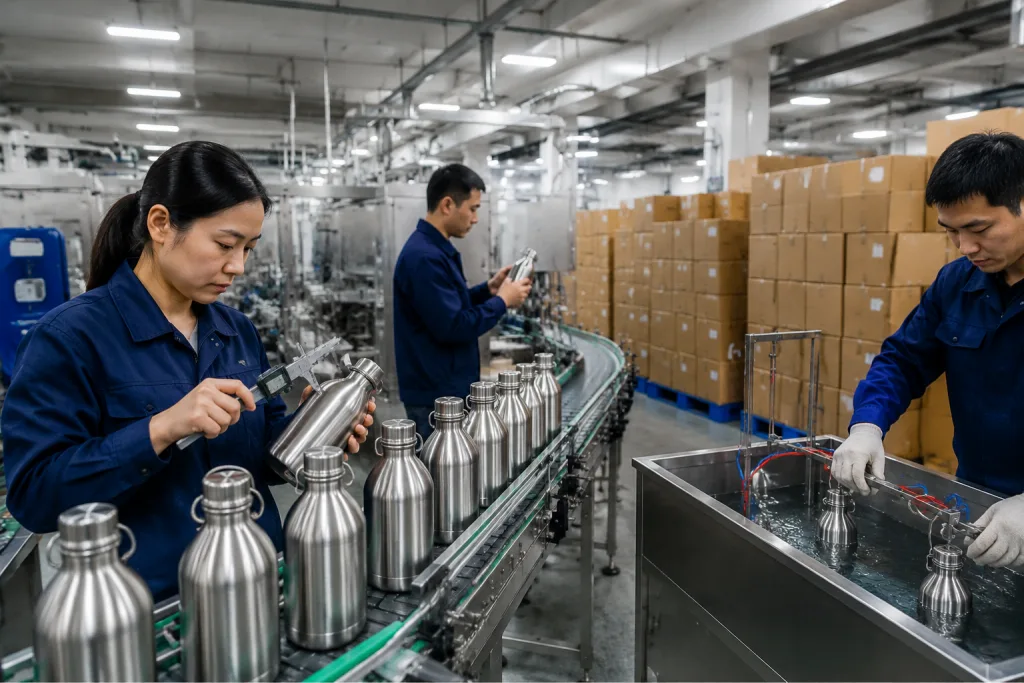
Good buyers read each listing like a factory datasheet. They check MOQ, material grade, wall thickness, lid fit, decoration method, and whether the supplier is a real canteen manufacturer or just a trading company. We run export jobs out of Zhejiang, and the factories that ship steady usually show their numbers upfront: 30,000 units per month, 7-15 day sampling, 25-35 day production, and audit files ready on request. That is the starting line. QC pulled a 0.8 mm sample on the bench, and if the buyer flags a vague spec, the math does not work.
Read the line items first
Open a supplier directory drinkware page and skip the hero copy. Read the spec lines first. A listing worth quoting should show material, capacity, structure, finish, plus MOQ or daily output. If it says only “high quality customized drinkware,” we close the tab; the buyer cannot compare that against a canteen factory running 3,000 pcs per shift on the laser line. You need numbers, not adjectives.
Start with material grade. For stainless drinkware, 304/18-8 is the baseline for most export programs. If the factory offers 316, expect a higher unit cost, often $0.25-$0.60 more depending on capacity and finish. For plastic, confirm PP, Tritan, or rPET by resin code, not just “eco-friendly.” Then check capacity tolerance with a measuring cylinder, not a catalog photo. A 750 ml custom growler that ships at 720 ml usable volume will create customer complaints and Amazon returns. For a canteen custom project, even a 20-30 ml deviation can matter if you sell to sports teams or outdoor buyers who expect exact fill marks; we had QC pull 12 samples last month after one buyer flagged a 25 ml short fill.
Use the spec sheet to cut weak suppliers fast. A good canteen supplier should tell you wall thickness in mm, lid material, gasket type, and decoration area without three follow-up emails. The wrong question is “can you customize it?” Ask whether the line has passed a 1.2 m drop test and 100% leak testing before packing. A strong canteen distributor can still source well, but they should disclose which factory makes the product, the carton pack, and whether the PO says white box or color box; we have seen one typo on a PO turn 48 cartons into a repacking job. If they cannot answer those basics, your directory search is not producing candidates.
MOQ tells you the factory type
I’ll rewrite the section in place, keep the HTML intact, and make the MOQ cues sound like a factory-side sales engineer wrote them.MOQ is not a random number. It tells you who you are dealing with. A real Zhejiang canteen factory usually quotes 1,000-3,000 units for a standard bottle and 3,000-5,000 for a custom canteen with new print or laser engraving. If a listing says 100 units with full customization, the math does not work. That is usually a trading company or a stock seller, not the source factory.
That matters because MOQ ties up cash and exposes you when the artwork misses. On the line, one-color silkscreen setup can add $35-$80, and QC will pull the first sample before we run the batch. Laser engraving keeps setup low, but the unit price can still be $0.10-$0.30 higher than blank stock depending on order size. A new lid mold is a different story. Tooling can run $3,000-$12,000, so the first PO needs enough volume to pay that back. We have seen buyers try to test a new SKU with 500 units and get burned.
Read the pattern. A flexible MOQ usually means stocked blanks, shared tooling, or a distributor model. A higher MOQ usually means the factory has die-cut, welding, or blow-molding slots booked ahead of time. Neither is bad. The wrong question is “can you go lower?” The right one is whether the MOQ fits your channel and your sell-through rate. If your seasonal program moves 2,000 units in 12 days, that is a good match; if your reorder cycle is 18 days, it is not.
Capacity is your delivery insurance
I’ll rewrite just the prose, keep the HTML tags and numbers intact, and make it sound like a real factory-side sales engineer wrote it.Monthly capacity is the number that tells you whether a supplier can absorb a spike or fold under it. A factory in Zhejiang saying 30,000 units per month works for a mid-size program; 100,000 to 200,000 units per month is the safer range if you are opening a retail line or feeding several canteen distributors. If your order is 15,000 units and the plant only runs 20,000 units per month total, you are one PO away from getting bumped. We’ve seen that go sideways on the line when QC pulled the sample late.
Ask for capacity by product family, not just one big headline. A canteen manufacturer may run stainless bottles at 50,000 units per month but only 10,000 units per month on wide-mouth growlers because the cap line is the choke point. That matters if you want a custom growler or customized growler with a special finish, because polishing and leak testing can cut output by 15%-25%. Same story on decorated canteen promotional items: one extra print color can add 2-4 days, and the buyer flagged it after the PO already hit our desk.
Delivery promises only make sense when the supplier shows the whole route. Typical lead time for a mature custom drinkware program is 25-35 days after sample approval, with 7-15 days for samples. If a canteen supplier promises 12 days for a fully customized canteen and embossing, they are counting production only. Ask for the full timeline: artwork approval, sample, tooling, mass production, inspection, packing, and vessel booking. The math doesn’t work otherwise, and a typo on the PO can cost you a day before we even start the mold.
Materials change the selling story
I’ll rewrite the section in-place, keep the HTML tags untouched, and make the prose sound like a factory-side sales engineer wrote it.Your end customer does not ask about metal grades, but your returns team does. For custom drinkware, stainless steel, aluminum, glass, and Tritan all carry a different cost and failure rate. Stainless is the safe call for a canteen customizable program because it holds up in shipping, takes dents better, and cuts breakage claims. At 0.4 mm wall thickness, we usually sit in the cost-efficient zone; 0.5-0.6 mm feels firmer and helps when the buyer wants a premium tag, but the weight and freight go up.
For a custom canteen or customized canteen, check whether the inside is electropolished or passivated. This is not marketing copy; it changes corrosion resistance and taste retention. We had a buyer flag a PO typo once because the spec said “polished” with no process called out, and QC pulled the sample before the line ran 5,000 pcs. If you are sourcing a canteen promotional campaign for a gym or university, a lighter wall and a basic cap can cut freight by 6%-12% versus a premium insulated model. That math matters. For a custom growler, confirm the neck finish works with carbonated drinks and the lid seal is rated for pressure swings. A growler that leaks at 1.2 bar comes back as a problem, not a product.
Do not skip compliance. For Europe, REACH and LFGB are the first files buyers ask to see. For North America, you may need ASTM-related testing, California Proposition 65 awareness, and food-contact declarations. A credible canteen manufacturer in China should be ready to show test reports from SGS, Intertek, or a comparable lab when the material or decoration needs it; we ship those reports with the sample pack when the buyer asks on day one.
Decoration affects margin more than you think
I’ll keep the HTML structure intact and rewrite the copy with a more grounded sales-engineer tone, adding concrete sourcing details and trimming the AI-ish phrasing.Decoration is where a lot of buyer math falls apart. A blank bottle may land at $1.80 FOB, but once we run silkscreen, laser, UV print, embossing, or full-wrap labeling, the same item can move to $2.35 or $2.90 fast. In supplier directory drinkware sourcing, compare each decoration method line by line; the same art file can behave differently on two canteen suppliers with the same body size.
Silkscreen usually wins on cost for 1 to 2 colors, especially on a canteen promotional run. Laser engraving looks clean on stainless and holds up after 50 wash cycles, but the unit cost often climbs by $0.10-$0.25. UV print handles gradients and fine branding, yet QC pulled the sample after an abrasion rub failed at the logo edge. If you want a customizable drinkware line for retail, ask for adhesion testing and dishwasher resistance; if you want a customized growler for hospitality, check stacking marks and bar-wash wear. The wrong question is “which decoration looks best?”—the math has to work first.
Do not approve artwork until the factory sends a layout with exact print area, seam position, and logo wrap length. We’ve seen a 2 mm shift turn into a rejected batch, and that one sheet saves money.
If you buy through a canteen distributor instead of a direct factory, ask who owns the tooling and print plates. On repeat orders, the plate fee should drop out or stay fixed, and the PO should say so in plain words; one buyer once typed “free plat” on the order and still got billed. If the quote changes every time, you are not buying efficiently.
Inspection rules decide real quality
I’ll rewrite the section in-place, keep the HTML tags and structure unchanged, and make it sound like a factory-side sales engineer wrote it.Quality control is not a slogan; it is a test sheet. Ask every canteen factory to state the AQL level used for final inspection. A common setup is AQL 2.5 for major defects and 4.0 for minor defects, though some export programs run tighter limits. If a supplier cannot say which defects count as major, QC already has a hole before the first carton leaves the line.
A practical inspection package for custom drinkware includes leak test, vacuum retention on insulated bottles, scratch check, print adhesion, drop test, and carton compression. For a customized canteen headed to retail, we run bottle-by-bottle leak testing on sample lots and lock the sampling method before production starts. For a distributor drinkware program, carton markings, UPC placement, and FNSKU labeling matter just as much as the bottle body; we once caught a PO typo on FNSKU labels that would have sent 3,000 units to the wrong warehouse. A supplier directory drinkware listing will not show you that. You have to ask.
Factory audits matter too. BSCI helps when your customer asks for social compliance. ISO 9001 signals process discipline, not perfect product quality, but it does show the factory keeps records and follows them. In Zhejiang, stronger export factories usually run to a clear QC system because their biggest buyers want the same result on order 1 and order 12, not a lucky shipment.
Price only makes sense FOB
I’ll rewrite the section in-place, keep the HTML untouched, and make the pricing advice read like a factory-side sales engineer wrote it.When buyers compare canteen custom quotes, they often compare the wrong number. Ex-works looks cheap until you add packing changes, inland trucking, export docs, and pallet load-up. Ask for FOB Ningbo or FOB Shanghai if you want a clean export comparison from China. Zhejiang factories quote those ports all day. That is normal. The point is simple: lock the same commercial term, then compare the numbers.
On a standard stainless bottle, FOB pricing may sit at $1.60-$3.80 depending on size, material, and decoration. A canteen customizable model with a premium cap or powder coat can jump past that fast. We had one buyer flag a PO where the lid code was typed wrong by one digit; the line stopped, and the “cheap” quote got expensive in a hurry. If a canteen vendor is 8% cheaper but slips 35 days, freight and lost sales can wipe out the gap. For distributor canteen programs, the real math is landed cost per sellable unit after rework, cartons, duty, and labeling labor. This is the wrong question to ask if you only stare at unit price.
Use a quote template that forces precision: product code, capacity, material, wall thickness, lid type, print method, color, packaging, carton count, MOQ, sample lead time, mass production lead time, and test standards. QC pulled the sample on a 0.5 mm wall spec before we shipped, because that number decides whether the bottle passes or fails after forming. If the vendor gives you all of that without back-and-forth, you are likely dealing with a professional canteen supplier or a trading team that knows the export desk. If they cannot, keep the directory open and keep searching.
Send your spec sheet for a direct quote
We’ll check MOQ, material, packaging, and lead time line by line, then return a clean FOB quote from our Zhejiang factory.
Frequently asked questions
How do I know if a supplier directory listing is a real factory?
Check for factory-specific numbers: monthly capacity, machine types, MOQ by SKU, and lead time. A real canteen factory in Zhejiang will usually quote something like 30,000-100,000 units per month, 7-15 days for samples, and 25-35 days for production. Ask for audit docs, product test reports, and whether they own tooling. If they avoid giving a registered company name, factory address, or production photos with timestamps, you are probably looking at a trading page, not a source canteen manufacturer.
What MOQ is normal for custom drinkware?
For standard custom drinkware, 1,000-3,000 units is common from a factory. A canteen custom order with basic logo print may start at 500-1,000 if the supplier has stock blanks, but full customization usually pushes it higher. A new mold, new cap, or special color can raise the real commitment to 3,000-5,000 units or more. If a canteen supplier claims 100-unit MOQ with complex customization, ask how they are handling tooling and whether you are actually buying from a canteen distributor.
What compliance should I request for Europe and North America?
For Europe, ask for REACH and food-contact testing; LFGB is often requested for Germany and nearby markets. For North America, request food-contact declarations and relevant ASTM or equivalent test reports where applicable. If the product is stainless, ask for material grade proof such as 304/18-8 and a corrosion or migration report if your customer needs it. A professional canteen supplier should be able to provide these documents without rewriting them for every quote.
How much does decoration usually add to the price?
A simple one-color silkscreen logo can add roughly $0.05-$0.15 per unit, depending on batch size. Laser engraving often adds $0.10-$0.30, while UV or multi-color decoration can add $0.20-$0.60 or more. If you request a canteen promotional campaign with multiple colors, special placement, or wraparound graphics, the setup cost can matter as much as the unit cost. Always ask for separate pricing for setup, plates, and repeat orders.
Should I work with a canteen distributor or direct canteen factory?
If you need speed, mixed SKUs, or low MOQs, a canteen distributor can be useful. If you need control over specs, repeat quality, and better margins, a direct canteen factory is usually the better route. The best answer depends on your volume. For a 500-unit test, distributor drinkware can be faster. For a 10,000-unit retail roll-out, direct sourcing in China or Zhejiang usually gives you better control over price, QC, and schedule.