Key Takeaways
- A practical supplier directory canteen quote should state MOQ, lead time, steel grade, wall thickness, and packing method
- For vacuum stainless canteens, 0.4-0.5 mm inner wall and 0.5-0.6 mm outer wall are common commercial ranges
- Logo cost can move from USD 0.08 for one-color print to USD 0.45+ for laser or multi-position decoration
- AQL 2.5/4.0 inspection and REACH/LFGB or FDA test scope should be agreed before deposit
A supplier directory canteen listing looks useful until 40 factories write the same four lines: 304 stainless, BPA-free lid, custom logo, 25-day delivery. That still does not tell you who can hold a ±0.2 mm mouth tolerance, pass LFGB/FDA checks, and ship a retail-ready canteen order into Europe or North America without carton damage.
Read the spec sheet like the person standing beside the line, not like a buyer scrolling catalogs. We run custom drinkware quotes in Hangzhou by capacity, steel grade, wall thickness, lid structure, finish, MOQ, AQL 2.5, and packing method; last month QC pulled a 750 ml sample because the powder coating was 18 μm short on the shoulder. Miss one line and the math does not work. Your landed cost moves, or your defect claim shows up after the container is already opened.
Start With Capacity And Use Case
Put capacity on the first spec line in any supplier directory canteen comparison, and do not let the buyer wave it through as “just size.” A 600 ml canteen, 750 ml canteen, 1 L custom canteen, and 1.9 L custom growler run through different mold sets, carton grids, lid torque targets, drop-test results, and freight quotes. On our line, a 750 ml body might sit cleanly in a 24 pcs export carton, while a 1.9 L growler often forces a 12 pcs carton and adds 3-5 mm foam at the handle.
For distributor drinkware programs, we usually steer buyers toward 500 ml, 750 ml, or 1 L because those sizes price cleanly and pack without drama. Outdoor promotional campaigns ask for 750 ml about 6 times out of 10; it feels solid in hand but does not punish the freight bill. Growler math is different. A distributor growler order usually starts at 1.2 L or 1.9 L, where vacuum retention and handle strength beat shelf looks, and QC pulled one 1.9 L sample last month after the handle showed movement at 18 kg load.
If you are using a supplier directory canteen page to shortlist canteen suppliers, ask each canteen vendor for brimful capacity and advertised fill capacity in writing. Same day. A bottle sold as 32 oz may test at 950 ml usable fill, while the shell volume is closer to 1,000 ml. That gap can wreck labeling, Amazon content, and customs documents; we have seen this go sideways when a buyer’s PO said “32OZ” but the carton mark artwork said “1000ML.”
At BottleForge Industrial in Zhejiang, China, our standard MOQ is 1,000 units per size for existing molds and 3,000 units for new color runs. A normal existing-mold lead time is 30-40 days after artwork approval, not after the first WhatsApp message. If a canteen factory promises 10 days for a fully canteen customized vacuum item, push back hard. They may mean sample assembly, not mass production; we run laser logo, powder coating, air-pressure leak test, and AQL 2.5 final inspection before we ship.
Material Line Items Are Not Decoration
A catalog line that says “304 stainless steel” does not settle the spec. Wrong question to ask. You need the BOM to show whether 304 is on the inner wall, both shells, or only the food-contact pieces. For North American and EU retail, we run 304 inner steel as the floor. Outer shells can be 304 or 201 when the buyer is chasing a USD 0.18-0.35 saving per canteen, but write it on the PI so nobody argues after QC cuts a sample open with the pipe cutter.
A normal vacuum canteen line item might read: inner 304 stainless steel, outer 201 stainless steel, PP lid, food-grade silicone seal, powder coating finish. That works for promotional canteen orders where the MOQ is 3,000 pcs and the target price is tight. For premium outdoor or corporate gift ranges, 304 inside and outside is easier to sell and easier to defend during compliance review. We have seen this go sideways when a buyer’s PO said “SS304 body” and their inspector read that as both shells.
Wall thickness is where weak canteen suppliers get exposed. For stainless vacuum canteens, common ranges are 0.4-0.5 mm for the inner wall and 0.5-0.6 mm for the outer wall. Thinner steel saves cost, then dents faster and shows weld pull near the bottom seam. QC pulled a 750 ml sample last month with a 0.36 mm inner reading on the micrometer, and the math did not work for drop testing. For a custom growler with handle loads, we use reinforced neck geometry or thicker shoulder material instead of making the whole body heavy.
Plastic and silicone need named materials too. Ask for PP, Tritan, silicone, or TPE on the spec sheet, not “food-grade plastic.” For EU sales, REACH and LFGB test reports are common. For the U.S., FDA food-contact testing is usually requested. A serious canteen supplier can show which lid, gasket, straw, or stopper was tested, not just send a generic certificate from another line; we reject those when the report photo shows a different cap mold number.
Vacuum Performance And Leak Claims
Vacuum performance is not a slogan on a carton. It needs a test method. “Keeps cold 24 hours” and “keeps hot 12 hours” are marketing claims unless the canteen factory states the starting water temperature, room temperature, fill level, and final test point. For a stainless vacuum canteen, we usually test hot water at 95°C, room temperature around 20°C, and record temperature after 6, 12, and 24 hours; QC uses a calibrated probe thermometer and logs the result by lot number.
A practical B2B spec could say: hot retention above 62°C after 6 hours for a 750 ml vacuum canteen, tested with 95°C water at 20°C ambient. That gives your inspector a clear accept or reject point. For customized growler programs, buyers push harder on cold retention and carbonation-adjacent use; last quarter one buyer flagged a 64 oz sample because the PO said “beer growler,” but the lid drawing had no pressure rating. Do not assume a growler lid is pressure-rated unless it is designed and tested for that job. The math doesn't work if the sales claim is stronger than the lid structure.
Leak resistance needs the same discipline. A canteen customizable with a flip straw lid has more failure points than a screw cap, including the straw hinge, air vent, silicone plug, and bite valve tolerance. A wide-mouth lid with silicone ring is simpler and usually more reliable for outdoor or industrial users. We run a 0.3 mm lid gasket check on incoming silicone parts because one soft ring can ruin a full carton. For a canteen distributor selling into multiple channels, fewer moving parts means fewer returns.
Ask the canteen manufacturer how they test leakage during production. A basic process includes vacuum test after welding, water leak test after assembly, and random finished-goods testing before packing; on the line, QC pulled the sample after a welded base showed a slow bubble under the water tank. At our Hangzhou facility in Zhejiang, we run about 500,000 stainless drinkware units per month across bottles, tumblers, canteens, and growlers. That volume only works if vacuum failure and lid leakage are caught before cartons are sealed. Once the master carton is taped, fixing it costs 12 days instead of 2 hours.
Logo Method Changes The Product
I’ll keep the HTML exactly as-is and rewrite only the prose, with tighter B2B sales wording, concrete factory details, and no AI-style filler.Decoration is not just branding. It changes unit cost, lead time, abrasion resistance, and sometimes the test file the buyer asks for. A supplier directory canteen listing may say “custom logo available,” but the real question is how we run it on the line. Common options are silkscreen printing, laser engraving, pad printing, heat transfer, water transfer, UV printing, and embossing on silicone or plastic parts.
For a simple canteen promotional order, one-color silkscreen on a powder-coated body usually lands around USD 0.08-0.18 per unit, depending on logo size and ink coverage. Laser engraving is usually around USD 0.20-0.45 per position. It looks cleaner, and it does not peel. We had a buyer flag a PO once because the logo count was typed as “2pos” on the order but the artwork showed one position, so QC pulled the sample before we cut screens.
If you need a canteen customized for a retail brand, ask for an artwork sheet with logo size in millimeters, Pantone color, print position, and tolerance. “Front logo” is not a spec. A proper approval should say 60 mm wide logo, centered 95 mm from base, Pantone 186C, tolerance ±2 mm. The math matters. We’ve seen 5,000 units come back with the mark sitting 8 mm too low for sleeve packaging.
For customized drinkware sold in Europe, ink and coating compliance matters. Ask whether the coating passes adhesion, cross-hatch, dishwasher simulation if required, and the chemical tests tied to your market. For a North American distributor canteen program, the standard changes by channel. A tradeshow giveaway and a retail outdoor item should not share the same decoration spec, and we have seen that go sideways when a buyer tried to hold both under one AQL 2.5 checklist.
Finish, Color, And Coating Risk
I’ll rewrite the section in-place, keeping the HTML tags and structure unchanged while stripping the AI phrasing and adding sharper factory-floor detail.Powder coating is the finish we ship most on custom drinkware because it feels premium and hides fingerprints. The coating still needs control. A cheap run chips at the base, picks up scuffs in carton vibration, or shows orange peel under retail lights. On one canteen order, QC pulled the sample after a 48-hour tape test failed at the rim. So when you compare vendors, ask for coating thickness, adhesion target, and cure record—not just a color card.
For stainless drinkware, powder coating usually sits around 60-90 microns. Thinner than that, and the finish wears fast. Thicker than that, and threads, lid fit, or cup holder size start drifting; we have seen a 0.3 mm mismatch turn into a buyer complaint on the packing line. Matte coatings show oil marks faster than semi-matte. Gloss can look sharp, but it also exposes small dents and weld lines. That is the wrong place to save money.
Color matching should start with physical samples. Pantone helps, but powder on curved stainless steel never reads the same as ink on paper. For a canteen customizable in three colors, approve one golden sample per color and keep it as the control piece. If the PO is split into two production batches, ask the factory how it holds batch-to-batch color under the same light source. We run into this problem when the buyer flags a 1.5 Delta E shift after delivery.
Raw stainless, brushed steel, and electro-polished finishes cut coating risk, but they also expose surface defects. Customizable canteen projects for outdoor, military-style, or industrial channels often go uncoated because the spec is about function, not showroom shine. That choice works when the buyer wants a 304 stainless look and can accept scratch marks from daily use. It is a practical call.
Packing Specs Affect Landed Cost
I’ll rewrite the section in place, keep the HTML exactly as-is, and tighten the prose so it sounds like a buyer-side sales engineer wrote it.Packing is where supplier directory canteen quotes start to drift. One canteen supplier may quote bulk polybag packing; another rolls in a printed gift box, instruction sheet, master carton, and drop-tested export pack. Those are not the same FOB. Split the packing line by line.
A basic export setup is simple: 1 unit in a polybag, 1 white box, 24 units per master carton, 5-ply carton, carton mark included. A retail setup runs heavier: printed color box, barcode label, warning insert, recycled kraft tray, outer carton with side marks. For Amazon FBA, the buyer flagged FNSKU labeling, carton weight under channel limits, suffocation warning on polybags, and carton dimensions set to cut inbound fees.
Carton size hits ocean freight and air freight on day one. A 750 ml stainless canteen with gift box may pack 24 pcs per carton at about 55 x 38 x 32 cm. A wide 1.9 L customized growler may pack only 12 pcs per carton and eat far more container space per unit. If you only compare unit FOB, the math does not work.
Ask each canteen vendor for gross weight, net weight, carton dimensions, packing ratio, and HS code recommendation. For large distributor drinkware orders, we also ask for a carton drop test: 1 corner, 3 edges, and 6 faces from 76 cm on moderate retail packs. QC pulled the sample on a crushed-box case last month. It is cheaper to strengthen the carton before shipment than to argue after arrival.
Quote Terms And Factory Proof
A proper quote from a canteen manufacturer needs more than unit price. Ask for FOB port, MOQ, sample cost, sample lead time, production lead time, payment terms, mold fee if any, packaging assumption, inspection standard, and quote validity. For Zhejiang production, FOB Ningbo and FOB Shanghai are the two ports we see most. BottleForge often ships from Ningbo; from our Hangzhou-area line, a 40HQ usually reaches Ningbo port in 1 day, while Shanghai can add 1 extra trucking day and about RMB 1,200 to RMB 1,800 depending on the forwarder. We write these items into the PI before anyone sends deposit. Saves arguments later.
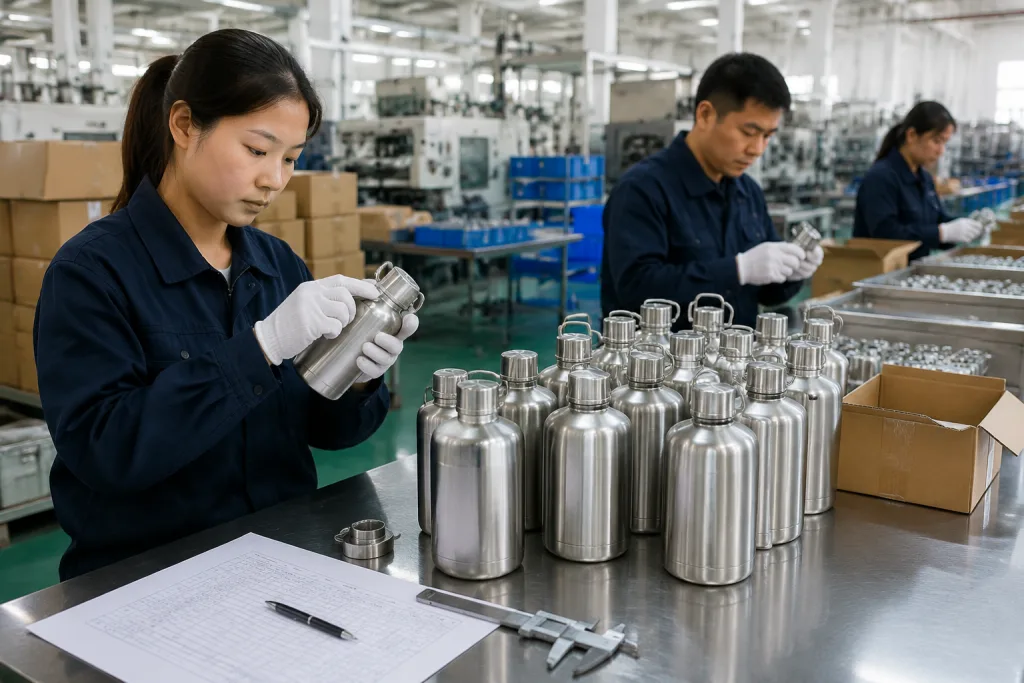
Factory proof matters because supplier directory pages mix real canteen manufacturers with trading companies and small canteen vendors. Trading companies are not automatically a problem, but this is the wrong question to ask: “Are you factory?” Ask who owns the tooling, who runs the polishing line, and whose QC stamp appears on the final inspection report. Request a business license, factory audit documents such as BSCI if required, ISO 9001 status if available, and recent production photos tied to your product category. Last month a buyer flagged a “factory photo” where the PO number on the whiteboard did not match the sample tag; QC pulled the sample and found it came from a different workshop.
For quality control, AQL belongs in the quote before deposit, not after cartons are sealed. A common inspection level is General Inspection Level II with AQL 2.5 for major defects and 4.0 for minor defects. Critical defects should be 0. We run checks for appearance, capacity, coating adhesion, logo placement, lid fit, leakage, vacuum retention, barcode scan, carton mark, and packaging damage. On the line, the inspector uses a 3M tape test for coating adhesion, a digital scale for capacity cross-checks, and a 24-hour upside-down leak test for selected samples. If AQL is missing from the PO, the math doesn't work when the buyer rejects 6 cartons out of 200.
If you are building a canteen customized line for retail, request pre-production samples and keep one approved sample at the factory and one in your office. We label ours with the PO number, Pantone code, logo file name, and approval date, then seal it in a clear bag near the QC desk. If you are buying canteen promotional units for an event date, lock artwork earlier and avoid last-minute color changes. We have seen this go sideways: a buyer changed powder coating color 9 days before packing, but coating cure, re-sampling, and vessel booking pushed the shipment from 12 days to 18 days. China factories can move fast. Paint still needs time to cure.
Send Your Canteen Spec Sheet For Review
We will check capacity, material, logo, packing, MOQ, and FOB assumptions before you commit to production.
Frequently asked questions
What should I ask a supplier directory canteen factory before quoting?
Ask for capacity, material grade, wall thickness, lid material, logo method, coating type, packing method, MOQ, FOB port, lead time, and inspection standard. A serious canteen factory should answer with numbers, not only “yes, we can custom.” For example: 750 ml, 304 inner/201 outer, 0.45 mm inner wall, 0.55 mm outer wall, PP lid with silicone seal, powder coating, laser logo, 1,000 pcs MOQ, FOB Ningbo, 35 days production. If the canteen supplier cannot state whether test reports cover the exact food-contact parts, keep asking. For EU buyers, REACH or LFGB scope matters. For U.S. buyers, FDA food-contact documentation is usually the baseline.
What MOQ is realistic for a custom canteen order from China?
For existing molds, a realistic MOQ is usually 1,000 pcs per size and 1,000 pcs per color for stainless vacuum canteens. Some canteen suppliers may accept 500 pcs, but the unit price and logo cost will be higher because setup time is the same. For a new mold, expect 3,000-5,000 pcs as a practical starting point, plus tooling cost. A canteen promotional order with a standard body and one-color print is easier to start small. A fully customized canteen with new lid, new shape, and retail packaging needs more volume because mold testing, vacuum validation, and packaging trials take time.
How do I compare canteen manufacturers and trading vendors fairly?
Compare them using the same written spec sheet. Give every canteen manufacturer and canteen vendor the same capacity, steel grade, wall thickness, logo process, color, packaging, inspection level, and delivery term. Otherwise you are not comparing suppliers; you are comparing assumptions. Ask whether they own production equipment for welding, vacuuming, polishing, coating, and assembly, or whether they subcontract key steps. A trading vendor can still be useful if they manage quality well, but they should be transparent. Request factory photos, audit records, sample history, and a named QC process. For orders above 3,000 pcs, we recommend third-party inspection using AQL before balance payment.
Is laser engraving better than printing for customized drinkware?
Laser engraving is more durable because it removes or marks the surface instead of adding ink. It is a good choice for premium customized drinkware, outdoor canteens, and corporate gifts expected to last. The cost is often USD 0.20-0.45 per position, depending on logo size and production speed. One-color silkscreen can be cheaper, often USD 0.08-0.18 per unit, and works well for canteen promotional campaigns with tight budgets. Printing is better for colorful brand marks, while laser is better for long-term wear. If your product will be dishwasher-marketed, test the exact coating and decoration combination before approving mass production.
What lead time should a distributor canteen buyer plan for?
For an existing stainless canteen mold with standard color and simple logo, plan 30-40 days after sample and artwork approval. Add 7-12 days for pre-production samples if color matching or new decoration is involved. For canteen customized projects with new molds, allow 60-90 days including tooling, first samples, revisions, and production. Sea freight to North America or Europe can add 25-40 days depending on route and congestion. If you are a canteen distributor working toward a seasonal launch, place the deposit at least 90 days before your warehouse deadline. Rush orders are possible, but they reduce your room for testing and inspection.