Key Takeaways
- A serious RFQ should state capacity, steel grade, wall thickness, finish, logo method, carton pack, and target price within ±5%
- Typical MOQ for a customized growler is 1,000 pcs per color, with 35-45 days bulk lead time after sample approval
- For beer growlers, test lid sealing, inner surface polishing, coating adhesion, and insulation before releasing a bulk PO
- AQL 2.5/4.0 inspection, REACH/LFGB documentation, and FOB Ningbo or Shanghai terms should be written into the PO
A supplier directory beer growler search looks fast for the first 20 listings. Then every profile says the same thing: 304 stainless, vacuum insulated, custom logo, 15-day delivery, 10 years export experience. Finding names is easy. Picking the factory that can turn your brief into 12 kg export cartons that pass AQL 2.5 and leave Ningbo on the booked vessel is where buyers get burned. We have seen this go sideways when a profile said “growler lid included,” but the sample arrived with a 48 mm plastic cap instead of the buyer’s 58 mm swing-top spec.
For B2B buyers, the safer file is simple: RFQ, quotation, sample, pre-production approval, bulk PO, inspection, shipment. No shortcuts. We manufacture custom drinkware in Hangzhou, Zhejiang, and we see the same 4 mistakes from first-time China buyers each month: capacity claims with no test report, lid drawings missing gasket material, logo artwork placed “center front” with no mm position, and PO lines that say “same as sample” after the buyer changed the handle color by email. QC pulled the sample, the buyer flagged it, and the math doesn’t work when a 3,000 pcs order needs rework 6 days before ETD.
Start With A Directory Shortlist
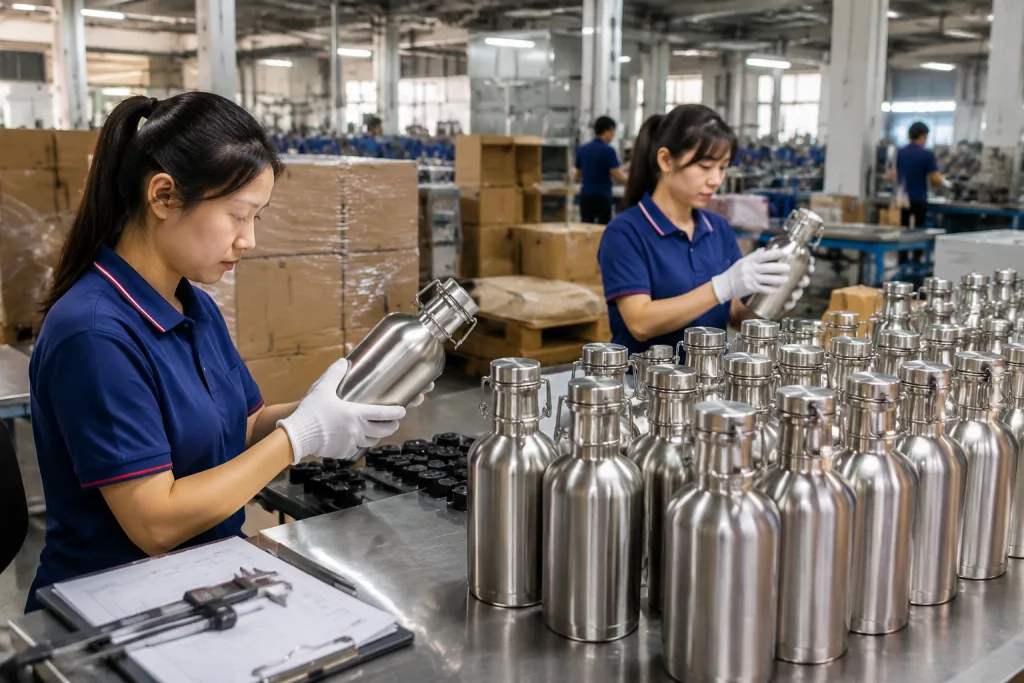
I’ll rewrite this section in place, keep the HTML structure unchanged, and tune the prose so it reads like a real factory-side sales note.A supplier directory beer growler search helps you build a first list. It does not pick the factory. Treat directory profiles as ads until you check the basics. You need to know if the company is a canteen factory, a trading company, or a mixed exporter. All three can work, but the risk is different. A real canteen maker should explain tooling, inner bottle welding, vacuum testing, powder coating defects, and carton drop test results without handing every question to another desk. We once had a buyer flag a PO typo on “growller” and that same file exposed a weak vendor fast.
Start with 8-12 potential canteen suppliers, then cut the list to 3-5 before you ask for samples. Ask for a recent BSCI or ISO 9001 audit, export markets, monthly capacity, and workshop photos taken on the line, not pulled from a brochure. At our Zhejiang facility, drinkware output runs about 420,000 units/month across bottles, tumblers, and growlers; that number matters because a 6,000 pc distributor growler order should not sit behind peak-season overflow. QC pulled the sample on a 1.2 mm wall check last week, and the math did not work for a supplier claiming “full capacity.”
Your first PO-style sourcing worksheet should already include line items, even before you issue the formal RFQ:
- Item: 64 oz stainless steel custom growler with screw lid
- Material: inner 304 stainless steel, outer 201 or 304 stainless steel
- Target order: 3,000 pcs, 2 colors, 1 logo position
- Trade term: FOB Ningbo, China
- Compliance: food-contact test for EU or US market
This forces every canteen vendor to quote the same product, not their easiest substitute. We’ve seen this go sideways when a buyer sent a loose inquiry and got a 500 ml beer mug back instead of a 64 oz growler.
Write The RFQ Like A PO
I’ll rewrite the section in place, keep the HTML structure unchanged, and tighten the copy so it reads like a buyer-facing sales engineer wrote it.Most bad quotations start with a weak RFQ. If you write, “please quote customized drinkware growler with logo,” you get prices that look cheap but do not compare. One supplier may quote 0.5 mm outer wall steel, another 0.6 mm. One includes powder coating, another quotes plain stainless. One adds a retail box; another assumes bulk pack. Write the RFQ like a draft PO. That is the right level.
For a custom canteen or customized growler, state capacity in both ounces and milliliters. A 64 oz growler usually lands around 1,900 ml, but lid geometry can change usable fill by 20-30 ml. Say if you need vacuum insulation, single-wall construction, beer-thread compatibility, handle, silicone gasket, pressure-relief feature, or a standard screw cap. Beer is not a sports bottle job. Beer buyers care about seal integrity, odor retention, cleanability, and carbonation handling on the line and in transit.
Use RFQ line items like these:
- Product name: 64 oz vacuum insulated beer growler
- Body: double-wall stainless steel, 0.5-0.6 mm outer wall
- Finish: matte black powder coating, 3H adhesion target
- Logo: laser engraving, 45 x 60 mm, front center
- Packaging: 1 pc/polybag, 1 pc/white box, 12 pcs/export carton
- Quality level: AQL 2.5 major, 4.0 minor
A canteen customizable program gets easier when the RFQ is strict. We’ve seen a buyer send a loose spec, then flag the sample because the box insert was missing and the artwork file had a typo; that sort of thing wastes 12 days fast. Suppliers that cannot quote cleanly at this stage usually fall apart when artwork, packing, and ship dates get tight.
Compare Quotes Beyond Unit Price
I’ll keep the HTML structure intact and rewrite the prose to sound like a buyer-facing sales engineer, with concrete factory details and cleaner quote logic.A low unit price does not mean much by itself. It usually leaves out the ugly bits. When we quote a custom growler, we itemize logo setup, sample fee refund terms, inner carton, export carton, barcodes, spare lids, and inland trucking to the port. For North America and Europe, ask straight away whether REACH, LFGB, FDA food-contact, or California Prop 65 papers are in the price or billed later. One buyer once missed a USD 180 test fee on a 2,000 pcs order because the PO only showed the unit price.
For reference, a 64 oz stainless customized growler with vacuum insulation, powder coating, and laser logo usually lands around USD 6.20-8.80 FOB China at 3,000 pcs. That range moves with steel grade, lid build, coating line loss, and carton spec. A single-wall canteen promo piece can come in lower, but that is a different item. Comparing it to a premium beer growler is the wrong question to ask; the field report from QC will not match, and the buyer will flag it later.
Your quote sheet should read like a PO draft:
- FOB unit price: USD per pc, with the stated logo
- MOQ: pcs per color and per logo version
- Sample time: usually 7-12 days for an existing mold
- Bulk lead time: 35-45 days after deposit and sample approval
- Payment: 30% deposit, 70% before shipment or against copy BL
- Validity: 15-30 days, since steel and FX move fast
If a canteen supplier will not split those lines, push back. We’ve seen that go sideways on the line when carton specs and freight were hidden inside one number. Ask for the breakdown before finance signs off, or you will spend the next round of emails untangling a PO typo and a missing charge.
Sample Before You Negotiate Hard
I’ll keep the tags and structure intact, then rewrite the prose to sound like a real sales engineer with tighter, more specific buyer language.Samples are not souvenirs. They are the cheapest inspection you will ever buy. Before you push a China factory to shave USD 0.20 off the quote, make sure the growler is worth buying at any price. For a custom growler, we ask for one stock sample and one decorated sample with logo, color, and packed carton. The stock piece shows the base welds. The decorated one shows whether the supplier can hold the finish when the line runs for a buyer who cares about the details.
Start with the lid. Fill the growler with water, close it, turn it upside down for 30 minutes, then shake it over a white towel. Any damp ring around the gasket or thread is a problem. Check the inside for black polishing dust or heat marks from welding. For vacuum models, we run a simple heat test: boiling water in, lid on, 6 hours on the bench, then check the temperature. For a 64 oz insulated growler, holding above 65°C after 6 hours at room temperature is a solid target, but shape and lid weight change the result. QC pulled one sample last month that dropped faster because the cap had a weak seal. The buyer flagged it immediately.
Your sample PO should be as formal as a bulk PO:
- Sample item: 2 pcs stock, 2 pcs customized growler
- Sample cost: USD 80-150 including logo setup, refundable after bulk PO above 3,000 pcs
- Artwork file: AI or PDF vector, Pantone color if printed
- Courier: DHL/FedEx billed to buyer or prepaid by supplier
- Approval deadline: buyer feedback within 5 working days after receipt
This protects both sides. The canteen manufacturer knows exactly what to make, and you do not end up debating a logo shift or coating feel that was never written down. We’ve seen that go sideways. A PO typo on a 3,000 pcs order can cost a week, and that math does not work.
Lock Artwork And Packaging
I’ll rewrite the section in-place, keep the HTML structure intact, and tighten the copy so it sounds like a factory-side sales engineer wrote it.Most custom drinkware problems show up after sample approval, not before. The buyer changes logo size, adds a retail sleeve, asks for FNSKU labels, or flips from a white box to a color box. Each change looks minor on paper. On the line, it can push production back 7-10 days. If you sell canteens into retail, ecommerce, brewery merch, or corporate gifting, packaging is part of the spec, not an afterthought.
For Amazon or 3PL shipments, lock down barcode type, FNSKU placement, suffocation warning on polybags if needed, carton marks, carton weight, and master carton size. For distributor programs in Europe, check language rules, recycling marks, and any country-level packaging limits. For North America, verify retail label claims. Do not print “dishwasher safe” unless the coating and logo method pass the test your customer will actually run. We’ve seen that one come back fast.
Your pre-production approval sheet should include:
- Logo method: laser engraving, silkscreen, heat transfer, or embossing
- Logo tolerance: placement ±2 mm, visual center aligned to the front curve
- Color standard: Pantone or approved sample chip under D65 light
- Box dieline: final PDF and AI files approved before mass printing
- Carton mark: SKU, color, quantity, gross weight, made in China
A canteen custom order should not go to bulk production until artwork is frozen. In our Hangzhou, Zhejiang shop, we release coating and logo work only after the buyer signs the pre-production sample or sends written approval. We once had a PO with “carton” typed as “caron”; QC pulled the sample, caught it, and saved a reprint. Slower? Yes. Cheaper? Also yes.
Control Bulk Production And Inspection
I’ll rewrite the section in-place, keeping the HTML structure intact and tightening the sales-engineer tone. Then I’ll make sure the wording includes concrete factory details, numbers, and a sharper buyer-side stance.Once the deposit lands, the line starts moving. For an existing mold custom drinkware order, a realistic bulk lead time is 35-45 days after sample approval. If the job needs a new lid mold, a special handle, or a private-shape custom canteen, add 25-40 days for tooling and trial runs. We’ve seen buyers push for a 20-day promise, then the coating booth backs up, the vacuum test fails, and shipping slips anyway. An honest schedule beats a pretty date on a sales sheet.
Your bulk PO needs line items the factory can run against, not just a product name and unit price:
- Quantity: 3,000 pcs, matte black 1,500 pcs, brushed steel 1,500 pcs
- Over/short shipment: ±3% allowed only with buyer approval
- Inspection: third-party inspection at AQL 2.5/4.0 before balance payment
- Defect rules: critical leakage, sharp edge, wrong logo, rust, failed vacuum test
- Spare parts: 1% spare silicone gaskets packed separately if agreed
- Shipment: FOB Ningbo, ETD within 7 days after passed inspection and balance
During production, ask for photos at three points: raw body before coating, finished logo before packing, and packed cartons on pallets. For distributor growler orders above 10,000 pcs, we run an in-line check at 20-30% completion; QC pulled one sample last month and caught a 1.5 mm logo shift before it turned into a full carton loss. This is the wrong question to ask: “Can you ship faster?” The math doesn’t work if the buyer flags defects at the port.
Plan Reorders Before First Shipment
I’ll rewrite the section in-place, keeping the HTML exactly as-is and tightening the sales-engineer tone. I’m preserving the heading and list structure, then I’ll make the prose more specific with factory-side details and cleaner reorder language.The first order tells us if the spec is real. The reorder tells us if the program can run. If you are building a canteen promo line or a long-running custom drinkware SKU, set reorder rules before the first container leaves China. Keep one approved golden sample on your desk and one at our factory. Record the steel grade, powder code, lid supplier, gasket hardness, carton size, and barcode file name. QC pulled the sample against that sheet; without it, a reorder six months later turns into a guessing game.
For canteen distributors and distributor drinkware buyers, the forecast is the part that saves the line. We can reserve coating time if you share rolling demand, even when firm POs land monthly. A 12,000 pc quarterly forecast with 3,000 pc monthly releases runs smoother than four urgent 3,000 pc orders with no warning. We’ve seen that go sideways. If your channel includes seasonal brewery merchandise or holiday corporate gifts, place replenishment POs 60-75 days before the warehouse date; a missed PO typo on the ship-to name can burn a full week.
Your reorder PO should repeat the critical lines:
- Reference sample: approved sample code and approval date
- Revision control: no material, lid, coating, or packaging change without written approval
- Unit price review: valid unless steel cost changes more than 5%
- Lead time: 30-40 days for repeat order with same artwork and packaging
- Claim window: buyer reports visible defects within 15 days after warehouse receipt
A supplier directory helps you find canteen suppliers. It does not manage the reorder. That part needs a clean record and one buyer who keeps the notes straight. That is where margin stays intact.
Send Your Growler RFQ For Factory Review
Share capacity, logo, target market, quantity, and packaging needs. Our Zhejiang team will return a practical FOB China quotation.
Frequently asked questions
What should I ask a supplier directory beer growler factory before sending an RFQ?
Ask whether they are the actual canteen factory or an export trader, then request monthly capacity, MOQ, sample lead time, bulk lead time, audit documents, and food-contact test reports. For a stainless custom growler, you should also ask for steel grade options, wall thickness, lid construction, gasket material, and available logo methods. A reliable China supplier should answer with numbers: for example, MOQ 1,000 pcs per color, sample time 7-12 days, bulk production 35-45 days, and output capacity above 200,000 drinkware units/month. If they only reply “good quality, best price,” keep them on the longlist but do not issue a PO yet.
Is a beer growler the same as a custom canteen?
Not exactly. A custom canteen is a broad category that can include outdoor bottles, military-style bottles, promotional flasks, or single-wall drinkware. A beer growler is usually designed around larger capacity, tighter sealing, better cleanability, and sometimes vacuum insulation. A 64 oz customized growler normally needs stronger attention to lid gasket performance and internal polishing than a basic canteen promotional item. If you are sourcing for breweries, distributors, or retail drinkware, write the product as “beer growler” in the RFQ and list the use case. This prevents canteen vendors from quoting a cheaper bottle that looks similar but performs differently.
What is a realistic MOQ for customized drinkware growlers?
For an existing mold stainless growler, a realistic MOQ is usually 1,000 pcs per color for laser engraving and 2,000-3,000 pcs if you need custom powder coating or printed retail packaging. For a private-shape customizable canteen with new tooling, MOQ can move to 5,000 pcs or more because the lid, body mold, and production setup need to be amortized. Some canteen suppliers offer 500 pcs, but the unit price may increase by 15-30% and color options may be limited to stock finishes. For distributor growler programs, 3,000 pcs is a more efficient starting point for pricing and production scheduling.
Which compliance documents do European and North American buyers need?
For Europe, ask for LFGB or EU food-contact test results, REACH information for coatings and silicone parts, and packaging compliance details if retail cartons are included. For North America, FDA food-contact documentation is common, and some buyers request California Prop 65 review depending on the sales channel. If the item is for children, different rules may apply, but most beer growlers are adult-use products. Your PO should state the destination market and required documents before production. Testing after production can add 7-10 working days and may create a shipment delay if labels or materials do not match the tested sample.
How do I compare a canteen manufacturer and a canteen vendor fairly?
Compare them using the same RFQ and the same PO line items. A canteen manufacturer may offer better control over welding, coating, and inspection, while a canteen vendor may coordinate multiple products if your order includes bottles, tumblers, and accessories. The fair comparison is not only price. Check sample quality, response accuracy, defect policy, payment terms, and whether they accept AQL inspection before balance payment. For example, a vendor quoting USD 6.10 FOB with unclear packaging may be more expensive than a factory quoting USD 6.45 FOB including white box, carton marks, and 1% spare gaskets.