Key Takeaways
- A serious supplier coffee mug quote should show MOQ, FOB, print method, and lead time in one line: 1,000 pcs, USD 2.15-4.80, 25-35 days.
- For corporate gifts, bulk coffee tumbler buyers usually need 304 stainless steel, 18/8 inner wall, and 0.5 mm body thickness minimum.
- In China and Zhejiang, factory-direct buying often saves 12-22% versus trading layers, but only if you verify AQL, REACH, and packing specs.
- The best coffee mug distributor for branded programs gives you sample photos, carton data, and decoration proof before mass production starts.
Most buyers start with one straight request: they need a supplier coffee mug that can pull double duty as a travel tumbler, leave the line on schedule, and protect margin. The trouble starts fast. “Coffee mug” can mean a ceramic desk mug, a stainless steel tumbler, or a gift set with a lid and spoon, depending on who sent the PO. We’ve seen that typo on the first inquiry waste a week.
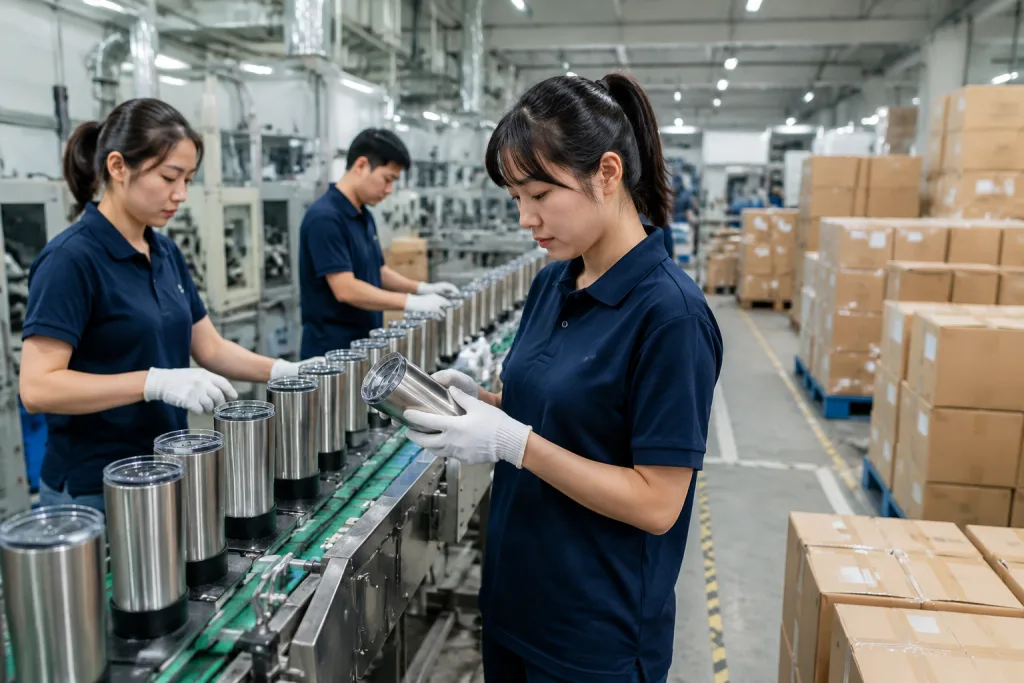
If you are buying for a coffee brand or a corporate gift program, you need a supplier in Zhejiang or anywhere else in China who answers the hard questions without dancing around them: can they do coffee mug custom decoration, what is the MOQ, what is the real FOB price, and how many days to shipment? At BottleForge in Hangzhou, our stainless tumbler line runs 120,000 units per month, with typical MOQ starting at 1,000 pcs and standard lead time around 25 to 35 days after sample approval. QC pulled the sample, checked the lid fit, and that is the level of detail a serious coffee mug factory should give you.
What are you actually buying?
Before you send an RFQ, define the item the way a factory quotes it, not the way a catalog sells it. A bulk coffee mug might mean a 12 oz ceramic cup, a glass mug, a 304 stainless piece, or a hybrid mug with a PP lid. For travel use, ask for a bulk coffee travel mug or bulk travel tumbler: sliding lid, double-wall vacuum body, and a base diameter that sits inside a 70 mm car cup holder. We see this go sideways about 6 times a month when a buyer writes “coffee mug” on the RFQ and expects a tumbler quote. QC pulled one sample last week with a loose slider because the PO only said “lid included.” That is the wrong question to ask. Quote the structure first, then compare price.
Here is the split we use on the line. A desk mug for office gifting can be 12 oz ceramic, pad printed, and packed in a white box with a 24 pcs master carton. A bulk coffee tumbler for retail needs stainless steel double-wall vacuum, a retail carton, and barcode space checked before artwork approval. A bulk travel mug for promo use can take a lower-cost lid with one-color print if the buyer accepts a simpler leak test. For a coffee brand, the safer spec is often a 16 oz or 20 oz tumbler with powder coating, 304 interior, and laser logo; the math works better than chasing a cheap lid that fails after 3 drop tests from 1.2 m. That is where coffee mug private label and coffee mug private labeling earn their keep: you lock the format, then we run tooling, coating, print, and carton around that spec.
- Use exact capacity: 12 oz, 16 oz, 20 oz, or 24 oz.
- State material: ceramic body, 304 stainless steel interior, Tritan lid, or bamboo accent.
- State use case: retail shelf, promo giveaway, Amazon FBA carton, employee gift, or distributor program.
- State finish: matte powder coat, glossy paint, or uncoated steel with visible weld control.
What should a quote include?
A usable quote from a coffee mug supplier or coffee mug manufacturer should stand on its own. If the supplier sends only a unit price, that is not a procurement quote; it is bait. Ask for the spec sheet with capacity in ml and material grade, logo print area in mm, carton count, gross weight, plus the packaging method. On our line, QC pulled a 40 oz tumbler sample last month and found the quoted carton size was short by 22 mm, which changed the freight cube. For China sourcing, especially from Zhejiang, a clean quote means 15 minutes of checking instead of 3 days of “please confirm” emails.
Good quotes for coffee mug in bulk purchasing show FOB Ningbo or FOB Shanghai, sample fee, sample lead time, mass production lead time, and payment terms. For reference, a common stainless travel tumbler might price at USD 2.35 to 3.90 FOB for 1,000 pcs, depending on finish and lid. If you need coffee mug customizable work, split the costs: Pantone matching by code, logo placement by print size, gift box by paper weight and insert type. We run into this often; the buyer sees “factory direct” and skips the tooling line, then the math does not work. That is how you compare a coffee mug factory direct offer against a trader quote without fooling yourself.
“If the quotation does not show MOQ, decoration method, and carton spec, it is not ready for procurement review.”
- Ask for FOB, not just EXW, if you want a real landed-cost comparison.
- Confirm whether the lid is included; it changes the cost by USD 0.25-0.80.
- Request Pantone matching if the brand color matters; one buyer flagged a PO typo of 186C vs 185C after samples were sprayed.
- Insist on packaging dimensions in mm for cube planning and freight estimates.
How do you judge quality fast?
I’ll keep the HTML exactly as-is and rewrite only the prose, tightening the language and adding a few concrete factory-floor details without changing the list structure or headings.You do not need a lab to cut bad suppliers. You need a short checklist and a blunt eye. For a stainless coffee mug custom made order, we ask for the material certificate, the leak test method, and the insulation report. A real double-wall tumbler should hold hot liquid for 6 to 8 hours and cold for 12 to 18 hours, depending on wall draw and lid seal. If a supplier throws out 10-hour or 24-hour claims with no test sheet, that is sales copy, not factory data.
For bulk runs, ask which AQL they use. A common export split is AQL 2.5 for major defects and 4.0 for minor defects, but the right level depends on your risk and carton count. Check wall thickness and lid tolerance too. A 0.4 mm body can pass a showroom check and still dent in transit; on the line, we run 0.5 mm or 0.6 mm for a premium bulk coffee tumbler. If the item is ceramic and sold as coffee mug promotional products, QC pulled the sample for glaze pinholes, handle pull strength, and chip marks. The buyer flagged one PO typo last month—“mug” vs “tumbler”—and that kind of slip usually means someone is not reading specs. China has plenty of capable factories. The real test is whether they can prove the numbers.
- Request 1 sample for function, 1 for decoration, 1 for drop-check reference.
- Ask for REACH compliance if you ship to Europe.
- Ask for FDA-related food-contact documentation if you serve North America.
- Verify lid leak test: upside-down for 2 hours, then carton shake test.
Which decoration fits your brand?
I’ll rewrite the prose in-place, keep the HTML structure untouched, and tighten the sales-engineer tone while preserving the existing heading and list.Decoration is where a lot of buyers miss the real cost. A coffee mug custom logo can go by screen print, laser engraving, heat transfer, UV print, or emboss/deboss, and each one changes unit cost, wear, and lead time. On the line, we see laser engraving win on stainless travel tumblers because it holds up to dishwashing and does not flake. Ceramic mugs are different; screen print stays cheaper at 3,000 pieces and handles simple branding cleanly. If you need full color, the math changes fast, and the prep can add 5-7 days before QC pulls the first sample.
The right call depends on how the mug sells. A premium coffee mug customized for a subscription coffee brand can support a two-color print plus an individual box. A coffee mug promotional piece for a trade show should keep the print simple and the turnaround tight. If your team is sorting a coffee mug supplier directory or coffee mug supplier list, price alone is the wrong question to ask. Check print tolerance first. We’ve seen a logo drift by 2 mm and the buyer flag it on a retail SKU, while the same shift passed on a giveaway mug with no issue and a barcode already mapped for Amazon.
- Laser engraving: best for stainless steel, durable, clean premium look.
- Screen printing: best for ceramic and simple one- or two-color logos.
- UV print: better for full-color graphics, but check abrasion resistance.
- Deboss/emboss: strong for tactile private label branding.
How do you buy without getting trapped?
I’ll keep the HTML structure intact and rewrite the prose to sound like a real sales engineer, with concrete sourcing details and less AI phrasing.The trap is usually not fraud; it is loose sourcing. A buyer searches for a coffee mug manufacturer, gets ten near-identical replies, then finds out one runs a 48-cavity mold, another buys lids from a trading firm, and a third quoted a carton that fails drop test at 60 cm. Treat the first round like a factory audit. Ask whether the supplier is a coffee mug oem manufacturer, whether they handle coffee mug private label work, and whether they can change mold details or only print your logo. Those are different businesses.
Factory-direct sourcing from China, especially Zhejiang, works best when you control four things: product drawing, sample sign-off, inspection plan, and shipping booking. A coffee mug factory direct quote can cut 12% to 22% versus layered trade pricing, but only if you stay on top of it. We have seen the math break when a buyer skipped the lid tolerance check and the line had to rework 800 pcs. If you buy from a coffee mug distributor or coffee mug distributors, you may get faster small-run response, but you are paying for that speed. For orders of 3,000 to 10,000 pcs, direct factory buying usually makes more sense, especially when you need steady replenishment and exact color matching.
“If the supplier cannot explain the mold, the lid source, and the inspection plan, keep searching.”
- Ask for factory videos, not just catalog PDFs; we run the line every week and QC can show the filling test and lid snap check.
- Confirm whether they own molds or source standard components; if they dodge that question, the buyer flagged it for a reason.
- Request a pre-production sample with your exact logo and box artwork; one PO typo on the carton code can stall a 20-day booking.
- Use a written defect acceptance standard before payment balance, with AQL 2.5 or your own limit spelled out.
What does a buying checklist look like?
I’ll rewrite the HTML prose to sound like a factory-side sales engineer, keep the tags and list structure intact, and preserve the existing numbers and terms.Use a checklist a procurement manager can sign off without back-and-forth. Start with the commercial fields: item name, capacity, material, color, logo method, packaging, MOQ, unit price, lead time, and ship port. Then add the technical side: wall thickness, lid type, test standard, carton quantity, and compliance papers. That is enough to compare a bulk coffee mug, a coffee mug bulk promo run, and a custom retail tumbler program without mixing them up.
For a corporate-gift order, a normal sheet might read like this: 1,000 pcs MOQ, USD 2.60 to 4.20 FOB, 25 to 35 days production, 1-color laser or print, individual box, and carton marking with SKU. QC pulled the sample on the line with a 0.5 mm wall gauge, and the buyer flagged a lid typo on the PO before we packed the cartons. If you need a coffee mug supplier for repeat orders, ask about monthly output, spare lid stock, and change-control steps. A real factory in Hangzhou or Zhejiang should also show BSCI audit status, REACH documents, and a steady packing line. That is the gap between a one-time quote and a supply setup that ships on schedule.
- Confirm MOQ and reorder MOQ separately.
- Confirm sample time: usually 5 to 10 days for custom work.
- Confirm mass lead time: usually 25 to 35 days after sample approval.
- Confirm payment terms: 30/70 or 40/60 is common for new buyers.
Send your tumbler spec and get a factory quote
We can quote your supplier coffee mug program with MOQ, FOB price, sample timing, and packaging details in one clean response.
Frequently asked questions
What MOQ should I expect for a supplier coffee mug order?
For custom stainless travel tumblers, a normal MOQ is 1,000 pcs per design and color. Some factories in Zhejiang can do 500 pcs for standard models, but your unit price will usually rise by 10% to 18%. If you need full custom molding, expect 3,000 pcs or more. For ceramic coffee mugs, MOQ can be 3,000 to 5,000 pcs depending on print colors and packaging. Always separate MOQ for sample approval from MOQ for mass production.
What is a realistic FOB price for a bulk coffee tumbler?
For a 16 oz or 20 oz stainless bulk coffee tumbler with basic powder coating and one-color logo, a realistic FOB China price is often USD 2.35 to 4.20 at 1,000 pcs. Premium boxes, laser engraving, copper lining, or upgraded lids can push it higher. If someone quotes far below that, check whether the steel grade, insulation spec, or packaging is being cut. For corporate gifts, packaging alone can add USD 0.20 to 0.80 per unit.
How do I choose between a coffee mug supplier and a coffee mug factory?
Choose a coffee mug factory if you need stable pricing, custom features, and repeated replenishment. Choose a distributor if you need small quantities, mixed SKUs, or faster access to stock items. A factory-direct order from China usually gives better control on molds, carton specs, and decoration consistency. If you are sourcing from Zhejiang, ask whether the supplier is also the actual manufacturer, because that affects lead time, margin, and defect handling.
What compliance documents should I request for Europe and North America?
At minimum, request REACH for Europe and food-contact declarations for the material used. For North America, ask for relevant FDA-related food-contact documentation from the raw material side, plus any migration or safety reports the factory has. If you are buying through a coffee mug manufacturer in China, also ask for BSCI audit status if your retailer requires it. Keep the documents tied to the exact SKU, not just the general factory.
Can I get coffee mug custom made packaging for corporate gifts?
Yes. Most coffee mug custom made programs can include individual boxes, inserts, belly bands, and barcode labels. A simple white box may cost almost nothing, while a printed retail box can add USD 0.15 to 0.60 each depending on paper and finish. If you are shipping to Amazon or a distributor network, confirm carton sizes, FNSKU placement, and master carton drop-test requirements before production starts.