Key Takeaways
- Plan 3,000 pcs MOQ for one custom color kids bottle, or 5,000 pcs if you need custom mold color matching
- Use AQL 2.5/4.0 inspection with leak, drop, torque, barcode, and logo adhesion checks before shipment
- A realistic China lead time is 30-45 days after deposit and artwork approval for standard kids bottle styles
- For school programs, carton allocation labels often save more trouble than expensive gift packaging
You are not buying a cute bottle. You are buying 12,000 small products that children will throw in backpacks, parents will inspect at the kitchen table, and buyers will blame on you if one cap leaks. A supplier children water bottle order needs tighter thinking than a normal promo bottle because size, mouth safety, coating adhesion, straw parts, and carton labels all have to line up. QC pulled one sample with a 0.8 mm cap gap last month. That batch got stopped.
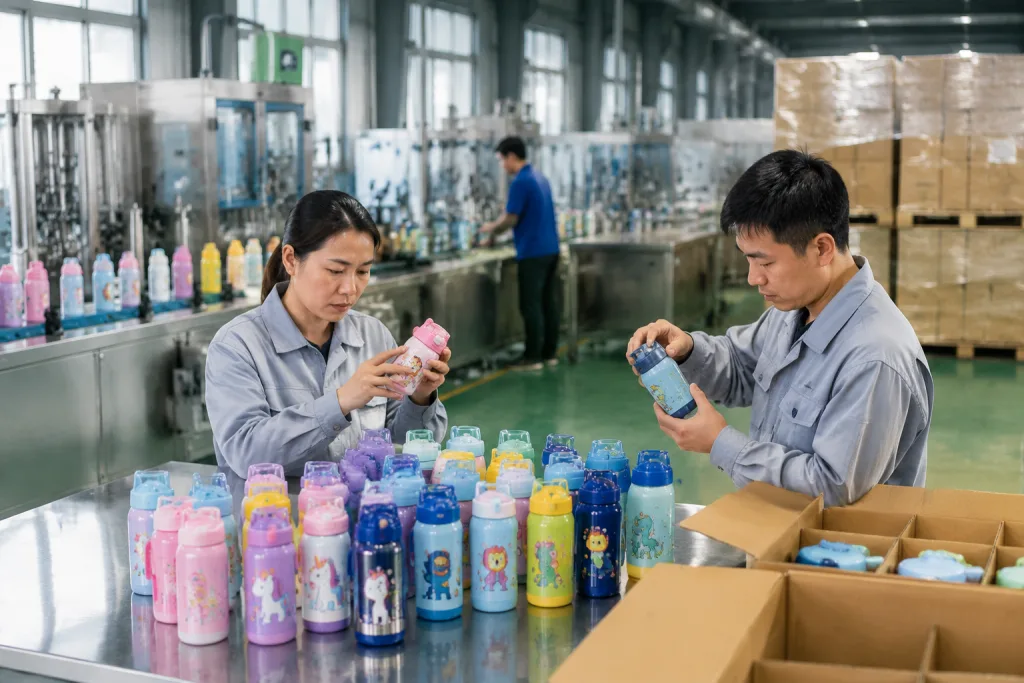
Here is a real buyer case: a school district program or kids-product importer wants a custom kids water bottle for back-to-school distribution. The target is 400 ml to 500 ml, BPA-free, branded, packed for fast allocation, and shipped from China on a fixed schedule. We run these orders in Zhejiang every season, and the buyer usually asks for 15-day sampling, then pushes for 30-day mass production. I’ll walk through how we would specify, sample, produce, inspect, and ship that order without pretending every option works the same.
Start with the real user
I’ll keep the HTML exactly as-is and rewrite only the prose, with tighter buyer-facing language and a few concrete factory details.Assume the buyer is placing 12,000 units for elementary school students aged 6 to 11. That changes the brief fast. A 750 ml sports bottle may look good in a catalog, but at full fill it is too heavy for most younger kids. For a bulk school water bottle order, 400 ml, 450 ml, and 500 ml are the sizes that work on the line. If the bottles are for retail, 350 ml for younger children and 500 ml for older children gives a cleaner range.
For this case, I would quote a 450 ml Tritan bottle with a flip straw lid, silicone carry loop, and a mouth wide enough for brush cleaning. Tritan is not the only material, but it is a solid default for a custom children water bottle: clear, impact-resistant, BPA-free, and lighter than stainless steel. If the program needs temperature retention, stainless steel vacuum is the right call, but the math changes on cost and weight. QC pulled a sample last week at 182 g for Tritan and 312 g for double-wall steel; the buyer flagged the steel as too heavy for six-year-olds.
A serious children water bottle supplier should ask who the bottle is for before talking about decoration. The cap is where complaints start. For school use, skip lids with five loose parts unless there is a clear reason. Small removable parts turn into cleaning problems and spare-part requests. A simple straw lid with a fixed hinge, food-grade silicone seal, and PP cap body is easier to QC and easier for children to use. We saw this go sideways on a PO with a typo in the lid code, and the buyer did not care that the print was perfect.
At our Hangzhou, Zhejiang production network, a standard children water bottle factory run handles about 180,000 to 220,000 plastic kids bottles per month, depending on lid complexity. MOQ is normally 3,000 pcs per style/color for existing molds. For a bulk kids water bottle order under 3,000 pcs, we can still quote it, but the unit price and color options will be tight. One 2024 school order came in at 2,400 pcs, and the buyer tried to push for six colors; that is the wrong question to ask.
Lock the specification before artwork
I’ll rewrite this section in-place, keep the HTML exactly as-is, and tune the prose to sound like a factory-side sales engineer. Then I’ll quickly sanity-check that I didn’t alter the tag structure or any fixed technical terms.Do not start with a logo file. Start with a specification sheet. A tight spec keeps the children water bottle manufacturer, trading office, and your buyer on the same page. For the 12,000 pc order, the first line should read like this: 450 ml Tritan body, PP flip straw lid, food-grade silicone straw and gasket, no BPA, no phthalates, no sharp edges, top-rack dishwasher preference, hand-wash label accepted if needed.
Then write down numbers. Do not leave wall thickness to guesswork. For a plastic custom kids bottle, 1.8 mm to 2.2 mm wall thickness is a normal range, depending on shape and drop target. Go thinner and you save cents, then QC pulls the sample and the drop test starts failing. For stainless steel custom made kids bottle orders, the inner and outer wall is often around 0.4 mm and 0.5 mm for 304 stainless steel, but the final gauge still depends on forming and target weight.
For school district buyers, compliance language has to be clean. For Europe, ask for LFGB food contact, REACH on restricted substances, and EN 14350 where the design is for younger children. For the United States, ask for FDA food-contact compliance and, where applicable, CPSIA, ASTM, and California Proposition 65 review. “Eco-friendly” is not a test report. That is the wrong question to ask. Ask for the test item, lab name, report date, and matching material description.
Here is the part buyers miss: the sample and the production resin must match. If your sample is Tritan TX1001 and the mass order quietly shifts to a cheaper copolyester, your report does not protect you. We’ve seen this go sideways on a PO typo alone. A reliable children water bottle manufacturer will print the material grade and supplier code on the production order, so the line cannot swap resin when prices move.
Before artwork, decide if you are buying a custom logo kids bottle, a full children water bottle customizable retail item, or a low-cost children water bottle promotional giveaway. Those three routes use different decoration, packaging, and QC priorities.
Sample like you expect problems
I’ll rewrite the section in-place, keeping the HTML structure and tightening the sales-engineer tone with concrete factory details and fewer generic phrases.Sampling is not a photo approval exercise. For this buyer case, we ask for 6 pre-production samples: 2 for your team, 2 for basic abuse testing, and 2 sealed as approval references. If you are a children water bottle distributor selling to 3 or 4 school districts, keep one signed reference sample in your office until the claim window closes. We had one buyer skip this step, then the district flagged a cap leak on week 6.
For a custom children water bottle, sample cost usually lands at USD 80 to USD 180 when logo setup and courier are included. Blank stock samples from an existing mold can be cheaper, sometimes USD 20 to USD 50 plus freight. A new lid mold is a different job and can run from USD 2,000 to USD 8,000 depending on mechanism and cavity count. Most school orders and importer programs should skip new mold work unless annual demand is above 50,000 pcs; the math does not work below that.
Test the sample in a boring, repeatable way. Fill it with water, close the lid, invert it for 30 minutes, then shake it for 60 seconds. Put it in a backpack with paper towels. Drop it from 1.0 m onto plywood or vinyl flooring, not concrete unless your market calls for that. Open and close the flip lid 200 times by hand. QC pulled a sample last month and the straw collar started whitening at cycle 160. Check whether children can bite the straw loose. These checks catch more real complaints than a studio photo ever will.
Logo approval belongs at sample stage too. For a custom school water bottle, silkscreen is the clean choice for one or two colors on a flat or gently curved panel. Heat transfer handles full-color art, but we still run an adhesion rub test with tape after 24 hours. Laser marking holds up better on stainless steel than plastic. A children water bottle customized with a large wrap print can look good on screen, then the artwork distorts on a curved transparent body and the reject rate climbs. This is the wrong question to ask if the print is chasing shelf appeal instead of line stability.
If your supplier in China says “mass production will be better than sample,” be careful. Sometimes true, often lazy. The sample should lock down the mass production target: cap fit, color, logo position tolerance, and packaging. We have seen this go sideways when a PO typo changed the bottle height by 8 mm and the carton insert no longer fit.
Price the order without hiding costs
I’ll rewrite the section in-place, keeping every HTML tag and structure intact while tightening the sales tone and adding concrete factory-floor detail.For a 12,000 pc order, the quote should break out product, decoration, packaging, testing, and shipping terms. A realistic FOB Ningbo or FOB Shanghai price for a 450 ml Tritan bulk children water bottle with one-color logo and standard OPP or paper sleeve packaging usually lands around USD 1.35 to USD 2.10, depending on lid design, resin grade, color, and inspection scope. On our line, a 0.8 mm wall and a basic flip lid do one cost bucket; a thicker wall and upgraded gasket move it fast. Stainless steel vacuum kids bottles sit around USD 3.20 to USD 5.80 FOB for common 350 ml to 500 ml sizes.
These are working ranges, not promises. Resin, stainless steel coil, exchange rate, and packaging all move. If a children water bottle vendor is 25% below the rest, ask what changed. We’ve seen that price come from thinner walls, cheaper lid material, weaker carton protection, no spare straws, or no third-party testing. QC pulled one sample last month and the cap thread was off by 0.6 mm. Low price only works when the spec stays put.
For children water bottle wholesale importers, carton configuration matters. A common pack is 24 pcs per master carton, with each bottle in a polybag or recyclable paper wrap. For school allocation, 12 pcs per inner carton is easier to handle, even if it adds USD 0.04 to USD 0.08 per unit. If the order may go to Amazon later, reserve FNSKU label space and check carton barcode rules before we run the line.
Payment terms for a bulk kids bottle order from China are commonly 30% deposit and 70% balance before shipment after inspection. Some established buyers use 20/80 or LC terms, but first orders are usually deposit-based. Production lead time is normally 30 to 45 days after deposit, artwork approval, and sample sign-off. Add 7 to 14 days if custom color matching needs lab dips and re-approval. The buyer flagged one PO typo once and we lost three days, so this is the wrong place to be casual.
A clean quote from a children water bottle supplier should state Incoterm, MOQ, validity period, carton size, gross weight, HS code estimate, test cost responsibility, and whether spare parts are included.
Build QC into the purchase order
I’ll rewrite the section in place, keep the HTML untouched, and tighten the language so it reads like a factory-side sales engineer wrote it.QC needs to sit inside the purchase order, not get argued about after defects show up. On a 12,000 pc children water bottle bulk order, I would spell out final random inspection under ANSI/ASQ Z1.4 or ISO 2859-1, with AQL 2.5 for major defects and 4.0 for minor defects. Critical defects stay zero tolerance: sharp edges, contamination, broken cap parts, loose small parts where relevant, and any serious leakage.
The inspection checklist should cover visual defects, color difference, logo position, logo adhesion, capacity check, weight check, lid torque or closure force, leak testing, drop testing, straw pull check, odor check, carton drop, barcode scan, and carton mark verification. For custom logo kids bottle orders, I also want a 3M tape test on printed areas. It is cheap, and it catches weak curing on the line.
Do not inspect only the bottle body. Kids bottle complaints usually come from accessories: missing silicone rings, blocked straws, weak hinges, cracked flip buttons, or dirty inner packaging. If the order is 12,000 units, pull a statistically valid sample and open cartons from different pallets. A clean top carton tells you almost nothing.
For color, use a Pantone reference, then set a realistic tolerance. Plastic resin, wall thickness, and surface texture all change how color reads. For a school program, Delta E under 2.0 is usually the wrong question; a signed physical color chip works better. If the school district wants a strict brand match, say it before the children water bottle factory buys the resin.
At BottleForge in Zhejiang, we normally recommend inline inspection after the first 10% to 20% is produced for new children water bottle custom projects. We have seen this go sideways when the buyer flagged logo height only after 1,500 pcs were done. Fixing a gasket fit or print position at that stage costs far less than reopening 12,000 pcs after packing and palletizing.
Pack for schools, not showrooms
I’ll rewrite the section in-place, keep the HTML exactly as-is, and tighten the prose so it sounds like a factory-side buyer guide with concrete ops detail.Packaging for children water bottle distributors is often overdesigned. A retail box looks nice on a shelf, but a school district cares more about fast classroom handoff, less trash, and clean grade-level sorting. We usually ship individual recyclable paper wrap, or a plain white box only when the bottle needs scratch protection. Then we pack inner cartons by school, grade, or color split.
Marking is where a lot of bulk kids water bottle orders go sideways. The master carton should show item number, color, quantity, gross weight, net weight, carton dimensions, country of origin, and PO number. If the buyer wants destination sorting, add a big side label with district name, school code, or pallet number. It costs almost nothing, and it saves warehouse staff from opening 500 cartons just to find one color.
If bottles ship to North America, confirm whether the buyer wants “Made in China” on the bottle, the packaging, or only the carton. The rule changes by market and sales channel, so do not let the factory use its default. For Europe, ask for language, recycling marks, and importer address before we print. QC pulled the sample once and found the label wording was off by 2 mm; the buyer flagged it immediately.
Palletization should be written into the PO. Loose-loaded cartons can save space, but palletized goods cut handling damage and make school receiving easier. For a 12,000 pc bulk school water bottle shipment packed 24 pcs per carton, you are looking at about 500 master cartons. At that size, carton compression strength and pallet layout are not optional.
One more practical point: add 1% spare lids or straws if the design has replaceable parts. For a children water bottle vendor, that is routine. For your service team, it stops a missing-straw complaint from turning into a refund. We’ve seen that math work, and we’ve seen it fail when the buyer tried to save 0.3% on spares.
Choose the supplier by evidence
I’ll rewrite the prose in-place, keep the HTML intact, and tighten it to sound like a buyer-facing factory note.A good children water bottle supplier is not the one with the longest catalog. It is the one that can hold the exact spec you are paying for. Ask for BSCI, Sedex, or ISO 9001 audit status if your customer needs it. Then ask for factory photos, material declarations, recent test reports, and a sample that matches the quote. If you are dealing with children water bottle suppliers through a trading company, spell out who owns QC. We have seen that part get fuzzy fast.
Using a trading partner is fine if they keep the line under control. For repeat children water bottle wholesale programs, you need traceability from body to lid. Which children water bottle manufacturers make the bottle shell? Which workshop runs the cap? Where is printing done? Who checks incoming silicone gaskets with a 0.02 mm feeler gauge? Those are the questions that stop headaches later. The wrong question is “who has the nicest brochure?”
For school district buyers, I would not switch suppliers to save USD 0.06 per unit after the first clean shipment. On 12,000 pcs, that is USD 720. One rejected container, one late vessel booking, or one cap-leak claim wipes that out. Stability wins. If you need a backup source, qualify it with a small parallel order before peak season, not after the buyer has already flagged the delivery date.
As a children water bottle manufacturer and exporter in Hangzhou, Zhejiang, we push buyers to approve the spec sheet, sample, artwork, carton marks, and QC checklist before deposit. It slows the first week. It saves week six. Whether you buy from us or another children water bottle factory in China, that is the difference between a controlled custom kids water bottle order and a PO full of assumptions. QC pulled the sample, checked the lid torque, and we caught the mismatch before the line ran 8,000 pcs.
The final supplier call should rest on evidence: matched sample, clear MOQ, written lead time, documented materials, inspection access, workable pricing, and fast answers when the technical part is unclear. If a children water bottle vendors list gives you only nice renderings, keep looking. The math does not work.
Send your kids bottle spec for a factory quote
Share quantity, material, logo, market, and deadline. We will return MOQ, FOB pricing, lead time, and QC suggestions.
Frequently asked questions
What is the normal MOQ for a custom children water bottle?
For existing molds, a practical MOQ is 3,000 pcs per style and color. If you need a custom Pantone body color, many factories prefer 5,000 pcs because resin mixing and machine setup waste become real costs. For stainless steel kids bottles, MOQ can be 1,000 to 3,000 pcs depending on coating and logo method. A children water bottle customizable project with a new lid mold is different; you should expect tooling fees and annual volume above 50,000 pcs to make the mold investment sensible.
Which material is best for a bulk school water bottle order?
For most school distribution projects, Tritan is the safest commercial choice: light, transparent, impact-resistant, and BPA-free. PP is cheaper but less premium and usually less clear. Stainless steel is stronger and supports insulation, but a 500 ml vacuum bottle can be too heavy for younger children and often costs USD 3.20 to USD 5.80 FOB. If your buyer wants low cost and easy classroom use, choose 400 ml to 500 ml Tritan. If the program emphasizes durability and cold retention, choose 350 ml to 450 ml stainless steel.
How long does a children water bottle customized order take?
For an existing mold with logo printing, plan 30 to 45 days after deposit, sample approval, and artwork approval. Add about 7 to 14 days for custom color matching, and more if third-party testing is required before shipment. Sea freight to North America or Europe may add 25 to 45 days depending on port pair and season. For back-to-school orders, do not place the PO in July and expect miracles. A safe timeline is to approve samples 90 to 120 days before the in-hands date.
Can we use our school district logo on each bottle?
Yes. A custom logo kids bottle can use silkscreen, heat transfer, UV print, pad print, or laser marking depending on bottle material and artwork. For one-color school logos on plastic, silkscreen is usually the most cost-effective and durable. For full-color mascots or gradients, heat transfer or UV print is better but needs adhesion testing. Provide vector artwork in AI, EPS, or PDF format, plus Pantone colors. For curved bottles, keep the logo area moderate; oversized artwork may distort or fail at the edges.
What should importers inspect before shipping kids bottles?
Use AQL 2.5 for major defects and 4.0 for minor defects, with zero tolerance for critical safety issues. Inspect leakage, cap fit, straw security, sharp edges, odor, color, logo adhesion, capacity, weight, carton marks, and barcode scans. For children’s products, also confirm material reports match the actual production materials. Open cartons from different parts of the finished batch, not only the top pallet. If the order is 12,000 pcs, a final random inspection is cheaper than sorting defects after the goods arrive at your warehouse.