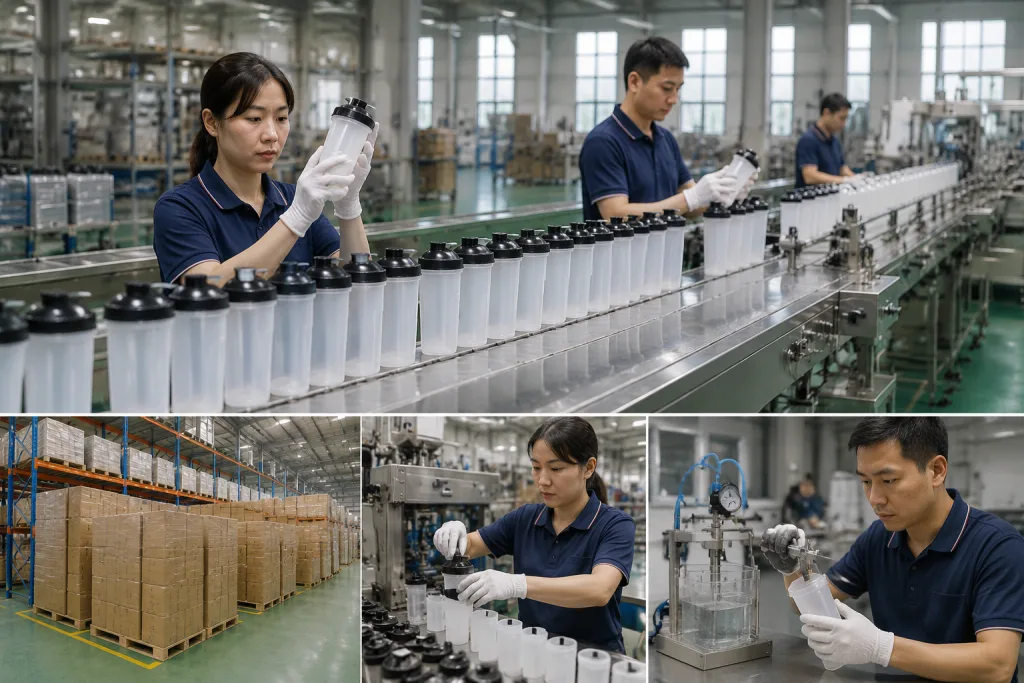
Key Takeaways
- MOQ for a serious supplier blender bottle program is often 3,000-5,000 units per SKU, with 35-45 day lead time after sample approval.
- A 700 ml bottle in Tritan or food-grade PP usually weighs 120-180 g; lighter parts cut freight but can hurt drop resistance.
- For print, laser marking lasts longer than 1-color silkscreen on textured bodies, while full-wrap UV print raises unit cost by USD 0.20-0.60.
- If you need canteen custom or custom drinkware for retail, ask for AQL 2.5 major / 4.0 minor inspection and carton drop testing before booking FOB.
- Zhejiang and broader China sourcing works best when you lock tooling, closure torque, and packaging spec before the first mass-run PO.
If you are sourcing a supplier blender bottle, the bad orders usually do not blow up on one huge mistake. They go sideways because five small specs were left open: resin grade, lid torque, ball type, print method, and carton pack-out. That is where margin gets burned, especially on China buys or when you run 6 SKUs across Europe and North America.
At BottleForge in Zhejiang, we see the same issue every week. A buyer sends “custom drinkware,” the sample passes glance test, then the line ships caps that loosen at 18 N·m instead of the agreed 24 N·m, graphics rub off, or QC pulled a sample with a smell that should have been caught on day one. If you want a canteen manufacturer, canteen supplier, or canteen factory to do real work for you, read the spec line by line and tie each item to cost, lead time, and claim risk. That is the difference between a reorder and a return.
Read the bottle spec first
I’ll rewrite the section in place, keep the HTML structure unchanged, and tune the prose to sound like a real factory-side sales engineer.When a buyer says “I need a supplier blender bottle,” we check the spec sheet first. Real specs give you volume in ml and oz, wall thickness in mm, resin type, lid build, and the use case: shaking, carry, or shelf display. Weak specs say “high quality” and “durable.” That is not procurement. That is hope.
Start with the body material. Tritan, PP, and stainless steel behave differently on cost, weight, smell retention, and print quality. A 500 ml PP shaker usually lands at USD 1.10-1.80 FOB China in volume, while a stainless custom growler or customizable growler can move to USD 4.50-9.00 depending on gauge and finish. We ran one 700 ml PP line last month where the buyer flagged a lid mismatch, and the math did not work until we changed the cap insert. If you buy for a canteen distributor or a distributor drinkware program, you need the spec that drives freight, breakage, and shelf appeal.
- Volume: 500 ml, 700 ml, 1,000 ml are the usual commercial sizes.
- Wall thickness: 0.8-1.2 mm for PP; 0.6-0.8 mm for some Tritan bodies.
- Weight: 120-180 g for plastic shaker bottles; 230-420 g for steel.
- MOQ: 3,000 pcs is common; 5,000 pcs is safer for custom color runs.
If your canteen supplier cannot quote these numbers without “checking with the factory,” you are not dealing with a production-ready line. QC pulled the sample on a 1,000 ml customized drinkware order here in Zhejiang because the carton test failed at 18 kg stack load, and we fixed it before shipment. We’ve seen that go sideways fast, so ask for the numbers up front.
Body material changes margin
I’ll rewrite the prose in-place, keep the HTML exactly as-is, and tune it to sound like a factory-side sales engineer.Material choice is not a style call; it sets your margin. For a customized drinkware program, the body material drives mold cycle time, scrap, clarity, odor resistance, and whether the shaker looks good enough for retail shelves. Tritan moves well on clear shakers because it gives a glass-like look without the breakage risk. PP costs less and runs easier on the line, but the part can look flat unless you pair it with color matching, matte texture, or a cleaner print process. Stainless steel gives you a stronger retail story, but the cost base is higher and the welding and passivation controls have to be tight.
For a canteen customized or custom canteen program, ask for the real loss rate during molding. A plant saying 1% scrap sounds nice, but if they cannot show cycle data from the injection machine, you are paying for hidden regrind or wall variation later. We had a buyer flag a PO typo on wall thickness once, and QC pulled the sample at 0.9 mm when the spec said 1.1 mm; that kind of miss changes the whole quote. Also ask whether the resin is food-contact compliant under FDA 21 CFR and REACH where needed. If you are shipping to Europe, REACH paperwork matters; if you are shipping to North America, buyers usually want FDA or LFGB support depending on the channel.
My rule is simple: if the supplier cannot explain why a 0.9 mm wall beats 1.1 mm for your target price point, they are selling a shape, not a program.
For a canteen manufacturer in China, especially in Zhejiang, stable resin sourcing matters as much as the machine itself. We run into this when a pellet lot shifts and the cap fit changes by 0.3 mm; the math does not work if you chase a 2-cent saving and end up with a container of warped bottles or cold-weather cracks.
Lid design decides complaints
I’m rewriting the section in-place, keeping the HTML structure and tightening the sales-engineer tone. I’ll keep the tech details intact and swap out the generic phrasing for sharper, factory-floor language.Most shaker bottle returns come from the lid, not the body. The weak spots are the cap thread, gasket, hinge pin, and flip-top closure. If you are sourcing from a canteen factory or canteen vendor, ask for torque numbers and leak data, not showroom photos. A lid that feels fine in the sample room can still fail a 24-hour inverted test at 40°C.
Get three specs in writing: thread pitch, gasket material, and leak test standard. A solid shaker lid should handle 10-15 inversion shakes with no seepage, and the hinge should still work after 3,000 open-close cycles. For a customizable canteen or customizable growler program, the same rule applies to screw tops and carry caps. We’ve seen buyers ignore this, then the freight bill jumps because one leaky lid forces extra packing and a bigger carton.
- Leak test: inverted for 24 hours, at room temp and warm condition.
- Cycle test: 3,000-5,000 open-close cycles for retail use.
- Gasket: silicone is safer than low-grade TPE.
- Thread: must stay consistent across all cavity outputs.
If you are a canteen distributor or distributor canteen buyer, this is where you protect your reviews. A bottle can print clean and still lose the account if the lid drips in a gym bag. That is the wrong place to save a few cents.
Decoration is not just branding
I’ll rewrite the section to sound like a factory-side sales engineer, keep the HTML intact, and preserve the structure and key numbers.Decoration sets the landed cost and the sell-through rate. For custom drinkware, the print method has to match the body finish, target retail price, and how the bottle will be handled after it leaves the line. We run silkscreen on simple logos for smooth plastic or steel. Laser engraving fits premium steel and coated surfaces because it does not rub off. UV print and full wrap graphics do pop on shelf, but they add process time and usually push unit cost up by USD 0.20-0.60 depending on coverage.
If you are ordering a canteen promotional run, do not overdo decoration. Promotional buyers want a low unit cost and a logo people can spot from 2 meters away. For that job, 1-2 color silkscreen is usually the right call. For retail, private label, or a custom growler line, matte powder coat, metallic ink, or a debossed mark makes more sense. QC pulled the sample through scratch testing and dishwasher resistance, because a bottle that looks sharp on day one and flakes in a week is a bad deal. The buyer flagged that on a 5,000-piece PO once, and the math did not work.
Ask your canteen supplier for exact logo placement tolerance, usually ±1.5 mm on smaller bodies and ±2.0 mm on larger containers. That is not paperwork fluff. On a crowded shelf, 3 mm off-center is enough for a buyer to reject the sample. If you work with canteen suppliers in China, send the Pantone code, print area in mm, and whether the artwork is one-sided or wraparound before sample approval. We have seen a PO typo on the print area turn into a full remake.
Packaging decides your landed cost
I’ll rewrite this section in-place, keep the HTML structure unchanged, and tighten the sales-engineer tone with concrete factory details and landed-cost specifics.Packaging is where buyers bleed margin without seeing it on the PO. A bottle that ships fine in a mailer can get crushed in retail, while a retail box can blow up cost on distributor programs. For a supplier blender bottle order, we run the spec by inner protection, carton count, outer carton strength, and pallet pattern. If the shipment goes from Zhejiang to the US or EU, carton size and pack weight hit the freight bill fast.
Take a 24-piece export carton for a 500 ml shaker. If the gross weight creeps past 11-13 kg, some warehouse teams start flagging it, and we have seen that turn into corner crush and repack charges. If you need FBA-ready packing, lock in FNSKU labels, any suffocation warning, and barcode position before the line starts. QC pulled the sample on one order because the buyer flagged a typo on the carton mark, and that delay cost 4 days.
- Retail box: 350-600 gsm paperboard for shelf display.
- Inner protection: pulp tray or PE bag with divider insert.
- Carton test: drop test and compression test for export lanes.
- Labeling: barcode, batch code, and origin marking.
A canteen vendor that skips packaging is not quoting landed cost. That math does not work. You need the cost from factory gate to warehouse shelf, including carton spec, pallet pattern, and the extra grams that show up in freight. On one 40HQ, a 120 g carton change moved the air freight quote by more than the product margin.
Compliance is a sales tool
I’ll rewrite the prose in place, keep the HTML intact, and make it sound like a factory-side sales engineer wrote it.Compliance is not back-office paperwork; it is what gets a buyer’s procurement team to say yes. If you are building a custom canteen or customized canteen line for Europe and North America, ask for the file set before you quote: FDA food-contact support, REACH, LFGB where it applies, and material declarations for stainless or polymer content. If the product carries a powder-coated finish, check the coating chemistry and migration data. If it is stainless steel, ask for test results on lead, cadmium, and other heavy metals at the stated thresholds. We have seen buyers stop a PO over a missing migration page. The math does not work if you try to fix it after sampling.
For a canteen manufacturer in Zhejiang, clean compliance documents cut approval time. A serious buyer often wants BSCI, ISO 9001, or factory audit support before they release the PO; last month a buyer flagged a PO typo on the company name and held the order for 12 days. They may also want an AQL inspection plan: 2.5 for major defects and 4.0 for minor defects is common for drinkware, though some retail programs tighten it further. We run QC with a pin gauge and a torque tester, then log the results by carton. If you are importing into Amazon or big-box retail, this is the part that keeps chargebacks and rejected deliveries off your desk.
Do not treat documents as optional because the sample looked fine. A clean sample from China does not remove batch traceability, especially when the same factory runs multiple canteen promotional and retail SKUs on the same line. Keep lot numbers, resin certificates, and inspection records together. QC pulled the sample, but the buyer still asked for the lot code on the carton and the ink batch on the label. That is how experienced canteen manufacturers handle repeat business.
Send Your Spec Sheet, Get a Real Quote
If you need a supplier blender bottle program from China or Zhejiang, send your target volume, lid type, logo file, and carton spec. We’ll quote the numbers, not guesses.
Frequently asked questions
What MOQ should I expect for a supplier blender bottle?
For a standard custom run, 3,000-5,000 pcs per SKU is normal in China, especially if you need a custom color, logo, or retail box. If you want multiple lid colors or a special mold finish, the MOQ can move to 8,000 pcs. In Zhejiang, a capable factory will usually quote 35-45 days after sample approval, plus 7-12 days for freight packing and booking. If the supplier offers 500 pcs with full customization, check whether they are reselling stock instead of running a real production line.
How much does a custom drinkware bottle cost FOB China?
A basic PP shaker bottle can start around USD 0.90-1.80 FOB China in volume, depending on size and print. Clear Tritan styles often land around USD 1.60-3.20. A stainless custom growler or customized growler is usually USD 4.50-9.00+, depending on wall gauge, lid structure, finish, and packaging. If you add laser engraving, matte powder coat, or special carton inserts, budget another USD 0.20-1.00 per unit. Always ask for the price at 3,000 pcs, not just sample pricing.
How do I check whether a canteen manufacturer is reliable?
Ask for factory photos, audit reports, and real production metrics: monthly output, QC process, and lead time. A reliable canteen manufacturer should be able to state monthly capacity, for example 300,000-500,000 units/month across lines, and explain how they handle leak tests, torque checks, and batch traceability. Request AQL inspection standards, material declarations, and compliance documents for your market. If they cannot describe their QC flow in plain numbers, they are probably not ready for a long-term distributor drinkware program.
What is better for branding, silkscreen or laser engraving?
For simple logos on a lower-cost canteen promotional product, silkscreen is usually the cheapest and fastest. For premium stainless steel or coated bodies, laser engraving gives better wear resistance and a cleaner retail look. Silkscreen often works best for 1-2 colors and smooth surfaces; laser is stronger when you want a permanent mark. On some custom canteen and custom growler lines, a combo approach is smart: laser on the body and printed artwork on the box. Expect laser to add time but reduce long-term abrasion complaints.
Can a canteen supplier handle Amazon FBA requirements?
Yes, if they have done it before. A good canteen supplier should support FNSKU labeling, carton barcodes, master carton specs, and safe pack-out for transit. Ask for carton dimensions and target carton weight so your inbound receiving stays under control. For Amazon, you also want batch codes and clean outer labeling. Many failures happen because the bottle is fine but the packaging is wrong. If you need FBA, share the prep spec before sampling, not after mass production has started.