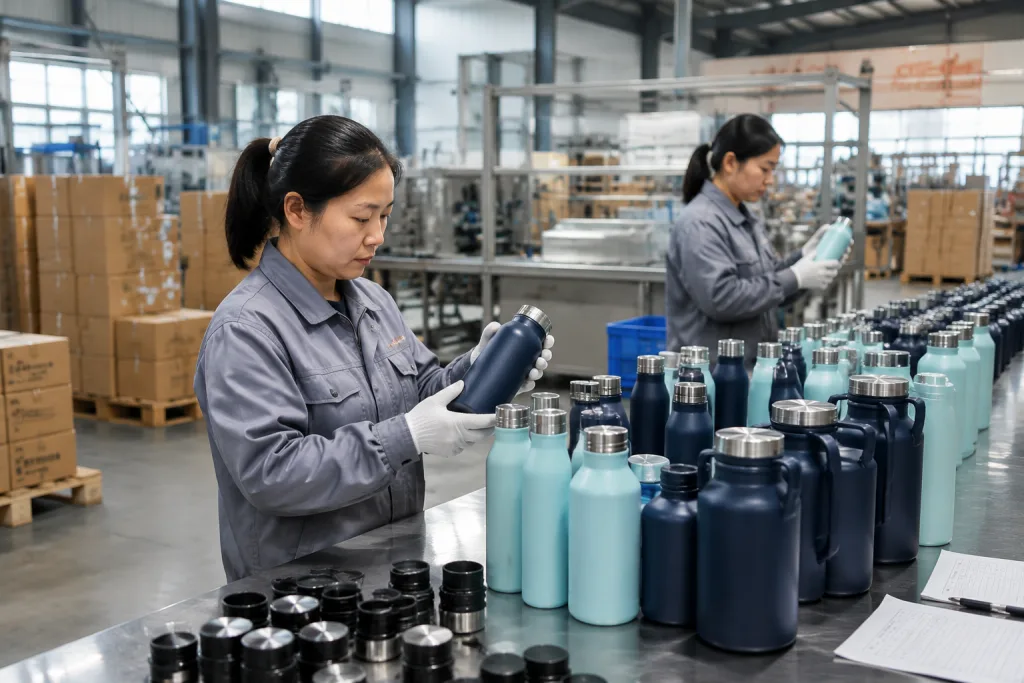
Key Takeaways
- Specify 0.50 mm inner and 0.60 mm outer 304 stainless walls for most retail bottles
- Use AQL 2.5 for major defects and AQL 4.0 for minor defects before shipment
- Plan 25-35 days for standard wholesale drinkware production after sample approval
- MOQ is usually 1,000 pcs per color for powder coating and 500 pcs for laser logo
Most stainless water bottles wholesale problems do not begin with bad intent. They start with a vague spec sheet, a rushed pre-production sample, and a buyer treating every 18/8 bottle like the same part. We’ve seen it on the line: 0.5 mm wall drift, a lid gasket 1 mm off, and cartons that pass a glance but fail the drop test. By the time the container reaches Europe or North America, the bill is already ugly—leaking lids, thin coating, dented cartons, logo placement off by 3 mm, or test reports that do not match the shipped SKU.
If you buy wholesale drinkware from China, think like a failure investigator before you approve the PO. Our Hangzhou, Zhejiang team sees the same problems across bulk drinkware programs: canteen wholesale, beer growler wholesale, alcohol flask wholesale bulk, and retail bottle launches. QC pulled the sample, the buyer flagged the cap torque, and the math did not work until we tightened the drawing, locked the tolerance, and held inspection before balance payment.
Thin Steel Creates Hidden Claims
I’ll keep the HTML exactly as-is and rewrite only the prose, tightening the claims and adding a few factory-floor details while preserving the structure.The first failure mode does not show up in a catalog shot. A bottle can look solid and still use thin stainless steel that dents in courier handling or pulls in a little around the shoulder after vacuum forming. For stainless water bottles wholesale, wall thickness matters more than the phrase “premium 304.” At our line, QC pulled a sample at 0.42 mm and the buyer flagged it before packing.
For most 500-1,000 ml double-wall bottles, a workable spec is 0.50 mm inner wall and 0.60 mm outer wall in SUS304. Use SUS316 only when the bottle is going near salt water, acidic drinks, or a higher retail ticket. If you are buying a bulk canteen or wholesale canteen for outdoor use, do not chase the lightest body. Saving 12-18 g per unit sounds neat, but a dent rate of 3% can erase the metal saving fast.
Ask the supplier for a cross-section measurement from production material, not just a line in the quotation. Put the weight tolerance into the PO, too: for example, 500 ml bottle body net weight 255 g ± 8 g before cap. That gives QC a quick check against material swap during inspection. We once saw a PO typo that read 250 g ± 8 g, and the whole batch argument started there.
Vacuum loss is the other common miss. Thin walls can move during vacuum sealing, and weak vacuum retention cuts insulation hard. Run a test with hot water at 95°C, room temperature 20-25°C, and readings at 6 hours and 12 hours. A sane target is ≥65°C after 6 hours for a 500 ml bottle. If you buy bulk growler, beer growler bulk, or growler wholesale products, set a separate test; 1.9 L and 2 L bodies cool on a different curve than small bottles. The math does not match one-size-fits-all.
Do not approve a stainless program on steel grade alone. Grade tells you corrosion resistance. Gauge and forming control tell you whether the bottle survives real distribution.
Lids Leak When Tolerances Drift
I’ll keep the HTML intact and rewrite the prose to sound like a factory-side sales engineer, with tighter, more specific sourcing language.Leakage kills repeat orders fast. We see it on the line: a cap that looks fine in hand fails once thread pitch, gasket height, and torque drift by a fraction of a turn. Cap geometry is not an accessory. It is an assembly. One mold can look clean and still miss a body from another mold by 0.3 mm on the mouth finish, and that is where the buyer flags it.
For drinkware wholesale programs, lock the cap drawing together with bottle mouth ID, OD, thread pitch, and gasket material before sample sign-off. Food-grade silicone needs a Shore A callout, usually 50-60 for most bottle gaskets. Softer than that, and the seal can roll or tear during cap-on tests. Harder than that, and compression goes uneven. For canteen bulk or canteen wholesale orders with wide-mouth caps, we run a 100% air-pressure or vacuum leak check on the assembly line, then an AQL inspection with the bottle inverted and filled.
One field test tells you a lot. Fill the bottle to 90%, close it to normal hand torque, invert it for 30 minutes, then shake it sideways for 30 seconds. For sports caps and flip lids, add a 1.0 m drop test on three sides with water inside. That sounds harsh. The math works. North American retail returns are harsher.
Alcohol flask bulk and alcohol flask wholesale orders need tighter control because narrow mouths, hinged caps, and small seals leave little room for error. If you buy alcohol flask in bulk for promotions, state whether the flask only needs to stay leak-resistant in a tote or whether it must stay leak-proof under bag movement. Those are different specs. We’ve seen this go sideways when a buyer used one line for both. A Zhejiang supplier can build either, but the quote changes once you ask for better gaskets and tighter inspection.
For replacement parts, confirm the spare cap MOQ before launch. A normal MOQ is 1,000-3,000 pcs per cap color. If you sell through distributors, keep 1-2% spare lid stock on hand; one cracked lid should not turn into a full account complaint.
Coating Fails Before Steel Does
I’ll rewrite the section with tighter factory-floor language, keep the HTML structure untouched, and make sure the prose sounds like a sales engineer wrote it.Buyers often blame the factory when powder coating chips, but the real miss is usually the spec sheet. “Matte black powder coat” is not a spec. It says nothing about coating thickness, adhesion, cure temp, salt spray, abrasion, or whether the logo gets laser engraved after coating or printed on top.
For stainless water bottles wholesale, powder coat thickness usually lands at 60-90 microns. Too thin and the edges show through. Too thick and threads, cup holders, or lids stop fitting right. For retail-grade bulk drinkware, we ask for a cross-hatch adhesion test to ISO 2409 or ASTM D3359, with 0-1 as the pass range. For coastal markets or outdoor wholesale drinkware, we run a 24-48 hour neutral salt spray test on coated samples. It is not a perfect real-world predictor, and that is the wrong question to ask, but it exposes bad pretreatment fast.
Logo decoration has its own failure modes. Silkscreen scratches when the ink or cure is off. Laser engraving holds up better, but it exposes the stainless underneath and can look low contrast on light colors. UV print gives color detail but needs rub testing. If your brand guide calls for a 0.3 mm line weight, QC pulled the sample on a curved bottle first. Do that before mass production.
Beer tumbler wholesale bulk and beer tumbler in bulk programs often use dark powder coat with large logos. That combo shows scratches after carton vibration. We ship those with each unit in a polybag or tissue wrap, then an individual white or kraft box with a divider if the product has a handle. For beer tumbler bulk orders, the handle must not touch another tumbler wall in the master carton. We’ve seen that go sideways on a 5,000-unit PO because the buyer flagged a packing typo and the line kept loading them too tight.
Our Zhejiang production partners usually run 300,000-500,000 drinkware units per month across bottles, tumblers, and growlers. At that scale, coating quality is not luck. It comes down to pretreatment control, a stable line speed, cure records, and packing discipline at the end of the line.
Compliance Gaps Delay Containers
I’ll rewrite the section in place, keep the HTML exactly as-is, and tighten the compliance language so it sounds like a factory-side sales engineer wrote it.The fourth failure mode is paperwork that looks clean until the importer, retailer, or customs broker asks for the exact model. A generic FDA or LFGB report may cover a bottle shell but miss the lid, straw, silicone gasket, or coating in your PO. If the report belongs to a different SKU, it won’t save you when the buyer flags the file pack.
For Europe, the usual stack is LFGB, REACH, and food-contact declarations, depending on the destination. For the United States, FDA food-contact compliance is standard, and California Proposition 65 review comes up when the material set calls for it. Kids products can also pull in CPSIA, ASTM, and tracking label rules. If you are pitching the best wholesale drink bottle for schools or youth sports, treat it as a children’s product until your compliance consultant signs off.
Do not wait until final inspection to chase documents. Put the file list in the PI: stainless steel material reports, silicone and PP or Tritan test reports, coating test where needed, BSCI or a social audit if your customer asks for it, and ISO 9001 if it sits in the vendor file. We run this weekly, and the math is simple: prior reports can land fast, but a new model test still takes 7-12 working days plus courier time. QC pulled the sample once and found a wrong wall-thickness note on the report. That delay cost 4 days.
For alcohol flask wholesale bulk, beer growler wholesale bulk, and wholesale growler orders, the wording on the label matters. Some markets push back on alcohol claims, capacity marks, and warning text. A beer growler in bulk with a swing-top cap may also need a pressure-use note. If it is not built for carbonation pressure, say that in the manual and on the box. We’ve seen this go sideways on a 1,000-unit PO because the buyer wanted “pressure safe” on the carton, and it was not true.
FOB China pricing should also say who pays for compliance testing. For a new private-label program, the cleaner setup is to put the final reports under the buyer’s SKU and artwork, not the factory name. Factory-held reports help with screening, but they do not always clear retail onboarding. One typo on a PO can burn a week, so we check the SKU code, cap code, and carton mark before we release the line.
Cartons Break Good Bottles
I’ll rewrite the section in-place, keep the HTML exactly as-is, and tune the prose to sound like a factory-side sales engineer.A perfect bottle still lands unsellable if packing gets treated like a side note. We see this on bulk drinkware orders all the time: the buyer chases unit price, then a stainless bottle with a curved body, painted finish, and loose cap rubs through thin pack-out during 30-45 days on the water.
Start with the channel. Amazon FBA, club retail, distributor pallets, and promo drops all want different packs. For FBA, keep the carton under 22.7 kg unless your forwarder signs off, add FNSKU labels, and ship master cartons that have already passed a drop test. For retail shelves, the color box has to take corner hits without crushing. For wholesale drinkware distributors, plain inner boxes can work, but barcode placement and carton marks still need to be clean.
A solid export carton spec is 5-ply K=A or K=B corrugated board for heavier bottles, especially 1 L canteens, bulk growler units, and beer growler wholesale orders. For a 2 L stainless growler bulk shipment, we run internal dividers or molded pulp when the finish is powder coated. QC pulled a sample on a 76 cm drop from one corner, three edges, and six faces; that is the floor, not a luxury, even if the load goes out on pallets.
Do not skip palletization. If you ship from Zhejiang to Ningbo or Shanghai port, the truck leg is short, but the cartons still take vibration, humidity, and stack pressure. Ask for pallet height, carton count, gross weight, and loading photos before you sign off. For North America, the usual ask is 40 x 48 inch pallet planning; for Europe, 1200 x 800 mm EUR pallet logic is the normal call.
Packaging also changes landed cost. The math does not work if a cheaper carton saves a few cents and then adds 2% damage in transit. A stronger carton that adds USD 0.08-0.15 per unit often wins once you count credits, replacements, and the buyer who flags the same issue twice in one season.
Price Pressure Moves Defects Upstream
I’ll rewrite the prose in place, keep the HTML exactly as-is, and tighten the copy so it sounds like a factory-side sales engineer wrote it.The last failure mode is commercial. The buyer pushes only on FOB unit price, then strips out the controls that keep the bottle stable on the line. 304 or 201 stainless, 0.4 mm vs 0.5 mm wall thickness, coating pretreatment, cap gasket grade, individual boxes, carton burst strength, and inspection hours all show up in the cost. If a quote comes in USD 0.35 below the pack, ask what got cut before you get excited.
For stainless water bottles wholesale from China, FOB ranges move with size, finish, and packing. A 500 ml double-wall 304 bottle with a standard lid and one-color logo usually sits around USD 3.20-4.80 FOB Ningbo at normal MOQ, depending on quantity, coating, and packaging. A 1 L outdoor canteen wholesale model often lands at USD 5.20-7.80. A 2 L wholesale growler or beer growler wholesale item with handle, powder coat, and retail box can run USD 9.50-15.00. QC pulled one sample at 4.6 kg carton weight last season and the buyer flagged it; the math moved because steel and FX moved, not because anyone was guessing.
MOQ should follow the process, not a sales brochure. Laser logo on stock color can often start at 500 pcs. Custom powder color is usually 1,000 pcs per color. New mold lids, custom handles, or special caps may need 3,000-5,000 pcs. For beer tumbler wholesale, alcohol flask wholesale, and mixed bulk drinkware programs, ask whether the factory can consolidate colors or SKUs to keep the line running. If the buyer wants seven colors at 300 pcs each, that is the wrong question to ask; setup loss eats the margin fast.
Inspection is not optional. Use AQL 2.5 for major defects and AQL 4.0 for minor defects, with critical defects at 0. Critical defects include sharp edges, contamination, serious leakage, wrong material, and unsafe packaging. Put the inspection checklist in the PO, not in a late email after goods are packed. We have seen a PO typo on carton size turn into a full repack job, and nobody on the floor called that a small issue.
The best supplier relationship is plain about trade-offs. If you want the lowest promo cost, say it and take simpler packaging. If you want retail quality, hold the spec and pay for it. A competent China factory can run both jobs, but it will not guess which failure you are willing to live with.
Send your bottle spec before you quote
We will review drawings, MOQ, decoration, packaging, and QC points so your wholesale order is priced against the right failure risks.
Frequently asked questions
What MOQ should I expect for stainless water bottles wholesale?
For standard factory models, MOQ is usually 500 pcs for laser engraving on stock colors and 1,000 pcs per color for powder coating or silkscreen printing. If you need a custom Pantone coating, special lid, molded handle, or unique bottle shape, expect 3,000-5,000 pcs because the factory must set up coating lines, tooling, and material purchase. Mixed SKU orders are sometimes possible if the bottle body is the same and only the logo changes. For canteen bulk, beer tumbler bulk, or alcohol flask bulk projects, ask whether MOQ is counted by size, color, or decoration method. That detail affects your launch budget more than many buyers expect.
How long does production take after sample approval?
A normal wholesale drinkware order takes 25-35 days after sample approval and deposit, assuming standard materials and no new mold. Add 7-12 working days if new compliance testing is required. Add 10-20 days for a custom lid mold or complex retail packaging. Peak season in China, usually before major holiday shutdowns and Q3 retail shipments, can stretch schedules by another 7-15 days. If you are shipping from Zhejiang through Ningbo or Shanghai, ocean transit to the US West Coast may take around 16-25 days port to port, while Europe often takes 30-40 days depending on routing.
What inspection standard should I use before shipment?
Use a written AQL plan. A common setup is AQL 0 for critical defects, AQL 2.5 for major defects, and AQL 4.0 for minor defects. Critical defects include leakage, sharp edges, foreign material inside the bottle, wrong food-contact material, and unsafe packaging. Major defects include visible dents, poor logo placement, coating peel, wrong capacity, or failed insulation. Minor defects include small cosmetic marks within an agreed limit. For stainless water bottles wholesale, include functional tests: 30-minute inversion leak test, insulation test, cap torque check, barcode scan, carton drop test, and random weight check against the approved sample.
Can I combine bottles, tumblers, growlers, and flasks in one order?
Yes, but consolidation has limits. A factory may combine stainless bottles, beer tumbler wholesale bulk, growler bulk, and alcohol flask wholesale items in one shipment, but MOQ is usually calculated by production process, not by container total. Powder coating colors, lid types, and packaging styles each create separate setup work. If you need a mixed wholesale drinkware program, start with shared finishes and shared carton standards. For example, 1,000 pcs matte black bottle, 1,000 pcs matte black tumbler, and 500 pcs laser-engraved flask may be easier than five custom colors at 300 pcs each. Consolidated loading can reduce freight cost, but it does not erase factory setup cost.
How do I know if the quoted price is too low?
Ask for the cost drivers behind the quote: stainless grade, wall thickness, body weight tolerance, lid material, gasket silicone, coating thickness, packaging grade, testing, and inspection scope. If one supplier is 8-15% lower than others, something is usually different. It may be thinner steel, lighter carton, no individual box, cheaper cap, or excluded compliance testing. For a 500 ml double-wall bottle, FOB China pricing around USD 3.20-4.80 is common for standard retail quality, depending on quantity and finish. A price below that can be valid for simple promotional goods, but you should confirm exactly which failure risks you are accepting.