Key Takeaways
- A realistic stainless bottle MOQ is 1,000-3,000 units per SKU for custom colors and logos
- 304 stainless steel is standard for inner walls; 316 is useful for higher-corrosion or premium projects
- Normal custom drinkware lead time is 30-45 days after artwork and deposit approval
- Use AQL 2.5/4.0 inspection, not random carton photos, for distributor drinkware orders
You are not just buying bottles. You are buying line control: 304 stainless thickness at 0.5 mm, repeat powder color under a D65 light box, FDA or LFGB material files, export paperwork, and a supplier who answers when 3 cartons fail the 76 cm drop test. A stainless water bottles manufacturer can look sharp on a website and still lose control at the weld seam, the coating booth, or AQL 2.5 inspection.
From Hangzhou, Zhejiang, we hear the same 4 buyer questions every week: what MOQ is real, why one custom canteen quotes 12 days and another needs 18 days, which logo method survives retail shelf handling, and when a canteen distributor should buy direct from China instead of paying a trader margin. Fair question. The wrong question is “who is cheapest”; we have seen that go sideways when QC pulled 20 scratched lids from a pre-shipment sample and the PO still had the wrong Pantone code.
First question: factory or trader?
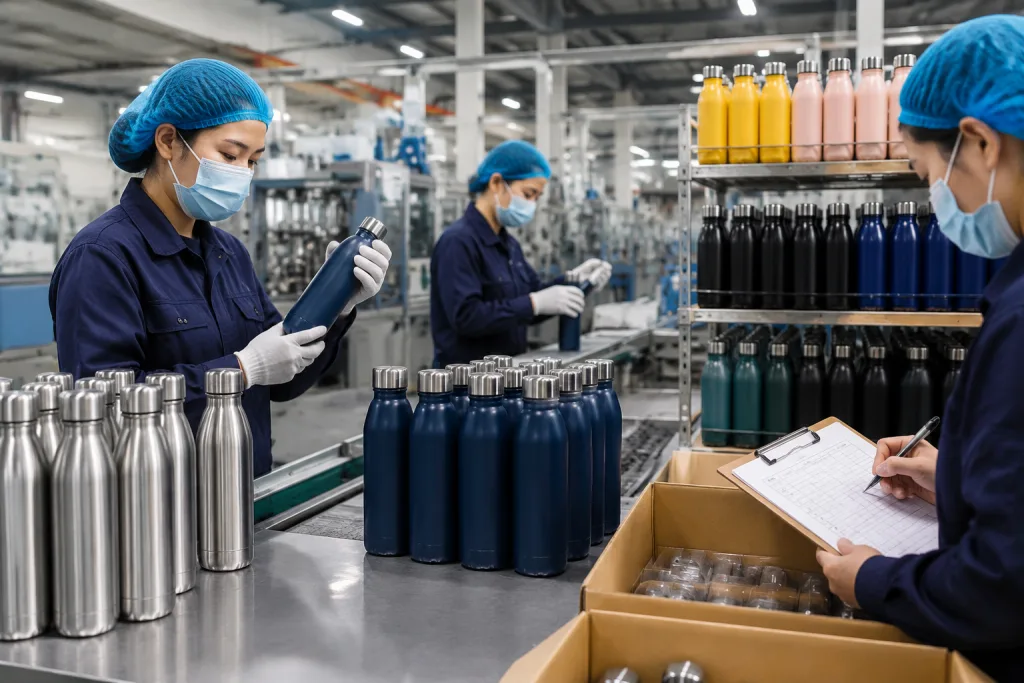
If this is your first China sourcing project, do not take the word “manufacturer” at face value. We see it printed on 8 out of 10 supplier profiles, even when the company owns no welding line. A real stainless water bottles manufacturer controls the core work: tube forming, laser welding, vacuum insulation, polishing, coating follow-up, and final inspection. A trader can still make sense for small mixed orders, but you should know who is holding the caliper and who is just holding your deposit.
Ask for three facts before you talk artwork: monthly capacity, main equipment, and which steps leave the building. At BottleForge Industrial in Zhejiang, our stainless bottle and tumbler output is typically 450,000-600,000 units per month across standard models, with trial MOQs from 1,000 units for selected stock shapes and 3,000 units for new colors or non-standard lids. On the line, we check mouth diameter with a go/no-go gauge before lids move to assembly. Those numbers matter because they show whether a canteen supplier can protect your ETD when every buyer suddenly wants Q4 shipment.
A direct canteen factory is the better fit when you need repeat orders, tighter brand color control, private mold parts, or documents for REACH, LFGB, FDA food-contact, and Prop 65 review. We run color checks against a Pantone card under a D65 light box because “close enough” becomes a claim when the buyer’s shelf set has 12 colors. A trading company may work if you need 200 units split across unrelated SKUs. That is not a manufacturer program, though, and the math usually breaks once you add mixed cartons, extra QC time, and logo setup fees.
For procurement managers, the test is simple: can the supplier explain wall thickness, vacuum failure rate, coating pre-treatment, carton compression, and AQL limits without forwarding your question to someone else? Good canteen manufacturers sound like production people. Weak canteen vendors repeat “best price” and “hot sale.” We have seen this go sideways when QC pulled the sample and found the logo failed a 3M tape test after one dishwasher cycle. Price matters, but unclear factory control costs more when the shipment is 12 days late or the coating chips before the product reaches retail.
What specifications should you lock?
I’ll rewrite the section in place, keep the HTML untouched, and tighten the prose so it sounds like a factory-side sales engineer.Before you ask for a quote, lock the bottle spec down hard. “500 ml stainless bottle with logo” is not enough for a real FOB quote. We need capacity, body diameter, total height, steel grade, lid type, finish, logo method, packaging, test standard, and target market. Miss one, and the number you get is just a placeholder. I’ve seen a buyer send a PO with “500ml botttle” typed wrong, then wonder why the line quoted the wrong neck finish.
For most custom drinkware programs, we run SUS304 on the inner wall at about 0.4-0.5 mm, with the outer wall around 0.5 mm, depending on shape and draw depth. For premium retail or acidic drinks, SUS316 inner steel is on the table, but it usually adds about USD 0.25-0.60 per unit by size. Don’t pay for 316 unless your compliance team or brand story actually needs it. QC pulled a sample last week at 0.38 mm on the liner, and the buyer flagged it before we shipped the full lot.
Lids are where a lot of projects go sideways. A canteen promo order may be fine with a simple PP screw lid, while outdoor retail may need a carry loop, silicone seal, straw lid, or chug cap. Confirm whether the plastic is PP, Tritan, or another BPA-free material, and ask for food-contact papers. For a custom growler or customized growler, lock the cap torque, leak test method, and mouth diameter for beer, coffee, or carbonated use. Pressure is the wrong place to guess; many vacuum bottles are not built for it.
For a canteen customizable program, define the finish in numbers and samples: powder coating, spray painting, electroplating, brushed steel, or matte raw stainless. Send Pantone or RAL codes, not a phone photo from the office. A proper canteen manufacturer should make a pre-production sample and keep it as the golden sample for mass production. Without that, your “sage green” turns into three different greens on repeat orders. We’ve seen that happen on the line with a 5,000-piece reorder, and the math doesn’t work.
How much should it cost?
I’ll rewrite the section in-place, keep the HTML tags intact, and tighten the sales-engineer tone with concrete factory details.FOB China pricing for stainless bottles moves with steel coil, USD/RMB swings, carton spec, lid structure, and decoration. Still, buyers need a working range. For a 500-750 ml double-wall vacuum bottle with 304 inner steel, standard lid, powder coating, and one-color logo, FOB usually lands around USD 3.20-6.50 per unit at 3,000 units. A simpler single-wall canteen for events can come in lower. A retail-grade custom canteen with a premium lid, gift box, and multi-position decoration can run above USD 7.00.
Watch quotes that sit 20-30% under the market. Sometimes it is a clean stock lot. More often the spec moved: thinner steel, cheaper coating, weak vacuum test, lighter carton board, or packaging left out. We saw one PO typo turn `gift box` into `no box`, and the buyer flagged it before the line packed 12,000 pcs. If your canteen vendor quotes USD 2.40 for a vacuum-insulated 750 ml bottle with custom color, laser logo, and color box, ask for the full BOM. The math does not work.
Tooling is separate. A new lid mold can range from USD 2,000-8,000, depending on sliders, silicone parts, and texture. A fully customized canteen body mold can pass USD 10,000, and we run an engineering review before we cut steel. For most distributor canteen programs, the smarter move is to start with an existing bottle body and customize color, logo, lid color, sleeve, and packaging. You get most of the brand effect without tying up cash in a mold that may never pay back.
Payment terms also change the landed number. Standard export terms from China are 30% deposit and 70% before shipment after inspection. On a repeat run, we can discuss credit terms later; on the first order, that conversation goes nowhere. Compare the same Incoterm, too: FOB Ningbo versus FOB Shanghai is fine, but FOB against EXW is not a fair fight. Zhejiang factories often ship through Ningbo because the cartons move out cleanly and the port side is efficient for drinkware cargo.
Logo and finish checklist
I’ll keep the HTML structure intact and rewrite the prose to sound like a buyer-side sales engineer, with concrete factory details and tighter wording.Decoration is where custom drinkware turns into brand stock, and it is also where first orders get messy fast. For stainless bottles, we run laser engraving, silk screen printing, heat transfer, UV printing, water transfer, and full-wrap powder coating. Each one fits a different brief. None fits every program.
- Laser engraving: durable and clean, usually the best call for corporate gifts and outdoor bottles. It cuts through the coating and leaves the metal showing, and it holds up well on powder-coated bodies.
- Silk screen: a good fit for one to three colors and promo canteen orders. On a 73 mm curved body, registration needs care or the logo starts to drift.
- Heat transfer: works for full-color art, gradients, and retail packaging looks. QC pulled the sample, then sent it for adhesion and rub checks before we signed off.
- UV printing: sharp detail for short runs. The buyer flagged it once on a field-use order, and the math was simple: it looked good, but it was not the toughest finish.
- Embossed or molded parts: strong brand presence, but the tooling fee is higher and the MOQ jumps with it.
A realistic decoration MOQ is usually 1,000 units for one-color logo on stock colors, 3,000 units for custom powder coating, and 5,000 units or more for complex wrap designs. If a canteen supplier quotes 300 units with custom color, custom lid, custom packaging, and low price, the order sheet is doing too much. We’ve seen that go sideways into handwork variation or a trader clearing mixed stock.
For a customizable growler or distributor growler program, ask for cross-hatch adhesion testing on coating, 3M tape pull after engraving or print, and 100-cycle rub testing if the bottles will move through daily handling. Dishwasher claims need a separate pass. A lot of powder-coated bottles stay hand-wash only because detergent and heat beat up the decoration after repeated cycles. If you want a dishwasher-safe claim for North America or Europe, test it and write the wording narrowly.
Our rule is simple: approve artwork on a curved sample, not a flat PDF. A 60 mm logo can look balanced on screen and crooked on a tapered 500 ml body.
Quality control buyers can enforce
I’ll keep the HTML structure intact and rewrite the prose to sound like a factory-side sales engineer, with tighter specifics and fewer AI-style phrases.Quality control has to be locked before the deposit, not argued after the line starts. For stainless water bottles, the inspection plan should cover raw material, vacuum performance, leak test, coating, logo position, capacity, odor, packaging, and carton condition. If you sell canteen stock to retailers, add barcode accuracy and master carton labels to the checklist. We’ve seen a buyer flag a PO typo on the carton count after the first run was packed, and that is a costly fix.
Use AQL inspection. A normal setup is AQL 2.5 for major defects and 4.0 for minor defects, with critical defects at 0. Critical defects include sharp edges, contamination, leaking, unsafe material, and wrong regulatory markings. Major defects include failed vacuum insulation, coating chips you can see from 30 cm, wrong logo color, lid mismatch, or heavy dents. Minor defects cover small cosmetic marks within the agreed limit. Put these definitions in the purchase order. The math doesn’t work if you leave them open.
Vacuum testing needs numbers, not vague promises. A practical factory check includes hot water retention testing, random vacuum spot checks, and leak testing by inversion or pressure method, depending on lid design. For a 500 ml vacuum bottle, a common benchmark is keeping water above 60°C after 6 hours when filled with boiling water and tested at room temperature. We run this on the bench with a thermometer probe and a lot code tag. Exact performance still depends on capacity, mouth diameter, and lid structure, so confirm the benchmark by model.
Compliance changes by market. For Europe, ask for LFGB, REACH, and food-contact declarations. For the United States, FDA food-contact expectations, CPSIA for children’s products, ASTM checks, and Prop 65 review may apply. For a kids bottle, do not treat it like a basic adult sports bottle. QC pulled the sample once and found a silicone straw that passed on the adult version but failed on the kids cap assembly. A responsible canteen manufacturer in China will tell you when third-party testing is needed instead of recycling one old report for every material and color.
Check the packaging too. A custom canteen is wasted if the color box collapses in transit. For e-commerce, use stronger E-flute or B-flute mailer options, drop-test the packed unit, and specify carton ply and gross weight limits. Cartons above 18-20 kg get pushed back by warehouses and split more often on the line. We ship plenty of 24-bottle master cartons, and we cap them before they become a damage claim.
Ordering timeline without wishful thinking
I’ll rewrite the section in place, keeping the HTML tags and the heading structure intact while tightening the sales-engineer tone and adding concrete factory-floor detail.A normal custom drinkware order is not a seven-day job unless you are buying blank stock. For a standard stainless bottle with an existing mold, custom color, one logo, and export carton packaging, plan 30-45 days for mass production after deposit and sample approval. Add 5-10 days for sample making and 3-7 days for artwork changes if your brand team is still arguing over logo size. We run this on the line all the time, and the clock starts when the PI and artwork are signed off.
Here is the sequence that holds up in real production. Day 1-3: confirm spec, target price, and compliance needs. Day 4-10: make the sample or match an existing sample. Day 11-14: approve artwork, Pantone, packaging dieline, and PI. Day 15: deposit received and materials booked. Day 16-35: production, coating, decoration, assembly, and internal QC. Day 36-42: final inspection, carton marking, booking, and loading. Sea freight then adds about 25-40 days to North America or Europe, depending on port, season, and carrier. QC pulled the sample at 10:20, and that is the kind of checkpoint that saves a late shipment.
If you need Amazon or marketplace prep, add FNSKU labeling, carton weight control, polybag warnings where required, and drop-test packaging. Distributor drinkware going to multiple warehouses needs a carton label template approved before production starts. Re-labeling in Zhejiang or at the port is possible, but the math does not work once you count labor, delay, and rebooking fees. We have seen a buyer flag the wrong carton code on a PO, and the whole lot sat for 4 days.
Peak season matters. Before Chinese New Year, coating and packaging suppliers get overloaded. After the holiday, labor return rates affect the first two weeks on the line. If your canteen promotional campaign must arrive in May, do not place the order in late March and expect a clean landing. A serious canteen factory will push back on that schedule. That is not bad service; it is risk control. Last year we had cartons held because the tape spec was 48 mm, not 50 mm, and that 2 mm gap turned into a complaint from the buyer.
For repeat orders, keep a live specification sheet: model code, capacity, steel grade, finish, Pantone, logo file version, packaging artwork, test reports, and approved sample photos. This is how canteen distributors keep order one and order four aligned. We also keep the signed sample in a sealed bag with the PO copy, so when someone asks why the print moved 1.5 mm, there is no guessing.
When direct sourcing makes sense
I’ll rewrite the prose only, keep the HTML tags intact, and tighten the voice so it reads like a factory-side sales engineer.Direct sourcing from a stainless water bottles manufacturer makes sense when your annual volume is steady, your brand wants control, and decisions move fast. If you buy 10,000-50,000 units a year across 2-4 models, going straight to a canteen manufacturer in China usually cuts unit cost, keeps repeats tighter, and shows you problems before they hit the dock.
It does not make sense if you need tiny mixed cartons, loose artwork control, or new changes every week after deposit. The line runs on stable jobs, not constant resets. QC pulled a sample last week with a fresh logo shift, and the buyer flagged it because the extra revision burned 2 days. We’ve seen this go sideways: the factory absorbs some chaos, then you pay for it in price, lead time, or weak accountability.
The best buyer-supplier setup is specific. You tell us the retail channel, target landed cost, required certification, packaging route, and expected annual volume. We tell you what is realistic, where the cost sits, and which spec is overbuilt. A custom growler for outdoor retail may need 316 inner steel and a reinforced handle. A trade-show giveaway usually does not. A customizable canteen for schools may need child-focused testing and simpler parts. A distributor growler for breweries may need stronger cartons and clear volume markings—on one PO we saw “12 oz” typed where “12 fl oz” should have been, and that typo caused a full artwork reset.
If you are comparing canteen suppliers or canteen vendors, do not send only a product photo and ask for “best price.” Send a short checklist: capacity, insulation requirement, logo method, color, packaging, market, order quantity, delivery date, and Incoterm. You get fewer fantasy quotes and better answers. That is the right question to ask. It keeps procurement boring, which is exactly what you want when 3,000 cartons are already on the water.
Send your bottle brief for a factory quote
Share capacity, quantity, logo, market, and delivery date. We will reply with MOQ, FOB pricing, lead time, and practical risk notes.
Frequently asked questions
What MOQ should I expect from a stainless water bottles manufacturer?
For existing molds and stock colors, 1,000 units per SKU is often workable for a simple logo. For custom powder coating, plan on 3,000 units because coating lines need setup time and color loss allowance. For a canteen customized with a new lid color, gift box, or full-wrap artwork, 3,000-5,000 units is more realistic. Private mold parts usually start higher because tooling and production validation must be amortized. If your first order is only 300-500 units, ask for stock bodies with laser engraving or silk screen printing instead of a fully customized drinkware program.
How do I compare quotes from different canteen manufacturers?
Put every quote into the same format: FOB port, capacity, steel grade, wall thickness, lid material, finish, logo method, packaging, carton quantity, MOQ, sample cost, lead time, and test reports included. A USD 4.10 bottle with 304 inner steel, powder coating, laser logo, and color box is not the same as a USD 3.60 bottle with thinner steel and bulk egg-crate packing. Ask each canteen supplier to confirm whether final inspection, barcode labels, and export cartons are included. If one quote is 15% lower, require a BOM-level explanation before switching.
Can I make a canteen customizable for multiple distributor customers?
Yes, but structure it carefully. Use one shared bottle body and create variation through powder color, logo, lid color, sleeve, or packaging. That keeps MOQ manageable. For example, you might run 6,000 units total across three colors at 2,000 units each, using the same 750 ml body and lid. A distributor canteen program becomes expensive when every customer wants a different mold, different cap, and different carton size. Keep the engineering platform common and customize the visible brand elements. This is the cleanest way to serve several canteen distributors without losing production control.
What certifications should I ask for before ordering?
Ask based on destination market and product type. For Europe, request LFGB food-contact testing, REACH review for coatings and plastics, and a declaration of conformity where applicable. For North America, FDA food-contact expectations, Prop 65 screening, and CPSIA testing for children’s bottles may be relevant. Factory audits such as BSCI or ISO 9001 can support retailer onboarding, but they do not replace product testing. A responsible canteen factory should match test reports to the actual steel, coating, plastic lid, silicone seal, and color used in your order, not send a random old report from another model.
How long does shipping and production take for customized canteen orders?
For an existing stainless bottle model with custom color and logo, sample approval usually takes 5-10 days and mass production takes 30-45 days after deposit. Final inspection and booking can add 3-7 days. Ocean freight from China to Europe or North America often takes 25-40 days port to port, longer during congestion. Air freight is possible for urgent canteen promotional campaigns, but it can add USD 1.50-4.00 per bottle depending on weight and destination. If you need retail delivery by a fixed date, count backward at least 75-95 days.