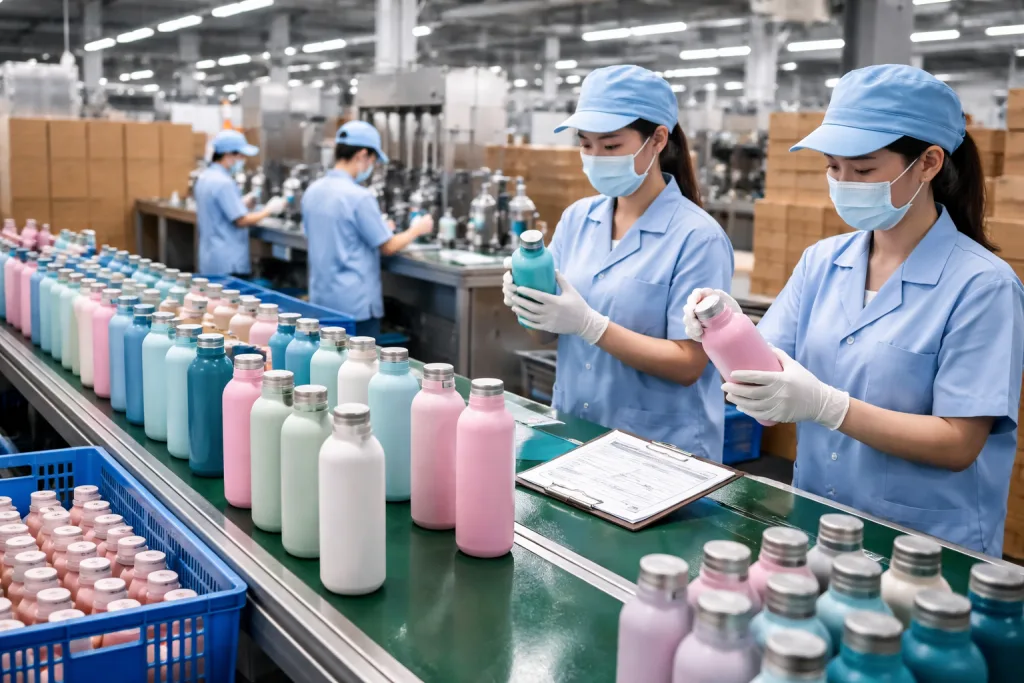
Key Takeaways
- For vacuum bottles, specify 304 inner steel, 201 or 304 outer steel, and 0.4-0.6 mm body thickness
- Use AQL 2.5 for major defects and AQL 4.0 for minor defects on mass production inspections
- A practical MOQ for custom stainless bottles is 1,000-3,000 units per color depending on finish and logo method
- Plan 7-10 days for pre-production samples and 30-45 days for bulk production after approval
A stainless water bottles factory can look clean on a video call and still ship 3,000 cartons with weak vacuum, crooked logos, rusty weld marks, or lids that crack after 14 days of use. We have seen QC pull samples from the line with a 0.8 mm logo shift and a lid thread that felt fine by hand but failed on the torque tester. The unit price is the wrong place to start. Most B2B buyers do not lose money because the bottle is 20 cents too high; they lose it because the spec leaves room for guessing, the inspection plan says “check quality” instead of AQL 2.5, and the factory gets to decide every gray area.
We run custom drinkware orders in Hangzhou, Zhejiang, and the same problems keep showing up with new buyers in Europe and North America: steel grade written as “stainless steel” instead of 304 stainless, powder coating approved from a phone photo, caps skipped from leak testing, samples pushed in 12 days when the mold shop needed 18 days, and packaging designed for a warehouse shelf instead of a distributor’s mixed-carton pick pack. One buyer flagged a PO typo last year where “matte black” became “mate black”; small mistake, 5,000 bottles at risk. If you source from China, your best protection is a tight purchase spec before the line starts.
Failure starts with loose steel specs
The first failure looks boring, so buyers skip it. They write “stainless steel bottle” on the RFQ and assume every canteen manufacturer quotes the same build. We don’t. Last month our quoting desk saw 2 POs for the same 750 ml bottle shape: one buyer expected 201 stainless outside, 304 stainless inside, 0.38 mm wall thickness, and a basic PP lid; the other expected 304 inside and outside, 0.5 mm wall, 65–75 μm powder coating, and a Tritan lid with a silicone seal. Both products are stainless. They are not the same product.
For most insulated water bottles, write the minimum spec like a QC sheet: 304 stainless steel for the inner liner, 201 or 304 for the outer shell, food-contact silicone, and FDA/LFGB-compliant plastic parts. For REACH-sensitive European programs, ask for material declarations before the 30% deposit, not after shipment. We have seen this go sideways when the buyer flagged REACH paperwork 6 days before vessel closing. If you need a customized canteen for outdoor retail, the catalog line is not enough. Put steel grade, wall thickness, capacity tolerance, coating type, and lid material directly in the PI; our merchandiser once caught a PO typo showing “0.35 mm” where the approved sample sheet said “0.5 mm.”
Body thickness matters more than buyers expect. A 0.4 mm outer shell can pass for a 3,000 pcs lightweight promotional order, but a retail-grade custom canteen feels better at 0.5 mm or above. QC pulled the sample after a 1.2 m drop test and found 4 small dents on the thinner shell near the shoulder radius. For a custom growler or customized growler, especially 1.2 L to 1.9 L, heavier gauge cuts dent complaints during trucking and field use. The math is plain: thicker steel adds cost and carton weight, but it reduces returns.
Do not ask a stainless water bottles factory for “best quality.” Ask for exact steel grade, exact wall thickness, and exact compliance documents.
Vacuum claims often hide weak testing
I’ll rewrite the prose tightly, keep the HTML exactly as-is, and make the copy sound like a factory-side sales engineer wrote it.Vacuum failure is the defect that reaches your customer first. The bottle looks fine, the logo looks fine, and the carton looks fine. Then the buyer fills it with hot water and the outer wall goes warm in 20 minutes. That points to a vacuum leak, weak welding, or sloppy evacuation control. For distributor drinkware, this is worse than a cosmetic flaw because you cannot repair it on site.
A proper canteen factory should test every insulated body before assembly. We run hot water retention checks, surface-temperature screening, and vacuum leak detection on the line. For a 500 ml to 750 ml bottle, a fair claim is often 95°C fill and above 60°C after 6-8 hours, depending on lid design, room temperature, and bottle shape. If a canteen vendor promises 24 hours hot and 48 hours cold without test conditions, the math doesn’t work. Starting temperature, room temperature, fill volume, and method all need to be on the spec sheet.
At BottleForge in Zhejiang, our insulated bottle line can ship around 450,000 units/month across common 350 ml, 500 ml, 750 ml, and 1 L sizes, and QC still rejects bodies during vacuum screening. We use that callout gauge every shift. Zero rejection is not a quality claim; it is a red flag.
Your purchase spec should call for 100% vacuum testing on insulated items, not random checks only. For final inspection, add a functional heat-retention test on pulled samples. If you are buying a customizable growler for beer, coffee, or outdoor use, add leak testing after cap assembly and a drop test on filled samples from 80-100 cm. We’ve seen a heavy distributor growler pass static inspection and still fail in the field because the lid stack was weak.
Coatings fail before the bottle fails
I’ll rewrite the section in-place, keeping the HTML tags and tightening the prose to sound like a factory-side sales engineer.Most complaints pinned on canteen manufacturers start with the coating spec, not the bottle. Powder coating, spray painting, UV coating, rubber paint, and ceramic-look finishes all age at different speeds. If your customized drinkware goes into gyms, construction sites, school programs, or outdoor retail, a nice matte finish is not enough. We run abrasion checks, cross-hatch adhesion, and dishwasher placement decisions before mass production starts.
Powder coating is usually the safer pick for stainless sports bottles because it gives better grip and stronger scratch resistance than standard spray paint. A normal coating thickness sits around 60-90 microns. Go thinner and it chips; go thicker and threads or cupholder fit can drift. On one 5000-piece run, QC pulled the sample after the shoulder cap started binding at 92 microns. For a canteen promotional order where budget matters more than long service life, spray painting can work, but the topcoat needs an upgrade if you want decent abrasion resistance.
Ask the stainless water bottles factory to run a 3M tape cross-hatch test on coated samples. For retail programs, we also ask for 50-100 cycles of rub testing with a dry cloth and a wet cloth. If the bottle has a handle lid, carabiner, or metal accessory, test the contact points. That is where the line gets scratched during shipping. The buyer flagged it after a carton test showed rub marks at the shoulder.
Color matching is another quiet failure mode. Pantone on paper, powder on steel, and a digital proof on a laptop do not read the same way. For canteen customized orders, approve a physical color chip or a coated bottle sample. If you are a distributor canteen buyer consolidating several SKUs, lock the color tolerance before production. A practical target is Delta E below 1.5-2.0 for strict retail work, but some promotional orders take a wider window to protect cost and lead time. We’ve seen this go sideways when a PO typo changed one shade code by one digit.
Logo methods create different risks
I’ll keep the HTML intact and rewrite the prose to sound like a factory-side sales engineer, with tighter wording and a few concrete shop-floor details.Custom branding is where a clean bottle turns into a rejected shipment. We’ve seen silkscreen smear on the line, laser engraving come out weak on dark powder coat, heat transfer lift on a tight curve, and full-wrap art miss the seam by 3-5 mm. A canteen customizable program needs the logo method matched to the bottle shape, coating, artwork size, and order quantity. No shortcuts here.
For one-color logos, silkscreen is the low-cost option and works best on straight walls. Setup runs about USD 35-80 per color per position, depending on artwork and supplier, and we usually see a 1-2 day setup on our screen frames. Laser engraving is cleaner for stainless or powder-coated bottles and usually costs about USD 0.20-0.60 per unit for common logo sizes. It holds up well, but the finish is bare metal or the underlayer, not a Pantone match. For photographic artwork or large wrap designs, heat transfer or 360° UV printing can work, but approve a curved-surface sample before deposit if the design crosses a taper.
The usual artwork miss is a buyer approving a flat PDF and never checking the real bottle radius. A 90 mm wide logo can look fine on screen and then crowd a 500 ml bottle in hand. For customized canteen and customizable drinkware orders, ask for a print-position drawing with distance from base, logo width, logo height, and orientation to the lid. QC pulled one sample last month where the lid arrow and logo faced opposite directions; the buyer flagged it in five minutes. If the cap has a drinking spout, the logo should face the user correctly when the lid is fully tightened.
If you are a canteen distributor or distributor drinkware supplier selling to several corporate accounts, set one approval path and stick to it. We ask for vector AI/PDF files, Pantone references, mockup signoff, and signed pre-production sample approval. It adds 2-4 days, but that is cheaper than arguing after 20,000 units are already packed. The math doesn’t work any other way.
Lids are the weak mechanical point
I’ll rewrite the section in-place, keep the HTML exactly as-is, and make it sound like a factory-side sales engineer wrote it.Buyers often spend 90% of their attention on the steel body and 10% on the lid. That split is backwards. In use, the lid drives most complaints: leaking seals, broken flip buttons, loose carry loops, straw fit issues, and plastic smell. We run ten lid options on the same bottle body, and the buyer flagged the same thing again and again: the lid is the weak mechanical point.
For leakproof claims, write down the test. Our basic line check is simple: fill the bottle, tighten the lid, lay it flat for 30 minutes, then shake it and invert it for one more cycle. For sports lids, add a negative-pressure check after hot filling, because steam and pressure swing will expose a weak seal fast. Silicone hardness matters too. A gasket that is too soft can deform; too hard, and it misses tolerance on the line.
Name the plastic. PP is common for caps and holds up well for hot-water contact. Tritan fits cases where you want clarity or a higher-end look. ABS may show up in decorative or moving parts, but food-contact exposure still needs a check. For North America, ask for FDA food-contact compliance. For Europe, LFGB and REACH paperwork may come up from retail buyers. If the bottle is for children, ASTM, CPSIA, and small-parts checks may apply, depending on the design. A PO typo on material code has cost a week before; this is the wrong question to leave vague.
For a custom growler or distributor growler, cap torque and thread quality need more attention than most buyers expect. Bigger volumes mean more hand force and more drop impact. If the growler uses a swing-top, handle lid, or wide-mouth screw cap, run 500 open-close cycles on samples. QC pulled the sample at 380 once and the hinge pin was already loose. Cheap test. Much cheaper than replacing lids in three warehouses.
Packaging mistakes show up in warehouses
I’ll rewrite the section in place, keep the HTML exactly as-is, and tighten the prose to sound like a factory-side sales engineer.Packaging is not decoration on B2B orders. It decides whether receiving stays clean or turns into a claims file full of dented bottles. We have seen a buyer approve a canteen quote with thin white boxes, no dividers, and a 5-ply master carton that looked fine in a sample photo. Then the load left Zhejiang, hit Ningbo or Shanghai port, rode a truck line in Germany or the United States, and the corner crush showed up.
For wholesale and distributor canteen programs, spell out the inner box material, master carton grade, carton drop test, and pallet spec. A 500 ml stainless bottle usually ships 24 or 48 pcs per carton, depending on the pack. For heavier customized growler orders, keep carton weight under 15-18 kg if people are hand lifting on the warehouse floor. If you sell through e-commerce or Amazon FBA, add FNSKU labels, suffocation warnings for polybags when needed, and carton labels that match the inbound plan. The math does not work if the labels drift.
Do not expect a gift box to protect the product. Most gift boxes are built to sell, not to survive freight. If the bottle has a powder-coated finish, we run a polybag or tissue wrap so the surface does not rub inside the box. For premium retail, a molded pulp insert or a stronger corrugated insert can be worth USD 0.15-0.40 per unit.
Ask your canteen manufacturer for a packaging drop test before mass shipment. ISTA-style testing may be required for some channels, but a factory drop test at 76 cm on corners, edges, and faces is still better than guessing. On export jobs, confirm carton marks, SKU codes, and barcode scannability before packing. QC pulled a carton with one PO typo once, and re-labeling 3,000 cartons after arrival was not a small problem.
Inspection should not be a formality
I’ll rewrite the section in place, keep the HTML exactly as-is, and tighten the sales-engineer tone with concrete factory details and fewer filler phrases.Final inspection gets treated like a box-ticking job. That is the wrong mindset. AQL is your last gate before FOB handover, and we have seen one loose lid spec turn into 3,000 rejected bottles at port. For custom drinkware, we run AQL 2.5 for major defects and AQL 4.0 for minor defects unless the retailer demands tighter limits. Critical defects get zero tolerance: sharp edges, contamination, wrong material, severe leakage, unsafe small parts, or a bad compliance mark.
Give the inspector a checklist built around failure modes, not a vague “check quality” note. Include capacity measurement, bottle weight range, coating adhesion, logo position, lid fit, leak test, vacuum test for insulated bottles, barcode scan, carton count, and packaging drop check. QC pulled a sample with a 32 mm neck finish last month, and the buyer flagged the logo shift by 2 mm; that is the kind of miss a plain visual check will not catch. If the order is canteen promotional, check logo color and placement against the signed sample. If the order is retail-grade customizable canteen, add tighter functional testing and appearance limits.
Timing matters. A pre-production sample usually takes 7-10 days after artwork and material confirmation. Bulk lead time is commonly 30-45 days after sample approval for 1,000-10,000 units, 12 days vs 18 days if you compare off-season to peak season on the same line, and special coatings stretch it further. Our normal MOQ in Hangzhou, Zhejiang is 1,000 units for standard models with a simple logo, 3,000 units per custom color, and more for a new mold or fully customized drinkware. We run the line fast, but rushing kills the buffer that catches defects.
Before deposit, ask your stainless water bottles factory for BSCI or ISO 9001 status if your customers require it, test reports for similar materials, production capacity, and a written QC flow. A serious canteen supplier answers straight and sends the files. A weak one sends more catalog pages. We’ve seen a PO typo on the finish spec turn into a full rework, so the paperwork has to match the sample line by line.
Send your bottle spec before you place the order
We will review steel grade, logo method, packaging, MOQ, and QC risks before your next stainless drinkware production run.
Frequently asked questions
What MOQ should I expect from a stainless water bottles factory?
For existing stainless bottle models, a realistic MOQ is usually 1,000 pieces with one simple logo and current stock colors. If you need a custom powder-coated color, plan on 3,000 pieces per color because coating lines need setup volume. For a custom canteen with new lid tooling, new body shape, or unique capacity, MOQ may rise to 5,000-10,000 pieces. A canteen promotional order can sometimes be lower if you accept available colors and standard packaging. Be careful with very low MOQ quotes from China if they include custom color, retail packaging, and multiple logo positions; something is usually being simplified.
How do I compare quotes from different canteen suppliers fairly?
Put every quote into the same structure: capacity, steel grade, wall thickness, lid material, coating method, logo method, packaging, testing, MOQ, lead time, and Incoterm. FOB Ningbo at USD 3.20 is not cheaper than FOB Shanghai at USD 3.35 if the first quote uses thinner steel, basic spray paint, and weak packaging. Ask each canteen vendor to confirm whether the price includes 100% vacuum testing, logo setup, inner boxes, master cartons, and export cartons. For distributor drinkware, also compare replacement lid availability and spare gasket cost because after-sales parts matter.
Which logo method is best for customized drinkware?
There is no single best method. Silkscreen is economical for one- or two-color artwork on straight bottle walls and often works well from 1,000 units. Laser engraving is more durable and usually costs about USD 0.20-0.60 per unit for common logo sizes, but it cannot match a Pantone ink color. Heat transfer and UV printing suit larger or full-color artwork, though curved surfaces increase alignment risk. For canteen customized projects, approve a physical pre-production sample, not only a digital mockup. The real bottle curve, coating texture, and lid orientation all affect the final result.
What quality tests should I require before shipment?
At minimum, require AQL final inspection with AQL 2.5 for major defects and AQL 4.0 for minor defects. Add 100% factory vacuum testing for insulated bottles, leak testing on assembled lids, coating adhesion testing, logo rub testing, capacity checks, carton drop checks, and barcode scanning if retail packaging is used. For a customizable growler or larger bottle, test lid torque and filled drop resistance from 80-100 cm. If your order is for Europe, include REACH or LFGB documentation where applicable. For North America, ask about FDA food-contact materials and relevant ASTM or CPSIA issues for kids’ products.
How long does a custom canteen order take from China?
For standard models with logo only, allow 7-10 days for sampling and 30-45 days for mass production after sample approval and deposit. Custom color, retail packaging, full-wrap print, or special lids can add 5-15 days. Sea freight to Europe or North America then adds roughly 25-45 days depending on port and season. Air freight is faster but rarely economical for stainless bottles because they are bulky. If you are a canteen distributor planning a seasonal launch, confirm artwork, sample approval, inspection date, and vessel cutoff before promising delivery to your customer.