Key Takeaways
- Typical stainless water bottles custom pricing starts around USD 2.20-3.80 FOB for 500 ml at 1,000 pcs, with decoration and lid changes adding USD 0.10-0.80 per unit
- Normal MOQ is 500-1,000 pcs for a standard customized drinkware SKU; complex canteen customized builds often need 3,000 pcs to hit a stable price
- Standard lead time is 25-35 days after sample approval, while rush orders can compress to 18-22 days if the factory slot is open
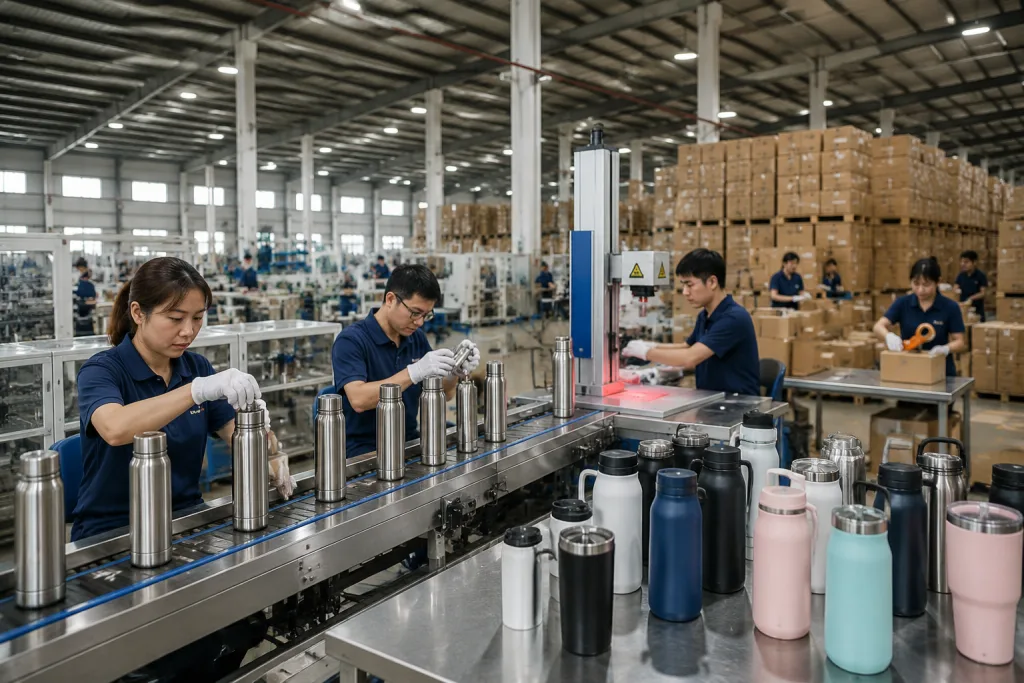
- A Zhejiang canteen factory with 300,000 units/month capacity can still bottleneck on lids, coatings, and packaging, not just the bottle body
If you buy stainless water bottles custom for retail, corporate gifting, Amazon, or distributor channels, the first mistake is always the same: buyers look at unit price first and ask about lead time after the PO is already moving. That is the wrong order. Real landed cost comes from 304 stainless or 201, 500 ml or 750 ml, lid parts, print method, carton spec, and whether the shipment needs to leave Zhejiang in 20 days or 35.
At BottleForge in Hangzhou, Zhejiang, we run this conversation every week. A buyer flags a canteen custom order at USD 2.40, then QC pulls the sample and the math shifts fast: the lid adds USD 0.35, matte powder coating adds USD 0.18, and a rush slot cuts production from 35 days to 22. If you know that stack before you confirm, you can choose a canteen manufacturer or canteen supplier with fewer surprises and a cleaner margin.
What Actually Sets Your Price
I’ve got the section and constraints. I’m rewriting the prose in-place, keeping the HTML tags and the pricing facts intact while making it read like a factory-side sales engineer wrote it.For stainless water bottles custom, the bottle body is not the whole quote. A buyer sees an 18/8 stainless shell and expects a clean number. The line does not work that way. Price comes from four items: steel gauge, inner and outer finish, lid build, and decoration. A 0.4 mm wall costs more than a 0.35 mm shell, but the thicker one takes dents better and cuts down retail complaints. QC pulled a sample with a flat-side dent after a 1.2 m drop test, and that is the kind of thing that changes the math fast.
For standard 500 ml and 750 ml sizes, FOB China pricing usually sits in these bands: plain brushed body at USD 1.80-2.40, powder-coated body at USD 2.00-2.70, and double-wall vacuum insulated at USD 2.40-3.80, before print and custom packaging. Add a laser logo and you are looking at USD 0.08-0.15. A one-color silkscreen logo is often USD 0.05-0.12. Wrap print, full-surface UV, or engraved personalization moves the number up. We had a buyer flag a PO typo on lid type once, and the re-quote changed by more than the logo cost. That is why a canteen manufacturer in Zhejiang asks for the exact artwork and lid spec before we quote in earnest.
Practical rule: if your target shelf price is tight, put the money into the lid and coating first, then trim the box. Buyers love fancy packaging, but the closure is what gets returned if it leaks.
MOQ Tiers That Matter
I’ll rewrite the section in place, keep the HTML structure intact, and tighten the sales-engineer tone with concrete MOQ details and factory-floor language.MOQ is not one number; it shifts with the build. For a stock shape with a standard lid, we run 500 pcs per color on the line. That fits a distributor test run, a small promo drop, or a first Amazon launch. Once the buyer flags a custom molded cap, a unique handle, or a two-tone coating, the real MOQ usually lands at 1,000-3,000 pcs because setup time, spray loss, and inspection rework go up.
Here is the cleaner way to read it. At 500 pcs, your unit price is usually 10-18% higher than at 1,000 pcs. At 1,000 pcs, you get the best balance of cost and supplier attention. At 3,000 pcs, we can often push better carton packing, a tighter drop test plan, and a steadier lead time. For a custom canteen or customizable canteen with molded parts, a canteen factory in Zhejiang may ask for 5,000 pcs if the tool or cap structure is new. That is not a sales trick; the mold trial, QC pull, and scrap rate are what drive the math.
- 500 pcs: fast test order, higher unit cost, fewer options
- 1,000 pcs: best baseline for customized drinkware
- 3,000 pcs: better price leverage for canteen customized programs
- 5,000 pcs: realistic for custom mold or canteen promotional projects
Lead Time From Sample To Ship
I’ll keep the tags intact and rewrite the prose to sound like a factory-side sales engineer, with concrete timings and a few line-floor details.Lead time is where a lot of importers blow the season. If you already have artwork and product specs, a canteen factory can usually turn a pre-production sample in 5-8 days. Stock lids move faster. We’ve seen 3-5 days when the lid is off the shelf and the print file is clean. If the buyer wants a new lid structure, custom color matching, or an engraved packaging insert, plan on 10-15 days just for sampling.
After sample approval, normal mass production for stainless water bottles custom is 25-35 days. In a busy quarter, 35-45 days is the number we quote when the coating line and assembly line are already booked. One buyer once flagged a PO typo on the cap color code, and that cost us a full day because QC had to pull the sample again. Ocean freight adds another 25-40 days to North America and 20-35 days to Europe, depending on port and routing. If you need a distributor canteen program for a fixed campaign date, count 75 days from PO to warehouse receipt, then add 10 more days for customs and domestic drayage. A supplier promising 12 days total for a vacuum bottle order is leaving something out.
Fast does not mean good. A 22-day production promise only works when the spec is frozen, the 304 stainless is confirmed, and no new tooling is on the table.
Where The Hidden Costs Hide
I’ll rewrite the section in-place, keep the HTML tags intact, and tighten the language so it sounds like a factory-side sales engineer. Then I’ll return only the rewritten HTML.The hidden costs show up once you break the quote into parts. Packaging is the first one. A plain brown carton usually runs USD 0.12-0.20 per unit, while a printed gift box adds USD 0.45-1.20. A custom insert for a custom growler or customizable growler adds another USD 0.10-0.35. Then there is compliance: REACH declarations for Europe, food-contact files, and sometimes ASTM test reports for the buyer’s folder. None of that looks scary on paper. The math changes fast if your canteen vendor has to chase paperwork after the PO lands.
Rework is the other place margin disappears. A powder coat that reads too glossy under the light booth, a laser mark that comes out faint, or a cap torque miss can turn a good order into a headache. On our Hangzhou line, we run 300,000 units a month, and QC still pulls the sample before packing because a 0.2 mm logo shift or a loose lid will get flagged by the buyer anyway. This is the wrong question to ask: “Who gave the lowest quote?” Ask which order ships once, clears AQL 2.5, and stays out of the returns pile.
If you are comparing canteen manufacturers, ask for the full landed structure: body, lid, decoration, packaging, and testing. Then compare FOB line by line.
Choosing The Right Bottle Build
I’ll rewrite the prose only, keep the HTML structure intact, and tighten it so it sounds like a factory-side sales engineer wrote it.Not every buyer needs the same bottle build. A sports program often wants a light single-wall bottle. A premium gift order usually needs vacuum insulation and a tougher coating. A canteen promo run can work with a simpler liner and a plain screw cap. Match the build to the use case. Don’t spec it like a trophy.
For stainless water bottles custom, 18/8 stainless steel is still the safest default for most B2B orders. Wall thickness in the 0.35-0.5 mm range is standard, and double-wall vacuum models usually sit at the thicker end if you want better rigidity on the line. If you need a custom canteen for outdoor, gym, or travel retail, check closure integrity, carry loop strength, and finish quality first. We’ve seen buyers ask for a straw lid, soft-touch coating, wide mouth, laser logo, and retail box at 1,000 pcs, then act surprised when the math doesn’t work. That spec can be built, but it will not run like a basic stock item.
When a growler spec makes sense
For beverage brands or taproom merch, a custom growler or customized growler makes sense when you need thermal retention and a 64 oz format. QC pulled the sample on one run because the carton crushed at the corners, and that was with a 12 mm divider already in place. Bigger body means higher freight and more damage risk. For distributor growler orders, thicker cartons and dividers are not a nice-to-have. They are cheap insurance.
How To Brief A Factory Clearly
I’ll rewrite this section in a more buyer-facing factory voice, keep the HTML tags intact, and make the brief sharper with concrete shop-floor detail and fewer generic lines.The best RFQ is short and exact. Tell the canteen supplier the capacity, steel grade, finish, lid type, logo method, carton style, quantity, target ship date, and destination market. If you leave out the lid, you are not asking for a quote; you are asking for a placeholder. Same story if you say “customizable drinkware” and skip whether you want print, color, or new tooling. We had a buyer send a PO with “black cap” once, and QC pulled the sample because there were three cap options on the line.
For a clean quote from a canteen manufacturer or canteen vendors network, give the factory a full brief: 500 ml or 750 ml capacity, 18/8 inner and outer steel, 0.4 mm wall target, powder coat matte black, one-color laser logo, individual box, 1,000 pcs, FOB Ningbo or FOB Shanghai, and target lead time of 30 days. That level of detail lets us price it without guessing and tells you fast if the schedule holds. The math doesn’t work when the buyer asks for a 30-day ship date but changes the lid after sample approval. We see that go sideways all the time.
Good buyers also ask about testing and inspection. AQL 2.5 for major defects and 4.0 for minor defects is a normal starting point. If your brand is strict, ask for leakage testing, dishwasher resistance notes, and carton drop test results before shipment. One carton drop at 60 cm can save a headache later, and the buyer flagged it for a reason.
Send your bottle spec for a real quote
We’ll price your stainless water bottles custom order with MOQ, lead time, and packaging broken out clearly, so you can buy from Zhejiang with fewer surprises.
Frequently asked questions
What is a normal MOQ for stainless water bottles custom?
For a standard shape with stock lid, 500 pcs is common, and 1,000 pcs usually gives you a better unit price. If you need custom tooling, special cap design, or a unique color match, many canteen manufacturers move to 3,000-5,000 pcs. For a canteen promotional campaign, 500-1,000 pcs is usually workable. For distributor canteen programs with repeat orders, 1,000 pcs is the practical floor because setup time and packaging costs spread better.
How much should I budget per unit?
A realistic FOB China budget for stainless water bottles custom is USD 2.20-3.80 per unit at 1,000 pcs for a 500 ml vacuum bottle. A simpler single-wall custom canteen can sit closer to USD 1.80-2.40, while premium finishes, gift boxes, or extra tooling push higher. Add USD 0.05-0.15 for logo work and USD 0.12-1.20 for packaging depending on box style. If your canteen supplier quotes far below that, check what is missing.
How long does production take in Zhejiang or China?
For a standard order, plan 25-35 days after sample approval. If the order includes a new lid, new mold, or complicated packaging, 35-45 days is safer. Sample making usually takes 5-8 days, or 10-15 days if there is new tooling. Then add ocean transit: about 20-35 days to Europe and 25-40 days to North America. A buyer who needs a fixed campaign date should start at least 75 days ahead.
What documents should a canteen supplier provide?
Ask for food-contact compliance documents, material specs, and test reports relevant to your market. For Europe, REACH support is often expected. For retail buyers, leakage test records, carton drop test notes, and a sample approval file matter more than marketing claims. If you need customs clearance support, also confirm the invoice description, HS code guidance, and packing list format before shipping. A serious canteen vendor should be able to share this quickly.
Can I order a custom growler or customizable canteen in mixed colors?
Yes, but mixed colors usually raise complexity and can increase MOQ or cost. A standard two-color split on a customized growler may only add USD 0.08-0.20 per unit if the factory already has coating capacity. More colors, soft-touch finishes, or low-volume splits can add more. If you want mixed colors for distributor drinkware, keep the total order at 1,000 pcs or above so the line changeover does not destroy your price.