Key Takeaways
- Typical factory MOQ starts at 500-1,000 pcs per SKU, with better pricing at 3,000+ pcs
- A standard 500ml 18/8 stainless bottle often sits at USD 1.05-2.30 FOB China depending on finish and lid
- Custom print adds 5-12 days; full customized lid or shape can add 20-35 days
- A Zhejiang canteen manufacturer with 300,000 units/month can usually hold steadier lead times than a trading-only canteen vendor
If you are sourcing from a stainless water bottle supplier, the question is not “what is the unit price?” It is what reaches your warehouse after decoration, packaging, carton specs, and freight are added. A clean USD 1.18 bottle can land at USD 2.40 fast once you add a one-color logo, an individual box, and a 3,000-unit run. We see this all the time. The buyer flagged the packing cost, not the bottle cost.
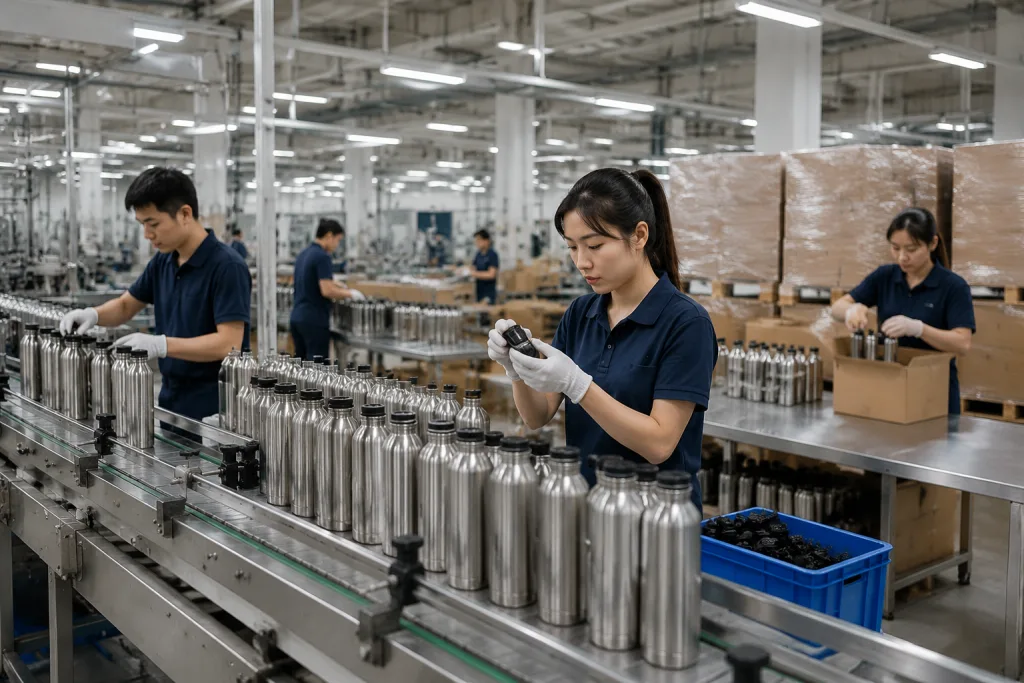
We build and export in Zhejiang, China, and drinkware pricing moves with MOQ, finish, and the slot on the line. If you are comparing canteen supplier quotes, ask for the factory breakdown, not the sales pitch. A serious canteen factory should give lead time by process: 7 days for sample work, 18-25 days for repeat orders, and 30-40 days when molds, new lids, or custom cartons are involved. QC pulled the sample at 1.5 mm wall thickness, and the math still held.
What really sets factory cost
I’ll keep the HTML tags and rewrite the prose with sharper factory-floor language, concrete numbers, and fewer AI-sounding transitions.For stainless drinkware, cost starts with steel grade, body structure, and how many operations we run on the line. A basic 500ml double-wall bottle in 18/8 stainless steel is not the same job as a single-wall custom canteen or a vacuum insulated growler. Wall thickness, usually 0.35-0.45 mm for the inner and outer shells, changes material use and forming stability. The lid drives cost too. A PP screw lid is cheap; a stainless lid with a silicone seal and laser logo is not.
In Zhejiang, we see buyers watch the shell and miss the finishing loss. Powder coating, gradient paint, UV print, and brushed textures all bring scrap risk and extra machine time. On a recent run, QC pulled the sample because the brushed line shifted 1.2 mm at the neck. A plain brushed body may cost USD 0.08-0.15 less than powder coat, while a full-wrap UV print can add USD 0.20-0.45. If you are buying custom drinkware for retail, that gap hits margin fast. If you are buying canteen promotional stock for an event, the cheapest decoration that still survives the truck ride is usually the right call.
Typical FOB China drivers often include:
- Steel grade: 201 is cheaper, 304 is standard, 316 adds cost for premium use
- Lid complexity: single-piece, dual-function, bamboo, or flip-top
- Decoration: silkscreen, laser, UV, wrap print, embossing
- Packing: bulk pack, white box, color box, retail-ready set
As a stainless water bottle supplier, we prefer to show the cost stack instead of hiding it behind one nice-looking number. The buyer flagged a PO typo last month—500 ml written as 50 ml—and that sort of mistake changes the quote fast. This is the right way to compare canteen suppliers on the same basis.
MOQ tiers that make sense
I’ll keep the tag structure intact and rewrite only the prose, with tighter factory-floor language and concrete MOQ numbers.MOQ is a line-setting issue, not a moral one. A canteen distributor asking for 300 pcs needs room to test the market. A factory running offset print and carton packing needs the line loaded. Both cases make sense, but the price steps up fast by tier.
For a standard stainless bottle, we run 500 pcs for a sample-scale order, 1,000 pcs for a first real run, and 3,000 pcs or more for cleaner pricing. Under 500 pcs, unit cost usually jumps 15-35% because labor, setup, and print changeovers get spread too thin. On one 18oz bottle line, QC pulled the sample and the buyer flagged a 0.6 mm lid gap; that kind of rework is exactly why tiny runs cost more. At 3,000 pcs, many Zhejiang factories can shave USD 0.10-0.30 per piece depending on the lid and print method.
Common MOQ behavior looks like this:
- 500 pcs: works for market tests, e-commerce pilots, or distributor drinkware samples
- 1,000 pcs: the normal entry point for a custom canteen or customized drinkware launch
- 3,000-5,000 pcs: best for branded retail, canteen promotion runs, and steady reorder programs
If you need a customized canteen in more than one color, ask whether the MOQ is per color or per total order. We have seen this go sideways on a PO typo: the buyer wrote 3 colors, 1,000 pcs total, while the supplier read 1,000 pcs per color. Some canteen suppliers accept 3,000 pcs split across 3 colors; others want 1,000 per color. That detail changes your inventory risk on day one. A good canteen vendor says it before the quote goes out, not after.
Lead times by order type
I’ll rewrite the prose in place, keep the HTML exactly as-is, and make the copy sound like a buyer-facing factory note with tighter timelines and a few shop-floor details.Lead time is where a lot of buyers miss a selling season. A stainless bottle looks simple on paper, then the line slows down once you change the lid, switch the carton, or add a second print method. In our Zhejiang plant, we can run 300,000+ units a month, but one PO typo or a late artwork file still holds the release.
Plan on this timeline: 5-7 days for sample confirmation on stock parts, 7-10 days for printed samples, 18-25 days for repeat production after deposit and artwork approval, and 30-40 days if you need new molds, custom caps, or special coatings. For a custom growler or customizable growler with a new handle or lid assembly, the math does not work if you leave only two weeks.
Where delays usually happen:
- Artwork arrives in PDF instead of vector format
- Pantone on logo or carton print misses the approved swatch
- Packaging signoff takes longer than the bottle run
- One order gets split across too many SKUs
If you need canteen customized for a retail launch date, lock the spec first, then ask for a schedule with sample signoff, pre-production proof, mass run, and packing dates. We had one buyer flag a 2 mm lid gap on the pre-production sample, and that saved a full rework. A real canteen factory should give you that schedule on day one.
Decoration changes the math
I’ll rewrite the prose inside the existing HTML, keep every tag intact, and tighten the sales-engineer tone with concrete factory detail and cleaner cost language.Decoration is often the highest-margin item for the supplier and the easiest place for a buyer to miss the real math. A one-color silkscreen logo usually sits at the bottom of the cost stack, often adding just USD 0.03-0.12 per piece depending on size and print position. Laser engraving looks clean and holds up well, but on stainless steel it can cost more than print because the line slows down and the tube clamp has to be reset. UV printing and wrap graphics work well for customized canteen and custom drinkware retail lines, but on a 500-piece trial the setup fee can wipe out the unit savings.
More decoration does not mean a better SKU. For canteen promo programs, the better play is usually a simple print on one stable model, plus a box that survives freight and shelf stacking; we’ve seen buyers chase a fancy finish and then the math falls apart. For a canteen distributor selling into sports or outdoor channels, a premium finish can justify an extra USD 0.20-0.60 per unit if it lifts sell-through. QC pulled a sample with a crooked logo last month, and the buyer flagged it in 10 minutes.
When we quote canteen custom work in Zhejiang, we split the decoration line from the bottle line, so you can see exactly what changes if you move from print to laser. That is the right way to compare canteen manufacturers on a like-for-like basis. It also catches small PO mistakes, like a 1-color file marked as 2-color, before the line starts.
Packaging and freight can outrun the bottle
I’ll rewrite this section in-place, keeping the HTML tags and structure intact while making the copy sound like a real factory-side sales engineer.Your landed cost is not the FOB bottle price. It is bottle, pack, carton, pallet, and freight. On a 500ml bottle, packaging adds USD 0.10-0.45 per unit, and the gap comes down to one choice: a plain white box or a full retail set. We run this math on the packing bench every week. Export cartons, inner dividers, and drop-test protection push it up again, especially when the buyer wants customized drinkware for Amazon, chain retail, or a gift program.
For air freight or urgent replenishment, dense drinkware eats margin. A stainless bottle is heavy, and that is the whole problem. A 500ml vacuum bottle often weighs 260-380 g depending on wall design and lid style; once packed, cube and gross weight move fast. QC pulled the sample and the gross weight was 18% over the PO because the lid insert was changed without a note. A better canteen supplier should tell you whether sea freight or mixed shipping makes sense for your order size; the math does not work if you guess.
Ask for these numbers before you approve the PO:
- Net weight and gross weight per carton
- Carton size and units per carton
- Drop-test standard used for export packing
- Whether packaging is retail-ready or bulk-ready
These details look small until the freight invoice lands. Then they are the whole story.
How to compare suppliers fairly
I’ll rewrite the section in place, keeping every tag and the heading structure unchanged, and tighten the sales language so it reads like a factory-side buyer note.Comparing canteen suppliers by unit price alone is a mistake. Two quotes at USD 1.38 can be worlds apart if one includes 304 steel, a silicone seal, and export carton, while the other is 201 steel with bulk packing. We run this check on the line with a 0.02 mm thickness gauge, and the gap shows up fast. Use one comparison sheet for material grade, wall thickness, decoration method, MOQ, sample time, and production lead time. That is how procurement teams in Europe and North America avoid false savings.
Ask whether the factory is a real canteen maker or just a trader pulling from three workshops. A direct factory in Zhejiang should show capacity, QC flow, and export history without drama. If the supplier says it handles customized growler, customizable canteen, and distributor canteen programs at scale, ask for monthly output, current lead times, and testing files. REACH, food-contact declarations, and the AQL inspection process should not need a long speech. We’ve seen buyers miss this and then the first PO came back with a carton-size typo.
Good sourcing is not finding the lowest quote. It is finding the quote that survives sampling, production, and reordering without friction.
If your target is a canteen distributor program or retailer launch, choose the supplier that keeps repeat orders steady across seasons. QC pulled the sample twice on a 500 ml bottle last week because the cap torque drifted, and that is the kind of issue that hurts later. The math does not work if you save USD 0.04 on the first order and lose the second one.
Send your spec sheet for a fast factory quote
Get a clear FOB breakdown, MOQ, and lead time from a Zhejiang stainless water bottle supplier that speaks in numbers, not guesses.
Frequently asked questions
What is a normal MOQ for a stainless water bottle supplier?
For standard stainless bottles, 500 pcs is a realistic trial MOQ, 1,000 pcs is the common commercial entry point, and 3,000 pcs or more usually gives better unit pricing. If you ask for multiple colors, check whether MOQ applies per color or per total order. A Zhejiang factory with a stable production line can often support mixed orders, but logo method and packaging change the rules fast. For customized drinkware with new lids or new molds, MOQ can move higher because tooling and setup need to be amortized.
How much should I budget for a custom canteen?
For a 500ml stainless custom canteen FOB China, many B2B buyers land in the USD 1.05-2.30 range depending on steel grade, lid style, and decoration. Add USD 0.03-0.12 for silkscreen, USD 0.08-0.25 for laser or more complex branding, and another USD 0.10-0.45 for retail packaging. If you want a canteen promotional box set, the total can rise quickly. Always ask for a split quote so you can see base bottle, logo, carton, and freight separately.
How long does production take in China?
For a standard reorder, expect 18-25 days after sample approval and deposit. New custom work, new molds, or special coatings often take 30-40 days. Sample time is usually 5-7 days for stock components and 7-10 days for printed samples. If you work with a canteen factory in Zhejiang with strong capacity, the line itself is rarely the problem; approvals and packaging changes are what usually push the schedule. Build a buffer if you are launching into retail or seasonal promotions.
What documents should I ask for before placing an order?
Ask for material confirmation, food-contact declaration, REACH or relevant market compliance documents, and the factory inspection standard. For export programs, request carton dimensions, gross weight, and packing list format. A professional canteen manufacturer should also explain AQL inspection levels, usually AQL 2.5 for major defects and 4.0 for minor defects in many drinkware programs. If your shipment is for Amazon or retail, confirm barcode and FNSKU labeling requirements before mass production starts.
Can one supplier handle distributor drinkware and retail custom orders?
Yes, but not every canteen supplier is set up for both. A distributor drinkware order often wants speed, bulk packing, and flexible reorders. Retail custom work needs stronger artwork control, packaging discipline, and tighter cosmetic standards. The best canteen distributors work with a factory that can switch between bulk programs and customized canteen runs without changing the quality bar. If you need custom growler or customizable growler SKUs alongside standard bottles, ask the factory to quote both on the same spec sheet so you can compare margin and lead time cleanly.