Key Takeaways
- MOQ usually starts at 500-1,000 pcs for custom stainless bottles, with 30-45 day lead time after sample approval
- A 18/8 stainless body with 0.4-0.6 mm wall thickness is the practical baseline for B2B drinkware
- Ask for AQL 2.5/4.0 inspection, REACH paperwork, and drop-test data before you pay
- A factory in Zhejiang with 80,000+ units/month is easier to scale than a trading-only canteen supplier
If you buy drinkware for a brand, chain, or distributor network, the hard part is not finding a stainless water bottle manufacturer. The hard part is finding one that holds your margin, passes compliance, and hits the ship date without turning your team into QC firefighters. In Zhejiang and across China, plenty of factories can quote a bottle. Fewer can hold the same 0.6 mm wall thickness, keep the brushed finish clean, and place the logo within 1 mm on 20,000 units, then repeat the same result six months later.
The better test is not a catalog. It is four decisions: the material build you need, the customization depth your channel can actually sell, the proof package the factory can show, and the landed cost your market can survive. We run this math every week. If those four points are off, a low FOB price from China can turn into a costly headache by the time cartons land in Europe or North America.
Start With the Use Case
I’ll rewrite the section in-place, keep the HTML exactly as-is, and tighten the copy so it sounds like a factory-side sales engineer wrote it.The first question is plain: what job is the bottle doing? A promo giveaway, a retail SKU, a distributor bundle, or a corporate gifting program all need different specs. A canteen promo item can live with a basic powder coat and a one-color logo, while a premium customized drinkware line for retail needs tighter finish control, stricter dimensional checks, and packaging that can sit on a shelf without looking cheap.
Do not let the factory sell you the same build for every channel. If you are making a custom canteen for event marketing, 500 ml is often enough and the cap can stay simple. If you are sourcing a custom growler or customizable growler for craft beverage accounts, mouth diameter, handle strength, and leak performance matter more than looks. For a distributor drinkware program, carton efficiency and repeat order consistency beat fancy features. We ship that way every week. The line knows the difference.
Decision rule: define the sales channel first, then ask the stainless water bottle manufacturer to recommend the bottle family. That sounds obvious, but too many canteen manufacturers quote the easiest mold in the shop, not the one your buyer can actually move. We’ve seen PO notes with a typo on the capacity, and the whole order got rechecked at QC. In Zhejiang, a solid factory will ask about your target price band, decoration method, and destination market before they talk about body style.
What moves in a holiday promo does not move at a wholesale reorder price. Build the bottle for the channel, not for the sample room.
Choose the Right Build
I’ll rewrite the section in-place, keep the HTML exactly as-is, and tighten the sales-engineer voice while preserving the specs and list structure.Material and build decide whether a bottle reads as a real program item or a low-grade private-label shortcut. For most B2B orders, 304 stainless steel is the default inside and out; 316 comes in when the buyer wants stronger corrosion resistance or a premium shelf story. If a canteen factory only says “stainless,” push back. Ask for the grade, wall spec, finish spec, and cap spec. We’ve seen POs with “SS bottle” in the description and that turns into a mess at sampling.
For double-wall insulated bottles, 0.4-0.6 mm stainless is the range we run on the line. Go thinner and you get denting, weaker thermal hold, and more rejects at forming. Go thicker and the unit weight climbs, which hurts freight and makes retail handling awkward. A 500 ml bottle usually lands around 240-320 g depending on the structure and lid. For schools, gyms, or outdoor programs, a lighter single-wall build is enough in a lot of cases, and the price gap is usually USD 0.40-1.10 per unit. QC pulled a 0.38 mm sample once; it looked fine in the carton, then failed the drop test. That is the wrong question to ask if you only care about the lowest quote.
Choose the format before you talk decoration. A custom canteen can mean a wide-mouth bottle, a military-style flask shape, or an insulated sports model, and each one changes cap choice, cleaning, and print area. The buyer flagged a PO typo on “growler” versus “growlter” last quarter, and we had to stop the job before mold approval. A canteen vendor that knows the line will propose tooling and cap pairings instead of forcing one body across every channel.
- Common spec baseline: 18/8 stainless, powder coat or electro-polish, BPA-free lid
- Insulation target: 12 hours cold, 6-8 hours hot for standard retail positioning
- Typical MOQ: 500 pcs for stock molds, 3,000+ pcs for new tooling
Customize Without Overbuying
I’ll rewrite this section in-place, keeping the HTML exactly as-is and tightening the sales-engineer tone. I’m going to preserve the heading structure and numbers, while swapping in more concrete factory-floor language and cutting the AI-ish filler.Customization is where buyers burn margin fast. A canteen custom project does not need every decoration method on the table. If speed and control matter, pick one main method: silk screen for one or two colors, laser engraving for a permanent clean mark, or UV print when the artwork has fine detail. Each one shifts cost, lead time, and reject risk. Mix too many effects and the canteen supplier spends more time babysitting the job than running the line.
For branded programs, think in layers. Bottle body, lid, carton. That is enough. A canteen customizable line can handle lid color swaps, silicone base rings, and custom carton art with no new tooling. We’ve run samples like that on a 0.2 mm logo tolerance check, and QC pulled the sample back when the print bled past spec. That is a better first order than asking for a fully custom canteen shape. Tooling can easily add USD 3,000-12,000, while a color change or logo print may add only USD 0.08-0.60 per unit.
Use customization to keep channels apart, not to impress your internal team. A canteen distributor usually needs one look for retail, another for promotions, and a third for private label. A flexible custom drinkware factory in China should handle those variants without turning each SKU into a new project. We’ve seen this go sideways when the buyer flagged a PO typo on the lid color code and the whole batch had to be held. That matters when you need distributor canteen pricing and a reorder path that actually works.
Practical approach: start with a customizable drinkware platform, then move to a customized drinkware variant only after you prove sell-through. Same rule for a customized growler: lock the shape and lid first, then spend on premium decoration after the channel responds. This is the wrong question to ask if the volume is still unproven.
Check Factory Proof, Not Promises
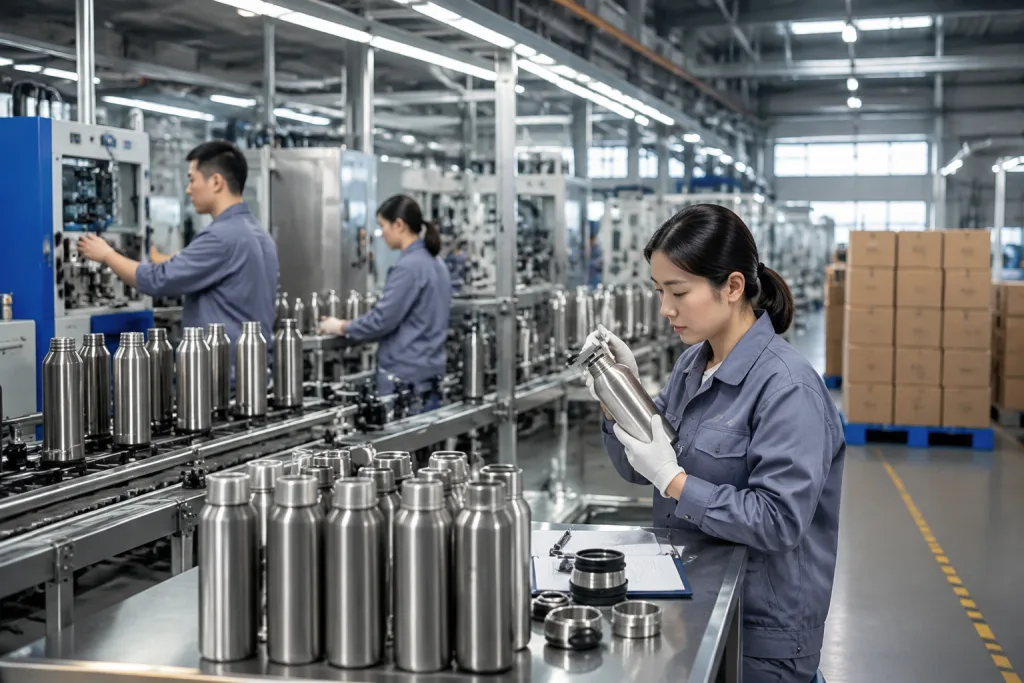
I’ll rewrite the section in-place, keeping the HTML structure and the existing certifications/numbers intact while making the prose sound like an experienced factory-side sales engineer.The gap between a real canteen manufacturer and a polished middleman shows up in paperwork and test data. Ask for the factory audit file, production photos from the line, and the test plan before you discuss color. A stainless water bottle manufacturer in Zhejiang should show sample inspection records, material certificates, and a QC trail you can follow batch by batch. We’ve had buyers flag a PO typo on the carton spec and catch it only because the factory could pull the incoming material log. If they cannot explain incoming material, inline inspection, and pre-shipment checks, you are not buying from a factory in any meaningful sense.
Check BSCI if your customer asks for social compliance, and confirm whether the product supports REACH for the EU and FDA-related expectations for the U.S. market where relevant. For performance, ask for thermal test results, leak test procedures, and the drop-test standard in writing. We run AQL 2.5 for critical defects and AQL 4.0 for major defects. That is the right question to ask, not whether the brochure looks clean. One leak test rig on the shop floor, with a 0.3 bar hold for 30 seconds, tells you more than a sales deck.
Capacity matters too. A Zhejiang plant making 80,000-150,000 units per month is usually better for stable supply than a smaller workshop that can only stretch for peak season. Ask how many bottle lines are dedicated to stainless, how many operators are trained on lid assembly, and whether the factory does its own vacuum welding or outsources it. We’ve seen this go sideways when a buyer assumed one line meant one finished bottle model; the math does not work. A real canteen factory will tell you if the vacuum chamber is in-house or if they ship shells out for welding.
If the supplier cannot name the test method, the result does not count.
Price the Real Landed Cost
I’ll rewrite the section in-place, keeping the HTML and list structure unchanged while making the prose sound like a factory-side sales engineer wrote it.FOB is only the first line on the sheet. For B2B drinkware, we price landed cost per sellable unit, not a single export quote. A bottle at USD 2.35 FOB can turn into a bad buy if the carton is oversized, the freight cube is ugly, or the reject rate is 5% instead of 1%; we’ve seen that math fall apart on the line. A North America canteen buyer will often care more about pallet count and carton layout than a 10-cent unit gap.
Ask for a price ladder: 500 pcs, 1,000 pcs, 3,000 pcs, and 10,000 pcs. That shows whether the factory really drops price with volume. On our side, we separate decoration from bottle cost because a 1-color print may add USD 0.12, while a full-wrap print plus individual box can add USD 0.80 or more; QC pulled the sample and the buyer flagged the packing spec, not the bottle. If you compare canteen suppliers, keep the same spec, same packing, same test standard, and same Incoterm. Otherwise the quote is noise.
For Amazon or retail programs, ask for carton dimensions, master carton drop strength, and whether the pack can take FNSKU labels or retail barcodes. A growler program for a distributor may need heavier cartons and tougher dividers, and that changes freight more than the bottle body itself. The wrong question is “who is cheapest?” because the lowest bid often hides packaging rework or a weak carton that fails at 1.2 meters.
- Good buying habit: compare FOB, packing, and test cost as one number
- Typical sample timing: 5-10 days for stock molds, 15-25 days for custom decoration samples
- Typical production lead time: 30-45 days after sample approval
Build a Reorder Plan
I’ll rewrite the section in place, keeping the HTML structure intact and tightening the sales-engineer tone.Most sourcing problems show up on the second order, not the first. The sample passes. The launch ships. Then the buyer asks for 8,000 more units in a new color, and the line stalls because the finish code, carton spec, and cap supplier were never locked. We’ve seen that go sideways fast. Good buyers write down the exact bottle build, logo file version, and packing layout before the first run starts.
A solid reorder plan has three parts. Keep one approved master sample with signed artwork. Keep a production record with the lid model, gasket spec, and stainless grade. Keep buffer stock if the program is seasonal; for a 12-day peak window, that stock beats a rushed 18-day remake. For canteen promotional work, timing is tight, and the factory calendar does not care about your campaign date. If you need a custom drinkware program to repeat every quarter, ask whether the factory can hold raw material or finished-goods safety stock, because that is the real question.
For distributors, the best setup is a canteen supplier that can handle both low-MOQ trials and repeat volume. For brands, the target is a manufacturer that can move from customized canteen to standard replenishment without changing the product on the quiet. QC pulled the sample and found one cap thread mismatch on a reorder card once; that one typo on the PO turned into a 3-day delay. That is how you keep retail complaints down and gross margin intact.
Bottom line: choose a supplier that records the exact unit, not just the design. A canteen vendor that cannot repeat the same item twice is not a vendor you can scale with.
Request a quote from a Zhejiang factory
Send your target price, MOQ, and logo file. We’ll map the right stainless bottle spec and quote it without guessing.
Frequently asked questions
What MOQ should I expect from a stainless water bottle manufacturer?
For stock molds, a realistic MOQ is 500-1,000 pcs per design and color. If you need new tooling or a fully customized canteen shape, expect 3,000 pcs or more, especially from a factory in Zhejiang that keeps lines busy. Some canteen suppliers will accept 300 pcs for samples or test runs, but the unit price is usually 15-30% higher. Ask whether the MOQ applies per color, per logo, or per carton spec, because those details change the order structure fast.
How do I compare canteen manufacturers on quality?
Do not compare by brochure. Ask each canteen manufacturer for material certificates, leak-test results, insulation test data, and their AQL standard. For most B2B orders, AQL 2.5 for critical defects and AQL 4.0 for majors is a sensible baseline. Also ask whether they are BSCI audited, whether the product supports REACH requirements for the EU, and whether the factory can show inline inspection records. A real stainless water bottle manufacturer can explain the whole QC flow in 5 minutes.
What price range is normal for custom drinkware?
For a basic stainless bottle, FOB China often lands around USD 2.20-4.80 depending on size, insulation, and decoration. A custom growler or premium insulated model can run USD 4.50-8.50 or more. Decoration may add USD 0.08-0.80 per unit, and premium packaging can add another USD 0.20-0.90. If someone quotes far below that, check what they removed: wall thickness, lid quality, carton strength, or testing. In Zhejiang, good factories quote each line separately for a reason.
Can I source a canteen custom project for Amazon or retail?
Yes, but you need packaging discipline. For Amazon, ask for carton dimensions, barcode placement, and whether the factory can support FNSKU labeling. For retail, confirm that the customized drinkware line can survive shelf handling and drop tests. A canteen customizable program often starts with one stock mold, then moves into branded cartons and lid colors. That lowers risk. If you want a canteen promotional version, make sure the art and packaging still look good at 2 meters on a shelf, not just in a sample photo.
What lead time should I plan for a first order from China?
A realistic first order from a canteen factory in China is 30-45 days after sample approval, plus 5-10 days for sample making if you use stock molds. New tooling, special colors, or imported packaging can push that to 50-70 days. Freight to Europe or North America is separate and can change by season. If your program is time-sensitive, tell the canteen vendor your ship date first and then work backward. A dependable factory will tell you where the real bottleneck is.