Key Takeaways
- Set RFQ line items by capacity, steel grade, wall thickness, finish, logo method, carton spec, and AQL level before asking for price.
- A realistic stainless bottle MOQ is usually 1,000 units per SKU for standard colors and 3,000 units for custom powder coating.
- Plan 7-12 days for pre-production samples and 30-45 days for bulk production after deposit and artwork approval.
- Use PO clauses for REACH, LFGB or FDA food-contact needs, carton drop test, spare parts rate, barcode/FNSKU labels, and inspection timing.
If you are sourcing a stainless water bottle factory, you are not just buying a bottle. You are buying on-time shipping, logo repeatability, food-contact paperwork, and a margin that still survives freight, duty, and retail markdowns. A low quote from China turns costly fast when the lid leaks, the carton fails a 76 cm drop test, or the Pantone shift shows up on the shelf.
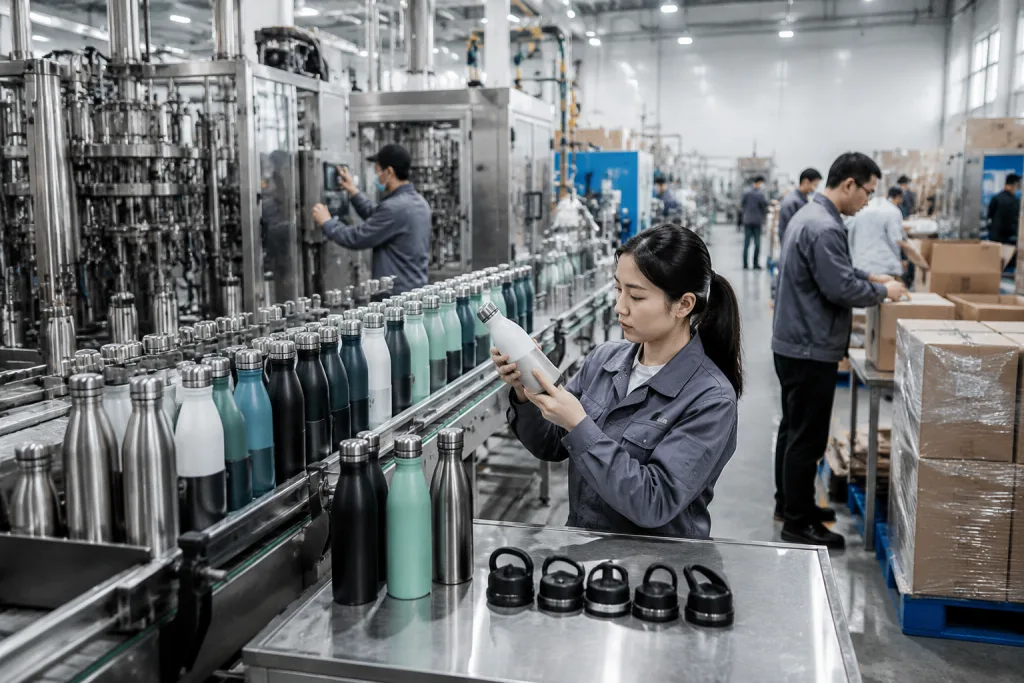
At BottleForge Industrial in Hangzhou, Zhejiang, we run OEM and ODM custom drinkware for distributors, promo programs, and brand owners. Our line handles 10,000 to 800,000 units/month by model and finish, with a typical MOQ of 1,000 units per SKU. We’ve seen buyers lose a week because the PO said “silver” and the sample was brushed steel, so here is the clean path from RFQ to sample to bulk PO.
Start with a usable RFQ
I’ll rewrite the section in-place, keep the HTML structure intact, and make the wording sound like a factory sales engineer wrote it. Next I’m patching only the prose inside the existing tags.A stainless water bottle factory can only quote what you actually define. If your RFQ says “500 ml bottle, logo, best price,” you will get a stack of numbers that do not compare. One supplier may price 201 stainless steel, another may quote 304 inside and 201 outside, and a third may leave out retail packaging. The lowest number is usually the least specified one.
Your first RFQ should read like a draft PO. Put the bottle type, capacity, lid material, insulation spec, decoration method, packaging, compliance market, and delivery term in one line. For example: 750 ml double-wall vacuum bottle, inner 304 stainless steel, outer 304 stainless steel, 0.45 mm inner wall, 0.50 mm outer wall, powder coating, one-position laser engraving, individual kraft box, 24 pcs/master carton, FOB Ningbo, 3,000 units. QC pulled a sample on a 0.45 mm wall last week, and the buyer flagged the missing carton count. The math does not work without those details.
For custom canteen and promotional orders, state the use case too. A school program, an outdoor retail SKU, and a distributor campaign need different lids, different handle strength, and different cartons. We run that decision off the end use, not guesswork. If the bottle is for daily commuting, hiking, sports clubs, gift-with-purchase, or Amazon FBA, a Zhejiang canteen factory can spec the parts with less back-and-forth.
Useful RFQ line items include:
- Product: capacity in ml/oz, mouth diameter, target dimensions, target weight.
- Material: 304 or 316 stainless steel, PP or Tritan lid parts, silicone ring grade.
- Performance: hot/cold retention hours, leak test requirement, vacuum rate.
- Decoration: silkscreen, laser, heat transfer, water decal, or full-wrap powder coating.
- Trade: FOB Ningbo or Shanghai, EXW Zhejiang, DDP estimate if needed.
Lock the commercial frame early
I’ll rewrite just the prose in place, keep the HTML structure intact, and tighten the commercial language so it reads like a factory-side sales note.After the RFQ, lock the quotation into separate lines for unit price, tooling, samples, packaging, inspection, and inland freight. Cheap unit pricing hides the damage elsewhere. We’ve seen a buyer accept USD 3.10 FOB on paper, then the logo plate, color setup, and carton change add USD 700 on a 1,000-unit trial.
Ask the stainless water bottle factory for 1,000, 3,000, and 10,000 pcs. That gives you the real curve. For standard custom drinkware, BottleForge usually sees USD 2.20-5.80 FOB per unit depending on capacity, steel grade, lid structure, coating, and pack-out. A custom growler or customizable growler at 1.9 L, with a heavy handle and swing cap, sits higher again if wall thickness goes past 0.60 mm.
Put the commercial terms into the PO draft before you send the deposit. Waiting until payment day is how orders slip. State the deposit rate, balance trigger, sample approval rules, and production lead time. Most China drinkware factories run on 30% deposit and 70% balance before shipment or against copy documents. If your company needs credit terms, raise it before sampling; after the goods are packed, the math does not work.
A clean commercial frame may look like this:
- Item 1: 3,000 pcs 750 ml customized canteen, powder coated black, laser logo, FOB Ningbo.
- Item 2: 3,000 pcs retail color box, E-flute, 4C print, barcode applied.
- Item 3: 2% spare lids and 1% spare silicone rings packed separately.
- Item 4: Pre-shipment inspection by buyer agency, AQL 2.5 major / 4.0 minor.
- Item 5: Delivery within 35 days after deposit, artwork, and golden sample approval.
This is not paperwork for the desk drawer. It stops the usual fight where the buyer expects a retail-ready distributor drinkware order and the factory priced a bulk-packed promo job.
Approve samples like production evidence
I’ll rewrite the prose only, keep the HTML tags intact, and make it sound like a factory-side sales engineer wrote it.Samples are not souvenirs. They are the proof that the factory read the order right and that your team already made the call. For canteen custom jobs, we usually ask for two stages: a blank structural sample and a decorated pre-production sample. The first checks size, lid fit, drinking feel, and weight. The second checks finish, logo, packaging, and carton marks.
For existing molds, a blank sample can ship in 3-5 days from Zhejiang. A decorated sample usually needs 7-12 days after artwork confirmation. If you ask for a new lid, a new body shape, or a custom mold for a customized growler, tooling adds 20-35 days before the first working sample. That is normal. What is not normal is approving a PDF and skipping the physical sample on a 10,000-unit PO.
Check samples with a simple buyer-side record. We weigh the bottle, measure height and diameter with calipers, check the mouth thread, fill it with hot water for 6 hours, and run a 30-minute inverted leak test. For powder coating, scratch resistance comes down to pretreatment and curing; ask the canteen manufacturer for coating thickness, usually 60-90 microns for standard powder finishes. QC pulled a sample once and found a 1.5 mm lid gap, and the buyer flagged it before we shipped the line.
Your sample approval email should use exact language: “Approved as golden sample for bulk production except carton warning label revision dated May 12.” Keep one golden sample at your office and one at the factory. A serious stainless water bottle factory will use the factory sample for line setup and QC comparison. If you are a canteen distributor selling to multiple retail accounts, make each artwork version a separate approved file with a revision number. We’ve seen this go sideways when one PO had a typo in the logo file and the buyer only caught it after carton print was done.
Define materials and compliance before deposit
I’ll keep the HTML tags untouched and rewrite only the prose, adding concrete factory-floor detail and tightening the compliance language.Material wording has to be exact. “Food grade” is not a spec. For stainless bottles, 304 on the inner wall is the normal baseline for Europe and North America. We sometimes see buyers try to save with 201 on the outer shell, and the math works only on paper; for a branded custom bottle, 304 inside and outside is the safer call. If the drink is acidic, the order is for a coastal market, or the product sits in premium outdoor retail, 316 inner steel is worth discussing, but the price jump is not small. On the line, we check the steel strip thickness with a caliper before we start the draw.
For EU orders, ask for LFGB, REACH, and any country-level packaging rules before you pay deposit. For the US, FDA food-contact, California Proposition 65 screening, and CPSIA may apply depending on who will use the bottle. If the bottle is for kids, do not treat it like a normal promo canteen. Ask for ASTM-related testing, small-parts risk, coating heavy metals, and bite-valve material if the design has one. QC pulled a sample last month because the lid insert was 1.2 mm loose, and that is the kind of miss that shows up after packing, not before.
Good factories in China do not give every certificate for free. Existing reports may cover standard steel, silicone, and plastic parts, but a buyer-specific test from SGS, Intertek, TÜV, or BV usually carries a lab fee and takes 5-10 working days. Put that in the PO, line by line. If the buyer asks for REACH SVHC, state the exact version. If a distributor growler order needs LFGB migration testing on the lid and body, name those parts, not just the whole set. We had one PO with “REACH ok” typed in the remark field; the buyer flagged it, and we had to resend the whole file.
Also lock down what cannot change. Silicone rings, PP lid grade, powder brand, and straw material should not move without written approval. Factory shortages are real, and a line supervisor will swap a sub-part if the PO is vague enough; that is how disputes start. Use a sentence like: “No material, component, coating, logo method, carton board, or packing ratio substitution without buyer written approval.” We ship a lot, and this single line saves more trouble than any sales promise. One typo on a PO can turn into a 3,000-piece rework.
Build the bulk PO line by line
I’ll rewrite the section in place, keeping the HTML exactly as-is and tightening the prose to sound like a factory-side sales engineer.The bulk PO is where the job becomes real. A custom drinkware order should not be one line that says “water bottles as sample.” That tells us nothing about tolerances, barcode location, carton strength, spare parts, change control, or who signs off late artwork. A clean PO gives procurement, the line, QC, and the forwarder the same facts. No guesswork.
Start at SKU level. If you have three colors, write three lines with the Pantone or RAL code, finish type, quantity, barcode, and packing spec. We run into trouble when buyers mix assorted colors into one vague line. One retailer sent 40% navy, 40% white, and 20% olive in a single note; the line was fine, but the carton plan was wrong, and the buyer flagged it on the first draft.
Then lock down the build controls. State the capacity tolerance, such as nominal 750 ml with usable fill line not less than 720 ml. State logo position tolerance, such as ±2 mm from approved artwork. For laser engraving, say whether the mark should cut through the coating to show stainless steel or stay dark. For silkscreen, list the Pantone code and the adhesion test, like 3M tape pull after 24 hours curing. The math does not work if this is left loose.
Packing needs its own section. Put in the inner bag type, retail box size, master carton ply, gross weight limit, shipping marks, pallet plan if needed, and drop test requirement. For Amazon or marketplace orders, list FNSKU, suffocation warning, carton label format, and keep carton weight under 22 kg where possible. We have seen a weak 5-ply carton turn into claims at the warehouse, and that bill hurts more than the upgrade at production. QC pulled the sample, and the corner crush failed on the first drop.
Finish with inspection and payment triggers. Example: “Final inspection when 100% goods produced and at least 80% packed, AQL 2.5 major / 4.0 minor, critical defects not accepted.” Put leakage, sharp burrs, wrong material, wrong logo, coating peel, and contamination under critical defects. One PO typo on a logo file name can drag a shipment by 12 days; a tight trigger keeps that from happening. This is how a custom canteen order stays under control.
Inspect before balance payment
I’ll keep the HTML structure intact and rewrite only the prose, tightening the sales-engineer tone and adding concrete factory-floor details without changing the headings or tags.Inspection costs less than replacement. Once customized canteen goods leave China, a small flaw turns into freight claims, support tickets, or retailer chargebacks. In Zhejiang, a pre-shipment inspection usually runs USD 180-350 per man-day, depending on agency and travel. That is cheap next to flying 3,000 leaking lids by air.
For stainless bottles, we check appearance, function, packing, and data. Appearance means dents, scratches, coating dust, color shift, weld marks, logo sharpness, and box print. Function means leak test, lid torque, straw fit, handle pull strength, vacuum sampling, and edge burrs. Packing means carton count, assortment ratio, barcode scan, FNSKU placement, polybag warning, and shipping marks. QC pulled a sample with a 0.3 mm dent last week; that kind of thing gets missed when the buyer only looks at photos.
AQL helps, but do not treat it like a shield. AQL 2.5 major / 4.0 minor is common for promotional and retail drinkware. Critical defects stay at zero. If 5 pieces leak in a 200-piece sample, the math does not work. That shipment fails. For a custom growler with a pressure cap or gasket, we run more functional tests than the basic visual table calls for.
Ask your stainless water bottle factory to finish internal QC before the third-party inspector shows up. At BottleForge Industrial, the line checks vacuum performance, coating adhesion, and leak rate before final packing, then supports buyer inspections at our Hangzhou, Zhejiang facility or partner workshops. We once had a buyer flag a PO typo on the carton mark and push the whole booking back two days; that is why inspection should sit in the production calendar, not after it.
Do not release the 70% balance until inspection passes or corrective action is on paper. If rework is needed, spell out who pays for reinspection. When the failure comes from the factory, the factory should pay or split the second inspection fee. Put that in the PO before the issue shows up.
Ship with fewer warehouse surprises
I’ll rewrite the section in place, keep the HTML structure untouched, and tighten the copy so it reads like a factory-side sales engineer wrote it.Shipping is where a lot of buyers learn the hard part: a bottle is not just a product, it is a carton spec, a label, a pallet pattern, and a customs line item. If you buy from stainless water bottle factories in China, lock the export carton dimensions before you book freight. We once saw a 2 cm carton-height shift turn a clean 40HQ plan into wasted space and a higher courier bracket.
For FOB orders, we ship to the port or the forwarder’s warehouse, usually Ningbo or Shanghai for Zhejiang production. DDP needs a sharper eye. It can work for small distributor canteen orders, but you still need the duty basis, importer of record, insurance, and delivery appointment rules in writing. The math does not work if fuel, tariff class, and the destination warehouse all stay vague.
Your shipment file should carry the commercial invoice, packing list, HS code suggestion, test reports, product photos, carton photos, and the inspection report. For stainless vacuum bottles, exporters use HS code families tied to vacuum flasks or stainless household articles depending on structure and market; your customs broker should lock the final code. QC pulled the sample on one 5000 pcs order because the PO had a typo on the carton mark, and that small error would have snowballed at customs. If you sell customizable drinkware through retail channels, keep certificates and batch records for at least several years because buyers do come back later and ask.
Before the container or LCL shipment leaves, ask for loading photos and a carton count check. For mixed SKUs, use a loading sequence or pallet labels so colors and accounts stay separated. We have seen this go sideways when one buyer’s navy bottles landed next to another account’s white units; the warehouse team spent half a day sorting by hand.
A controlled sourcing process is not slow. It is faster because every stage has a decision: RFQ sets cost, sample sets the spec, PO sets the rules, inspection sets release, and shipping sets handover. That is how custom canteen, distributor growler, and broader customized drinkware programs stay profitable.
Send your stainless bottle RFQ for factory review
Share capacity, quantity, logo method, packaging, and destination market. We will return a practical quote with MOQ, lead time, and risk notes.
Frequently asked questions
What MOQ should I expect from a stainless water bottle factory?
For standard stainless bottle molds, expect 1,000 units per SKU as a realistic MOQ. If you need a custom powder-coated color, 3,000 units is more practical because coating lines need setup time and color change cleaning. For canteen promotional orders with simple laser engraving on stocked colors, some factories may accept 500 units, but the FOB unit price will rise. For a new lid, new body, or customized growler mold, MOQ can move to 5,000-10,000 units because tooling and component sourcing need volume. Always ask for price breaks at 1,000, 3,000, and 10,000 units so you can see where the cost curve changes.
How long does sampling and bulk production usually take?
For an existing stainless bottle or customizable canteen mold, a blank sample usually takes 3-5 days, and a decorated pre-production sample takes 7-12 days after artwork approval. Bulk production is commonly 30-45 days after deposit and golden sample approval for 3,000-20,000 units. Peak season before summer and Q4 can add 7-15 days, especially for powder coating and retail packaging. If you need a new mold for a custom growler or special cap, add 20-35 days for tooling before functional sampling. Freight time is separate: ocean to North America or Europe can add roughly 25-45 days port to port.
Which logo method is best for custom drinkware?
Laser engraving is the safest option for long-term durability on powder-coated stainless bottles because it removes the coating and exposes a clean mark. It is good for premium custom drinkware and distributor canteen programs where the logo is one color. Silkscreen is cheaper for simple artwork and can match Pantone colors, but adhesion depends on ink, curing, and coating surface. Heat transfer works for multi-color graphics, but it needs careful testing for abrasion and dishwasher claims. For most B2B buyers, I suggest laser for 1-position logos, silkscreen for budget promotional canteen orders, and heat transfer only after a physical adhesion sample passes tape and rub testing.
What inspection standard should I put in my PO?
Use AQL 2.5 for major defects and AQL 4.0 for minor defects as a normal starting point for stainless drinkware. Set critical defects at zero tolerance. Critical should include leakage, unsafe sharp edges, wrong material, wrong capacity, severe contamination, wrong logo, and coating peel that exposes large areas. Require inspection when 100% of goods are produced and at least 80% are packed. For a customized growler, straw lid, or sport cap with more functional risk, ask the inspector to increase leak and assembly testing beyond the visual sample size. Also state that failed factory-caused inspections require corrective action and reinspection before balance payment.
Can you support canteen distributors with retail packaging and barcodes?
Yes, but it must be specified early. A canteen distributor often needs retail color boxes, UPC or EAN barcodes, FNSKU labels, suffocation warnings, carton labels, and account-specific shipping marks. These are not minor details for the factory; they affect artwork approval, carton printing, packing labor, and inspection. For Amazon-style orders, provide FNSKU files at final size and confirm carton weight limits, usually under 22 kg where possible. For retail, send the packaging dieline, barcode test requirements, and any language rules. We can pack by SKU, color ratio, or account, but each packing rule should be written as a PO line item.