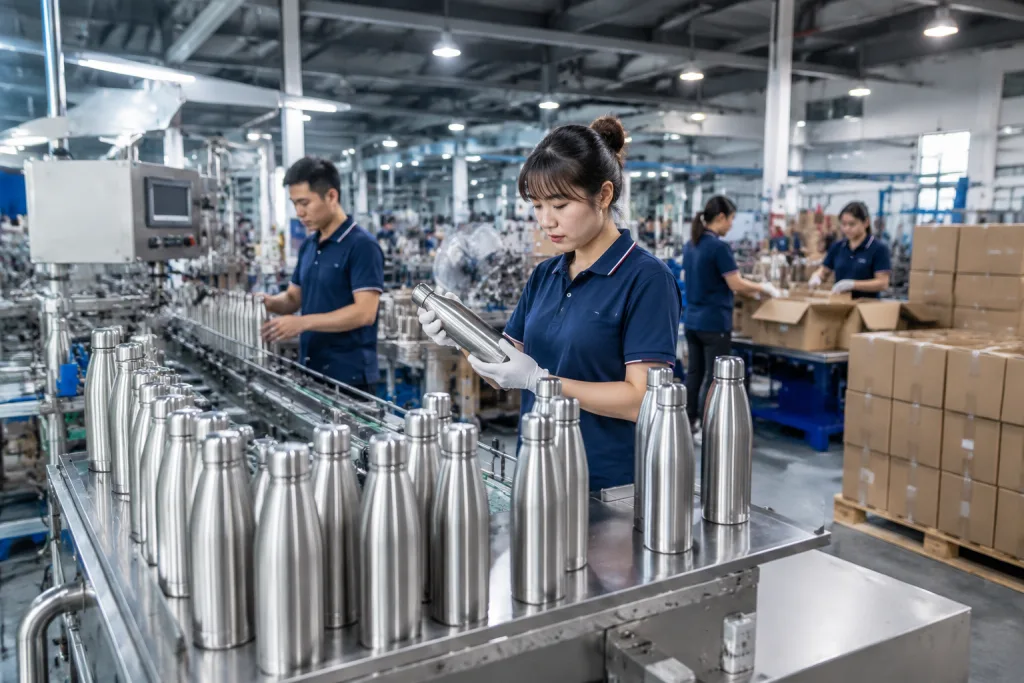
Key Takeaways
- Typical MOQ for stainless water bottle custom starts at 500-1,000 pcs; complex lids often need 3,000 pcs.
- A 500 ml 304 bottle usually lands around USD 1.80-3.80 FOB China depending on finish and logo method.
- Normal production lead time is 25-35 days after sample approval; peak season can add 10-15 days.
- Ask for AQL 2.5/4.0 inspection, vacuum hold tests, and coating adhesion data before you pay deposit.
If you are buying stainless water bottle custom for retail, corporate gifting, or marketplace sales, the hard part is not choosing a shape. The hard part is keeping the order profitable after decoration, packaging, testing, and freight. A bottle that looks cheap at USD 1.80 can blow up the margin once you add 304 steel, a laser logo, a color box, and export cartons. We have seen a PO typo on lid color turn into a rework batch on the line.
Most procurement mistakes happen because buyers treat drinkware like a simple commodity. It is not. In Zhejiang, the better factories quote by steel grade, wall thickness, coating, lid tooling, and MOQ. A solid canteen factory will say it straight: 500 pcs and 20,000 pcs are two different jobs. That honesty saves time. QC pulled the sample at 0.3 mm wall thickness once, and the buyer flagged it before production. For this product, that is the right question to ask, not “what is your lowest price?”
What you are really buying
I’ll rewrite the section in-place, keep the HTML and heading structure intact, and tighten the sales-engineer voice while preserving the specified technical numbers and terms.When you source stainless water bottle custom, you are not just buying a container. You are buying steel grade, forming quality, insulation performance, lid reliability, and decoration durability. Two bottles can both show 500 ml on the spec and still land at very different landed costs. We’ve seen that on the line. A plain single-wall bottle in 201 stainless is cheap, but for most export programs we start from 304 stainless steel unless the buyer signs off on a lower grade.
A proper spec sheet should list wall thickness, usually 0.4-0.6 mm for single-wall and around 0.35-0.5 mm for vacuum shells, plus coating type, lid material, and the test standard you want. QC pulled a sample once and found a 0.32 mm shell where the PO called for 0.4 mm. If you are buying for a brand, ask the canteen supplier to state whether the bottle is for custom drinkware, customizable drinkware, or promotional stock. That is not a cosmetic label. It changes tolerance, packing, and how much sorting we do before ship. For example, a canteen promotional order may run with simpler cartons, while a retail program needs barcode labels, master carton marks, and tighter cosmetic acceptance.
- 304 steel is the safe export baseline for drinkware.
- 316 steel suits acidic beverages, but it raises cost by 10-20%.
- Vacuum walls improve insulation, and they add weld and leak checks.
- Logo method changes the visual life of the product more than buyers expect.
Ask these four procurement questions
I’ll rewrite the prose in place, keep the HTML structure and all specific numbers/codes intact, and tighten it so it sounds like a sales engineer wrote it.Before you compare offers, put the same four questions to every canteen factory: what is the exact MOQ, what is the stable lead time, what tests are in the quote, and what is the real FOB price at your target quantity. If the reply is loose, the line is not export-ready. We run this check on every RFQ. A Zhejiang factory worth your time answers in numbers, not soft talk. For example: MOQ 1,000 pcs, sample lead time 7 days, mass production 30 days, and monthly capacity 200,000 units. That is the data you need when the buyer flagged a campaign for Q3 or a holiday drop.
Ask whether the factory is a canteen supplier, direct canteen vendor, or trading middleman. The name on the card matters less than traceability, but direct production gives you better control over mold edits and carton layout. If you are a canteen distributor or distributor drinkware buyer, ask one more thing: can they mix SKUs in one outer carton, or does each model need its own run. Mixed packing cuts freight, and it also creates label mistakes if QC is not on the ball. We’ve seen that go sideways on a PO with a wrong SKU code by one digit.
Do not approve a quotation until the supplier shows the bottle structure, lid BOM, and test plan in writing. If they cannot, you are not comparing the same product.
- MOQ often starts at 500-1,000 pcs for stock molds.
- New lid tooling can push MOQ to 3,000-5,000 pcs.
- FOB pricing should be quoted by capacity, decoration, and packaging level.
- Ask for written confirmation of leak test, drop test, and temperature retention claims.
Decoration changes your margin
I’ll rewrite the section in place, keep the HTML structure unchanged, and tune the prose to sound like a factory-side sales engineer. Then I’ll give you just the updated HTML.Decoration is where a lot of orders go red. A laser logo usually runs USD 0.08-0.20 per piece; a 4-color silk screen or full-wrap UV print adds USD 0.15-0.60 once you count screen setup and curing time. Powder coating can add another USD 0.20-0.45. If the buyer wants shelf presence, fine. If it is a supermarket pack built on a tight landed cost, those extra passes eat the margin fast.
This is where custom canteen, canteen customizable, canteen customized, and customizable canteen stop being marketing words and become a spec sheet. They tell you how much can change without opening new tooling. A lid color swap is easy. A new handle on a custom growler or customizable growler is a different job. We’ve had buyers flag a PO because they wrote “new lid” but sent a sketch with a fresh hinge boss; the math didn’t work, and the mold quote jumped. The same rule applies to a customized canteen or customized growler: ask whether the line is only printing, or if we are cutting steel.
If you need custom drinkware for a launch with tight branding, ask for one pre-production sample with the exact Pantone code and one plain control sample. We run that check on the bench, and QC pulled the sample against a 3.0 mm logo register line before release. It shows you fast whether the coating, gloss, and logo position stay stable across the batch. In Zhejiang, the better factories do not make a drama out of it because this is normal export work.
- Laser engraving is durable and usually the lowest-cost mark.
- UV print looks premium but scratches fast if pretreatment is weak.
- Powder coat improves grip and hides shell marks.
- Approve one signed color sample before mass production.
Testing beats promises
I’ll keep the HTML structure intact and rewrite the prose to sound like a factory-side sales engineer, with concrete shop-floor details and no AI filler.Do not buy on pictures. Buy on test data. For vacuum bottles, ask for a vacuum hold check, lid torque check, leak test, and thermal retention report. On a 500 ml insulated bottle, a normal target is 6-12 hours hot and 12-24 hours cold, but the result moves with ambient temperature, wall thickness, and headspace in the bottle. We run this on the line with a torque wrench and a water bath. If the supplier only sends marketing numbers and skips the test condition, the claim is dead on arrival.
For export drinkware, ask for AQL 2.5 on major defects and AQL 4.0 on minor defects. That is the right baseline for retail packaging, though some buyers push for tighter cosmetic limits on logo scratches and print alignment. If the order goes to a retailer or Amazon-style channel, ask for barcode and carton labeling support, including FNSKU application if needed. QC pulled the sample last week and found a carton typo on the inner box, so this is the wrong place to guess.
Test records matter most when you place repeat orders. A canteen manufacturer that files results by lot number can trace a bad cap, liner, or weld fast. We saw one claim turn into 18 cartons instead of 1,200 because the lot card matched the failed batch. That is the difference between a clean fix and a freight-sized headache.
- Request one random sample from each production line, not a handpicked sample.
- Check lid seal after 3 opening cycles and 20 tightening cycles.
- Ask for drop test at 1.2 m on concrete for retail programs.
- Require REACH, LFGB, or FDA-related documents based on your market.
What pricing should look like
I’ll rewrite the section in-place, keep the HTML and numbers intact, and tighten the sales tone so it reads like a factory-side quote discussion.For a standard 500 ml single-wall bottle in 304 steel, FOB China usually lands around USD 1.20-2.20 at higher volume. Vacuum-insulated models sit closer to USD 2.30-4.80, and lid style drives a lot of that gap. Basic packaging adds USD 0.10-0.35; gift boxes and retail inserts push it up fast. If a quote comes in far below that band, the steel grade, coating, and insulation claim need a hard check — we’ve seen buyers get burned on a 0.4 mm wall and a fake 304 callout.
That spread is why a canteen distributor should stop looking at unit price alone. The math does not work that way. Ocean freight, customs paperwork, local warehousing, and repacking can add another 8-18%, depending on carton size and destination. One European buyer flagged a PO typo on the port code and lost three days. A solid canteen vendor in China should quote FOB Ningbo or FOB Shanghai clearly, and explain where Zhejiang production fits in the shipping plan.
If you are running a promotional push, the cheapest supplier is rarely the right one. A canteen promotional order with 50,000 units needs stable output, not a bargain sample quote that falls apart on the line. QC pulled the sample with a lid torque issue at 18 N·m, and that is the kind of miss that kills a launch. In Zhejiang, factories with real metal forming and finishing lines protect your timeline better than an agent juggling three subcontractors.
- Single-wall retail programs: roughly USD 1.20-2.20 FOB.
- Vacuum bottles: roughly USD 2.30-4.80 FOB.
- Packaging can add 5-15% to unit cost.
- Freight and duties can add 8-18% to landed cost.
Your supplier checklist
I’ll rewrite the section in-place, keep the HTML exactly as-is, and tune the copy to sound like a factory-side sales engineer with tighter, more specific language.Run a short checklist before you place the order. First, confirm who you are dealing with: direct canteen factory, trading company, or a mixed setup. Second, check certifications and audit history, especially if you need BSCI, ISO 9001, or social compliance records. Third, ask for current output and whether the line is dedicated to one category or shared across custom drinkware, custom growler, and tumbler programs. We have seen mixed lines work fine when scheduling is tight; when the line is loose, the buyer pays for it.
Next, check the production flow. A proper canteen manufacturers setup should show shell forming, welding, polishing, coating, printing, assembly, and packing in that order. Ask how many units per month the site can actually ship, not the number in the brochure. In Zhejiang, a solid plant may run 150,000-300,000 units/month depending on model mix. QC pulled one sample last week at 0.35 mm wall thickness, and that told us more than a sales deck ever will. Also ask who owns final inspection. If the answer is “our warehouse team checks it,” the math does not work.
Finally, define your buyer role. If you are a canteen distributor or distributor growler buyer, you need flexible SKU support and clean outer-carton marks; one typo on a PO can turn into a 12-day delay. If you are a brand owner, you need tighter decoration control and a clear replacement rule. If you are a retailer, you need shelf-ready packaging and fewer hand fixes at receiving. The right supplier in Zhejiang should know the difference and quote like they ship it every week.
- Factory audit or recent third-party report.
- Written spec sheet with steel grade and thickness.
- Signed sample and carton mark approval.
- Inspection plan with AQL levels and defect definitions.
Send your bottle spec and get a real quote
We’ll check MOQ, decoration, test requirements, and FOB pricing in one pass, so you can compare suppliers without guessing.
Frequently asked questions
What is the usual MOQ for stainless water bottle custom orders?
For stock molds, MOQ usually starts at 500-1,000 pcs. If you want a new lid, new handle, or a fully customized canteen body, the MOQ often moves to 3,000-5,000 pcs because the factory needs to cover tooling and setup cost. In Zhejiang, a good canteen supplier will explain whether the MOQ is per color, per logo version, or per total style. Ask that before you send artwork. Otherwise you may think you ordered 1,000 pcs and discover the factory split the quantity by colorway.
How much should I budget per bottle?
A plain 304 single-wall bottle can be around USD 1.20-2.20 FOB China at volume, while a vacuum-insulated bottle usually sits around USD 2.30-4.80 FOB. Decoration adds cost fast: laser engraving may be USD 0.08-0.20, screen print USD 0.15-0.40, and powder coating or special finishes can add USD 0.20-0.45 more. For landed cost, add packaging, freight, duty, and local handling. For many North America and Europe programs, total landed cost ends up 8-18% above FOB once the shipment is fully cleared.
Which tests should I ask the factory for?
At minimum, request leak test, vacuum hold test, lid torque test, and a drop test if the bottle is retail-facing. For insulation claims, ask for the exact test condition, not just a headline number. A serious canteen manufacturer should also provide material documentation for REACH, LFGB, or FDA-related requirements depending on your market. If the supplier is in China or Zhejiang and cannot produce test data by lot, that is a warning sign. For commercial orders, ask for AQL 2.5 major and 4.0 minor defect levels.
Can I customize color, logo, and packaging together?
Yes, but each change affects lead time and price. A simple logo change may add only 2-3 days for tooling setup, while a new Pantone body color can add 5-7 days if the coating line needs a dedicated batch. Gift boxes, barcode labels, and retail inserts can add another 3-5 days to packing. For a canteen customized program, approve the color sample first, then the pre-production sample with the logo and carton marks. That sequence reduces rework and keeps the shipment on schedule.
How do I choose between a factory and a distributor?
If you need direct control over molds, coatings, and timelines, buy from a canteen factory or canteen manufacturer. If you need smaller mixed orders, faster communication, or local stock support, a canteen distributor or distributor drinkware partner may be easier. For large custom drinkware programs, direct factory pricing is usually better, and you get stronger control over QC. In Zhejiang, a good factory should show monthly output, sample lead time, and inspection records. If a distributor cannot explain the original production source, you are taking extra risk without a clear benefit.