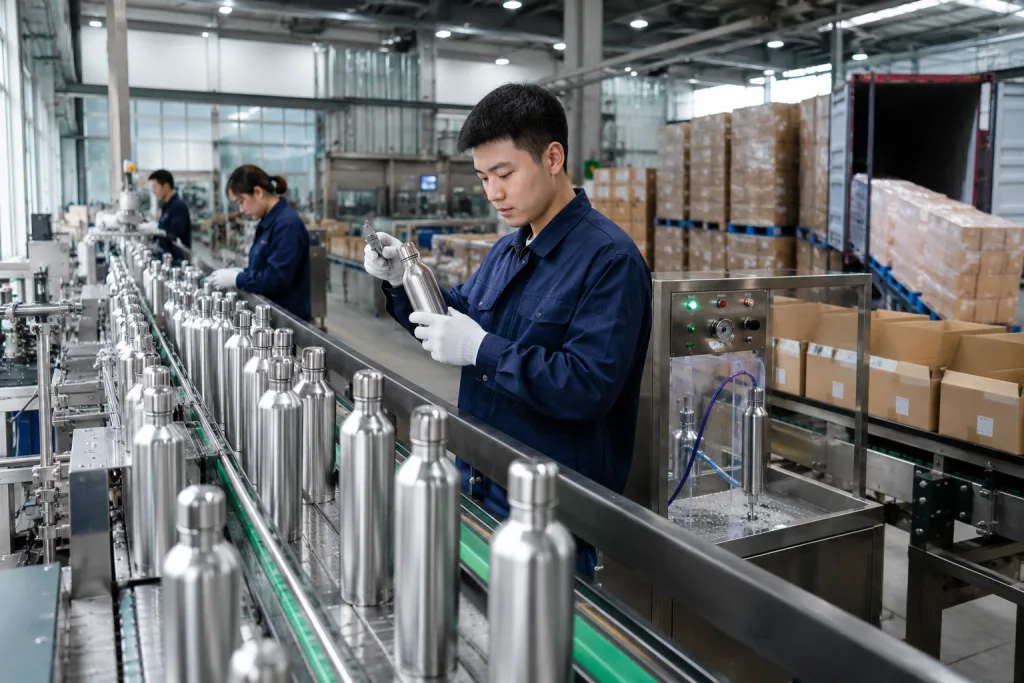
Key Takeaways
- MOQ for standard stainless water bottle bulk orders usually starts at 1,000 pcs, with 25-35 day lead time after sample approval
- 18/8 stainless with 0.4-0.5 mm wall thickness is the safest baseline for retail-grade wholesale drinkware
- AQL 2.5 for major defects and 4.0 for minor defects is a practical acceptance target for most buyers
- FOB China pricing commonly ranges from USD 1.85 to 5.40 per piece depending on capacity, lid, and finish
If you are buying stainless water bottle bulk for retail, promotions, or private label, the wrong spec will cost more than the unit price. A 500 ml single-wall bottle, a 24 oz vacuum tumbler, and a wide-mouth canteen may look close in a catalog. On the line, they are different jobs. One needs a different lid torque, and one can fail drop testing at 1.2 m if the wall spec is off.
The clean way to source is to start with use case, then lock down steel grade, wall thickness, lid system, and decoration method. That is how buyers in Europe and North America avoid claims, dead stock, and price shocks. We run these programs every month in Hangzhou, Zhejiang, and the question we hear most is not about price first; it is about whether the sample passed a 24-hour leak check before the buyer flags the PO typo.
Compare the bottle before the price
I’ll rewrite the section in-place, keeping the HTML structure and table intact while making the prose sound like a real sales engineer wrote it. Then I’ll do a quick pass to strip any leftover AI phrasing and keep the buyer-facing details specific.Price only makes sense after you lock the sales channel. A gym chain buyer, a brewery buyer, and a corporate gifting buyer want different specs, even if all three type in stainless water bottle bulk. We run this comparison from fit first, then cost.
| Build | Best use case | Typical capacity | Notes for buyers |
|---|---|---|---|
| Single-wall bottle | Low-cost promotions, events, entry retail | 500-750 ml | Lighter, cheaper, but not for hot insulation |
| Vacuum insulated bottle | Retail, outdoor, premium gifting | 500-1000 ml | Higher margin, better for wholesale drinkware programs |
| Wide-mouth canteen | Sports, military-style, field use | 600-1000 ml | Strong fit for bulk canteen and canteen wholesale orders |
| Growler style | Brewery merch, refill stations | 1.9 L / 64 oz | Good for growler bulk and beer growler wholesale |
| Flask style | Gifts, travel, specialty alcohol sets | 200-350 ml | Works for alcohol flask bulk and alcohol flask wholesale bulk |
Do not push one spec across every channel. A brewery buying beer growler in bulk needs seal performance and odor control; we’ve seen that go sideways fast when the cap liner is wrong. A retailer selling canteen bulk wants color range and a box that stacks clean on the shelf. A promo buyer may only care about print area and landed cost. This is the wrong question to ask: “What is the cheapest bottle?” Ask which build matches the use case.
If the spec is still fuzzy, line up 3 samples side by side. One vacuum bottle, one canteen wholesale option, and one growler wholesale option will show the real gap in weight, lid feel, and shelf value in under 30 seconds. QC pulled the sample at 08:40 and the buyer flagged the cap torque before lunch.
Where your cost really moves
I’ll rewrite the section in-place, keep the HTML exactly as-is, and tighten the copy so it reads like a factory-side sales engineer wrote it.Most sourcing mistakes start when buyers stare at the outside and miss the cost drivers under the hood. On stainless water bottle bulk runs, the price usually moves with steel grade, wall thickness, lid build, coating, and pack-out. A plain 18/8 bottle with a PP lid can sit around USD 1.85-2.40 FOB China at 1,000 pcs. Add powder coating, laser logo, and a bamboo cap, and that same bottle jumps to USD 3.20-4.60. We’ve seen a buyer flag a PO typo on “304” versus “18/8” and the math changed on the spot. A premium double-wall growler or beer tumbler bulk order can go to USD 5.40 or more.
Here is the rule we use on the line: every extra process adds a touch more risk and a touch more cost. Double-wall vacuum structure means more forming time and a leak test on each batch. Powder coating adds curing, plus adhesion checks with the cross-hatch tool. Full-color wrap printing brings setup work and color matching headaches. If your buyer is a distributor, those extras can pay back. If you are building a price-led wholesale canteen line, they usually do not.
- Wall thickness: 0.4 mm is common; 0.5 mm feels stiffer but adds cost and weight.
- Steel grade: 304/18-8 is standard; 316 goes to harsher use or a premium spec.
- Lid type: screw cap, flip cap, carry loop, straw lid, or loop handle each changes tooling and leak rate.
- Decoration: silk screen is cheaper; laser engraving is durable; UV print costs more and gives QC more to check.
For drinkware wholesale buyers, the lowest quote is not always the lowest landed cost. Carton strength, inner packaging, and breakage rate can wipe out a 10% saving fast. QC pulled a sample last month and found one loose bottle in a 24-pack shipper; that kind of miss is why we push buyers to ask about drop test results, not just unit price.
MOQ, sampling, and factory reality
I’ll rewrite the section in-place, keep the exact HTML structure, and make the copy sound like a real factory-side sales engineer.Real sourcing starts when the factory tells you what it can repeat, not what it can show in a photo. In our Hangzhou, Zhejiang plant, we run up to 300,000 units per month across bottle and tumbler lines, with a standard MOQ of 1,000 pcs per SKU for most stainless bottle builds. On the line, a 0.3 mm wall shift or a loose lid print can turn into a claim later, so we quote the repeatable spec first. Custom lids, special coating, or mixed colorways can push that higher. That is normal in China, and the buyer who asks for a 500 pcs MOQ on a new mold is asking the wrong question.
Sampling usually takes 7-10 days for standard structures and 12-15 days for custom caps or special finishes. Mass production commonly takes 25-35 days after sample approval and deposit. QC pulled the sample yesterday? Good, because one missing silicone ring can cost you a week. If you need a seasonal drop, build one extra week into the calendar for carton testing, pre-shipment inspection, and freight booking. Buyers who treat the schedule as fixed instead of negotiable usually pay for it later.
For canteen bulk, bulk drinkware, and growler bulk programs, ask for these three checkpoints before you place the order:
- Confirmed drawing with 500 ml capacity tolerance, finish code, and logo placement
- Approved pre-production sample with lid torque and leak test at 12 hours
- Written packing spec with carton drop requirement and barcode format
If you are comparing drinkware wholesale suppliers in China, ask whether they are quoting FOB, CIF, or DDP. We saw a PO last month that mixed up Ningbo and Shanghai, and the freight math broke immediately. A low FOB price from Zhejiang can turn expensive if the carton pack or export documents are weak. Clear terms save time and protect margin.
Quality checks that prevent claims
I’ll keep the tags and heading intact, then rewrite the copy to sound like a factory-side sales engineer, with tighter QC language and a few concrete shop-floor details.Buyers in Europe and North America want proof, not sales talk. For stainless water bottle bulk, the file set should cover the material declaration, REACH for the target market, and LFGB or FDA food-contact support based on where the bottle ships. We also ask for the PO to spell out the steel grade; a typo like `3040` instead of `304` has burned a buyer before. ISO 9001 shows process control, not product approval, but it still matters when you are vetting a new plant. BSCI comes up fast when the retailer’s compliance team gets involved.
Inspection needs hard numbers. We run AQL 2.5 for major defects and 4.0 for minor defects on standard drinkware; for a premium chain order, one buyer pushed major defects down to 1.5, and the math got ugly fast. The defects that cause claims are usually plain to see: dented bodies, loose lids, print off by 1 to 2 mm, and odor on first open. A bottle can pass a visual check and still come back if the seal is weak or the coating chips after a few washes. QC pulled the sample, checked the torque on the lid, and caught the issue before the line kept running.
For beer growler wholesale bulk and wholesale growler programs, ask for leak testing on every sampled unit plus pressure or drop validation on the shipper carton. For alcohol flask wholesale bulk, confirm the inner lining or surface treatment if your market wants odor neutrality. For beer tumbler bulk and beer tumbler wholesale orders, test dishwasher resistance when the channel asks for it; we’ve seen that go sideways after one hot wash cycle. These are not extra checks. They are what keep claims off the books.
Good QC is not about rejecting product. It is about proving the product is the same on container 1 and container 10,000.
Branding that survives real use
I’ll keep the tags intact and rewrite the prose with tighter sales-engineer tone, concrete factory detail, and cleaner B2B phrasing.Decoration is where a lot of wholesale drinkware looks fine on a proof and fails after three weeks in a bag or truck. The right method depends on the substrate, the body color, and how hard the end user will handle the bottle. Silk screen is still the low-cost answer for a simple 1-color logo. Laser engraving stays sharp on stainless and does not peel. UV print can carry more color, but QC needs to check the coating system, because scratch resistance changes fast from one line to another.
If you are building a private label line, ask the factory to quote logo cost and setup cost as separate lines. That is the only clean way to compare custom-logo programs across bottle types. We run this on the line all the time, and a flat-body bottle with one-color silk screen is usually the cheapest build. A wrap print on a tapered canteen or growler wholesale item needs tighter fixture control, and the scrap rate can jump a few points. The buyer flagged that on a PO last month because the artwork had a 2 mm shift the sample never showed.
Packaging decides how the brand lands at the door. A plain polybag works for drinkware bulk promotions, but Amazon and distributor channels often ask for a retail box with EAN, FNSKU, and an instruction leaflet. We have seen this go sideways: the bottle passed finish inspection, then the carton failed a 1 m drop test after the inner tray was cut 3 mm too short. A good bottle in a crushed box still ships like a bad product.
For broad commercial use, keep the spec lean: 304 steel, 0.4-0.5 mm wall, one decoration method that holds up, and a carton pack that survives freight. That setup works for wholesale canteen stock, bulk drinkware for events, and a premium launch into North America or Europe. This is the right question to ask first, because the math does not work when the spec gets fancy before the packaging does.
How to choose the right supplier
I’ll rewrite the section in a more field-tested sales style, keep the HTML structure intact, and strip the AI-ish phrasing while adding concrete factory details and tighter sourcing language.The right supplier is not the one with the biggest catalog. It is the one that can hold your spec on the line, match the sample again on the third run, and ship from China without making excuses when QC pulls a cap at random. If you source from Zhejiang, ask for factory photos, a simple line layout, and a recent inspection report dated within 30 days. Good factories in China send those fast because we run this drill every week.
Split the quote into sample cost, tooling, unit price, and freight. A supplier quoting beer growler wholesale or alcohol flask in bulk may bury tooling in the bottle price. Another leaves out the inner box or export carton, then the math stops working. Use one incoterm for every offer, or the comparison sheet turns useless. We’ve seen a 12-day lead time and an 18-day lead time look the same on paper because the packing line detail was missing.
If you need a fast filter, use this test:
- Can they explain steel grade, lid structure, and coating without guessing?
- Can they give a lead time in days, not just “soon”?
- Can they show AQL and compliance documents for your market?
- Can they quote the same bottle in canteen bulk, growler bulk, and wholesale drinkware formats without rewriting the spec each time?
Suppliers who answer straight usually know export work. The ones hiding behind broad catalog copy usually create trouble after deposit; the buyer flags a typo on the PO, and suddenly the lid drawing is “under review.” That is the wrong supplier for a stainless water bottle bulk order in Zhejiang, and it is the wrong supplier anywhere in China.
Source stainless bottles with fewer surprises
Send your target capacity, finish, and channel. We will quote the right stainless water bottle bulk spec, not a guess.
Frequently asked questions
What is a realistic MOQ for stainless water bottle bulk orders?
For standard retail builds, MOQ is usually 1,000 pcs per SKU. If you want custom coating, a special lid, or mixed colors, 3,000 pcs is more realistic. For very simple single-wall bottles, some factories in China can go lower, but the price will rise fast. A proper buyer compares MOQ against setup cost, not just unit price. If you need several designs for one launch, ask for one master carton spec and one logo method to keep the order efficient.
What price range should I expect from a China factory?
For FOB China, basic 18/8 single-wall bottles often fall around USD 1.85-2.40 each at 1,000 pcs. Vacuum insulated retail models are commonly USD 2.90-4.60, and premium growler or tumbler formats can reach USD 5.40 or more. The final number depends on wall thickness, lid, coating, and packaging. If a quote looks too low, check whether it includes decoration, inner box, and export carton.
Which material is better: 304 or 316 stainless steel?
For most wholesale drinkware, 304/18-8 is the right choice. It is widely accepted, easy to source, and performs well for bottled water, sports use, and retail. 316 is better when the buyer wants higher corrosion resistance or a premium story, but it costs more and is usually unnecessary for standard stainless water bottle bulk programs. For Europe and North America, document the material clearly and match it to the market claim.
How long does production usually take?
Standard sampling takes 7-10 days, and custom samples can take 12-15 days. After sample approval and deposit, mass production normally needs 25-35 days. Add another 5-7 days if the order requires special packaging, inspection, or color matching. For seasonal campaigns, you should plan at least six weeks before the ship date so you have time for corrections, not just production.
Can I mix canteen, growler, and flask styles in one order?
You can, but only if the factory treats them as separate SKUs with clear specs. A bulk canteen and a growler bulk order may share steel grade, yet they usually need different lids, neck sizes, and packing. Mixing styles can raise setup cost and slow production. If your goal is to test the market, keep the same logo method across all SKUs and ask for a single export packing standard so your warehouse and FBA intake stay simple.