Key Takeaways
- Choose 304 stainless steel at 0.4-0.5 mm wall thickness for most outdoor wholesale flask programs
- Plan 30-45 days mass production after confirmed sample and deposit for China factory thermos orders
- Use laser engraving for 1-color durable logos; use powder coating plus screen print for retail shelf impact
- Set AQL 2.5 for major defects and require vacuum retention testing on every production lot
If you sell outdoor gear or run promotional drinkware programs, a stainless vacuum flask wholesale order looks simple until the quote sheet lands on your desk. Same capacity, same color, same logo, yet prices can swing from USD 0.80 to USD 2.50 per unit. The gap sits in steel grade, wall thickness, vacuum loss rate, lid structure, coating, packing, and inspection terms.
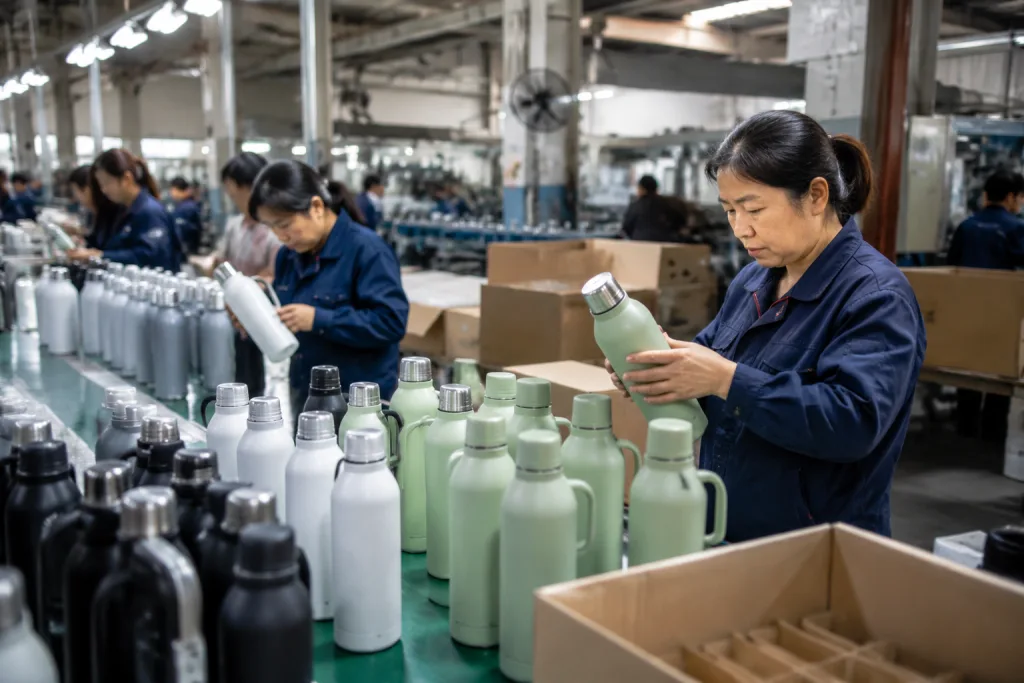
You need a buying filter, not a catalog dump. At BottleForge Industrial in Hangzhou, Zhejiang, we run custom thermos programs for retailers, distributors, and promotional brands that want steady quality from China. Our order range is 3,000 to 80,000 units, and the line turns out about 450,000 thermos units a month with a normal lead time of 30 to 45 days after sample approval.
Start With Four Buying Decisions
I’ll rewrite the section in-place, keep the HTML exactly as-is, and tighten the sales-engineer voice with concrete factory details and cleaner phrasing.A stainless vacuum flask wholesale project usually wins or loses before the line starts. The first decision is the use case. A 500 ml promo thermos for an employee gift does not need the same 72 mm body diameter, lid seal stack, or paint abrasion resistance as a 1,000 ml outdoor flask going to retail shelves. Outdoor buyers care about grip, drop resistance, cup-lid use, and heat holding after 12 hours. Promo buyers usually care more about logo size, carton strength, color match, and ship date.
The second decision is the grade you want to pay for. A reliable manufacturer thermos with inner 304 stainless steel, 0.45 mm body material, silicone sealing rings, and copper-coated vacuum insulation will not price the same as a thin giveaway piece. We run these programs every week. For most bulk thermos orders, the workable FOB Ningbo or Shanghai range is USD 4.20 to USD 8.80, depending on capacity, finish, lid, and packaging. If someone asks for retail feel at giveaway money, the math does not work.
The third decision is customization depth. A custom thermos can be a laser logo on an existing mold, or it can be a customized thermos with an exclusive color, new lid tooling, retail box, barcode, carton marks, and compliance papers. Those are not the same job. QC pulled the sample on one project because the buyer flagged a 1.2 mm logo offset on the proof. Treat simple branding and full OEM as separate purchasing plans.
The fourth decision is inspection responsibility. If you buy from a thermos vendor on photos and the lowest unit price, you carry the risk. If you define AQL, function tests, coating adhesion, carton drop requirements, and pre-shipment sampling, the supplier thermos program becomes measurable. We’ve seen this go sideways when a PO typo changed the carton count from 24 pcs to 42 pcs. That is less glamorous than picking Pantone colors, but it saves claims.
Select Steel, Capacity, And Construction
I’ll rewrite the section in-place, keep every HTML tag and list structure intact, and make the prose sound like a factory-side sales engineer.Most wholesale buyers should specify 304 stainless steel for both the inner wall and the outer wall. On food-contact surfaces, 304 is the baseline we run for North America and Europe. Some thermos quotes swap in 201 on the outside to shave cost. Fine for dry indoor promo jobs. Not fine for outdoor retail, marine orders, camping kits, or winter programs. If the flask is going into a serious outdoor channel, write 304/304 into the purchase order and have the buyer initial it.
Capacity hits both user value and freight. The usual sizes are 350 ml, 500 ml, 750 ml, 1,000 ml, and 1,500 ml. A 500 ml thermos customizable model moves well for corporate gifting and day hikes. A 750 ml or 1,000 ml factory thermos works better for outdoor retail, but carton volume climbs fast. We have seen a 1,000 ml flask pack 24 pieces per master carton, while a 500 ml version packs 36 pieces. That gap changes sea freight and warehouse handling. The math does not lie.
Wall thickness is where cheap offers hide. For a standard vacuum flask, we usually spec 0.4 mm to 0.5 mm stainless sheet. Below 0.35 mm, dents show up around the shoulder and base. QC pulled a batch at 0.32 mm once, and the buyer flagged it after a drop test. Heavy-gauge bodies feel better in hand, but they raise cost and slow the line.
- Inner steel: 304 stainless steel, food-contact polished surface.
- Outer steel: 304 preferred, 201 only for cost-driven indoor use.
- Insulation: vacuum layer with copper coating for better heat retention.
- Seals: food-grade silicone, not low-grade rubber with odor issues.
If your brand sells at retail, ask for cut-body photos or a sample from current mass production, not only a polished showroom sample from a thermos manufacturer. We have seen the showroom piece hide a weak weld seam, and that goes sideways fast once the first container lands.
Insulation Claims Need Test Rules
I’ll rewrite the section in-place, keep the HTML intact, and tune the prose so it sounds like a factory-side sales engineer wrote it.Heat-retention numbers look clean on a catalog page, but they are hard to compare across suppliers. One thermos supplier may print 12 hours above 60°C, another may print 24 hours hot, and both can be true if the starting water, room temperature, fill level, and lid are different. For stainless vacuum flask wholesale orders, lock the test rule before you approve artwork. That saves arguments later.
We run a simple factory test: fill the flask with water at 95°C, close the lid within 60 seconds, hold it at 20°C to 25°C room temperature, then read the result after 6, 12, and 24 hours. A decent 500 ml flask usually stays above 65°C after 6 hours and above 50°C after 12 hours. On the line, a 1,000 ml body often holds better because the thermal loss is slower. Check cold retention too if the order is for summer sports or camping.
Vacuum failure is the costly defect. The outside can look perfect and still dump heat fast because the vacuum layer is weak. QC pulled the sample, knocked it on the bench, and the shell still passed appearance, but the retention curve was off. A proper thermos factory should run vacuum detection during production, not wait until packing. At BottleForge Industrial in Zhejiang, China, we use in-line vacuum checks and lot-based hot water retention testing before final inspection.
Do not approve a claim like “keeps hot 24 hours” unless the test report matches the exact capacity and lid you are buying.
Lid design changes the result more than most buyers expect. A screw stopper with a separate cup lid usually holds heat better than a flip-top drinking lid. Push-button lids are convenient, but they add parts, gaskets, and leakage risk. For distributor thermos orders, fewer moving parts usually means fewer complaints after shipment. We’ve seen the math go sideways when a buyer chose a trendy lid and then blamed the body.
Decide How Custom Is Necessary
I’ll rewrite the section in-place, keeping the HTML tags and structure untouched while making the prose sound like a factory-side sales engineer.Customization has levels. The cheapest thermos custom option is a stock body with one logo method, packed in a plain white box. We ship that a lot for promo runs, and if the color is already on the line it moves fast. The next step is a customizable thermos with Pantone-matched powder coating, laser engraving or screen print, custom box, barcode label, and carton marks. That is the sweet spot for outdoor retailers and promo brands.
A fully customized thermos can include a new lid, new body shape, molded silicone handle, debossed base mark, special carry strap, or exclusive retail packaging. It is doable, but the MOQ changes. For stock-shape custom logo orders, 1,000 to 3,000 pieces per SKU is the normal range. For a custom color, plan on 3,000 pieces per color. For new tooling, 10,000 pieces is the point where the math starts to work, because the mold, engineering samples, and line setup need volume to pay back.
Logo method should match the sales channel. Laser engraving is clean and durable on 304 stainless or coated bodies, but it usually reads as one color. Silk screen printing is cheaper for larger logos and sharp retail branding, but adhesion depends on coating quality and curing; QC pulled a sample at 48 hours, and that test saved one buyer from a peeling complaint. UV printing gives more color, but I would not lead with it for hard outdoor use unless the artwork needs it and the buyer signed off after testing. Embossing or debossing looks premium, yet it needs tooling and extra development time.
For thermos promotional orders, keep the artwork simple and approve a physical pre-production sample. For retail, ask the factory thermos team for coating chips, logo strike-off, packaging dieline, and a packed carton sample if shelf presentation matters. We had a buyer flag a PO typo on the carton mark once, and that tiny mistake delayed the whole booking by 4 days.
Price The Whole Landed Program
I’ll rewrite the section in-place, keep the HTML unchanged, and tighten the sales language so it sounds like a factory-side quote review.Unit price is only one piece of stainless vacuum flask wholesale buying. A cheap FOB number can turn expensive after a logo move, a carton size change, QC failure, late vessel booking, or rework on the line. We run quotes in one sheet: capacity, steel grade, wall thickness, lid type, finish, logo process, packaging, MOQ, sample cost, tooling cost, lead time, Incoterm, and validity period.
For a 500 ml manufacturer thermos with 304 stainless steel, powder coating, one-position laser logo, and white box, a fair FOB China price usually lands around USD 4.20 to USD 5.80 at 3,000 to 5,000 pieces. Add a retail color box and you are up another USD 0.25 to USD 0.60. Add a fancier lid, a handle, or gift packaging and the jump is often USD 0.50 to USD 1.50. A 1,000 ml outdoor flask usually sits at USD 6.20 to USD 9.80, depending on the body structure. The math does not lie.
Payment terms change the risk profile. We usually see 30% deposit and 70% before shipment after inspection; that is the normal deal for a first order. For repeat distributors with steady annual volume, we can discuss staged payment or release against shipping docs, but the buyer flagged it if you ask for loose terms too early. A PO typo on the balance date has caused more than one delay.
Freight needs a hard look from day one. A heavy thermos bulk order sent by air can wipe out margin fast. If the launch date is fixed, lock the production lead time and vessel schedule before you tell retailers a delivery week. Ningbo and Shanghai are the ports we use most for Zhejiang exports, and we normally quote FOB Ningbo unless the buyer asks for EXW, CIF, DDP, or Amazon FBA prep. We’ve seen this go sideways when the carton size was 20 mm too big for the target freight plan.
Quality Control Before Deposit
I’ll rewrite this section in-place with tighter B2B sales language, keep every HTML tag exactly as-is, and preserve the technical terms and inspection standards.Quality control starts before you wire the deposit. Your purchase order should define the product, not just point to a photo. Put capacity tolerance, material grade, coating color, logo size, lid type, packing method, barcode label, carton marks, and inspection standard in writing. For most stainless vacuum flask wholesale programs, AQL 2.5 for major defects and AQL 4.0 for minor defects is a practical baseline. Critical defects stay at zero: leakage, sharp edges, wrong food-contact material, or a vacuum failure. We’ve seen the buyer flag a PO typo on lid type and the whole line had to stop.
Ask thermos suppliers for compliance documents by market. Europe usually means REACH, LFGB food-contact testing, and packaging rules. The United States means FDA food-contact expectations and, for children’s drinkware, ASTM and CPSIA issues may come up. If the flask is not for children, don’t pay for children’s testing you do not need, but do not skip food-contact verification. QC pulled the sample at the line and found the wrong ink code on the carton, which is the kind of miss that turns into a claim.
A proper pre-shipment inspection should check more than appearance. Use capacity measurement, leakage testing, lid torque, coating adhesion with a cross-hatch tape test, logo rub test, odor check, carton drop test, barcode scan, and heat retention sampling. If you sell through e-commerce or retail, carton strength matters. Thin export cartons save a few cents and create crushed-packaging complaints later. We run a 15 kg drop test on outer cartons for this reason, and the math does not work if the box fails at the corner.
Factory audits help, but they are not magic. BSCI, ISO 9001, or Sedex-style paperwork shows the supplier thermos operation has systems, but your product spec still controls the order. A clean audit will not save a vague spec sheet. The buyers who keep problems down send a clear requirement sheet, approve a golden sample, then inspect against that sample before shipment. One clean sample is worth more than a stack of certificates.
Choose The Right Supplier Relationship
I’ll rewrite the section in place, keep the HTML tags unchanged, and tighten the sales-engineer tone with a few concrete factory-floor details.There are three sourcing routes we see all the time: a trading company, a direct factory, and a hybrid export manufacturer. A trading company fits a mixed order with 8 to 12 product categories in one carton. A direct thermos factory gives tighter technical control if it has real export experience. A hybrid manufacturer thermos partner, like our Hangzhou team with dedicated lines in Zhejiang and nearby China supply chains, can handle engineering, sampling, QC, packing, and export paperwork without sending you to five different desks.
Outdoor retailers need repeatability, not surprises. You may reorder the same 750 ml flask every season, so the powder coat thickness, lid gasket, and carton size have to stay locked. Promotional brands care about speed and artwork control. A 5,000-piece distributor thermos order for an event cannot land three weeks late because someone missed a logo typo on the PO.
Ask direct questions before you choose a thermos vendor. How many units per month can this line make? What is the MOQ per color? Can they send a pre-production sample in 7 to 10 days? Do they run vacuum testing on the line? What defect rate did QC record last quarter? Can they pack FNSKU or retailer labels if needed? If the answers stay vague, the shipment will probably be vague too.
The right thermos manufacturers will push back when the spec is off. If your artwork is too fine for powder-coated engraving, or your retail box fails a carton drop test at 80 cm, you should hear it before mass production. We’ve seen buyers argue this point, then pay for rework after the first pallet cracked in transit. That kind of supplier thermos feedback feels slower at the start, but it saves money fast.
Build your stainless thermos program with clearer specs
Send capacity, logo, quantity, target market, and delivery date. Our Zhejiang team will return a practical quotation and sampling plan.
Frequently asked questions
What MOQ should I expect for stainless vacuum flask wholesale?
For stock-shape stainless vacuum flask wholesale orders, 1,000 pieces is sometimes possible for a simple laser logo, but 3,000 pieces per SKU is a more realistic planning number. For custom powder coating, use 3,000 pieces per color as your baseline. For a new lid, new body mold, or a fully customized thermos, the practical MOQ often starts around 10,000 pieces because tooling, trial production, and QC setup need volume. If you are testing a new outdoor retail line, start with one body shape in two colors instead of five colors at low volume.
How long does a custom thermos order take from China?
A normal custom thermos order from China takes about 7 to 10 days for a logo or color sample, then 30 to 45 days for mass production after sample approval and deposit. Complex packaging, new tooling, or peak season can add 10 to 20 days. Sea freight to North America or Europe commonly adds 25 to 40 days depending on port and service. If your promotional thermos has a fixed event date, work backward from delivery, not factory completion. Zhejiang factories using Ningbo or Shanghai ports can move efficiently, but vessel space still needs booking.
Which logo method is best for outdoor thermos retail?
For outdoor retail, laser engraving is the safest logo method because it resists scratching, washing, and cold-weather handling better than many printed options. On powder-coated bottles, the laser usually reveals the stainless layer or a lighter contrast mark. Silk screen printing is useful for larger one-color or two-color logos, especially for promotional brands, but you should request adhesion testing. UV printing can handle full-color artwork, but I would not use it for hard outdoor positioning without abrasion and dishwasher-style checks. For most thermos promotional orders, laser or screen print gives the best balance of cost and reliability.
What certifications should a thermos supplier provide?
At minimum, ask your thermos supplier for food-contact material declarations and test reports relevant to your market. For Europe, buyers often request LFGB and REACH documentation. For the United States, FDA food-contact expectations apply, and children’s products may need CPSIA and ASTM-related review. BSCI or ISO 9001 can support factory evaluation, but they do not replace product testing. Check that the report covers the actual food-contact parts: stainless steel inner wall, silicone gasket, plastic lid components, and coating if relevant. A report for a different model from three years ago is not enough for serious retail distribution.
How do I compare quotes from different thermos manufacturers?
Put every thermos manufacturer quote into the same checklist: capacity, inner and outer steel grade, wall thickness, lid construction, coating type, logo method, packaging, MOQ, lead time, Incoterm, payment terms, and inspection standard. A USD 0.70 cheaper quote may use 201 outer steel, thinner 0.32 mm body material, basic paint, or a lighter carton. Ask for packed carton dimensions and gross weight because freight can change landed cost. Also compare sampling speed and QC detail. A factory thermos quote that includes AQL inspection, vacuum testing, and clear replacement terms is often cheaper than a low quote that creates claims.