Key Takeaways
- A practical RFQ should include capacity, steel grade, finish, logo method, lid type, packing, Incoterm, and target quantity such as 3,000 units.
- For most stainless thermos programs, sample lead time is 7-12 days and bulk production is 30-45 days after deposit and artwork approval.
- AQL 2.5/4.0 inspection should cover vacuum performance, leakage, coating adhesion, barcode scan, carton drop, and logo position.
- BottleForge Industrial supports MOQ from 1,000 units per color and monthly capacity around 600,000 stainless drinkware units in Zhejiang, China.
You do not need a polished brand story when you choose a stainless vacuum flask supplier. You need proof the factory can hold temperature, print your logo cleanly, pass your compliance file, and ship 3,000 or 30,000 units without swapping the lid gasket halfway through the run. We run that check on the line every day.
Outdoor retailers and promo buyers lose money in the gap between RFQ, sample sign-off, and bulk PO. A 500 ml custom thermos that looked fine on a PDF can turn into a leaking carton of claims if wall thickness, powder coat, test standard, and spare parts are not written into the order. Last month QC pulled a sample at 0.38 mm and the buyer flagged it; the math does not work. From Hangzhou, Zhejiang, we handle these calls every week for buyers sourcing from China.
Start with a usable RFQ
I’ll rewrite the section in place, keep the HTML tags intact, and tune the copy to sound like a real sales engineer writing RFQ guidance.A stainless vacuum flask supplier can quote fast, but a fast quote is not a useful quote. If your RFQ says “send price for 500 ml thermos custom logo,” you get numbers that look cheap and cannot be compared. One thermos factory may quote 201 stainless steel, another 304 inner only, another a thinner 0.35 mm outer wall, and another no retail box. The spreadsheet looks clean while the product risk stays hidden.
Write the RFQ like a PO draft. Put down capacity, shape, mouth diameter, lid type, insulation target, material, coating, logo process, packing, testing, Incoterm, and annual forecast. For outdoor retail, a 750 ml wide-mouth flask with 304 inner and outer, copper-coated vacuum layer, 0.45 mm outer wall, 0.40 mm inner wall, powder coating, and leakproof screw lid is a different job from a low-cost 500 ml promotional thermos with gift box. We run that split every week on the line, and the buyer flags it when the drawing is too vague.
Your first RFQ line should look like this: Item 1: 500 ml stainless vacuum flask, 304 stainless steel inner and outer, double-wall vacuum, powder coated, one-color silk screen logo, individual white box, 24 pcs/carton, FOB Ningbo, 3,000 pcs, target delivery 40 days after deposit. If you want a customizable thermos with two lid choices, list them as separate options instead of asking the supplier thermos team to guess. We’ve seen that go sideways on a PO typo: one lid code, two prices, and a week lost in back-and-forth.
Ask the factory thermos supplier for a quote table with unit price, mold cost if any, sample cost, carton dimensions, gross weight, MOQ per color, production lead time, payment terms, and validity period. At BottleForge Industrial in Zhejiang, China, our standard MOQ for many stainless thermos models starts at 1,000 units per color, with monthly stainless drinkware capacity around 600,000 units. QC pulled a sample last Friday and the carton came in at 58 x 39 x 28 cm, so the math works when the buyer gives clean data; a supplier who can make 2,000 samples nicely may still miss a 50,000-unit seasonal launch.
Lock the product specification
I’ll rewrite the prose in place, keep every HTML tag and the original structure, and tighten the spec language so it sounds like a buyer-facing factory note.Once the RFQ price range works, stop arguing price and lock the spec. This is where a lot of promo brands get burned. We have seen a quote say “304 stainless steel” and the buyer later finds it is 304 inside, 201 outside. Another line says “keeps hot 12 hours” with no test method. “Laser logo” is vague too; if the PO does not say logo size, location tolerance, and whether the laser cuts through the powder coat to silver steel, QC will guess.
For a customized thermos PO, spell out the build. A common retail spec is 304 stainless steel inner and outer, food-contact PP lid, silicone gasket, double-wall vacuum insulation, and copper coating between the walls for better heat retention. On cheaper promo runs, 304 inner with 201 outer can work if your market and compliance file allow it. For Europe, we run LFGB or EU food-contact paperwork where needed, plus REACH checks for coatings and parts. For North America, the buyer flagged FDA food-contact declarations more than once, and kids or youth items may need ASTM review depending on the design. The math does not work if the compliance plan is missing.
Write performance as a measurable line. Example: Fill with 95°C water, close lid, test at 20°C ambient; water temperature not less than 55°C after 12 hours for 500 ml sample. Cold retention can be written the same way with 4°C water and a 24-hour read. Leakage should be tested with the bottle inverted and shaken, then laid horizontally for 30 minutes. Powder coating adhesion should pass cross-hatch tape testing, usually 3M tape after grid cut, with no major peeling.
Your PO line items here should include steel grade, wall thickness target, lid material, gasket material, coating color code such as Pantone or RAL, logo artwork file name, packaging dieline version, and approved sample reference. We had a PO with a typo on the artwork file name once, and the line printed the wrong logo on 12,000 pcs. If the thermos supplier cannot put these details into the proforma invoice, they are not ready for a controlled bulk thermos program.
Price the real landed cost
I’ll rewrite the section in place, keep the HTML intact, and tighten the pricing language so it reads like a factory-side sales engineer wrote it.The ex-factory unit price is only one line in the math. We’ve seen a factory quote at USD 3.20 lose to a USD 3.45 offer once the carton collapsed in transit, the lid had no spare gasket plan, and barcode labels got billed after the PO. Outdoor retailers and promo distributors need the full landed cost, not just the bottle price.
Ask for FOB Ningbo or FOB Shanghai if you want a clean China-to-China comparison. Most Zhejiang plants ship through Ningbo; from Hangzhou, the truck run to the port is usually 2 to 4 hours, and the line knows that route by heart. A real quotation should show 1,000, 3,000, 5,000, and 10,000 pieces, because powder coating, logo setup, and packing labor spread out fast. A 500 ml stainless vacuum flask usually lands around USD 3.10-4.20 FOB, while a 1 L outdoor flask is more like USD 5.20-7.50 FOB when the cap and body spec are heavier.
Do not hide the channel. A corporate gift distributor and a retail shelf buyer do not buy the same way, and this is the wrong question to ask if you lump them together. If you need FNSKU labels, Amazon carton labels, suffocation warnings, or master carton weight under 15 kg, say it before sampling; QC pulled the sample and the buyer flagged one carton at 16.8 kg, so we fixed it before mass run. If you need a printed retail box, insert card, spare gasket, and an English-French instruction sheet, put each item on the RFQ.
Suggested PO costing lines: unit price FOB, logo setup charge, sample fee, mold fee if custom lid or body, retail box cost, barcode label cost, inspection cost, spare parts cost, and estimated carton CBM. A good thermos factory will accept this list. It keeps both sides honest. If a supplier only gives one all-in number, the math does not work when you need to trim cost later without hurting the flask.
Approve samples without guessing
I’ll rewrite the section in place, keep the HTML intact, and tighten the sales-engineering tone with concrete factory details and cleaner buyer language.Sample approval is not photo approval. A custom thermos sample needs hands-on checking by your team, not just a look on a sales desk in Zhejiang. For most existing molds, BottleForge Industrial ships samples in 7-12 days after artwork confirmation. If you need a new lid mold, custom silicone boot, or special handle, tooling adds 20-35 days before the first usable sample leaves the line.
Ask for two sample stages when the order matters. First, take a blank structure sample to check size, drinking comfort, lid threading, weight, and thermal performance. Then ask for a pre-production sample with final powder coating, logo, packaging, barcode, and instruction sheet. We’ve seen buyers approve the shape and then complain that the logo warped on a tapered body. That’s the wrong question to ask at the sample stage.
Your sample review sheet should record actual capacity, empty weight, mouth diameter, height, base diameter, lid turns to close, leak test result, thermal test result, coating color under D65 light if possible, and logo position tolerance. For a 500 ml flask, ±3 mm on logo position is realistic; for wrap print, settle seam alignment before you issue the PO. Laser engraving, silk screen, heat transfer, UV print, and water transfer all behave differently on curved steel. Laser stays durable but keeps to one color. Silk screen is cost-effective for simple logos. Heat transfer suits full-color artwork, but QC pulled the sample and flagged abrasion marks after the rub test.
When the sample is approved, name it clearly in the PO: Bulk production must match approved pre-production sample BF-500-PP-2026-03, signed by buyer on 18 March 2026. This is not paperwork for its own sake. A thermos manufacturer cannot hold bulk quality to a vague WhatsApp photo. A signed sample, artwork file, and packing file are the three anchors of a clean production order.
Write the bulk PO tightly
I’ll rewrite the section in place, keep the HTML exactly as-is, and tighten the prose so it reads like a factory-side sales engineer wrote it.The bulk PO is where sourcing turns enforceable. A one-page PO with only quantity and price is not enough for a stainless vacuum flask supplier. It should read like a production instruction sheet. We write it to kill assumptions before steel is cut, before coating starts, before printing, packing, and loading.
Use one PO line for each SKU. Example: SKU ST500-BLK: 500 ml stainless vacuum flask, matte black powder coating, white silk screen logo, 3,000 pcs, USD 3.68/pc FOB Ningbo, 24 pcs/carton, retail white box, EAN label on box, AQL inspection required. If you have four colors, list four lines. Do not write “assorted colors” unless the ratio does not matter. For distributor thermos programs, color mix mistakes create inventory trouble fast because sales teams pre-sell by color. We’ve seen a buyer flag this on a PO typo, and the line still ran the wrong ratio.
Write payment terms in plain language. A common first-order term from China is 30% deposit and 70% balance before shipment after passed inspection. Repeat buyers with a clean order history can get better terms, but do not plan launch dates around credit that has not been approved. Standard bulk thermos lead time is 30-45 days after deposit, sample approval, and packaging file approval. In peak season before Q4, we see that stretch to 12 days more on powder coating and retail box printing. The math does not work if the buyer books freight too early.
Add compliance and inspection terms directly into the PO. State the AQL level, required reports, defect definitions, and who pays for reinspection if the first pass fails. For example, Final random inspection to ANSI/ASQ Z1.4, General Inspection Level II, AQL critical 0, major 2.5, minor 4.0. Major defects should cover leakage, wrong material, weak vacuum performance, sharp edges, serious coating peel, unreadable barcode, and logo mismatch. Minor defects can be small cosmetic dots within the agreed limit. That is normal language for manufacturer thermos orders. If a supplier pushes back, ask for the reason.
Control production before shipping
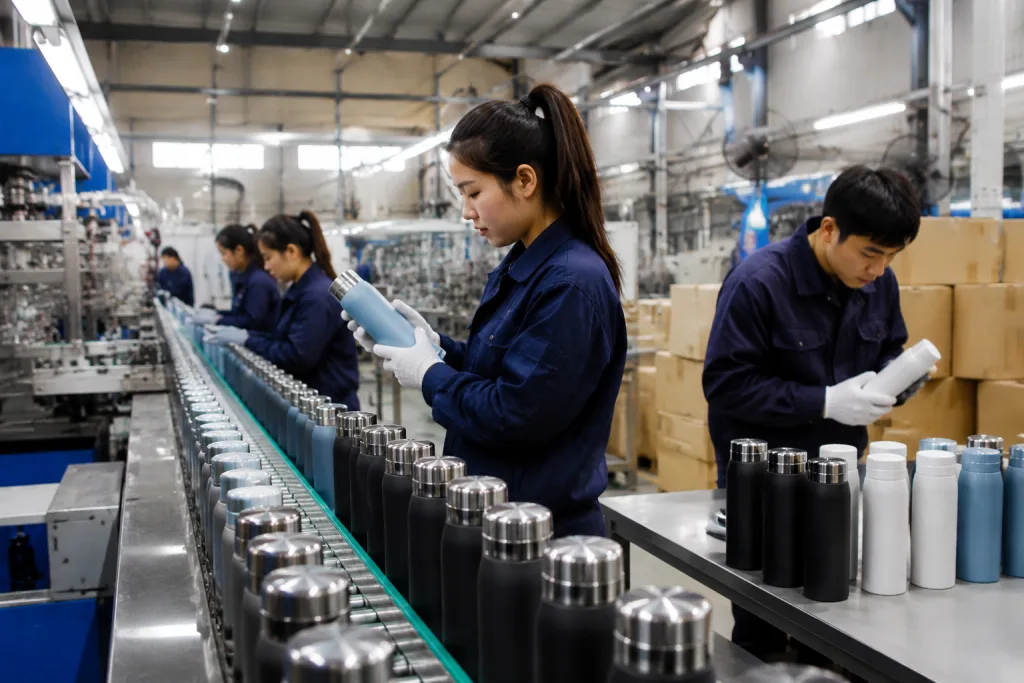
I’ll rewrite the prose only, keep the HTML tags intact, and tighten the sales-engineer tone with concrete factory details and fewer AI-style transitions.After the deposit lands, the job is not done. Ask for a production schedule with dates for material prep, tube cutting, welding, vacuuming, polishing, coating, printing, assembly, packing, and final inspection. We run this off a wall board on the line, and a real thermos manufacturers team can send milestone photos, but photos do not replace inspection. They only help you catch a bent lid ring or a bad print plate early.
For stainless vacuum flasks, watch the vacuum step and the lid build. The body can look clean while insulation fails because the seal is weak. A factory should run vacuum tests during production, not only at final inspection. For a 3,000-piece custom thermos order, we normally check the first 50 to 100 pcs before the full print run starts. If the coating shade is off or the logo jig shifts 2 mm, catching it after 100 pieces is a small loss; catching it after 3,000 is bad math.
Final inspection should cover quantity, workmanship, dimensions, weight, coating, logo, packing, barcode scan, carton marks, carton strength, and function. Pull samples by AQL, not by the factory picking “good pieces.” QC pulled the sample on one 5,000-piece lot and found a 1.8 mm lid gap that the eye test missed. For vacuum performance, many inspections use a smaller functional sample because thermal testing takes time, but the sample count still needs to be written down. Leak testing should cover upright, inverted, and horizontal positions. Do carton drop testing if the order will move through parcel networks or a retailer DC.
Before shipment, confirm shipping marks, any pallet requirement, the container loading plan, and the document set. For FOB orders, your forwarder will need the commercial invoice, packing list, booking details, and sometimes HS code confirmation. On one PO, the buyer flagged a “carton marks” typo one day before stuffing, and that cost us an extra reprint. For stainless vacuum flasks, HS code classification can shift by market and construction, so let your customs broker lock the final import code. A reliable thermos supplier in Zhejiang should give carton size, gross weight, net weight, and CBM early enough for freight planning.
Plan reorders and spare parts
I’ll rewrite the section in a more field-tested sales tone, keep the HTML exactly as-is, and preserve the technical specifics and numbers.The first shipment is not the finish line. If the product moves, the next PO should be smoother, faster, and tighter on color and fit. We keep a project file with the signed sample, artwork, dielines, inspection report, material declarations, carton specs, and complaint log. That file saves time when a buyer comes back 6 months later asking for the same matte green, the same lid torque, and the same barcode position.
For outdoor retailers, spare parts are part of the deal. A stainless flask body can run for years, but lids and silicone gaskets take the hits on the line. If you sell through retail or e-commerce, order 1-2% spare lids and 2-3% spare gasket sets with the bulk shipment. For promotional thermos programs, the spares are less visible, but one replacement lid can keep a client from walking after an event. Put the spare parts on the PO with unit pricing. No freebies, no vague promises.
Reorder planning needs a forecast and a safety stock number. If your seasonal launch needs 20,000 units in September, do not wait until late July to ask the thermos factory for production space. We usually push buyers to lock the reorder window 60-75 days before warehouse arrival when sea freight is in the plan. That leaves room for PO confirmation, 30-45 days of production, QC pulled the sample, loading, sailing, and customs. Air freight can save a small urgent lot, but the math does not work for stainless steel.
As a China stainless vacuum flask supplier, BottleForge Industrial prefers repeat orders that stay boring. We keep approved specs, color chips, and packing data by project because that is where the margin lives. A buyer once flagged a PO typo on the carton count, and that cost two days on the schedule. We’d rather fix that on file than chase it at the dock. Treat the supplier relationship like one shared technical record, and your thermos bulk program gets easier to run and cheaper to manage.
Send your stainless thermos RFQ for review
Share capacity, quantity, logo file, target market, and delivery date. We will return a practical FOB quote and sample plan.
Frequently asked questions
What MOQ should I expect from a stainless vacuum flask supplier?
For existing BottleForge Industrial molds, a realistic MOQ is usually 1,000 units per color for stainless thermos orders. Some simple promotional thermos projects can be discussed at 500 units if you accept stock colors and standard packaging, but the unit price will be higher because coating, printing, and setup costs are spread over fewer pieces. For custom color powder coating, retail box printing, or multiple logo positions, 1,000-3,000 units is a cleaner starting point. If you need a new body mold or custom lid, the MOQ may move to 5,000-10,000 units because tooling and production setup are heavier. Ask for price breaks at 1,000, 3,000, 5,000, and 10,000 units.
How long does sampling and bulk production take?
For an existing stainless vacuum flask model, blank or logo samples usually take 7-12 days after artwork and payment are confirmed. A pre-production sample with final coating, logo, packaging, and barcode often takes 10-15 days because box printing and surface finishing add time. Bulk production for standard orders is normally 30-45 days after deposit and sample approval. During peak season, especially before September and October shipments from China, allow an extra 7-10 days. If your project includes a new lid mold, custom handle, silicone boot, or special retail packaging, tooling and sample correction can add 20-35 days before bulk production even starts.
Which logo method is best for a custom thermos?
It depends on artwork, budget, and durability requirements. Laser engraving is the most durable because it marks the metal or cuts through coating, but it is usually single-color silver or dark contrast. Silk screen printing is cost-effective for one- or two-color logos and works well on straight bottle sections; expect setup charges around USD 30-80 per color depending on artwork. Heat transfer or UV printing is better for full-color graphics, gradients, or promotional thermos artwork, but you should test abrasion and dishwasher exposure if you plan to claim heavy use. For outdoor retail, we often recommend laser for premium flasks and silk screen for clean brand marks on powder-coated bodies.
What should be included in an inspection for thermos bulk orders?
A final random inspection should use ANSI/ASQ Z1.4 or ISO 2859 sampling, commonly General Inspection Level II with AQL critical 0, major 2.5, and minor 4.0. The checklist should cover quantity, dimensions, weight, steel grade documentation, appearance, coating adhesion, logo position, barcode scanning, packaging, carton marks, leakage, lid fit, and thermal performance. For leakage, samples should be filled, inverted, shaken, and laid horizontally for 30 minutes. For insulation, define the water temperature, ambient temperature, and pass point before the PO. Do not accept a vague “keeps hot 12 hours” claim without test conditions. For retailer orders, add carton drop testing and label verification.
Can you support both outdoor retail and promotional distributor orders?
Yes, but the two channels need different controls. Outdoor retail usually needs stronger product specification, retail packaging, color consistency, spare parts, compliance files, and repeat-order stability. Promotional distributor orders often prioritize price, event date, logo accuracy, and fast approval. For retail, we may recommend 304 inner and outer steel, powder coating, retail box, instruction sheet, and spare gasket planning. For promotional programs, a standard model with one-color silk screen logo and white box may be enough. BottleForge Industrial in Hangzhou, Zhejiang can handle both, but you should tell us the channel at RFQ stage so we quote the right material, packing, inspection, and lead time.