Key Takeaways
- 304 stainless is the default; 316 matters when chloride exposure or premium positioning justifies a 12% to 18% material cost increase.
- For bulk thermos orders, 500 ml to 750 ml is the most efficient size range for outdoor and promotional programs, with 1.0 mm body thickness common.
- AQL 2.5 for major defects and 4.0 for minor defects is a realistic incoming inspection target on bulk thermos programs.
- A 35-day lead time and 3,000-unit MOQ are normal for a capable Zhejiang thermos manufacturer on custom finishes.
If you are buying stainless vacuum flask bulk, the first mistake is treating every flask like the same product with a different logo. They are not. The decisions that matter are plain on paper and costly in production: steel grade, insulation performance, lid design, and whether the factory can hold tolerance across 5,000 or 50,000 units. We have seen the math break on a 0.3 mm wall spec. In Zhejiang, buyers lose margin not because the flask looked bad, but because the handle cracked, the powder coat chipped, or the vacuum failed after a few months in distribution.
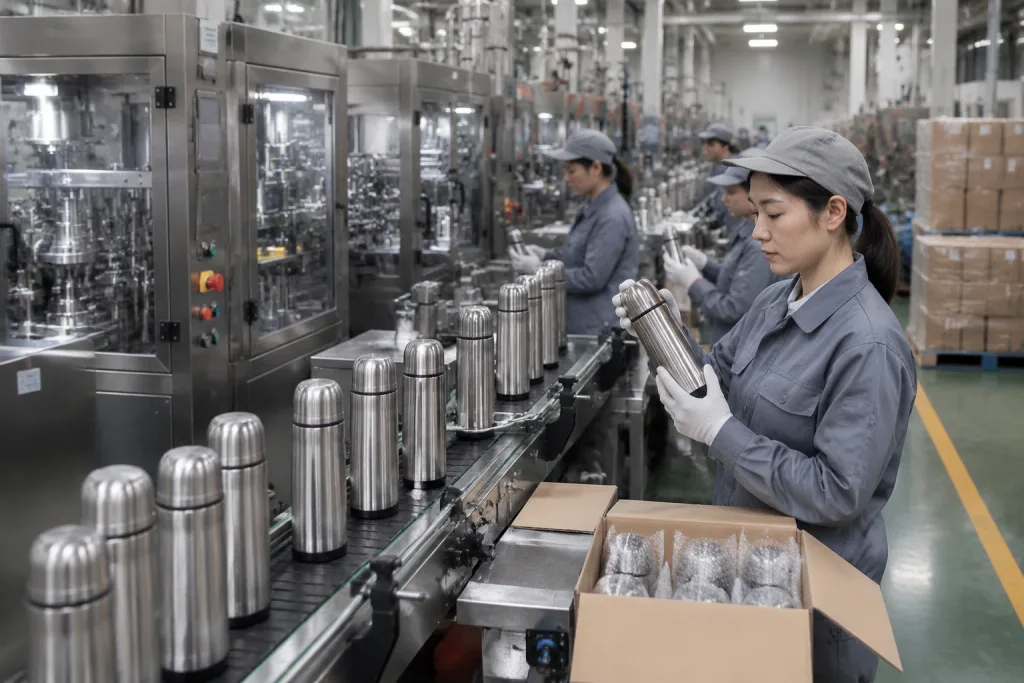
For outdoor retailers and promotional brands, the job is to balance appearance, durability, and landed cost. A good custom thermos program starts with the use case, then works back to wall thickness, 304 versus 316 stainless, and the decoration method that survives shipping. BottleForge in Hangzhou runs one stainless line at 120,000 units per month, with a 3,000-unit MOQ and a 35-day lead time for bulk orders. QC pulled the sample at 72 hours and checked the seam with a caliper. That is the level of detail you should ask from any thermos factory or thermos supplier in China.
Start with the use case
I’ll rewrite the section in place, keeping the HTML structure and the original technical meaning, while stripping the AI-ish phrasing and adding more factory-floor specificity.Before you compare quotes, pin down the job the flask has to do. A promotional thermos for a trade show has a different spec from a distributor thermos sold through outdoor shops. The promo piece needs low decoration cost, steady color, and low reject risk. The retail item needs better hinge life, tighter vacuum retention, and packaging that survives a 1.2 m drop test. If you skip this step, you optimize the wrong thing and then blame the factory. We’ve seen that go sideways plenty of times.
For outdoor retailers, the split is blunt: day-hike bottles usually sit in the 500 ml to 750 ml range, while car-and-camp buyers often choose 1,000 ml. On our line, the same body can carry three volumes, but the lid, base, and carton should change with the channel. A customizable thermos for a national promo campaign can run a simpler cap; a thermos customized for field use should not. If the buyer drinks straight from the flask, mouth feel and sealing-ring access matter more than a fancy print. If the flask rides in a pack, we check cap lock, coating hardness, and leak performance after 24 hours inverted. QC pulled one sample at 18 hours last month because the ring sat 0.8 mm off-center.
Buy the flask for the use case, not for the catalog photo. That one call cuts most bulk mistakes.
Manufacturers in Zhejiang know this drill, but you still need to spell it out in the RFQ. Ask for sample configuration by channel: one for retail shelf, one for event giveaway, one for distributor territory packs. A serious thermos vendor will price them differently because the risk is different. We had a buyer flag a PO typo on the carton size once, and the math did not work until we corrected the pack-out.
Choose steel and wall spec
I’ll rewrite just the prose inside the existing HTML, keep the tags and list structure intact, and tighten the sales-engineer tone.The first spec decision is stainless grade. 304 stainless steel is the default we run for most stainless vacuum flask bulk programs. It handles coffee, tea, and daily water use without drama, and it keeps landed cost in a range that still leaves margin for outdoor retailers. 316 stainless gives stronger corrosion resistance for salt air or harsher washing, but the buyer flagging it as “premium” is the wrong question to ask. On one 20,000-piece run, the material gap was 12% to 18% before print and freight.
Wall spec matters just as much. A body thickness of 0.45 mm to 0.6 mm is common on value models, while heavier retail builds often sit around 0.6 mm to 1.0 mm. We checked a batch with a 0.48 mm shell on calipers, and QC pulled the sample after one dent test, so the line moved it to a sturdier spec. Thicker walls improve dent resistance and hand feel, but they also add weight and cut margin. If your buyer sells to hikers, a heavy flask turns into a return problem. If the channel is distributors asking for a premium feel, the math can work. This is where a real stainless thermos manufacturer earns the order, by telling you which spec fits the channel—not by saying yes to every request.
- 304: best default for coffee and tea programs
- 316: better for coastal, sports, and premium SKUs
- 0.45-0.6 mm: lower-cost, lighter bulk thermos builds
- 0.6-1.0 mm: sturdier retail and gift builds
Do not skip the internal finish. Food-grade passivation is standard on a competent thermos factory, and we expect compliance papers that line up with REACH for EU orders and ASTM-related material declarations where the buyer asks for them. We once saw a PO typo that listed “304SS” on the body but blanked the liner spec, and that sort of gap slows the whole job. If the supplier cannot explain steel source, polishing, and weld inspection in plain English, you are talking to the wrong factory in China.
Insulation is a marketing claim until tested
I’ll rewrite this section in place, keeping the HTML structure and the existing italicized keywords, while stripping the AI-ish phrasing and adding a few concrete factory-floor details.Every catalog says “keeps hot for 12 hours.” That line means nothing without the test setup. A bottle checked with 95°C water, 20°C room air, cap fully closed, and no preheat will behave differently from a field sample that gets warmed first and opened six times. For bulk buying, ask for both the lab result and the use-case number. A solid double-wall vacuum flask should stay above 60°C after 6 to 8 hours under standard conditions, and an efficient shape can do better.
Heat retention comes down to vacuum quality, neck design, and the lid seal, not just the shell. We run more narrow necks when the buyer wants stronger insulation, but cleaning gets harder. Wide mouth works for ice and soup, yet heat drops faster. That trade-off is the real issue in buying thermos bulk. If you are sourcing a thermos distributor line for outdoor retail, pick the neck around how customers use it, not around the decoration setup. A 52 mm mouth looks fine on paper; on the line, it changes the whole lid spec.
Ask for vacuum leak-rate control and drop-test data. In our Zhejiang shop, QC pulled random samples after thermal cycling and 1.2-meter drop tests to catch seal failure and cap loosening. We’ve seen a buyer flag a PO typo on the cap color code and that one small error cost a full rework. A good manufacturer thermos partner gives you the numbers, not “sample passed.” If the program is large, require carton compression and vibration testing too. Once it hits transit, the carton is part of the product.
For promotion projects, a lower insulation claim can make sense if it cuts weight and cost. For outdoor retail, I’d spend on a better vacuum and a lid gasket with a longer service life. The math is simple. Less leakage, fewer complaints, better repeat orders.
Decide on lid and carry features
I’ll rewrite just this section, keep the HTML exactly as-is, and tune the copy to sound like a factory-side sales engineer with a few concrete shop-floor details.The lid is where most bulk orders go sideways. Buyers lock onto body color and logo position, then the cap leaks, the button drags, or the drinking part fails after 60 days. If you want a custom thermos program that stays off the service desk, spec the lid with the same care as the steel. A plain screw cap is the cheapest route and usually the safest. A one-hand push-button top feels better in use, but it adds parts, more assembly time, and more failure points. We’ve seen a 0.3 mm gasket mismatch turn into a week of rework on the line.
For outdoor retailers, a carry loop, silicone base, and non-slip coating usually pay back faster than a fancy lid. For promo brands, a simple lid is often the right call because the decorated body does the selling. If you need a thermos promotional item for a launch, consistency across 10,000 units matters more than clever mechanics. If you are building a premium customizable thermos, soft-touch lids, powder coat texture, and laser logo placement can support a higher unit price. QC pulled the sample and flagged a lid torque spread of 1.8 N·m to 2.4 N·m; that’s the kind of range the buyer notices.
- Screw cap: lowest risk, best for thermos suppliers chasing scale
- Push-button lid: better user feel, tighter defect control needed
- Integrated cup top: common for gift sets and travel use
- Wide-mouth top: good for ice, soup, and mixed beverages
Ask about spare gasket policy too. A few cents in extra seals can save a distributor account later. In bulk thermos orders, we usually pack 1 spare ring per 20 units for retail programs. Small line item. Big difference. It also cuts down on the kind of PO drama we’ve seen before, like a buyer flagging a typo on the seal spec after the carton artwork was already approved. A professional thermos supplier in China should quote gasket hardness, closure torque, and cycle life, not just the lid photo.
Decoration changes the economics
I’ll rewrite just the HTML prose, keep every tag intact, and tune the copy to sound like a factory-side sales engineer.Once the structure is fixed, decoration decides whether the unit price stays under control. We run silk screen, laser engraving, heat transfer, and powder coat with limited print; each one lands on a different cost line. For a two-color logo, silk screen usually wins on price. For a retail piece, laser engraving on a coated body looks cleaner and holds up better. If the buyer changes artwork late on a 10,000-piece run, a full-wrap print turns into extra plates, extra setup, and extra pain.
Do not overbuy decoration just because the brand team wants every effect on one cup. On a thermos custom order, each added step brings yield risk. Multi-color printing on curved stainless surfaces needs tighter fixture control, and QC pulled the sample more than once during ramp-up on a 38 mm logo panel. A good thermos factory in Zhejiang will tell you when the artwork is too fine for the chosen diameter. Listen. Thin lines disappear after coating, and 4 pt type fails more often than buyers expect.
For outdoor retail, abrasion resistance matters. Powder coat at 60-80 micron film thickness usually survives backpack use better than cheap paint. For distributors thermos programs, one standard body color plus one logo method keeps inventory sane. We’ve seen this go sideways when a buyer wanted three shell colors, two lid colors, and one late packaging change; the math does not work. If you sell through multiple channels, keep the same shell and change only the decoration. That is the cleanest way for a thermos distributor to scale without piling up SKUs.
When you compare a supplier thermos quote from China, split tooling, decoration, and carton fees line by line. A PO typo on “laser” versus “silk screen” can move the cost by 8%-12%, and some low quotes hide that gap until the change order lands. Clear pricing is better than clever pricing.
Manage MOQ, lead time, and QC
I’ll rewrite the section in-place, keeping the HTML tags and the key numbers intact, while stripping the AI-ish phrasing and adding concrete factory-floor details.Bulk buying is a supply call, not just a product call. On a stainless line in Hangzhou or the wider Zhejiang belt, a workable MOQ is often 3,000 units for a custom thermos with standard decoration, and lead time usually lands at 35 days after sample approval and deposit. Need special caps, mixed colors, or individual retail cartons? Add time. A buyer once pushed for a 7-day promise on a fully customized vacuum flask. The math does not work.
Ask for the quality plan before the line starts. AQL 2.5 for major defects and 4.0 for minor defects is a normal starting point, but your market decides the bar. Outdoor retail needs tighter leak and dent control than a one-off promo run. Ask for pre-production samples, first-article approval, in-line checks, and final inspection photos; QC pulled the sample at the 500-piece mark on one order because a 0.8 mm lid gap showed up early. Good factories do not dodge this. They know it saves both sides trouble.
Also ask where each step sits in the factory flow. A real thermos manufacturer can tell you if welding, polishing, vacuum sealing, and packing stay in-house or go out. In-house control usually means steadier output. If the thermos manufacturers you speak with cannot state monthly capacity or the process sequence, they are likely trading, not making. That is fine if you want a trading layer, but price it as a trading layer. We have seen this go sideways when a PO typo moved the cap spec from 28 mm to 82 mm.
For promotional brands, the inspection cost can look heavy on paper. It is still cheaper than replacing 2% of a 20,000-unit order because the lids leak. That is where a disciplined thermos supplier in Zhejiang saves money: catch the problem before freight, not after complaints. One batch we shipped passed final check, then the buyer flagged a carton print error at receiving because the SKU line was off by one digit. Small miss, big headache.
Price the landed cost, not the factory quote
I’ll rewrite the HTML in place, keep the tags intact, and tighten the copy so it sounds like a factory-side sales engineer.A quote of USD 2.40 says little on its own. Ask whether it covers decoration, inner box, master carton, export mark, and palletization. A plain 500 ml stainless bottle usually starts around USD 2.10 to USD 3.20 FOB, depending on steel grade, lid type, and finish. Add a premium cap, better vacuum retention, and retail packaging, and the number jumps fast. That is normal. What is not normal is finding packing or compliance charges after you have already locked your sales price.
Ask your factory thermos partner to quote in layers: body, lid, print, carton, and optional accessories. We run it that way on the line because a buyer once flagged a PO typo on carton size, and the freight math blew up by 18%. Layered pricing makes it easier to compare supplier thermos offers from China and see where the margin is going. If the factory says “all in” but will not split the parts, you cannot negotiate cleanly. For importers in Europe and North America, ask for REACH documentation, food-contact declarations, and carton dimensions early, because the wrong pallet fit can cost more than the bottle itself.
One more thing: if you want to sell through Amazon or retail chains, make sure the packaging leaves room for labeling and barcode placement without covering the logo. QC pulled the sample on one run because the barcode sat 6 mm too close to the side seam, and the carton had to be reworked. A thermos distributor or thermos manufacturers program should not force your ops team to remake every box. Packaging discipline is part of product design, not a side job. That is even more true when your thermos supplier is in China and your inventory moves by container, not by carton.
If you want a clean buying rule, pay more for the part the customer touches, and less for the part they never notice. The math works. That keeps the program commercially sane.
Request a bulk quote with real spec control
Send your target volume, steel grade, lid style, and packaging needs. We’ll turn it into a quote you can actually compare.
Frequently asked questions
What is the best steel grade for stainless vacuum flask bulk orders?
For most bulk thermos projects, 304 stainless is the best default. It gives solid corrosion resistance for coffee, tea, and general outdoor use without pushing the cost too high. If your customers are near salt air, sweat-heavy sports use, or you want a more premium positioning, 316 is worth considering. Expect 316 to add roughly 12% to 18% in material cost before decoration and packing. For typical outdoor retail programs in Zhejiang or China, 304 remains the practical choice unless your spec requires more.
What MOQ should I expect from a thermos manufacturer in China?
A serious thermos manufacturer in Zhejiang will often quote around 3,000 units MOQ for a custom thermos with standard decoration. Some simple stock bodies can go lower, and highly customized lids or packaging can push the MOQ up. For mixed colors or special cartons, expect the MOQ to rise. If someone offers 500 units with a full custom build, check whether they are a factory or a trading layer and ask for proof of capacity, QC process, and sample consistency.
How long does bulk thermos production usually take?
A typical lead time for stainless vacuum flask bulk production is about 35 days after sample approval and deposit, if the design is straightforward. Add 7 to 10 days for complicated lids, new molds, or multi-step decoration. If you need individual retail packaging, Amazon-ready labels, or extra compliance documents, build in more time. Zhejiang factories can move quickly, but real production still needs vacuum sealing, curing, inspection, and packing time.
What inspection standard should I use for custom thermos orders?
A common starting point is AQL 2.5 for major defects and 4.0 for minor defects. For promotional thermos orders, you may accept a slightly looser cosmetic tolerance if the branding is simple and the budget is tight. For outdoor retail, keep leak testing, drop testing, and lid function checks strict. Ask for pre-production samples, first-article approval, and final inspection photos so the supplier cannot hide variability inside the carton.
What is a realistic FOB price for a stainless thermos?
A plain 500 ml stainless thermos often sits around USD 2.10 to USD 3.20 FOB depending on steel grade, lid type, surface finish, and carton quality. Add laser engraving, full-color print, or a premium push-button lid, and the price rises. The right question is not only the factory quote but what is included: body, lid, logo method, inner box, export carton, and pallet. A clear quote from a supplier thermos partner in China should separate those items.